GATE CS vs. GATE DA: How to Decide Which Paper (or Dual Paper) to Target
GATE CS and GATE DA reward different strengths. Compare their syllabus, decide which fits your goals, and see how the official two-paper option works.
KnowledgeGate Team
Exam prep & CS education
29 Sep 20265 min read
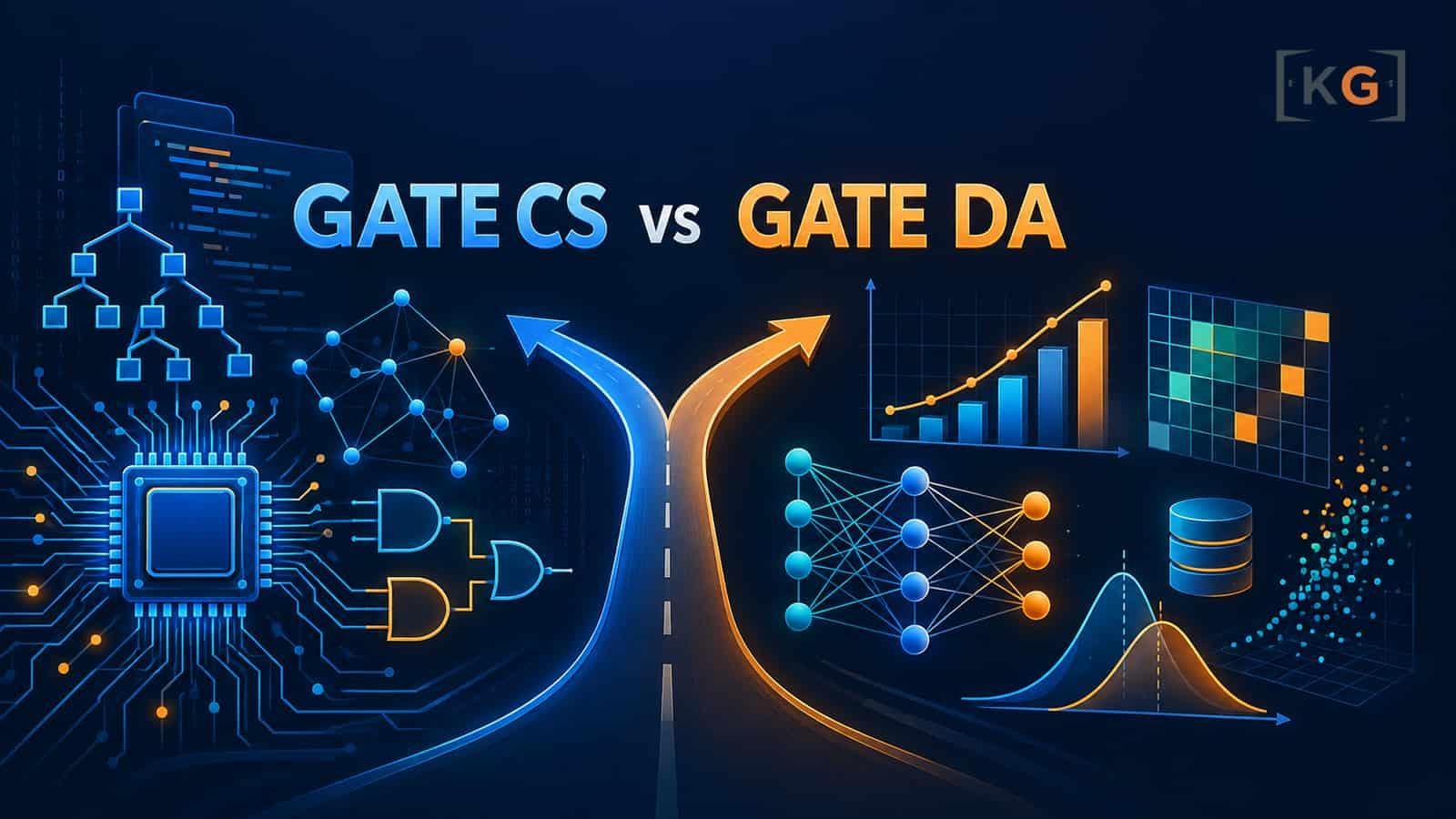
Choosing between GATE Computer Science and Information Technology (CS) and GATE Data Science and Artificial Intelligence (DA) can feel like choosing between two careers.
In practice, the better paper is the one whose syllabus you can master and whose score is accepted by the programmes or recruiters you want.
For GATE 2027, use the revised official syllabus and current two-paper list: the organiser says syllabi have been revised, so older comparison charts may be stale.
1. What is different in the syllabi?
Both papers test computing and mathematics, but their emphasis differs.
CS covers a broad computer science foundation, including systems and theory.
DA moves deeper into probability, statistics, machine learning and artificial intelligence.
The table summarizes the official syllabus areas; it does not imply fixed marks or equal difficulty for every candidate.
Area | GATE CS | GATE DA |
|---|---|---|
Programming | C programming and core programming concepts | Python programming |
Data structures and algorithms | Data structures and algorithms, with broader computer science foundations | Data structures, basic algorithms, searching, sorting, divide-and-conquer and introductory graph algorithms |
Mathematics | Discrete mathematics and engineering mathematics, including linear algebra, calculus, probability and statistics | Probability and statistics, linear algebra, calculus and single-variable optimization |
Systems | Digital logic, computer organization and architecture, operating systems and computer networks | Not listed as separate syllabus areas |
Theory | Theory of computation and compiler design | AI search, logic and reasoning under uncertainty |
Data and intelligent systems | DBMS and its core concepts | DBMS and data warehousing, plus machine learning and AI |
Typical specialist emphasis | Building and understanding computing systems | Modelling data and learning or reasoning from it |
The syllabus names are a more reliable guide than labels such as “easy” or “applied.” DA still requires mathematical depth, while CS includes subjects that reward careful conceptual preparation.
Read the complete official GATE 2027 syllabus and note any topics added or revised for your exam year.
2. Choose one paper by matching it to your strengths
Choose GATE CS if you enjoy the computing foundation
CS may fit you better if you are comfortable with operating systems, computer architecture, networks, compilers, discrete mathematics and theoretical computer science. These topics make the paper a natural choice for aspirants who want to retain a broad computer science foundation while applying to postgraduate programmes.
It can also be the more relevant choice when a target recruiter specifies the CS paper. PSU recruitment rules change by post and year: do not assume a company accepts CS simply because it has done so before, and do not treat a GATE score as a job guarantee. Check the current recruitment notice for the exact discipline, paper code, degree requirements and score validity.
Choose GATE DA if data and mathematical modelling motivate you
DA may fit you if probability, statistics, linear algebra and optimization are among your stronger subjects, and you want to study machine learning, AI or data science in more depth.
Its syllabus includes supervised and unsupervised learning, neural networks, clustering, dimensionality reduction, search and logic.
Choosing DA does not mean you can skip programming or algorithms.
Python, data structures and algorithmic thinking are in the syllabus.
Before committing, try a small set of official or representative questions from statistics, machine learning and AI.
If you find the reasoning engaging and are willing to build the foundations, DA deserves serious consideration.
Let eligibility narrow the choice
Make a shortlist of specific M.Tech or research programmes, not just institute names. Open each department’s current admission page and record which GATE paper codes it accepts, degree prerequisites, shortlisting rules and any additional selection stages. A programme title containing “AI” or “Data Science” does not by itself prove that it accepts DA; similarly, a CS score is not universally accepted for every computing programme.
You can explore KnowledgeGate’s GATE category and GATE Guidance course while building that shortlist. For a wider computing foundation, browse the Coding & Skills category.
For context on how outcomes depend on more than one score, see same GATE score, different college options and what a low GATE rank means.
3. Is attempting both CS and DA a good strategy?
For GATE 2027, the official two-paper table lists CS with DA as a permitted secondary-paper combination, and DA with CS as a permitted secondary-paper combination. Candidates must select a primary paper, and two-paper options are subject to the organiser’s combination list and scheduling feasibility. The official page also cautions that the secondary paper’s centre may differ within the same city.
Check the live two-paper combination rules before applying because combinations may change.
Both papers share the General Aptitude component: the official pattern assigns 15 marks to GA in each paper. There are also related concepts across programming, algorithms, databases and mathematics, but conceptual overlap is not a guarantee of identical questions or a fixed percentage of shared marks. Plan to study each paper’s exact syllabus separately.
A dual-paper plan is most sensible when:
You have enough preparation time to cover both papers without weakening your primary paper.
Your target programme shortlist genuinely accepts both paper codes.
You can schedule full-length practice for each paper and review mistakes from each syllabus.
The added exam fee and the practical exam schedule work for you.
If you prepare for both, choose a primary paper early rather than dividing every week evenly. Finish shared foundations where the syllabi genuinely overlap, then reserve dedicated blocks for paper-specific areas.
A CS-first student will still need focused DA preparation in probability, statistics, machine learning and AI. A DA-first student will still need focused CS preparation in systems, discrete mathematics, theory and the CS syllabus’s specific programming requirements.
Do not treat the second paper as a low-effort backup. Each paper requires its own preparation and exam performance. Before registration, check the official application guidance and the admissions criteria for every programme on your list.
4. A practical decision checklist
Answer these questions in writing:
Which syllabus would I rather study for several months: systems and theory, or statistics and machine learning?
Which paper matches the eligibility rules of the programmes I would actually join?
If PSU recruitment matters to me, which paper codes appear in current notices for my target posts?
Can I prepare for a second paper while keeping my primary-paper mock scores on track?
Have I checked the current year’s official syllabus, paper pattern and two-paper list?
If the first two answers clearly point to one paper, focus there. Add the other only when it expands realistic options and you can prepare for it properly. A carefully selected single paper is a stronger plan than two half-prepared papers.
The takeaway
Choose CS for a broad computer science syllabus that includes systems and theory. Choose DA for a syllabus centred on statistics, machine learning and AI. Consider both only after checking the official combination list, your available study time and each target programme’s accepted paper codes. Start with the current official syllabus, map your options, then build a preparation plan around the paper that best matches your goals.
Keep learning

GATE MSQs: How to Avoid Option Traps
A practical elimination method for GATE MSQs: test each claim, spot common option traps, and understand why partial selections earn no credit.
5 Oct 20265 min readGATE CS Preparation
GATE CS Study Plan for Working Professionals
A practical GATE CS plan for working professionals: a 12-hour weekly timetable, flexible subject roadmap, PYQ practice, revision and mock analysis.
1 Oct 20266 min read72 viewsGATE CS Preparation
How to Build an 'Error Log' That Boosts Your Exam Score by 20%
1 Oct 20263 min readGATE CS Preparation

Decoding the GATE Virtual Calculator: Speed Hacks & Common Miscalculations
A practical guide to the GATE on-screen calculator: function-entry order, memory keys, angle modes and NAT precision.
29 Sep 20266 min readGATE CS Preparation