Data Structure for GATE: Syllabus Map, Past-Paper Weightage and Preparation Order
Map the official GATE Data Structure scope, read the two 2026 CS sessions without turning them into a forecast, and follow a verified 48-hour study order.
KnowledgeGate Team
Exam prep & CS education
Updated 23 Sep 20264 min read
Data Structure seems a loose list when GATE scope, priorities and the Algorithms boundary are unclear. The official syllabus, both GATE 2026 CS sessions, a worked BST example and a dependency-led order inform GATE CS preparation options. GATE publishes a paper pattern, not a guaranteed topic-wise allotment, so past-paper weightage is planning evidence, not a prediction.
What the official GATE syllabus includes under Data Structure
The official GATE 2026 CS syllabus calls Section 4 "Programming and Data Structures". It lists C, recursion, arrays, stacks, queues, linked lists, trees, BSTs, binary heaps and graphs. Prepare five buckets: C, recursion and arrays; linked lists; stacks and queues; trees, BSTs and heaps; graph representations.
Section 5 separately covers searching, sorting, hashing, complexity, design techniques, graph traversals, minimum spanning trees and shortest paths. Algorithm for GATE: syllabus, weightage and pattern maps that separate section's exam emphasis, complexity, graph-algorithm drills and study order. Data Structure preparation instead starts with representations and operations, checks them against 2026 structure questions, and follows the 48-hour dependency plan below. Tag the primary skill: heap shape, BST traversal and queue state are Data Structure; shortest-path correctness and hashing are Algorithms.
The official 2026 CS pattern had 100 marks: 15 for General Aptitude, 13 for Engineering Mathematics and 72 subject marks, with no fixed Data Structure share. Do not call all 72 marks Data Structure weightage or reuse them across cycles.
What the two completed GATE 2026 sessions show about weightage
Both completed GATE 2026 CS sessions are worth reading question by question. The core Data Structure questions and their marks show where the paper actually spent its Data Structure marks.
Editorial classification of official GATE 2026 core Data Structure questions
Session and question | Primary topic | Marks |
|---|---|---|
CS1 Q23 | Binary minheap leaf indices | 1 |
CS1 Q33 | Maximum height of a full binary tree | 1 |
CS1 Q39 | Recursive size of a singly linked list | 2 |
CS1 Q40 | BST insertion order | 2 |
CS1 Q62 | Preorder to postorder in a BST | 2 |
CS1 core total | 8 | |
CS2 Q12 | Binary-tree traversal definitions | 1 |
CS2 Q49 | BST inorder successors and insertions | 2 |
CS2 Q50 | Stack and queue assignment | 2 |
CS2 core total | 5 |
This classification is editorial, not official. Trees and BSTs appeared in both sessions; CS1 also had heaps and linked lists, while CS2 had a stack-queue trace. The 8-mark and 5-mark totals describe one year, not a promised range or multi-year trend.
CS1 Q24 and CS2 Q30 tested hashing, an Algorithms topic, so both are excluded from the totals.
Turn the pattern into priorities without dropping a syllabus area
Secure C pointers, recursion and array indexing first. Continue through linked lists and stack-queue traces, then give the largest block to trees, BST operations, traversals and heaps. Learn graph representations before graph algorithms. Repeated tree questions justify extra practice, not omissions.
Audit official papers with seven columns: session, question number, marks, primary syllabus bucket, secondary overlap, correct or wrong, error reason. Give each question one primary bucket and preserve session totals. This prevents double-counting and false fixed percentages.
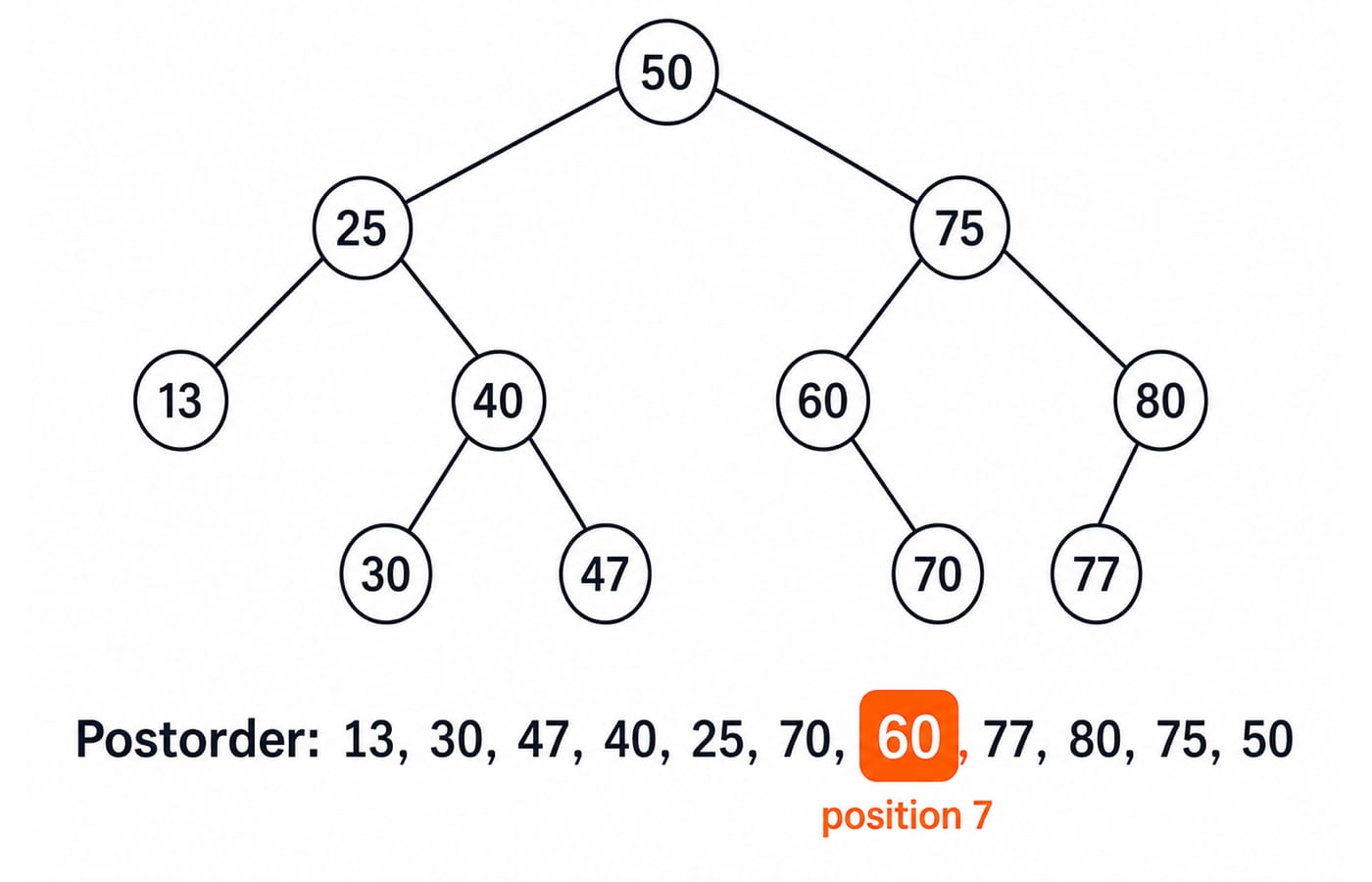
Worked official example: rebuild the BST and locate 60
GATE 2026 CS1 Q62 gives preorder 50, 25, 13, 40, 30, 47, 75, 60, 70, 80, 77.
Root
50has left root25: child13on the left, and40on the right with children30and47.Right root
75has left child60with right child70, and right child80with left child77.Left postorder is
13, 30, 47, 40, 25; right postorder is70, 60, 77, 80, 75.Append
50:13, 30, 47, 40, 25, 70, 60, 77, 80, 75, 50. Starting from 1,60is seventh.
Two traps are putting 70 under 75, despite 60 < 70 < 75, and visiting a node before both subtrees. Review Binary Trees and Binary Search Trees.
A 48-hour preparation order that respects dependencies
Eight weeks at 6 hours give 48 hours. Allocate 10 to C pointers, recursion and arrays; 6 to linked lists; 6 to stacks and queues; 10 to trees and BSTs; 5 to heaps; 5 to graph representations; 6 to mixed solving and error repair. Check: 10 + 6 + 6 + 10 + 5 + 5 + 6 = 48. This is study time, not weightage.
Weeks 1 and 2 build the C, recursion, array and linked-list base. Week 3 covers stacks and queues; weeks 4 and 5 cover trees and BSTs; week 6 adds heaps and graph representations; week 7 solves mixed questions; week 8 retests errors. Hour blocks may cross weeks. The GATE Guidance course provides a full-syllabus route. With less time, scale every block instead of deleting one.
Practise all answer forms, then review before adding volume
The GATE 2026 pattern used 1-mark and 2-mark MCQ, MSQ and NAT questions. Wrong MCQs had negative marking; MSQ and NAT did not, and MSQ had no partial marking. Confirm your cycle's pattern.
Use 30-question blocks: 10 untimed concept checks, 10 pointer, state or traversal traces, and 10 timed mixed questions. Classify misses as concept, invalid pointer or bound, wrong order, arithmetic, or time pressure. Record the corrected invariant and retest after 48 to 72 hours.
More than 1,500 Data Structure questions are live in KnowledgeGate's practice bank. That is breadth, not 1,500 GATE PYQs. After covering every bucket, use the GATE Test Series for timed practice.
Common planning mistakes
Forecasting from one year causes skipped areas. Retain the official map.
Double-counting hashing or graph algorithms inflates totals. Use one tag.
Memorised traversals fail on bound-sensitive BSTs. Draw with bounds.
No error log means repeated failures. Retest logged skills.
The short version
Use the official scope, treat 8 and 5 marks as a 2026 sample, and follow the 48-hour order. Spend 20 minutes: rebuild Q62, check 60 is seventh, and create the audit sheet before another official paper.
Keep learning
Hashing Data Structure: Hash Functions, Collision Resolution and Worked Examples
Trace the same eight keys through separate chaining and linear probing, then learn how tombstones, load factor and rehashing affect correctness and speed.
Updated 24 Sep 20266 min readDSA & Algorithms
Shortest Path Algorithms: Dijkstra, Bellman-Ford and Floyd-Warshall with Worked Examples for GATE CS
Learn the relaxation idea behind shortest paths, trace three core algorithms by hand, and choose the right method from edge weights and source count.
Updated 21 Sep 20265 min readDSA & Algorithms
Time Complexity Analysis of Algorithms: Big-O, Recurrences, and Worked Examples for GATE and Interviews
Learn to count operations, compare asymptotic bounds, analyse loops, solve divide-and-conquer recurrences, and explain best and worst cases with confidence.
Updated 20 Sep 20267 min readDSA & Algorithms
Sorting Algorithms: Complete Guide with Worked Examples for GATE CS and Interviews
Build a reliable sorting toolkit for GATE CS and coding interviews. Compare six core algorithms, follow two worked traces, and learn the traps behind stability, space and pass counts.
Updated 19 Sep 20266 min readDSA & Algorithms