

Programming Paradigms MCQs: 11 Solved Questions on Concepts and Classifications
Solve 11 published programming paradigms questions using mechanism cues, worked traces and a compact revision grid for classifications and modular design.
KnowledgeGate Team
Exam prep & CS education
Updated 6 Nov 20267 min read
Programming paradigm questions reuse overlapping vocabulary such as declarative, imperative, module and abstract data type, so reliable answers depend on classifying each concept by its mechanism rather than remembering one language per paradigm. Classifying each concept by its mechanism helps solve the 11 previous-year MCQs. Mark your answer first, then check the mechanism cue in the explanation to see why the classification fits. For wider study material on related topics, explore Coding & Skills.
Build a mechanism-first map before solving
Paradigm or style | Main unit | State model | Exam cue | Representative language |
|---|---|---|---|---|
imperative | commands and variables | state changes step by step | command-based, procedural | C |
object-oriented | objects combining data and methods | state belongs to objects | abstract data type, encapsulation | Java or Smalltalk |
functional | expressions and functions | prefer values without side effects | expression evaluation, side-effect free | Lisp |
logic | facts, rules and queries | inference finds a result | clauses, theorem proving | Prolog |
modular | independently understandable modules | state is hidden behind module interfaces | high cohesion, low coupling, procedure calls | language-independent design style |
Languages can support several paradigms; these are textbook representatives, not exclusive boxes. See the Programming Languages Survey.
A runs x = 2; x = x + 3 and ends at x = 5; its changing store is imperative. B gets [4, 9, 16] from map(square, [2, 3, 4]) without changing the input, so it is functional. C has parent(asha, ravi), parent(ravi, meera) and an ancestor rule. The query ancestor(asha, meera) succeeds by inference, so it is logic programming. D creates Counter(value = 10) and calls increment(5) to reach state 15; its data-plus-method unit is object-oriented.
Programming paradigms MCQs 1-3: match the core families
Question 1 (UGC NET 2021)
Match List I with List II
List I (Programming Paradigm): A. Imperative; B. Object-oriented; C. Logic; D. Functional.
List II (Characteristic): I. Declarative, clausal representation, theorem proving; II. Side-effect free, declarative, expression evaluation; III. Imperative, abstract data type; IV. Command-based, procedural.
Choose the correct answer from the options given below:
A. A ‐ IV, B ‐ III, C ‐ I, D ‐ II
B. A ‐ III, B ‐ IV, C ‐ I, D ‐ II
C. A ‐ IV, B ‐ III, C ‐ II, D ‐ I
D. A ‐ II, B ‐ III, C ‐ I, D ‐ IV
Answer: A. Clauses give C-I; side-effect-free expressions D-II; commands A-IV; therefore object-oriented is B-III. Solved question.
Question 2 (GATE 2004)
Choose the best matching between the programming styles in Group 1 and their characteristics in Group 2.
Group 1
Programming Style
Group 2
Characteristics
P
Functional
1
Command-based, procedural
Q
Logic
2
Imperative, abstract data type
R
Object-oriented
3
Side-effect free, declarative, expression evaluation
S
Imperative
4
Declarative, clausal representation, theorem proving
A. P-2, Q-3, R-4, S-1
B. P-4, Q-3, R-2, S-1
C. P-3, Q-4, R-1, S-2
D. P-3, Q-4, R-2, S-1
Answer: D. Functional-3, logic-4, object-oriented-2, imperative-1. Only D has 3, 4, 2, 1. If you guessed, rebuild all four pairs from the cues before moving on.
Question 3 (GATE 2008)
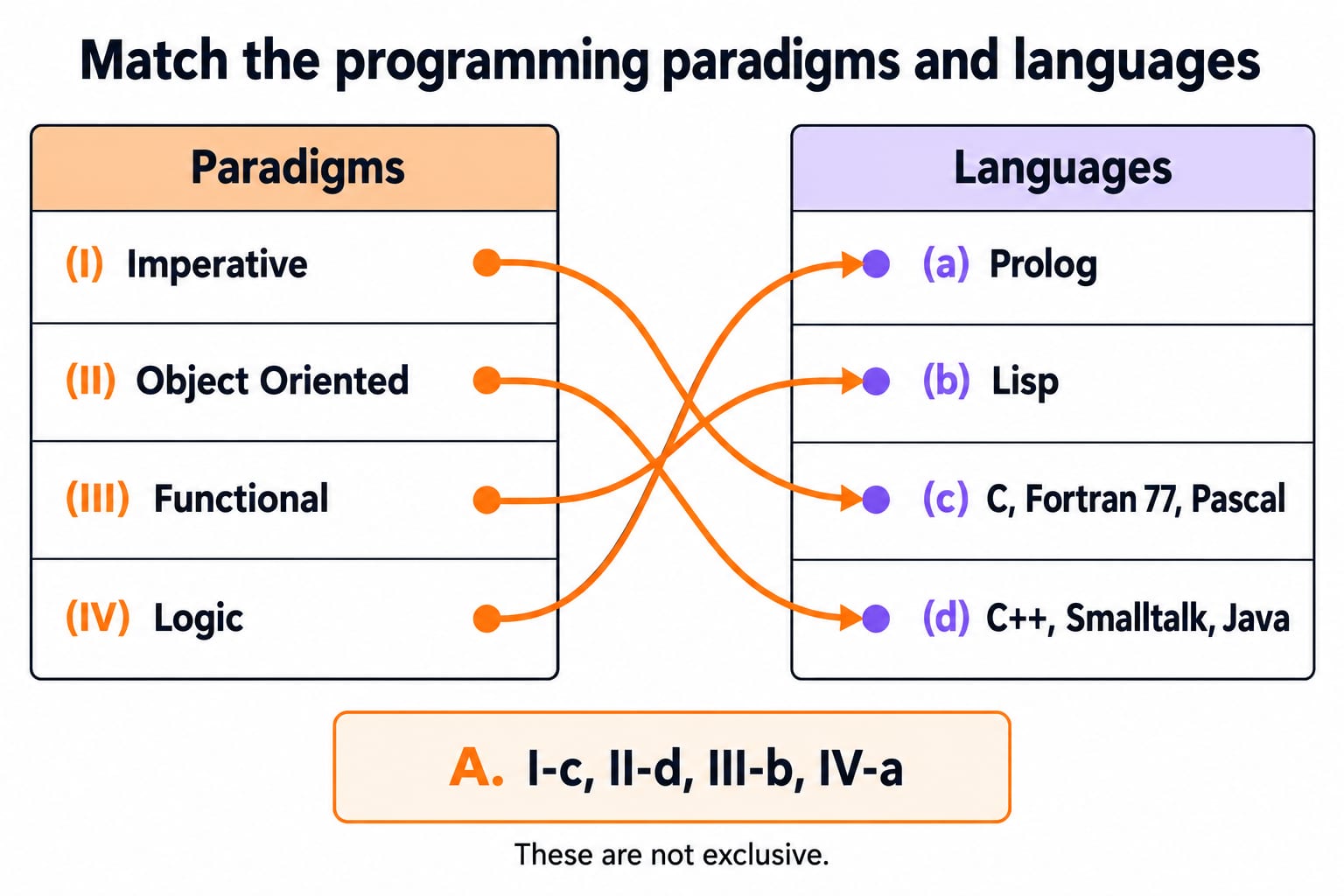
Match the programming paradigms and languages given in the following table.
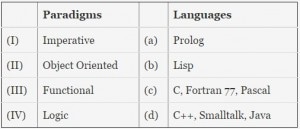
Paradigms | Languages | ||
|---|---|---|---|
(I) | Imperative | (a) | Prolog |
(II) | Object Oriented | (b) | Lisp |
(III) | Functional | (c) | C, Fortran 77, Pascal |
(IV) | Logic | (d) | C++, Smalltalk, Java |
A. I-c, II-d, III-b, IV-a
B. I-a, II-d, III-c, IV-b
C. I-d, II-c, III-b, IV-a
D. I-c, II-d, III-a, IV-b
Answer: A. Imperative matches C, Fortran 77, Pascal; object-oriented matches C++, Smalltalk, Java; functional matches Lisp; logic matches Prolog. Hence I-c, II-d, III-b, IV-a. These are not exclusive.
Programming paradigms MCQs 4-6: structured and modular design
Question 4 (Kendriya Vidyalaya Sangathan 2017)
In structured programming, a program is decomposed into modules. Coupling and cohesion describe the characteristics of modules. A good decomposition should attempt to:
A. Minimize coupling and minimize cohesion
B. Maximize coupling and minimize cohesion
C. Minimize coupling and maximize cohesion
D. Maximize coupling and maximize cohesion
Answer: C. Cohesion keeps related work together; coupling is external dependence. Keep mean([18, 24, 30]) = 24 inside statistics and pass only 24 to reporting: high cohesion, low coupling. Solved question.
Question 5 (Navodaya Vidyalaya Samiti 2017)
In this programming methodology, common functionalities are grouped together into separate, independent units. The whole program is divided into several units that interact through procedure calls.
A. Object Oriented Programming
B. .NET Programming
C. Modular Programming
D. Random Programming
Answer: C. Independent units using procedure calls are modules. Statistics returns 24; reporting consumes it through a call. .NET is a platform ecosystem, not this methodology. Solved question.
Question 6 (DSSSB 2021)
Which of the following statement(s) is/are correct about modular programming approach?
I. Ease of use
II. Reusability
A. Only I
B. Only II
C. Both I and II
D. Neither I nor II
Answer: C. Focused modules are easier to use and reuse. One function gives mean([18, 24, 30]) = 24 and mean([6, 9, 12]) = 9. Both hold. Solved question.
Programming paradigms MCQs 7-9: event queues, intermediate form and extensibility
Question 7 (DSSSB 2021)
What is responsibility of event queue in event driven programming?
A. Create new event
B. Delete the event
C. Make a sequence in which event is executed
D. Change the event
Answer: C. Sources create events; queues order them. Arrivals click#1 at 12 ms, timer#2 at 18 ms, key#3 at 21 ms form that sequence unless a priority rule applies. Solved question.
Question 8 (DSSSB 2021)
_____ is a CPU independent machine language style instruction set into which .NET Framework programs are compiled.
A. Machine language
B. High level language
C. Intermediate language
D. Assembly language
Answer: C. CPU independent decides it. Machine language and assembly target processors; high-level language is input. The compiled target described is intermediate language. Solved question.
Question 9 (BPSC 2023)
The programming language that has the ability to create new data types is called
A. Overloaded
B. Encapsulated
C. Extensible
D. More than one of the above
E. None of the above
Answer: C. Extensible means programmers can add types. For Point = {x: 3, y: 4}, magnitude is sqrt(3^2 + 4^2) = sqrt(9 + 16) = 5. Overloading adds signatures; encapsulation hides details. Solved question.
Programming paradigms MCQs 10-11: imperative statements and top-down order
Question 10 (HTET 2024)
Which statement indicates an action to be performed during execution of assembled program?
A. Declarative Statement
B. Imperative Statement
C. Direction Statement
D. Compiled Statement
Answer: B. Imperative means execution action. With R1 = 7, R2 = 5, ADD R1, R2 makes R1 = 12. Declarative statements instead define or describe. RSSB Basic Computer Instructor course hub (question page unavailable).
Question 11 (DSSSB 2021)
Rearrange steps involved in top-down design programming?
I. Analyze the problem
II. Revise and resequence
III. Write the main modul
IV. Connect the modules in proper order
V. Write the remaining modules
A. II → IV → V → III → I
B. III → I → V → IV → II
C. V → III → I → IV → II
D. I → III → V → IV → II
Answer: D. For [72, 64, 88], I defines inputs and average. III sketches readMarks -> computeAverage -> classify -> print. V implements (72 + 64 + 88) / 3 = 224 / 3 = 74.67, rounded, plus other helpers. IV connects calls; II moves validation before calculation. Thus I → III → V → IV → II. Solved question.
Five traps these classification questions use
Shared vocabulary: identify the mechanism, not a familiar word.
Language equals one paradigm: representatives are not exclusive.
Cohesion-coupling reversal: inside together, outside lightly connected.
Platform versus paradigm:
.NETis not modular design.Sequence without dependencies: order by prerequisites.
Use a 90-second grid. First 30 seconds: imperative -> commands, OOP -> objects and ADTs, functional -> side-effect-free expressions, logic -> clauses and inference. Next 30: high cohesion + low coupling, event queue -> ready-event sequence. Final 30: I -> III -> V -> IV -> II. Check mismatches only. Continue with Programming Languages and Java examples, while treating Java as a multi-paradigm language.
Seven-cue re-test and the next study step
Answer in order: (1) x changes from 2 to 5 through assignments; (2) clauses plus theorem proving; (3) a side-effect-free map of [2, 3, 4] to [4, 9, 16]; (4) focused modules with few external dependencies; (5) click#1, timer#2, key#3 waiting to run; (6) a programmer-defined Point type with x = 3, y = 4; (7) analyse, main module, remaining modules, connect, revise.
Answers: imperative; logic; functional; high cohesion with low coupling; event queue; extensible language; I -> III -> V -> IV -> II.
The short version: classify by mechanism, keep high cohesion plus low coupling, and order by dependencies. Practise with Java: Concepts, MCQs, Coding Questions and Python: Concepts, MCQs, Coding Questions.
Redo all 11 tomorrow in 12 minutes. Mark mechanism M, design D, or ordering O. Revisit only the cue family that caused an error.
Keep learning
Data Abstraction Explained: Hide Implementation Details with a Worked Java Example
See how a stable Account contract protects its invariant while the Java implementation changes from a running balance to a transaction ledger.
Updated 16 Nov 20265 min readProgramming Languages Survey
Programming Paradigms Explained: Concepts, Classifications and Worked Examples
Learn how imperative, procedural, object-oriented, functional and declarative styles organise the same computation, and how to classify code from visible evidence.
Updated 15 Nov 20265 min readProgramming Languages Survey
Introduction to Visual Basic (VB): Concepts, Worked Code and Exam Patterns
Learn how a VB.NET form turns text-box input and a button click into a traced result. Then practise operators, loops, procedures, scope and debugging.
Updated 14 Nov 20266 min readProgramming Languages Survey
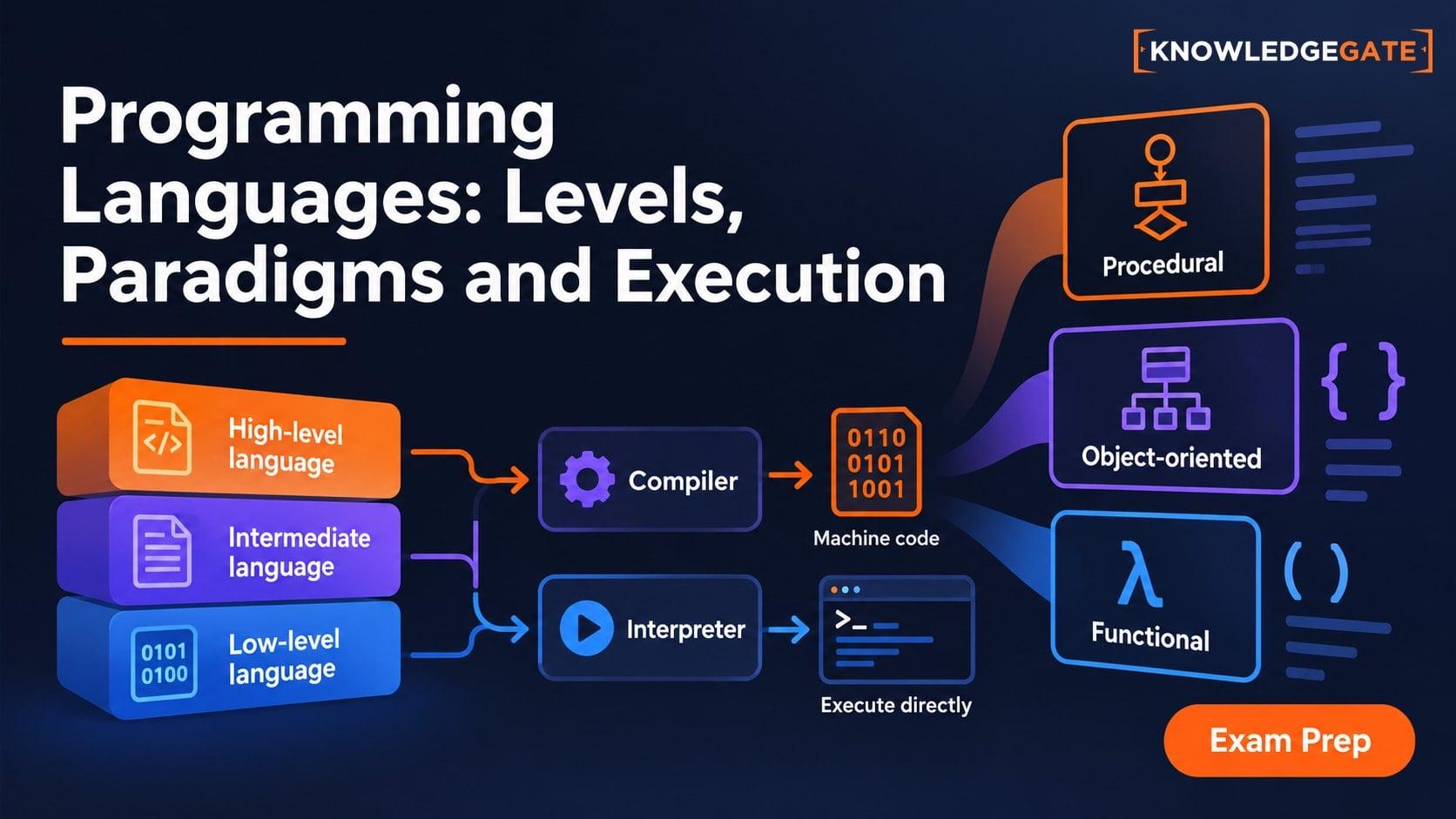
Types of Programming Languages: Levels, Paradigms and Execution Models
Learn why low-level, object-oriented, compiled and dynamically typed describe different axes. Build a clear classification map through one result expressed three ways.
Updated 13 Nov 20266 min readProgramming Languages Survey