

Principles and Implementation MCQs: 7 Solved MCQs Plus 4 OOD Problems
Practise seven bilingual Principles and Implementation MCQs plus four application problems on object-oriented design decisions.
KnowledgeGate Team
Exam prep & CS education
Updated 5 Nov 20267 min read
OOD questions use nearby labels such as identification, representation, relationships, operations, control, optimization, packaging, and documentation. A familiar word can still point to the wrong activity. Cohesion and coupling, object identity and representation, relationships and packaging, operations and optimization, control, reuse, and documentation are the focus. Answer each MCQ on your own, or write a short two-line design diagnosis for each problem, before reading its explanation. Each question heading opens the matching practice page. Use Coding & Skill Development Courses for the wider programming route.
Build the OOD decision sheet before solving
Clue in the question | OOD activity | Exact worked value |
|---|---|---|
domain nouns | object identification | Librarian, Book, Member M17 |
stored state | object representation | Patient P101 has treatmentDetails=[X-ray] and billAmount=1200 |
collaboration | design of relationships | Passenger P1 books Ticket T501 |
methods | classification of operations | Ticket.confirm() |
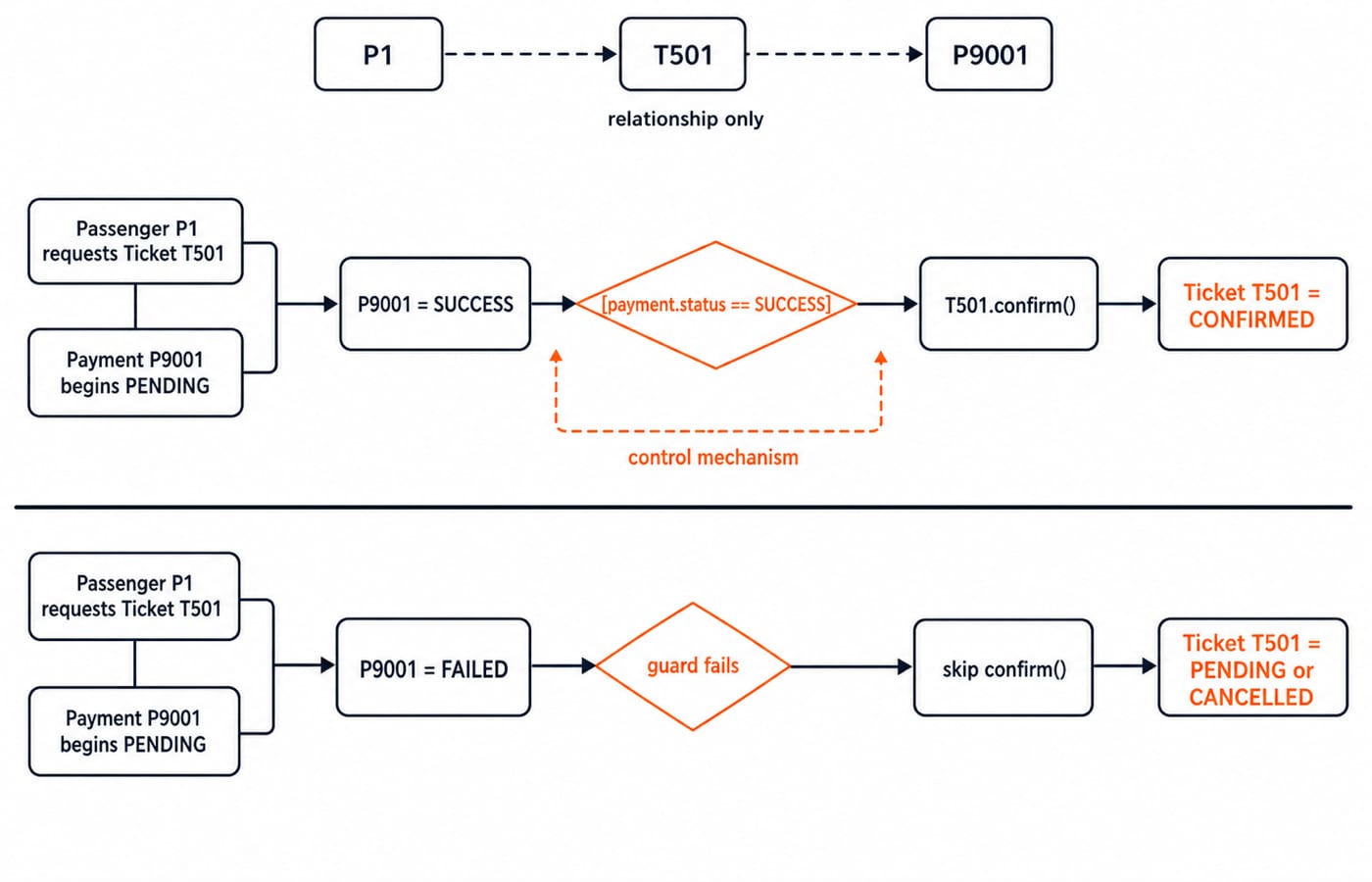
execution condition | control mechanism | confirm only when Payment P9001 is SUCCESS |
same output with less work | design optimization | reduce up to 100,000,000 comparisons to about 10,000 indexed lookups |
related classes | packaging | school.result contains ResultProcessor and GradePolicy |
maintainer intent | documentation | generateResult accepts exactly 3 marks |
Do not collapse cohesion, module focus, into coupling, module dependency. A relationship links Ticket T501 with Payment P9001; a guard decides whether T501 may become CONFIRMED. Use Object-Oriented Programming (OOP): Four Pillars and a Worked Dynamic-Binding Example for the four pillars and its employee dispatch trace; this set tests OOD activity selection and design diagnoses.
Principles and Implementation MCQs 1-2: cohesion and coupling
Question 1
Which principle ensures that a module performs a single well-defined task? कौन-सा सिद्धांत यह सुनिश्चित करता है कि कोई मॉड्यूल एक ही स्पष्ट रूप से परिभाषित कार्य (single well-defined task) करे?
A. High coupling हाई कपलिंग
B. High cohesion हाई कोहेज़न
C. Low abstraction लो एब्स्ट्रैक्शन
D. Strong encapsulation स्ट्रॉन्ग एनकैप्सुलेशन
Correct answer: B. High cohesion.
An InvoiceValidator may contain validateTaxId(), validateLineItems(), and validateTotal(). Every method supports one validation responsibility, so the module has high cohesion. Coupling concerns other modules, while encapsulation hides internal state but does not guarantee a single task.
Question 2
Which design principle ensures minimal dependency between modules? कौन-सा डिज़ाइन सिद्धांत मॉड्यूल्स के बीच न्यूनतम निर्भरता (minimal dependency) सुनिश्चित करता है?
A. High cohesion हाई कोहेज़न
B. Low coupling लो कपलिंग
C. Tight binding टाइट बाइंडिंग
D. Encapsulation एनकैप्सुलेशन
Correct answer: B. Low coupling.
An OrderService importing 8 concrete payment, inventory, email, and database classes has many change paths. Depending on 3 narrow interfaces shields callers from implementation changes. That is lower coupling; cohesion concerns responsibilities within one module.
Problems 3-4: object identity, representation, and relationships
Question 3
A hospital management system is being developed to handle patient admissions and treatments. During implementation, developers create a class named Patient that stores attributes such as patientName, disease, doctorAssigned, treatmentDetails, and billAmount. After deployment, the system starts showing inconsistent behavior: whenever treatment details are updated, billing values are unintentionally overwritten, and multiple patients seem to share similar treatment records. Determine the underlying reason for this unexpected behavior. Justify how improper object identification and representation have affected the system design, and explain the correct approach.
Without code, the bug is inferred. Independent state is P101 = {patientName:Asha, treatmentDetails:[X-ray], billAmount:1200} and P102 = {patientName:Ravi, treatmentDetails:[MRI], billAmount:2400}. Reusing one Patient can overwrite both state types. Sharing only the treatment list cannot explain the scalar bill. Use separate patient objects, private state, and controlled updates. For constructors, allocation, and lifetime mechanics, use Instantiation MCQs: 6 Solved MCQs Plus 3 Object-Creation Problems; Q3 instead diagnoses independent state and representation in a faulty domain model.
Question 4
Which step in OOD involves determining how objects collaborate to fulfill system behavior? OOD में कौन-सा चरण यह निर्धारित करता है कि सिस्टम के व्यवहार को पूरा करने के लिए ऑब्जेक्ट्स आपस में कैसे सहयोग (collaborate) करेंगे?
A. Object representation ऑब्जेक्ट रिप्रेजेंटेशन
B. Design of relationships रिलेशनशिप्स का डिज़ाइन
C. Algorithm design एल्गोरिथ्म डिज़ाइन
D. Packaging classes क्लासेस का पैकेजिंग
Correct answer: B. Design of relationships.
In Passenger P1 -> Ticket T501 -> Payment P9001, relationships record P1 booking T501 and T501 linking to P9001. Representation covers fields, algorithms cover computations, and packaging groups classes.
Principles and Implementation MCQs 5-6: packaging and operations
Question 5
Which design concept improves maintainability by grouping related classes together? कौन-सा डिज़ाइन कॉन्सेप्ट संबंधित क्लासेस को एक साथ समूहित करके सिस्टम की मेंटेनबिलिटी (Maintainability) को बेहतर बनाता है?
A. Inheritance इनहेरिटेंस
B. Packaging classes क्लासेस का पैकेजिंग
C. Polymorphism पॉलीमॉर्फिज्म
D. Encapsulation एनकैप्सुलेशन
Correct answer: B. Packaging classes.
Let school.domain contain Student and Exam, school.result contain ResultProcessor and GradePolicy, and school.ui contain ResultController. A grading change stays in the 2-class result package, not all 5 classes. Other options solve different problems.
Question 6
Which OOD step determines the operations and methods of objects? OOD का कौन-सा चरण ऑब्जेक्ट्स के ऑपरेशन्स और मेथड्स को निर्धारित करता है?
A. Object identification ऑब्जेक्ट पहचान
B. Object representation ऑब्जेक्ट रिप्रेजेंटेशन
C. Classification of operations ऑपरेशन्स का वर्गीकरण
D. Algorithm design एल्गोरिथ्म डिज़ाइन
Correct answer: C. Classification of operations.
For Patient P101, behaviours include assignDoctor("Dr Rao"), recordTreatment("X-ray"), and calculateBill(). Classification assigns them to Patient or a collaborator. Identification finds objects, representation selects state, and algorithm design specifies operation steps.
Principles and Implementation MCQs 7-8: optimization and candidate objects
Question 7
Which OOD concept focuses on improving performance without altering system functionality? कौन-सा OOD कॉन्सेप्ट सिस्टम की कार्यक्षमता (functionality) को बदले बिना प्रदर्शन (performance) को बेहतर बनाने पर केंद्रित होता है?
A. Design optimization डिज़ाइन ऑप्टिमाइज़ेशन
B. Object representation ऑब्जेक्ट रिप्रेजेंटेशन
C. Control implementation कंट्रोल इम्प्लीमेंटेशन
D. Algorithm design एल्गोरिथ्म डिज़ाइन
Correct answer: A. Design optimization.
Searching 10,000 patient records linearly for each of 10,000 lookups can require up to 10,000 x 10,000 = 100,000,000 comparisons. An ID index returns identical data with about 10,000 keyed lookups after construction. This does not promise universal constant time.
Question 8
Which OOD activity involves identifying candidate classes from problem domain nouns? OOD की कौन-सी गतिविधि समस्या क्षेत्र (problem domain) के संज्ञाओं (nouns) से संभावित क्लासेस (candidate classes) की पहचान करने से संबंधित है?
A. Algorithm design एल्गोरिथ्म डिज़ाइन
B. Object identification ऑब्जेक्ट पहचान
C. Object representation ऑब्जेक्ट रिप्रेजेंटेशन
D. Design optimization डिज़ाइन ऑप्टिमाइज़ेशन
Correct answer: B. Object identification.
In A Librarian issues a Book to Member M17, the nouns are candidates, issues suggests an operation or relationship, and M17 is an instance value. Filter duplicate, attribute, and irrelevant noun candidates.
Problems 9-11: control, reuse, and documentation
Question 9
A railway reservation system is designed using classes such as Passenger, Ticket, and Payment. The system establishes relationships in which a Passenger books a Ticket, and each Ticket is linked to a Payment. During testing, it is observed that even when the payment transaction fails, the system still generates and confirms the ticket. Developers argue that since the relationships among classes are correctly defined, the system should function properly. Determine the reason behind this unexpected behavior. Identify whether the issue lies in relationships or control mechanisms, and justify your answer based on OOP principles.
The links can be correct while control is wrong. If Payment P9001.status = FAILED, Ticket T501.status stays PENDING or becomes CANCELLED; only SUCCESS permits confirm(). Put the guard in the booking workflow or domain service and test both branches. Associations enforce no business rules.
Question 10
A banking system is developed with classes such as SavingsAccount and CurrentAccount, both containing a method calculateInterest(). Initially, both classes independently implement similar logic for interest calculation. Later, during system updates, developers modify the interest formula in SavingsAccount but forget to update it in CurrentAccount. As a result, customers with different account types receive inconsistent interest calculations, even though the logic was originally the same. Determine the reason for this inconsistency. Justify how the lack of optimization and poor implementation strategy caused this issue, and explain the correct OOP-based approach.
Duplication created two change points. With principal = 100000, rate = 0.06, and time = 1, 100000 x 0.06 x 1 = 6000. A stale 0.05 copy returns 5000, a 1000 mismatch. Centralise calculation in an InterestPolicy or base operation. Use different rates only for different rules; inheritance is optional.
Question 11
A school result processing system is developed using classes such as Student, Exam, and ResultProcessor. The system initially works correctly. However, after a few months, a new developer modifies the generateResult() method in ResultProcessor. After modification, the system starts producing incorrect grades for certain students. On investigation, it is found that the developer misunderstood the purpose of some methods and reused them incorrectly due to lack of proper documentation. Determine the underlying reason for this unexpected behavior. Justify how poor documentation and implementation strategy contributed to the issue, and explain the correct approach using OOP principles.
Document that generateResult([82, 78, 90]) accepts 3 marks and computes (82 + 78 + 90) / 3 = 250 / 3 = 83.33. Under illustrative A >= 80, it returns A; a wrong 4-subject helper gives 250 / 4 = 62.5 and, under C >= 60, returns C. These are illustrative grade boundaries, not an institution's policy. Document preconditions, name policies, and test 83.33 and A.
Diagnose the misses and choose the next practice step
Questions | Diagnostic distinction |
|---|---|
Q1-Q2 | module focus versus module dependency |
Q3-Q4 | independent state versus collaboration |
Q5-Q6 | grouping classes versus assigning methods |
Q7-Q8 | unchanged output versus candidate discovery |
Q9-Q11 | guards, shared logic, and documented contracts |
Retest 7 MCQs in 7 minutes, then 4 problems in 12, totalling 19. For each miss, record trigger, activity, and one worked value.
Practise implementation with Java Course: Concepts, MCQs & Coding Questions.
In short: nouns identify objects; fields represent state; relationships connect them; operations assign behaviour; guards control transitions; optimization preserves behaviour; packaging groups classes; documentation preserves intent.
Keep learning
Data Abstraction Explained: Hide Implementation Details with a Worked Java Example
See how a stable Account contract protects its invariant while the Java implementation changes from a running balance to a transaction ledger.
Updated 16 Nov 20265 min readProgramming Languages Survey
Programming Paradigms Explained: Concepts, Classifications and Worked Examples
Learn how imperative, procedural, object-oriented, functional and declarative styles organise the same computation, and how to classify code from visible evidence.
Updated 15 Nov 20265 min readProgramming Languages Survey
Introduction to Visual Basic (VB): Concepts, Worked Code and Exam Patterns
Learn how a VB.NET form turns text-box input and a button click into a traced result. Then practise operators, loops, procedures, scope and debugging.
Updated 14 Nov 20266 min readProgramming Languages Survey
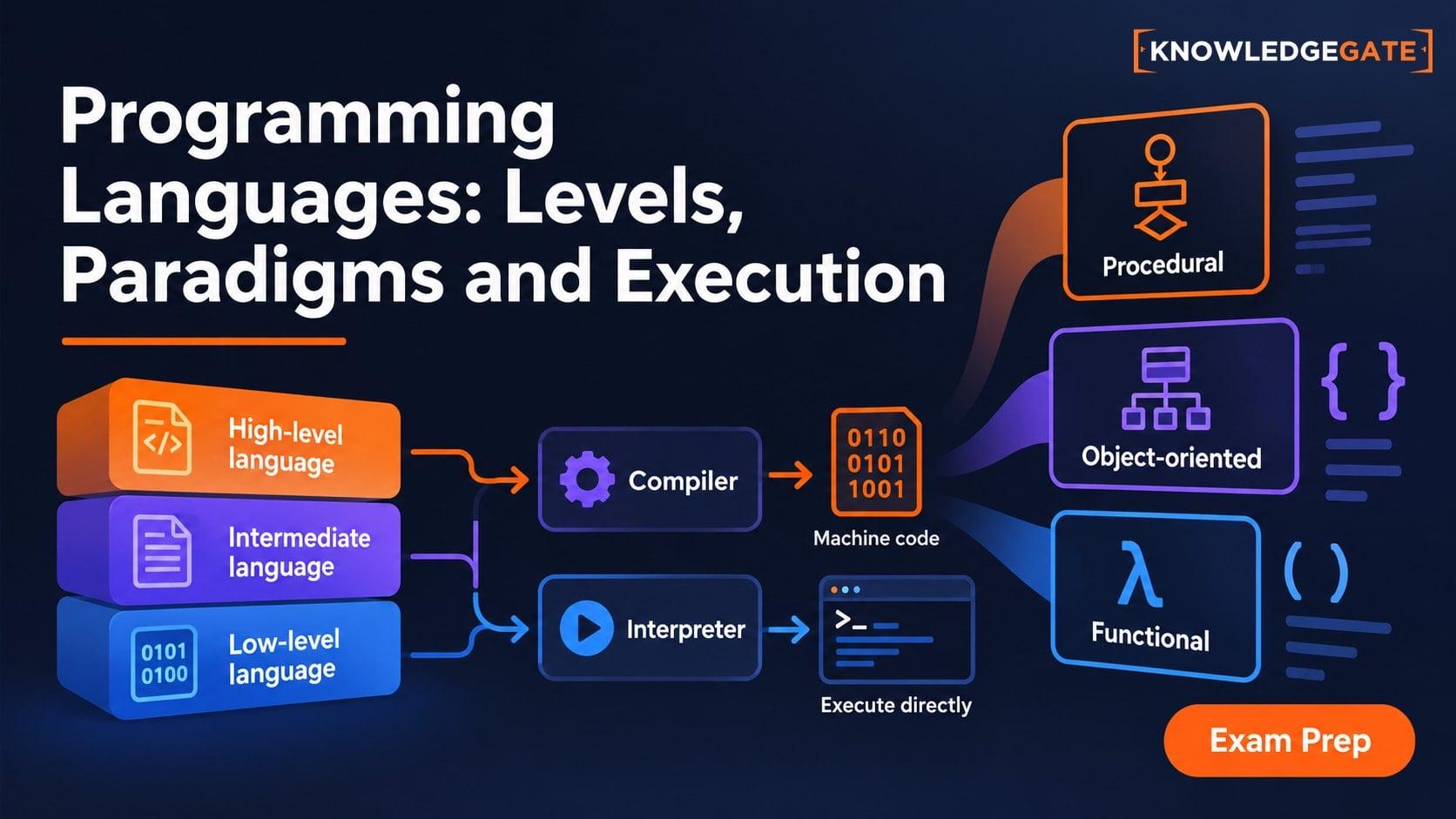
Types of Programming Languages: Levels, Paradigms and Execution Models
Learn why low-level, object-oriented, compiled and dynamically typed describe different axes. Build a clear classification map through one result expressed three ways.
Updated 13 Nov 20266 min readProgramming Languages Survey