

Programming Languages for GATE: Syllabus Map, Question Patterns and Study Order
Map the GATE programming scope correctly, trace C and recursion step by step, audit practice patterns honestly, and follow a 12-session study order.
KnowledgeGate Team
Exam prep & CS education
Updated 16 Nov 20265 min read
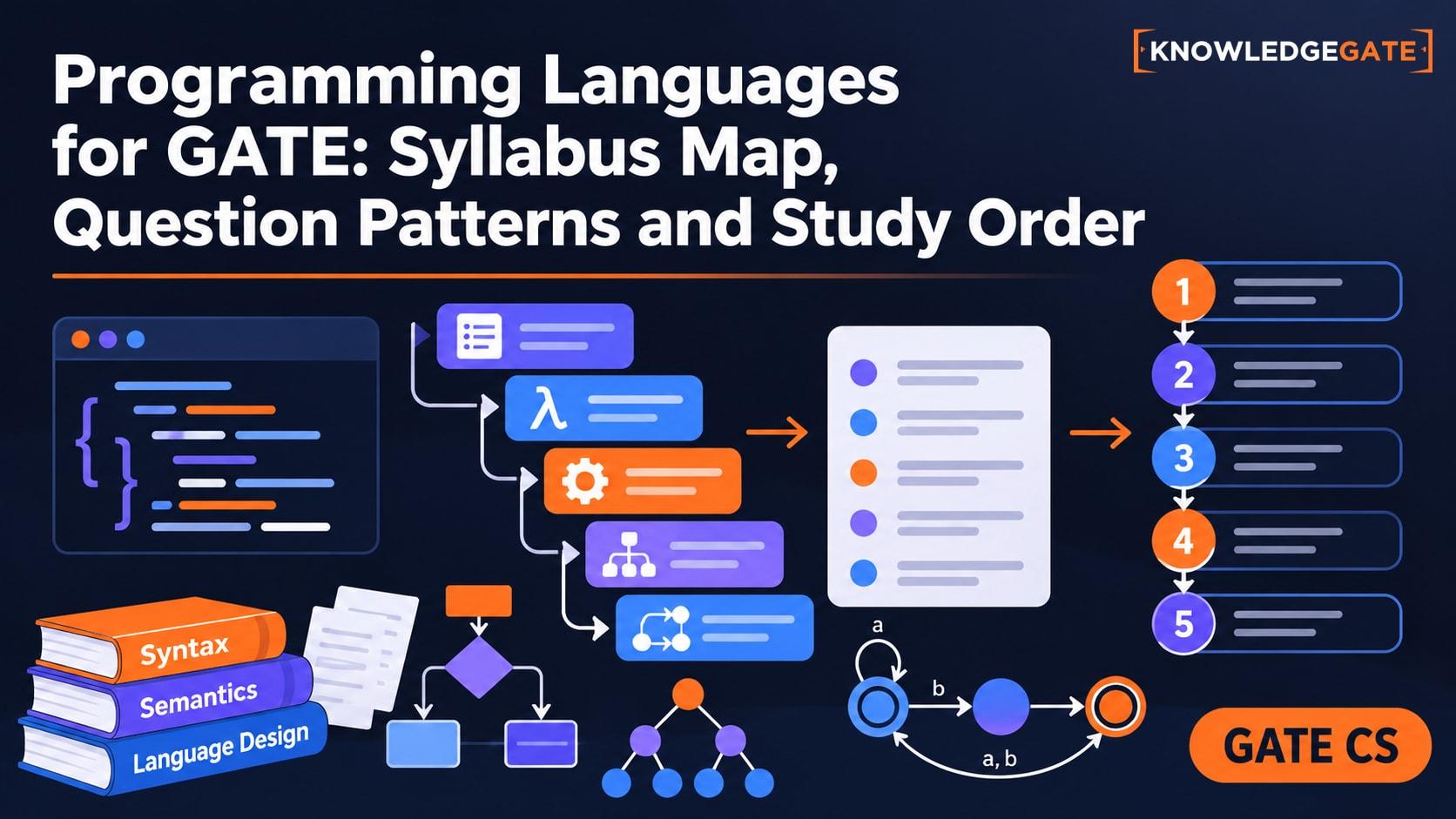
“Programming Languages” is a useful study label, but it can mislead GATE CS aspirants about what to prepare. The official GATE 2027 CS syllabus places the relevant material under “Programming and Data Structures” and names C, not a list of languages. Use that scope to interpret question patterns and set a preparation order, then confirm the named topics in the official GATE 2027 CS syllabus.
What “Programming Languages” means for GATE CS
The official GATE 2027 CS syllabus lists Programming in C, recursion, arrays, stacks, queues, linked lists, trees, binary search trees, binary heaps and graphs in Section 4. Java, Python, language history and object-oriented programming are not named in that section. Lexical analysis and parsing belong to the separate Compiler Design section.
Use C as notation for program behaviour. Then study recursion and the named data structures as operations that you may need to trace, simulate or reason about. The GATE CS Exam category shows where this block sits in the full exam path.
Build the syllabus map before counting questions
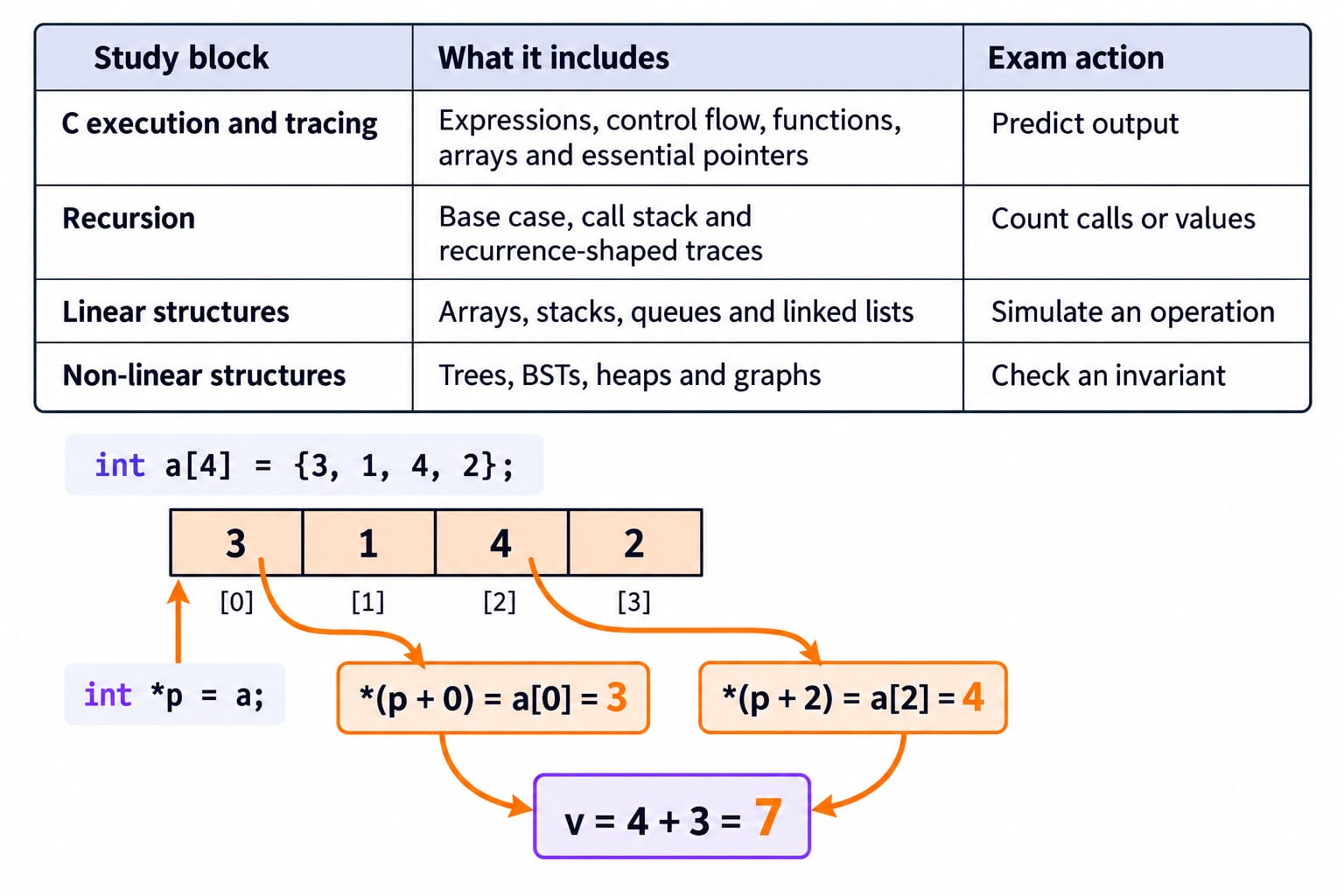
Study block | What it includes | Exam action |
|---|---|---|
C execution and tracing | Expressions, control flow, functions, arrays and essential pointers | Predict output |
Recursion | Base case, call stack and recurrence-shaped traces | Count calls or values |
Linear structures | Arrays, stacks, queues and linked lists | Simulate an operation |
Non-linear structures | Trees, BSTs, heaps and graphs | Check an invariant |
Consider this original C trace:
int a[4] = {3, 1, 4, 2};
int *p = a;
int v = *(p + 2) + *(p + 0);
p points to the first element of a. Therefore, *(p + 2) = a[2] = 4 and *(p + 0) = a[0] = 3. So v = 4 + 3 = 7. This connects array indexing, pointer movement and exact value tracking.
If you cannot yet trace assignments, loop bounds and function calls on paper, fix that first. More data-structure practice can conceal this weakness instead of correcting it.
Read weightage as a rolling pattern, not a quota
The official GATE 2027 syllabus names topics but does not assign a topic-wise marks split to Programming and Data Structures. A fixed percentage or promised question count would therefore be misleading. GATE CS Subject Weightage explains why subject allocation is a planning signal, not a guarantee.
Use your own practice log instead of turning one sample into GATE history. Suppose 24 attempted past-paper questions contain 9 code traces, 5 recursion questions, 6 linear-structure questions and 4 questions on trees, heaps or graphs:
Code traces:
9 / 24 = 37.5%Recursion:
5 / 24 = 20.8%to one decimal placeLinear structures:
6 / 24 = 25%Non-linear structures:
4 / 24 = 16.7%to one decimal place
Choose revision by errors, not bucket size. If you get 7 of 9 code traces right, you made 2 errors. If you get only 2 of 5 recursion questions right, you made 3 errors. Recursion is next week's priority even though the trace bucket is larger.
See how one trace becomes MCQ, MSQ or NAT
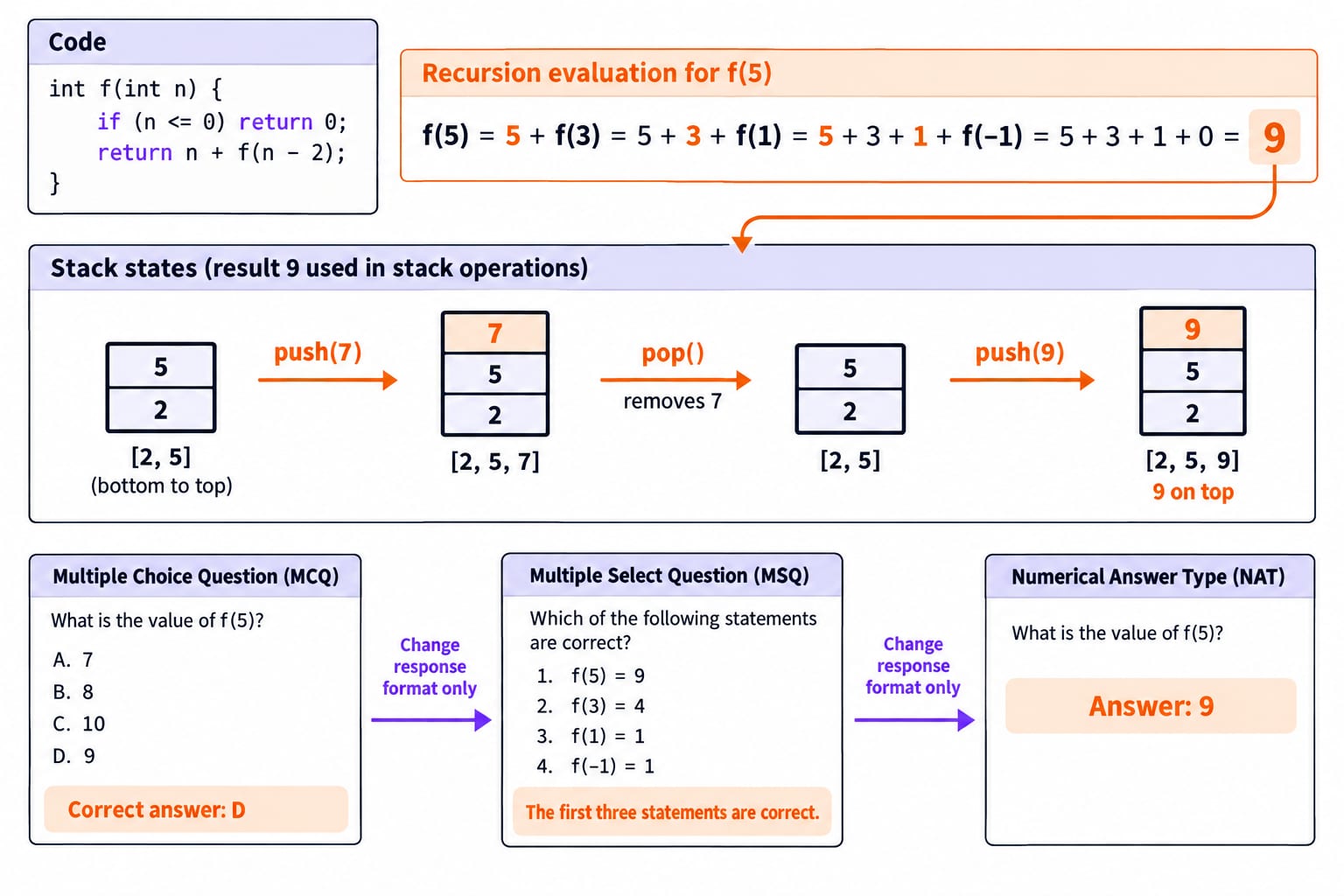
Trace this original function as a one-number task:
int f(int n) {
    if (n <= 0) return 0;
    return n + f(n - 2);
}
For f(5), write the calls before adding:
f(5) = 5 + f(3) = 5 + 3 + f(1) = 5 + 3 + 1 + f(-1) = 5 + 3 + 1 + 0 = 9.
The recursion trace gives one exact value: 9.
Now take a stack containing [2, 5] from bottom to top. After push(7), it is [2, 5, 7]. Then pop() removes 7, returning it to [2, 5]. Finally, push(9) produces [2, 5, 9], with 9 on top. The same trace supports all three response formats:
MCQ: After the three operations, what is the top element? A. 2, B. 5, C. 7, D. 9. Correct answer: D.
MSQ: Select every true statement: the pop removes 7; the final stack contains three values; the final top is 9; the final top is 7. The first three statements are correct.
NAT: Enter the final top element after the three operations. Answer: 9.
Only the response format changes; the state trace and answer stay fixed. MCQ, MSQ or NAT? GATE Question Types Explained compares the formats. Confirm the current marking pattern on the official GATE site for your attempt.
Follow a 12-session preparation order
Keep each session to 75 minutes: 25 minutes of concept review, 35 minutes of solving and 15 minutes of error-log correction.
Sessions 1 to 3: C tracing, arrays and pointers.
Sessions 4 and 5: functions and recursion.
Sessions 6 to 8: stacks, queues and linked lists.
Sessions 9 and 10: trees, BSTs and heaps.
Session 11: graphs.
Session 12: a mixed timed set.
Move a missed session to the next available slot without changing the order. Do not compress two sessions into one rushed block. After every third session, re-solve one previously wrong question without notes. GATE Guidance by Sanchit Sir provides a structured route through the subjects.
Fix the traps that make correct-looking traces fail
Three habits cause many tracing errors: changing two variables mentally in one step, losing the recursion base case, and treating a data structure as a picture instead of applying its operation order. Replace them with one written routine on every line: state before operation, operation, state after operation.
Item | Predicted | Correct | Cause | Retest | Result |
|---|---|---|---|---|---|
| 8 | 9 | Omitted the | After 48 hours | 9 |
Final stack top | 7 | 9 | Forgot the final | Next review | 9 |
Keep concept practice and official past-paper analysis as separate entries in your log. Concept practice builds coverage; past papers reveal the exam's wording and decision patterns.
Use a checkpoint to choose the next action
Before moving on, reproduce the array and pointer result 7, the recursion result 9, and the final stack [2, 5, 9]. Then classify 12 past-paper questions you have attempted into the four syllabus buckets. If either trace is wrong, return to sessions 1 to 5. If both are correct but slow, begin mixed timed practice.
The short version is simple: take the scope from the official syllabus, audit past questions without turning your sample into fixed weightage, learn in dependency order and retest errors. Use the GATE Test Series for the immediate practice step. If you are planning all subjects across six months, place this 12-session block inside that larger calendar.
Go deeper with the full courseGATE Guidance by Sanchit Sir
Keep learning

Programming Languages for GATE: C Syllabus Areas, Weightage Pattern and Prep Order
Build a bounded C preparation map, calculate topic shares from your own PYQ audit, and practise two fully worked traces before following a 14-day study order.
Updated 30 Oct 20266 min read51 viewsProgramming Languages Survey
MCA Entrance Computer Science Prep Map: Programming, DSA and DBMS in the Right Order
Study MCA entrance computer science as a dependency chain, not a list. Trace C, reason about DSA, and carry one data set through hashing, normalisation and SQL.
Updated 25 Jul 20266 min readMCA Entrance

CUET PG Computer Science Revision Map: Study Subjects in Prerequisite Order
Build CUET PG Computer Science revision in dependency order, then practise each block with the right kind of trace. Keep DBMS and networks in a separate programme-level lane.
Updated 5 Aug 20266 min readMCA Entrance
HPSC PGT Computer Science Syllabus: Topic Map and Study Order
Turn a flat HPSC PGT Computer Science checklist into six connected preparation lanes. Use the worked school-lab case and balanced diagnostic to decide what to repair next.
Updated 30 Oct 20266 min read90 viewsHPSC Teaching