

Disaster Recovery Planning: RTO, RPO, Backup Design and Worked Exam Scenarios
Learn to separate outage time from data-loss exposure, compare backup chains, and build a dependency-aware recovery runbook through exact worked calculations.
KnowledgeGate Team
Exam prep & CS education
Updated 17 Nov 20266 min read
RTO, RPO, backup, replication and failover answer different recovery questions: how long service may be unavailable, how far recovery may roll data back, how state is restored and how traffic moves. An exam-submission incident makes those differences concrete through recovery timing and backup-chain calculations. These concepts build on the wider GATE CS Exam Preparation Courses & Test Series track without carrying a fixed weightage.
Disaster recovery planning: scope, components and boundaries
Disaster recovery planning documents how to restore applications, data and infrastructure after disruption. Rank services and dependencies, assess impact, set objectives, choose mechanisms, assign owners and a runbook, then test and revise.
Planning question | Output | Example |
|---|---|---|
What must return first? | Ranked service list | Authentication before the exam portal |
How much loss is tolerable? | RPO | 15 minutes |
Business continuity keeps essential work going; disaster recovery restores its technology. High availability reduces ordinary component-failure interruption. A backup is a recoverable copy. A replica aids availability but may copy deletion or corruption, so it cannot replace backups.
The hypothetical service has authentication, an application tier, a database, object storage, DNS and monitoring. Its recovery point preserves committed state, explained in Transactions & Concurrency Control in DBMS, although concurrency control and site recovery are separate.
RTO and RPO: calculate outage and data-loss exposure correctly
RTO targets maximum disruption-to-restoration time. RPO targets maximum recoverable-data age at disruption. A 60-minute RTO and 15-minute RPO are policies; an observed 65-minute recovery misses RTO, while a 12-minute gap meets RPO. RTO measures unavailability, RPO potential data loss. Neither equals backup frequency.
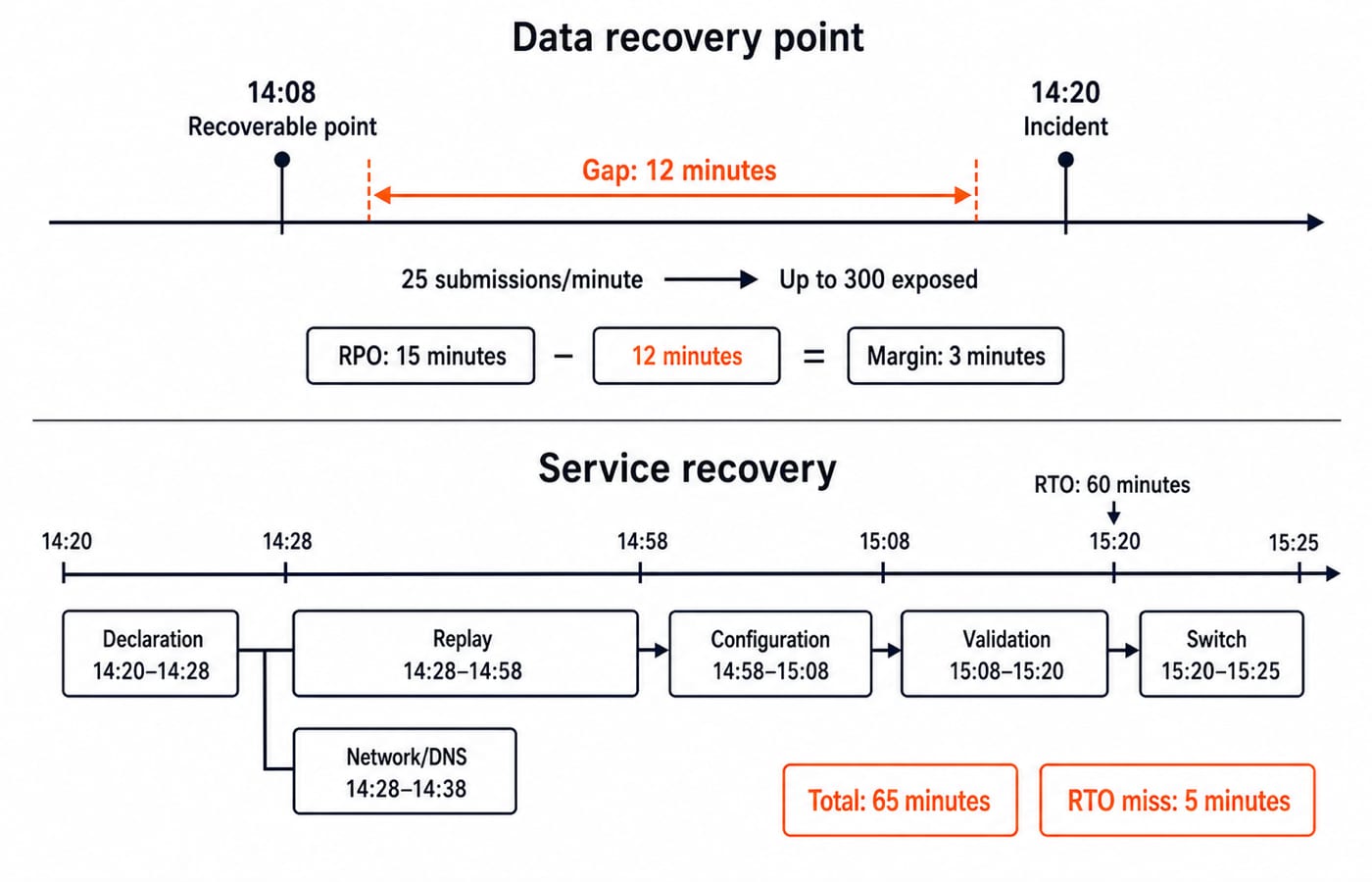
Failure occurs at 14:20; the newest safe recovery point is 14:08.
Gap = 14:20 - 14:08 = 12 minutes.
Exposure = 12 x 25 submissions/minute = up to 300 submissions, which another durable source may help reconcile.
RPO margin = 15 - 12 = 3 minutes, so the target is met.
The 300 are exposed, not certainly lost. Detection and declaration take 8 minutes. Replay takes 30 minutes parallel to 10 minutes of network and DNS work, so the phase is max(30, 10) = 30, not 40. Configuration takes 10, validation 12 and switching 5. Total = 8 + 30 + 10 + 12 + 5 = 65 minutes. Service returns at 15:25, missing RTO by 5.
Backup design: full, incremental, differential and replication trade-offs
Full backup copies the dataset. Incremental copies changes since any previous backup; differential copies changes since the latest full. Logs refine recovery points, snapshots capture storage state, and replication keeps a serving copy. Keep three copies, two storage forms and one off-site. Immutable or offline media protects differently from a live replica.
Assume a 600 GB Sunday full, 36 GB of new non-overlapping changed blocks daily through Saturday, with no compression or metadata overhead.
Full plus six incrementals = 600 + (6 x 36) = 816 GB.
Differentials are 36, 72, 108, 144, 180 and 216 GB.
Full plus all differentials = 600 + 36 + 72 + 108 + 144 + 180 + 216 = 1,356 GB.
Saturday incremental recovery reads 816 GB across seven sets: full plus six incrementals. Differential recovery reads 816 GB across two: full plus latest 216 GB differential. At 180 GB/hour, either lower bound is 816 / 180 = 4.533... hours, about 4 hours 32 minutes, before setup, log replay and validation. File Systems and Disk Scheduling in OS explains why layout and I/O affect restoration, although disk scheduling alone does not set recovery time.
Recovery architectures: cold, warm and hot choices follow the objective
Cold recovery restores infrastructure and data after declaration. Warm keeps part ready. Hot maintains a near-ready or serving peer. These are relative readiness levels, not time promises. Active-passive uses a standby; active-active serves from multiple environments. All still need backups, consistency checks and controlled failback.
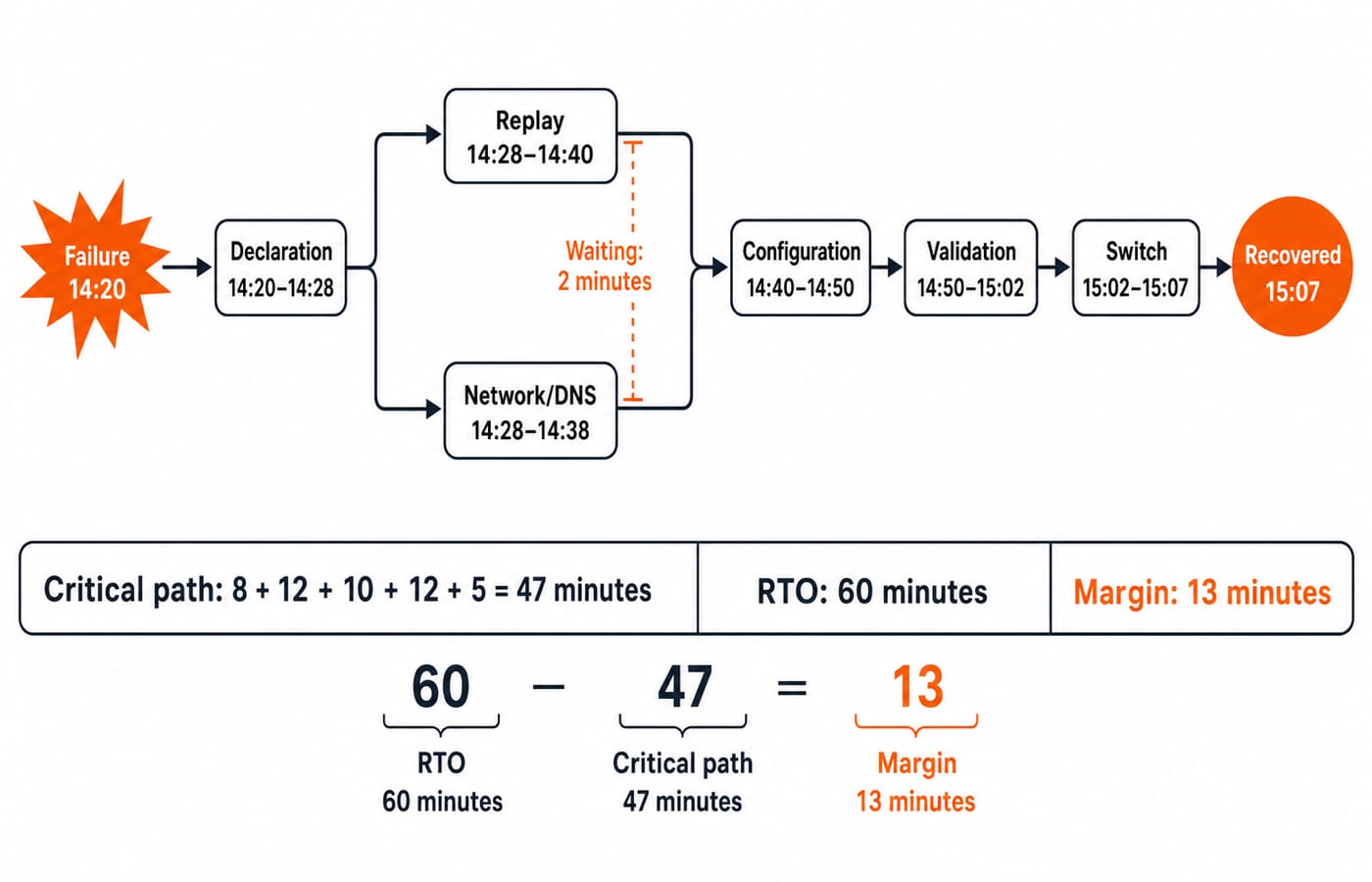
A warm replica cuts replay from 30 to 12 minutes; network work stays 10. The parallel phase is max(12, 10) = 12. Total = 8 + 12 + 10 + 12 + 5 = 47 minutes, restoring at 15:07 and meeting RTO by 13. Reducing only network time cannot fix the original plan because replay was the bottleneck.
Disaster recovery builds on Operating Systems for GATE: Deadlocks, Scheduling, Memory fundamentals. Hot is not always best; choose by impact tolerance, dependency order, consistency and drill evidence.
Disaster recovery runbook: sequence owners, dependencies and proof
Step | Owner role | Entry condition | Action | Exit evidence | Planned interval |
|---|---|---|---|---|---|
Declare recovery | Incident lead | Disruption confirmed | Declare | Log entry | 14:20-14:28 |
Replay warm replica | Database owner | Declared | Replay | Consistent point | 14:28-14:40 |
Prepare routing | Network owner | Declared | Prepare DNS/routing | Route check | 14:28-14:38 |
Apply configuration | Application owner | Both complete | Configure | Healthy dependencies | 14:40-14:50 |
Validate service | Validation lead | Configured | Check authentication, one test submission and stored-file retrieval | End-to-end proof | 14:50-15:02 |
Switch traffic | Incident lead | Validation passes | Redirect | Live transaction | 15:02-15:07 |
Configuration waits for both branches; validation waits for configuration. A server response alone cannot trigger switching. Evidence covers database, object storage, authentication and one transaction. Failure stops the runbook and records the decision. Define declaration authority, status cadence, alternate contacts, audit log and rollback trigger. Recovery ends after verification; failback is a later controlled procedure.
Recovery testing and common traps: prove the plan before an incident
A tabletop tests decisions and contacts; backup-restore proves readable data; component failover tests one dependency; an end-to-end drill measures the service path. Record timestamps, point age, reconciliation, integrity, failures and follow-ups. Backup success is not restore proof.
A drill records detection 11, replay 15, parallel network work 9, configuration 10, validation 14 and switching 6 minutes. Total = 11 + max(15, 9) + 10 + 14 + 6 = 56, meeting RTO by 4. Plan = 47, so variance = 56 - 47 = 9. Record it and improve detection, replay, validation and switching.
Trap | Correction |
|---|---|
RPO called downtime | RPO limits data age; RTO limits outage. |
Parallel times added | Take the longest branch. |
Replica trusted against deletion or ransomware | Keep immutable or offline copies. |
Hot chosen before mapping dependencies | Let objectives and dependencies choose. |
Backup success called proof | Verify a restore. |
Traffic switched before validation | Require transaction evidence. |
Recovery called failback | Plan failback separately. |
Disaster recovery exam patterns: recognise the operation being tested
Exam-style operations include identifying RTO or RPO, calculating gaps and exposed records, finding critical paths, comparing backup storage or restore sets, choosing readiness, and spotting controls that fail against corruption. Key values are a 12-minute gap, exposure of 300 submissions, recoveries of 65 and 47 minutes, incremental storage of 816 GB, and differential storage of 1,356 GB.
Pattern A: Failure 14:20, recoverable point 14:08. Gap = 12 minutes, not the 15-minute target.
Pattern B: After 8 minutes, tasks 12 and 10 run in parallel, then 10, 12 and 5. Recovery = 8 + max(12, 10) + 10 + 12 + 5 = 47, not 57 or 35.
Practise definitions, time arithmetic, backup chains, dependency graphs, architecture choice, then mixed scenarios.
Disaster recovery planning: the short version and next step
Recall: prioritise service, set RTO and RPO, keep recoverable copies, choose architecture, write a dependency-aware runbook, then test and revise. The original plan took 65 minutes and missed by 5; the warm plan took 47 and passed by 13, with the same 12-minute gap.
For a structured path, use GATE Guidance by Sanchit Sir. For concept revision, redraw both timelines and recompute the backup table unaided.
Self-test: incident 15:52, recoverable point 15:41, rate 32 records/minute. Find the gap and maximum exposure, then decide whether a 10-minute RPO is met.
Go deeper with the full courseGATE Guidance by Sanchit Sir
Keep learning

Physical Security and Disaster Control: Layered Controls, RPO and RTO Worked Example
Learn how physical controls, disaster planning and recovery targets work together. Follow an exact incident timeline to test RPO, RTO and a warm standby.
Updated 6 Nov 20266 min readTeaching Recruitment (Computer Science)

OOP Design Scenarios: Composition, Interfaces and Abstract Classes
Learn to defend OOP design boundaries through two complete examples: a multi-channel incident alert service and a report exporter with independent formats and destinations.
Updated 17 Sep 20266 min readInterview Corner
C++ Exception Handling: Typed Errors, Stack Unwinding and Safe Recovery
Build a small C++ parser that reports machine-readable failures, recovers only from a malformed optional field, and preserves saved state when a required field fails.
Updated 8 Sep 20266 min readC++

Fundamentals of Planning in AI: STRIPS, State-Space Search and a Worked Blocks World Plan
Build a planning problem from facts, actions and goals, then follow every add and delete effect through a complete six-step Blocks World solution.
Updated 11 Oct 20266 min read64 viewsML & Data Science