HPSC PGT Computer Science Syllabus: Topic Map and Study Order
Turn a flat HPSC PGT Computer Science checklist into six connected preparation lanes. Use the worked school-lab case and balanced diagnostic to decide what to repair next.
KnowledgeGate Team
Exam prep & CS education
Updated 29 Jul 20266 min read75 views
A long Computer Science syllabus becomes unmanageable when programming, systems, databases, networks, theory and pedagogy sit in one flat checklist. Six preparation lanes, one dependency path, a worked school-lab example and a 36-question diagnostic turn that checklist into an order you can actually follow. The HPSC PGT Computer Science exam preparation page is a useful orientation point, and the HPSC document issued for your own post remains the authority on official scope and pattern.
1. Fix the official boundary before making the topic map
Start with the syllabus or notice for the exact HPSC post and advertisement you are targeting. On the HPSC website, check four things on the document itself: its title, the post name, the advertisement number and the issue date. Copy those four values to the top of your own topic list, so every later decision about scope traces back to one named document rather than to memory.
Then keep the sources apart. A topic named in that issued document is scope; a topic you picked up from a course page, a senior's notes or an article is a study grouping until the document confirms it. Never merge an old PGT syllabus, an Assistant Professor syllabus or a coaching list into the same list. Teaching CS Exams Compared: DSSSB, KVS, RSSB shows why recruitment boundaries differ even when the subject name is identical.
2. Turn the syllabus into six preparation lanes
Planning lane | Topics to check in the applicable HPSC syllabus | What to settle before you study it |
|---|---|---|
Foundations and supporting knowledge | Computer fundamentals, discrete mathematics, Boolean logic and digital logic | Check whether discrete mathematics and digital logic are named at all before budgeting weeks for them. |
Programming and problem solving | C or other named languages, OOP, data structures, algorithms and complexity | Study the language the document names; do not substitute one you already know. |
Core systems | Computer organisation, operating systems and system software | Check whether system software has its own heading or sits inside computer organisation. |
Data management | Data models, relational algebra, SQL, normalisation, transactions and indexing | Read past a bare DBMS heading: transactions and indexing need to be named separately. |
Networks and connected computing | Data communication, network layers, addressing, web technologies and security | Web technologies and security are not implied by the network layers; confirm each is listed. |
Theory, software and teaching | Theory of computation, compiler concepts, software engineering, ICT and pedagogy | Include pedagogy, ICT and teaching aptitude only where the document names them. |
The six lanes are a filing device, not headings lifted from the document, and six equal rows do not mean six equal shares of marks. Move a topic to whichever lane you will genuinely study it in, and add AI, graphics or cloud only when the issued document or a live HPSC course page puts them in scope.
3. Study prerequisites before isolated chapters
Follow these dependencies:
Boolean logic to digital logic to computer organisation to operating systems.
Programming basics to data structures to algorithms to complexity.
Sets and relations to the relational model to SQL to normalisation to transactions.
Basic networking precedes web and security, while programming makes software engineering examples concrete. Pedagogy and ICT can run in parallel.
Those chains give a six-pass order: foundations; programming and data structures; algorithms plus core systems; DBMS plus networks; theory, compiler and software engineering; then pedagogy, ICT and mixed revision. The order follows the dependencies, so it says nothing about how many marks each pass is worth. A strong programmer may compress Pass 2, but only after proving that strength on questions rather than on feeling. The HPSC PGT Computer Science 2026 complete course walks the same material in a structured sequence.
4. Work one school-lab case across programming, data, systems and networks
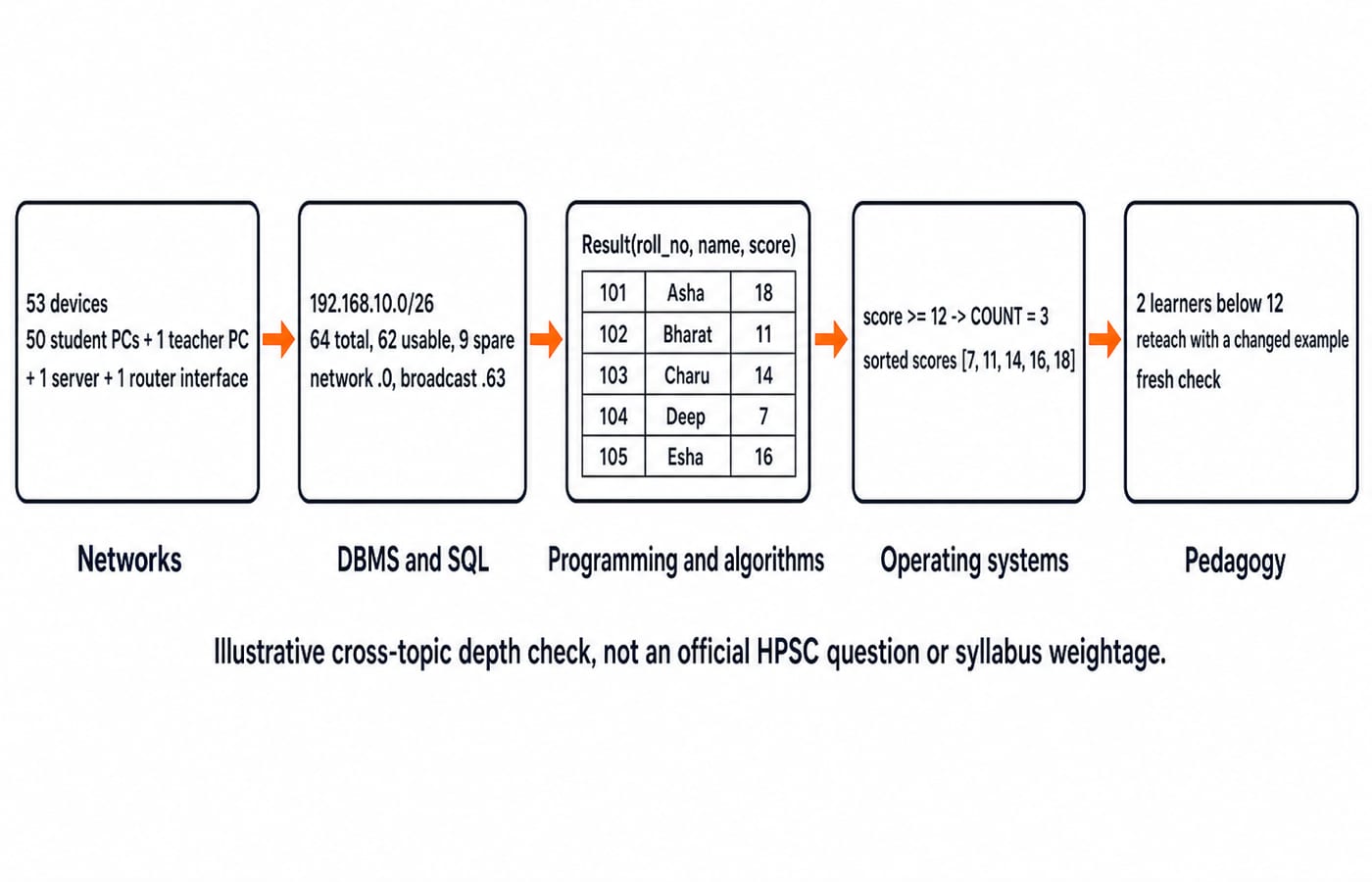
One case can test four lanes at once. A school lab has 50 student computers, 1 teacher computer, 1 server and 1 router interface, so it needs 50 + 1 + 1 + 1 = 53 usable addresses.
For 192.168.10.0/26, the host part has 32 - 26 = 6 bits. That gives 2^6 = 64 total addresses and 64 - 2 = 62 conventionally usable host addresses. After assigning 53, 62 - 53 = 9 remain, so the subnet is large enough. In this block, .0 is the network address and .63 is the broadcast address.
The server stores Result(roll_no PRIMARY KEY, name, score) with (101, Asha, 18), (102, Bharat, 11), (103, Charu, 14), (104, Deep, 7) and (105, Esha, 16). The query SELECT COUNT(*) FROM Result WHERE score >= 12; returns 3, since 18, 14 and 16 qualify. A sorting program produces [7, 11, 14, 16, 18].
The operating system decides who may touch that file. The teacher account owns it and needs read and write, which is 4 + 2 = 6; the student group needs read only, which is 4; nobody outside the lab needs access at all, which is 0. The permission bits are therefore 640, and a student process that opens the file for writing is refused by the OS before the database ever sees the request.
Sorting belongs to algorithms, storage and queries to DBMS, permissions and process scheduling to the OS, and addressing to networks. Pedagogy turns the two scores below 12 into a changed explanation and a fresh check.
5. Keep pedagogy and supporting knowledge out of the leftovers pile
Technical recall and teaching judgement are different study jobs. For every concept, add one explain, one diagnose and one adapt prompt. In the lab case, explain why /26 provides 62 usable addresses. Diagnose an answer of 63 as subtracting only one reserved address. Adapt by drawing the .0 to .63 strip, then ask a fresh /27 check: 32 - 27 = 5, 2^5 = 32 total addresses and 32 - 2 = 30 conventionally usable addresses.
Match the depth to the document: study pedagogy, teaching aptitude and classroom ICT as far as the issued syllabus names them, and no further. Teaching Aptitude for CS Recruitment Exams develops the explain, diagnose and adapt method in more detail.
6. Use a 36-question audit to choose the next lane
Build an even home diagnostic: 6 questions per lane x 6 lanes = 36 questions. Equal counts are what make the six lane scores comparable with each other; they are not a claim about how the real paper is split. Suppose one sitting comes out like this: Foundations 4/6, Programming 5/6, Core systems 2/6, Data management 4/6, Networks 3/6, and Theory, software and teaching 3/6.
The total is 4 + 5 + 2 + 4 + 3 + 3 = 21/36 = 58.3%. The missed items are 2 + 1 + 4 + 2 + 3 + 3 = 15. Core systems contributes 4/15 of the misses. Networks and theory, software and teaching each contribute 3/15; the remaining lanes contribute 5/15 together.
Repair core systems first, then networks and theory, software and teaching. Re-run the audit on fresh questions before you re-rank, and keep a correct guess in the repair queue until it repeats. This audit only picks the lane; turning each individual miss into a specific repair is the separate job worked through in HPSC PGT Computer Science PYQs: Build an Error-Driven Practice Loop. Once the mapped lanes are ready for mixed timed practice, use the HPSC PGT (CS) Test Series.
7. Avoid map-reading mistakes, then take the next step
A course page read as the syllabus: it creates scope the document never asked for. Reconcile every lane with the HPSC document before you spend a week on it.
Equal rows given equal hours: weaknesses persist. Allocate repair time from the
21/36audit.Prerequisites forgotten: OS, DBMS or algorithm errors repeat. Recheck with fresh values.
Pedagogy postponed: knowledge never becomes a teaching decision. Pair each technical block with one explain-diagnose-adapt prompt.
The short version: verify the official boundary, file topics into six lanes, follow the dependencies, run the 36-question audit and repair the largest gap. Use the HPSC PGT Computer Science 2026 complete course for structured coverage or the HPSC PGT (CS) Test Series for mixed practice, and keep the issued HPSC document open beside both.
Keep learning

HPSC PGT Computer Science: Algorithms and Computer Architecture Problems
Learn a two-lane method for Algorithms and Computer Architecture practice, with verified Dijkstra, direct-mapped cache, and pipeline examples.
Updated 6 Aug 20265 min readHPSC Teaching
HPSC PGT vs DSSSB TGT Computer Science: Choose Haryana or Delhi
Use a qualification gate, syllabus-overlap calculation and weighted fit score to decide whether HPSC PGT or DSSSB TGT Computer Science deserves your next study block.
Updated 4 Aug 20266 min readHPSC Teaching
HPSC Teaching CS Weightage: Rank Topics with Four Evidence Signals
Build a defensible HPSC Computer Science revision order without invented percentages. Score syllabus gaps, verified recurrence, prerequisite reach and fresh weakness, then turn the result into a ten-hour week.
Updated 1 Aug 20265 min readHPSC Teaching
HPSC Teaching Computer Science: 14-Week Study Plan for Working Aspirants
Use a repeatable 12-hour week to map the official syllabus, diagnose six CS lanes, practise retrieval, review timed sets and finish with focused revision.
Updated 27 Jul 20266 min readHPSC Teaching