

PPP, TCP/IP and VoIP Protocols: Framing, Packet Flow and Worked Examples
Follow one voice packet from RTP through UDP, IPv4 and PPP. Decode fields, spot RTP loss, and calculate payload, overhead, line rate and delay.
KnowledgeGate Team
Exam prep & CS education
Updated 30 Oct 20266 min read

PPP, TCP/IP and VoIP often appear in one protocol list, so they look like alternatives. They are not: PPP frames one point-to-point link, TCP/IP is a layered suite, and VoIP is a service built from several protocols. The end-to-end path is PPP frame to IPv4 packet to UDP datagram to RTP media, with field values that reveal loss, overhead, line rate and delay.
1. PPP, TCP/IP and VoIP protocols: one end-to-end map
PPP is a data-link protocol for a point-to-point connection. TCP/IP is the suite whose link, internet, transport and application layers cross interconnected networks. VoIP carries voice over IP using signalling, description, media and control protocols, not one protocol named VoIP.
In our call, host A 192.0.2.10:40000 sends 20 ms voice packets to B 198.51.100.20:50000. Its access link uses PPP, the network packet is IPv4, and media is RTP over UDP.
Term | Scope or layer | Job | Unit seen | Identifier used next |
|---|---|---|---|---|
PPP | Data link | Frame one point-to-point link | Frame | PPP Protocol field |
IPv4 | Internet | Route across networks | IP packet | IPv4 Protocol field |
UDP | Transport | Carry an independent datagram | Datagram | Port numbers |
RTP | Application media | Describe media order and timing | RTP packet | Sequence number, timestamp and SSRC |
SIP | Application signalling | Control a session | Message | Method and transaction identifiers |
2. PPP framing and link setup: LCP, authentication and NCP
The order is LCP, optional authentication, NCP, then data. LCP establishes the link and negotiates options. PAP or CHAP runs only if configured. An NCP such as IPCP then configures IPv4 before PPP carries its packets; it does not replace IP.
The uncompressed frame is: opening Flag 0x7E (1 byte), Address 0xFF (1), Control 0x03 (1), Protocol 0x0021 for IPv4 (2), Information containing the IPv4 packet, FCS (assume 2), and closing Flag 0x7E (1).
For Information [0x45, 0x7E, 0x7D, 0x21], replace data 0x7E with [0x7D, 0x5E] and data 0x7D with [0x7D, 0x5D]. The transmitted Information becomes [0x45, 0x7D, 0x5E, 0x7D, 0x5D, 0x21], growing from 4 to 6 bytes. Delimiter Flags stay unescaped; assume no other field needs escaping. Compression or a 32-bit FCS changes the count, so state assumptions.
3. TCP/IP encapsulation: how each layer finds the next protocol
At A, RTP becomes a UDP payload; UDP becomes an IPv4 payload; IPv4 becomes PPP Information. B reverses the process: PPP Protocol 0x0021 selects IPv4, IPv4 Protocol 17 selects UDP, and destination port 50000 selects the media socket.
This is demultiplexing, not three kinds of address. IP addresses name network endpoints; ports name transport endpoints inside a host. A frame crosses one link. A router removes it, forwards the IP packet, then applies a new frame for the next hop.
The Application Layer Protocols: DNS and HTTP Guide contrasts ordinary request-response applications with this media path.
4. VoIP protocol roles: SIP, SDP, RTP, RTCP and UDP
SIP can initiate, modify and end a session. SDP can advertise media addresses, ports and codecs. RTP carries timestamped voice; RTCP reports reception and timing. SIP does not carry audio, and RTP does not set up the call.
UDP suits media because a late voice packet can be less useful than a missing one. TCP retransmission and head-of-line blocking can delay newer audio. Still, UDP gives no delivery, ordering or congestion guarantees. RTP sequence numbers and timestamps expose loss, order and timing, but provide neither reliability nor reserved quality of service.
TCP vs UDP: Transport Layer Explained covers the wider comparison.
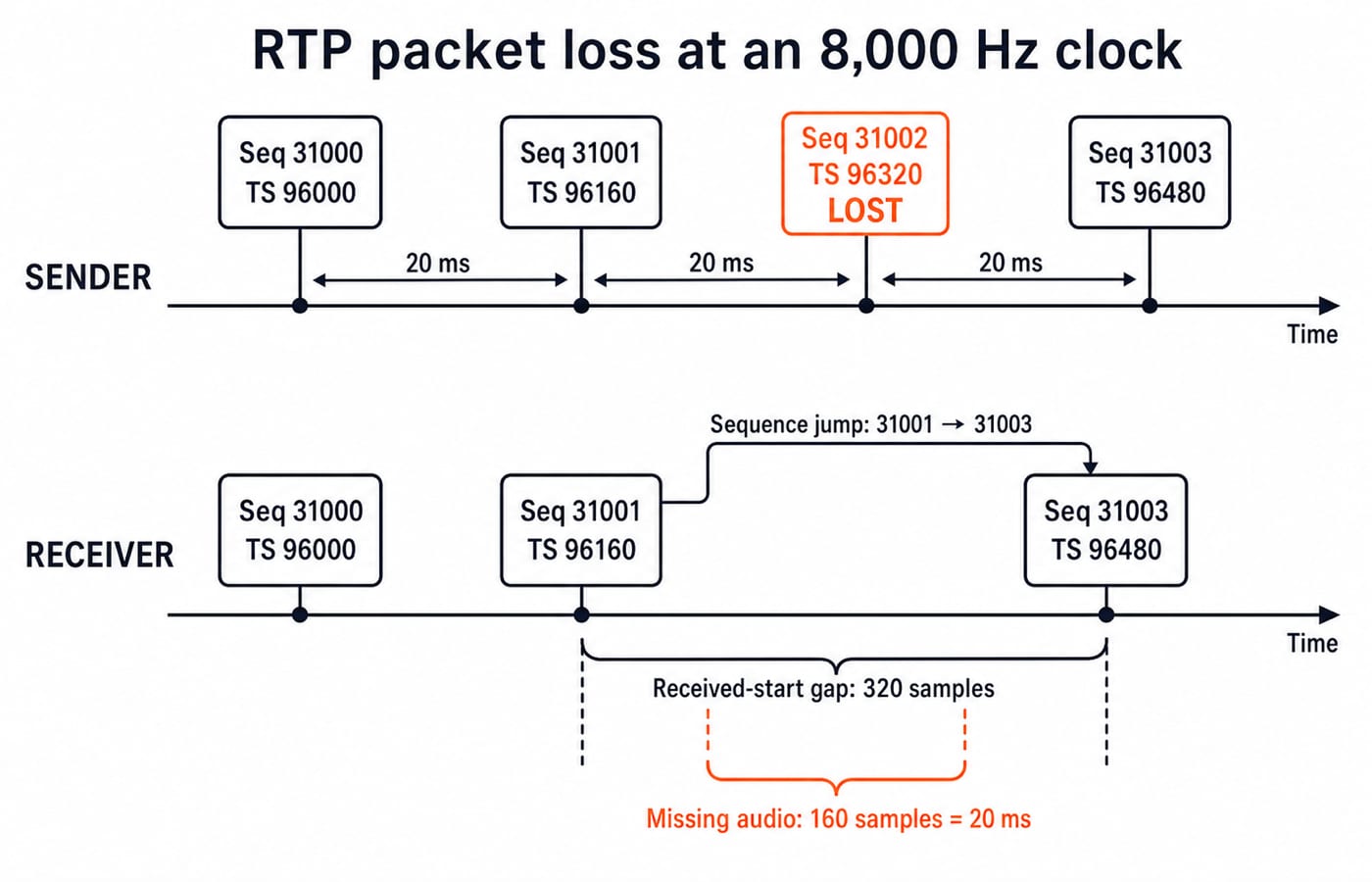
At an 8,000 Hz clock with 20 ms packets, each timestamp advances by 8,000 x 0.020 = 160.
Receive 31000/96000, then 31001/96160; lose 31002/96320; receive 31003/96480. The sequence jump shows one loss. The last two received starts differ by 96480 - 96160 = 320 samples, but the missing interval is one 160-sample packet, or 20 ms. A receiver may conceal it, but RTP alone cannot reconstruct it.
5. VoIP worked example: packet size, bit rate and one-way delay
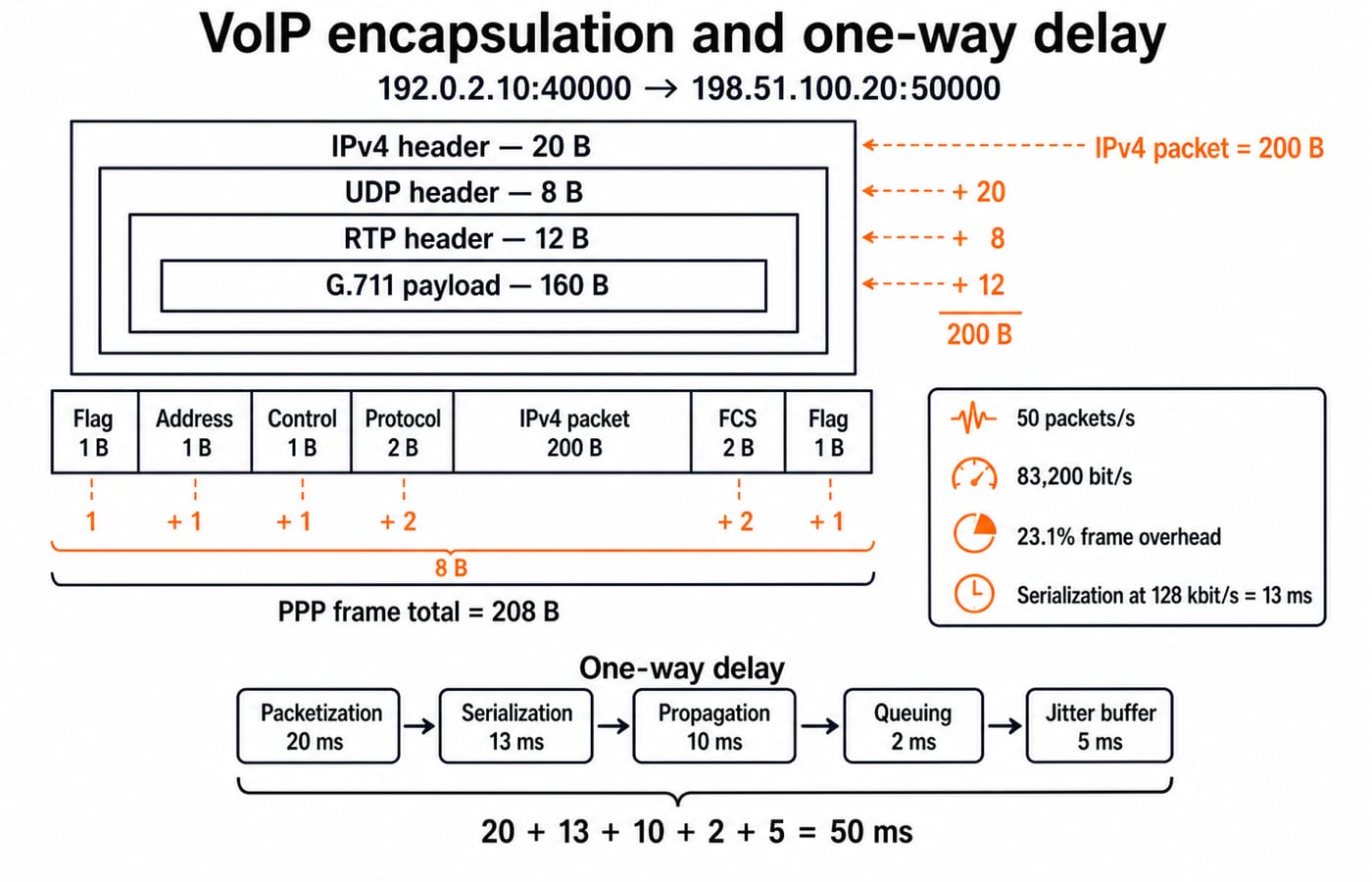
Assume G.711 at 64,000 bit/s, 20 ms packetisation, RTP 12 bytes without CSRC or extension, UDP 8, IPv4 20 without options, and uncompressed PPP with a 2-byte FCS, two unshared Flags and no stuffing. Use a 128,000 bit/s link, 10 ms propagation, 2 ms queueing and 5 ms jitter-buffer delay. Ignore codec look-ahead and processing delay.
64,000 bit/s x 0.020 s = 1,280 bits = 160 bytes
160 + 12 + 8 + 20 = 200 bytes per IPv4 packet
1 Flag + 1 Address + 1 Control + 2 Protocol + 200 Information + 2 FCS + 1 Flag = 208 bytes
At 1 / 0.020 = 50 packets/s, rates are 200 x 8 x 50 = 80,000 bit/s for IPv4 and 208 x 8 x 50 = 83,200 bit/s for PPP.
Non-voice bytes are 208 - 160 = 48. Against the transmitted PPP frame, overhead is 48 / 208 x 100 = 23.0769%, about 23.1%.
208 x 8 / 128,000 = 1,664 / 128,000 s = 0.013 s = 13 ms
One-way delay is 20 + 13 + 10 + 2 + 5 = 50 ms: 20 ms packetisation, 13 ms serialization, 10 ms propagation, 2 ms queueing and 5 ms jitter buffering. Shared Flags, compression, stuffing, a different FCS, codec look-ahead or processing delay would change the result.
6. PPP, TCP/IP and VoIP traps that objective questions exploit
PPP is not an application protocol. TCP/IP is more than TCP plus IP. VoIP is not one protocol.
SIP handles signalling, not RTP media. RTP over UDP does not guarantee delivery. A PPP frame does not pass unchanged through every router.
PPP Protocol 0x0021 means IPv4; IPv4 Protocol 17 means UDP; UDP port 50000 is not a protocol number. RTP sequence 31003 exposes order or loss, while timestamp 96480 expresses sampling time.
160 bytes is payload, not the full packet. For frame overhead, divide 48 by 208, not 160. Add no UDP retransmission delay unless a higher layer is stated. Assume neither compression nor stuffing without instruction.
7. PPP, TCP/IP and VoIP exam patterns: classify, trace and calculate
Question shapes include layer and job matching; ordering LCP, optional authentication and NCP; decoding Protocol fields; octet stuffing; separating SIP/SDP from RTP/RTCP; inferring RTP loss; and calculating payload, headers, bit rate or delay.
Use this four-check routine:
Label each item as link, internet, transport, signalling or media.
Follow the exact encapsulation order.
Write every header and link assumption.
Check the units before doing arithmetic.
Check for 6 bytes after escaping, timestamp step 160, PPP frame 208 bytes, and modelled delay 50 ms. For a wider practice route, use GATE CS Exam Preparation.
The worked traces here explain byte stuffing, encapsulation, RTP loss, line rate and delay. For ten earlier exam questions centred on role and layer elimination, use PPP, TCP/IP & VoIP MCQs: 10 Solved Questions.
8. PPP, TCP/IP and VoIP protocols: the short version and next step
PPP frames one local link.
IP routes packets between networks.
UDP delivers an independent transport datagram.
RTP identifies media order and sampling time.
SIP and SDP coordinate the session separately from the media.
Each layer answers a different question. Now escape [0x45, 0x7E, 0x7D, 0x21] unaided, then rebuild 160 -> 200 -> 208 bytes and the 50 ms delay.
GATE Guidance by Sanchit Sir provides a structured Computer Networks route after you can reproduce both worked examples unaided.
Keep learning

PPP, TCP/IP & VoIP MCQs: 10 Solved Questions
Solve 10 previous-year PPP, TCP/IP and VoIP questions with step-by-step explanations. Learn to separate protocols, services, media and network layers before choosing an option.
Updated 3 Aug 20267 min readComputer Networks MCQs

Computer Network Troubleshooting Scenarios: Diagnose Latency, DNS and Packet Flow
Work through three evidence-led network troubleshooting cases: a 650 ms latency split, a stale DNS answer, and a TCP SYN-ACK lost on the return path.
Updated 12 Sep 20266 min readInterview Corner
Computer Networks Interview Questions: Trace OSI, TCP/IP and Routing Step by Step
Follow one synthetic web request across DNS, ARP, TCP, NAT and longest-prefix routing, then turn each step into a strong interview answer.
Updated 18 Oct 20266 min read64 viewsComputer Networks

TCP/IP Model Explained: Four Layers, Worked Encapsulation and Exam Traps
Learn the four TCP/IP layers through one complete packet journey. The worked example calculates headers, MTU fit, frame efficiency and serialization time step by step.
Updated 15 Sep 20266 min read124 viewsComputer Networks