

Mobile Communication Protocols: WAP Stack, Worked Overhead Example and Exam Traps
Separate bearers, mobility and application protocols, trace a legacy WAP request, and calculate how compact encoding changes frames, overhead and serialization time.
KnowledgeGate Team
Exam prep & CS education
Updated 28 Oct 20265 min read

Students often mix up a wireless bearer, a mobility protocol and an application protocol. Then they memorise WAP layer names without seeing how one request crosses the stack. Wireless communication involves three distinct concerns: the bearer carries bits, the mobility mechanism maintains reachability or service while a device moves, and the application-layer protocol formats and exchanges messages.
Mobile communication protocols: separate the three meanings
A bearer is the underlying radio or data service that carries bits. A mobility mechanism maintains reachability or service while a device moves or changes its attachment point. An application-layer protocol defines how applications format and exchange messages. They solve different problems, so the terms are not interchangeable.
Application-facing mobile web protocols fit the Computer Networks part of GATE CS Exam Preparation, while cellular air-interface engineering addresses the radio link. Legacy Wireless Application Protocol (WAP) operates at the application-facing mobile web layer, not at the cellular air interface.
The historical boundary matters. WAP was designed when handsets, wireless links and device memory were heavily constrained. Modern smartphones normally use Internet application protocols over standard IP transports. A present-day mobile web request does not automatically pass through a WAP gateway.
WAP protocol stack: what each layer contributes
Read the legacy WAP stack from the application down towards the bearer.
Layer | Main contribution |
|---|---|
WAE | Wireless Application Environment for applications and content |
WSP | Session-style web interaction and compact representation |
WTP | Lightweight transaction service |
WTLS | Optional wireless-oriented security |
WDP | Consistent datagram service across different bearers |
Bearer | Underlying service that carries the data |
The boundaries are more useful than a forced one-to-one mapping with TCP/IP. WTP is transaction-oriented, but it is not merely TCP under another name. WDP hides differences among bearers; it is not an application layer. WTLS handles protection when present, while WSP handles session and web-interaction concerns.
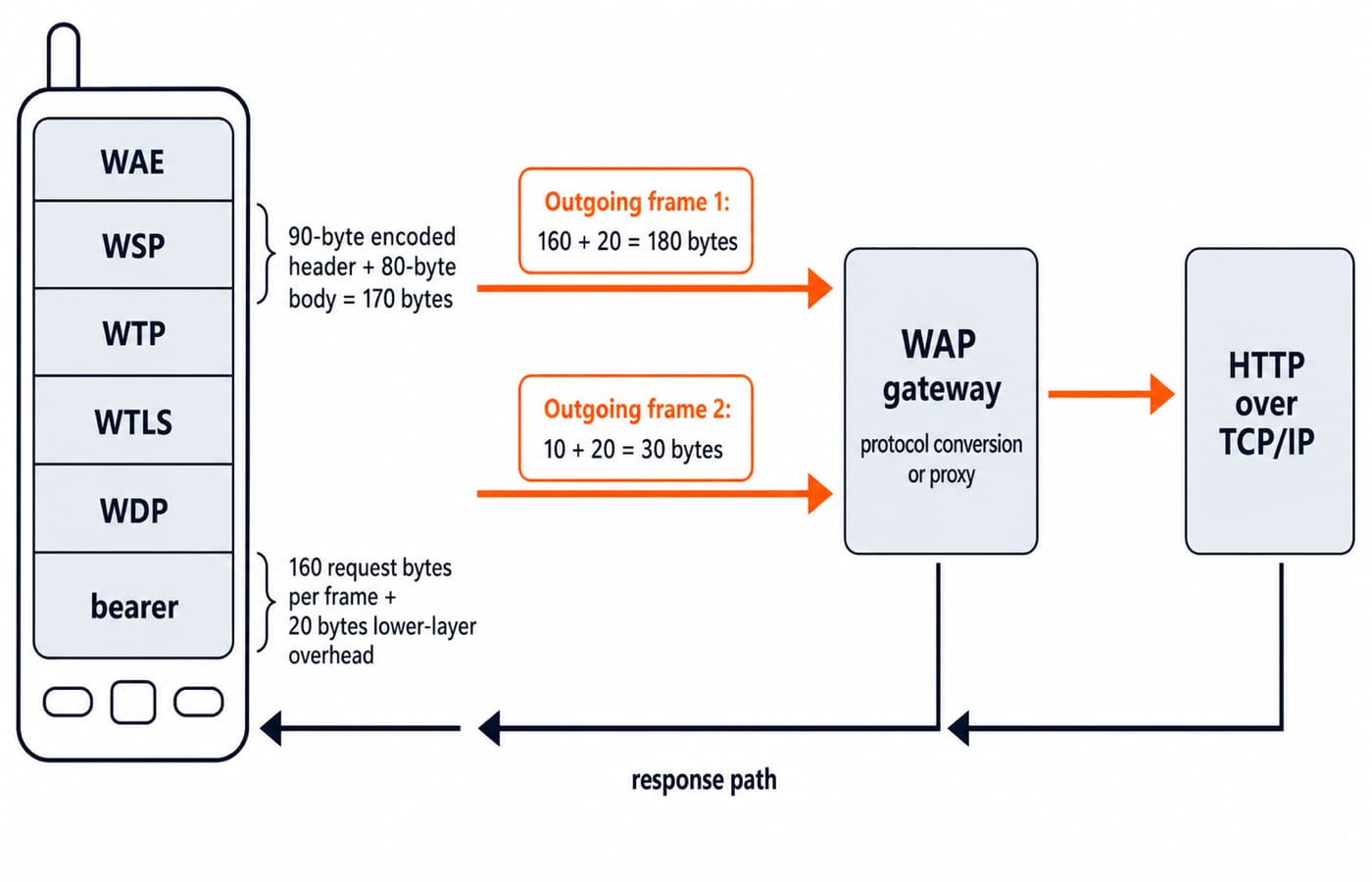
Consider one request for a resource. WAE creates the application action. WSP represents the request compactly. WTP manages the transaction. WTLS protects the exchange if security is used. WDP presents a consistent datagram service and passes the data to the bearer.
WAP gateway: trace one request end to end
On the outward path, the handset passes the request down its WAP stack to the bearer. The bearer carries it to a WAP gateway. The gateway translates or proxies the compact WAP-side interaction into an Internet-side HTTP interaction, then sends it to the origin server. The response follows the reverse route.
This architecture suited constrained devices because compact representations and bearer adaptation could reduce traffic on the wireless leg. The origin server could still use ordinary web protocols. The trade-off is that the gateway becomes another system and trust boundary, while protocol conversion makes end-to-end reasoning more complicated.
Mobile protocol overhead: a fully worked framing example
Protocol header sizes vary, so use the supplied values as exam assumptions. Assume:
Conventional text HTTP form: 620-byte header and 80-byte body.
WSP-style encoded form: 90-byte header and the same 80-byte body.
Each bearer frame carries at most 160 request bytes and adds 20 bytes of lower-layer overhead.
There is no padding. Ignore acknowledgements, encryption padding, gateway-side headers and retransmissions.
Link rate is 16,000 bits per second.
Conventional request
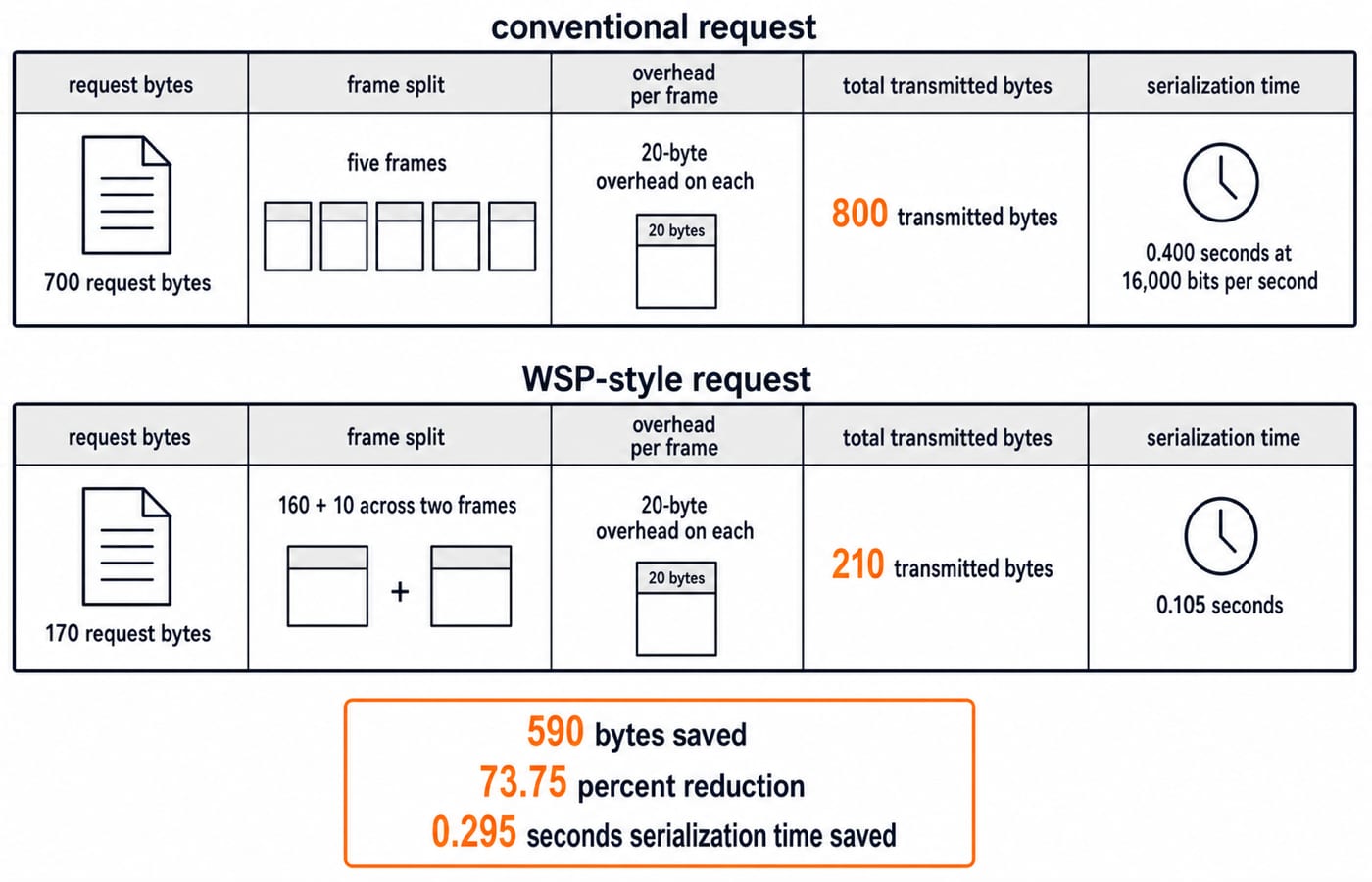
Request size = 620 + 80 = 700 bytes.
Frames required = ceiling(700 / 160) = ceiling(4.375) = 5 frames. The request bytes can be split as 160, 160, 160, 160 and 60.
Frame overhead = 5 x 20 = 100 bytes.
Transmitted data = 700 + 100 = 800 bytes.
Serialization time = (800 x 8) / 16,000 = 6,400 / 16,000 = 0.400 seconds.
WSP-style request
Request size = 90 + 80 = 170 bytes.
Frames required = ceiling(170 / 160) = ceiling(1.0625) = 2 frames, carrying 160 and 10 request bytes.
Frame overhead = 2 x 20 = 40 bytes.
Transmitted data = 170 + 40 = 210 bytes.
Serialization time = (210 x 8) / 16,000 = 1,680 / 16,000 = 0.105 seconds.
Therefore, byte saving = 800 - 210 = 590 bytes. Percentage reduction = (590 / 800) x 100 = 73.75%. Serialization-time saving = 0.400 - 0.105 = 0.295 seconds.
Serialization time is only the time needed to place these bits on the link. Total response time may also include propagation, processing, queueing and retransmissions.
Legacy WAP versus modern mobile web protocols
Concern | Legacy WAP answer | Common modern answer | Exam-safe distinction |
|---|---|---|---|
Application or session exchange | WAE and WSP | HTTP/HTTPS semantics and application APIs | Compare the service provided, not just layer names |
Transaction or transport | WTP transaction service | Standard IP transports | WTP is not simply TCP renamed |
Security | WTLS when used | TLS with modern Internet protocols | Both protect communication, but belong to different architectures |
Bearer adaptation | WDP abstracts bearer differences | IP offers a common network service | WDP is below the WAP application-facing layers |
Gateway dependence | Protocol conversion or proxy is central to the legacy model | Direct Internet protocol use is common | Do not insert a WAP gateway into every mobile request |
Modern mobile applications commonly use HTTP/HTTPS semantics over IP transports, often with persistent or multiplexed connections. Specialised application protocols may still be chosen for messaging or constrained devices. For the ordinary web side of this comparison, revise Application Layer Protocols: DNS and HTTP Guide.
Mobile communication protocol traps that lose marks
Equating WAP with radio technology. WAP sits above the bearer and was designed to work across bearer types.
Mapping every WAP component directly onto TCP/IP. Compare functions instead. WTP provides transactions, WSP provides session-style web services, and WDP abstracts the bearer.
Confusing Mobile IP with WAP. Mobile IP concerns reachability while a node moves. WAP defines an application-facing communication stack.
Applying the numerical mechanically. First identify payload capacity, overhead per frame, padding and retry cost. A changed assumption can change the ceiling operation, frame count and answer.
Mobile communication protocols in exam questions
Four common question shapes are: order the WAP layers, match each layer to its role, trace the gateway path, and calculate frame count or overhead from supplied values.
Use these rapid checks:
Which layer points to bearer independence? WDP, because it provides a consistent datagram service over different bearers.
Which layer points to a transaction-oriented request and response? WTP, because transaction service is its role.
Which layer points to security in the legacy WAP stack? WTLS, because it supplies wireless-oriented protection when used.
For adjacent application-layer practice, solve Application Layer MCQs: 12 Solved DNS, HTTP, Email. Use the GATE Test Series when you want broader timed Computer Networks practice.
Mobile communication protocols: the short version and next step
Keep this six-line chain ready:
WAE creates the application action.
WSP shapes the web interaction.
WTP manages the transaction.
WTLS protects it when present.
WDP normalises datagram delivery.
The bearer carries the data.
Under the stated toy assumptions, compact encoding reduced transmitted data from 800 to 210 bytes because a smaller representation also reduced the frame count and repeated overhead. For structured coverage of the full Computer Networks subject, continue with GATE Guidance by Sanchit Sir.
Keep learning
Communication Protocols in Operating Systems and Distributed Systems: IPC, RPC and a Worked Reliability Trace
Separate OS communication mechanisms from protocol guarantees, then trace how a lost reply, a retry, and request-ID deduplication affect server state.
Updated 9 Nov 20266 min readOperating Systems
DMA, Interrupts and Programmed I/O for GATE: Cycle-Stealing and Overhead Numericals Solved
Track who moves the data, who owns the bus and how often the CPU must intervene. Two worked numericals turn DMA and interrupt overhead into simple rate calculations.
Updated 24 Jul 20266 min read87 viewsC Programming & Data Structures

Mobile Technology in Computer Networks: Cellular Concepts, GSM, CDMA and Handoff with Worked Examples
Build a clear picture of cellular networks, GSM roles, CDMA decoding, handoff and Mobile IP, then test it with two fully worked numericals.
Updated 19 Aug 20266 min readComputer Networks
Security in Mobile and Wireless Computing: Threats, Controls and a Worked Replay-Attack Example
Learn where wireless, device, application and identity controls apply, then trace exactly how a server detects message tampering and rejects a replay.
Updated 10 Oct 20266 min readGATE Strategy & Roadmap