PPP, TCP/IP & VoIP MCQs: 10 Solved Questions
Solve 10 previous-year PPP, TCP/IP and VoIP questions with step-by-step explanations. Learn to separate protocols, services, media and network layers before choosing an option.
KnowledgeGate Team
Exam prep & CS education
Updated 3 Aug 20267 min read
PPP, TCP/IP and VoIP questions look like abbreviation recall, but their options often mix technologies, services, transmission media and network layers, which makes guessing from a familiar acronym unreliable in a timed set. The reliable route is a three-step read: identify the job the protocol does, locate the layer it sits on, then eliminate every option belonging to a different job or layer. Answer each of the ten questions below before reading its explanation.
Build the protocol-role map before solving
Keep this compact map beside you. VoIP carries voice over IP, while RTP carries real-time media. DHCP supplies host configuration and may begin with broadcast. HTTP and SMTP are application protocols, TCP provides transport, IP handles network-layer delivery, and PPP belongs to the data-link layer. FTP is the dedicated file-transfer answer.
Use three passes. First, ask what each option is: Optical Fibre is a medium, not a call-routing technology. Second, classify application protocols by job: SMTP handles email, FTP handles files, and HTTP supports web communication. Third, classify TCP, IP and PPP by layer. The GATE CS Exam Preparation Courses & Test Series page carries the full Computer Networks route these questions sit inside.
Write your answers down before you start: Q1 __, Q2 __, Q3 __, Q4 __, Q5 __, Q6 __, Q7 __, Q8 __, Q9 __, Q10 __.
VoIP meaning and use: Questions 1 to 3
Question 1
Asked in UGC NET Paper I, 2020.
Which one of the following allows a phone call to be routed over network wires?

A. Video Conferencing
B. Teleconferencing
C. Optical Fibre
D. VOIP
Answer: D. VOIP. VoIP is the mechanism that carries voice over an IP network. Video conferencing and teleconferencing are broader services. Optical fibre is a physical medium, not a call-routing technology. The reusable test is mechanism versus service versus medium. Open the solved question.
Question 2
Asked in UGC NET Paper I, 2026.
Assertion (A): VoIP is an acronym that stands for Voice over Internet Protocol.
Reason (R): VoIP is a technology that allows you to make voice calls using a broadband Internet connection instead of a regular phone call.
Choose the most appropriate answer from the options given below:

A. Both (A) and (R) are correct and (R) is the correct explanation of (A)
B. Both (A) and (R) are correct but (R) is not the correct explanation of (A)
C. (A) is correct but (R) is not correct
D. (A) is not correct but (R) is correct
Answer: A. Check both statements before their relationship. The assertion expands VoIP correctly. The reason correctly describes voice calls through an Internet connection and explains the term. Option B fails at the relationship check: R does explain A. Open the solved question.
Question 3
Asked in Eklavya Model Residential Schools, Computer Science, 2026.
Which of the following protocols is primarily used to enable voice communication over the Internet (Internet Telephony)?

A. POP3
B. SMTP
C. TELNET
D. VOIP
Answer: D. VOIP. Eliminate by job. POP3 retrieves email, SMTP sends or relays email, and TELNET supports remote terminal access. None provides voice over IP. “Internet Telephony” should trigger “VoIP”. Open the solved question.
Real-time media and voice conversion: Questions 4 and 5
Question 4
Asked in DSSSB, Computer Science, 2021.
Which protocol is used for basic transmission of multimedia content?

A. Real-time transport protocol
B. Real-system transport protocol
C. Real-system transfer protocol
D. Real-software transport protocol
Answer: A. Real-time transport protocol. RTP expands to Real-time Transport Protocol and carries real-time media. The other options are invented near-matches. RTP does not set up a voice call by itself. Practise the Computer Networks TCP and UDP transport-layer MCQs for related distinctions, then open the solved question.
Question 5
Asked in RSSB, Computer Science, 2023.
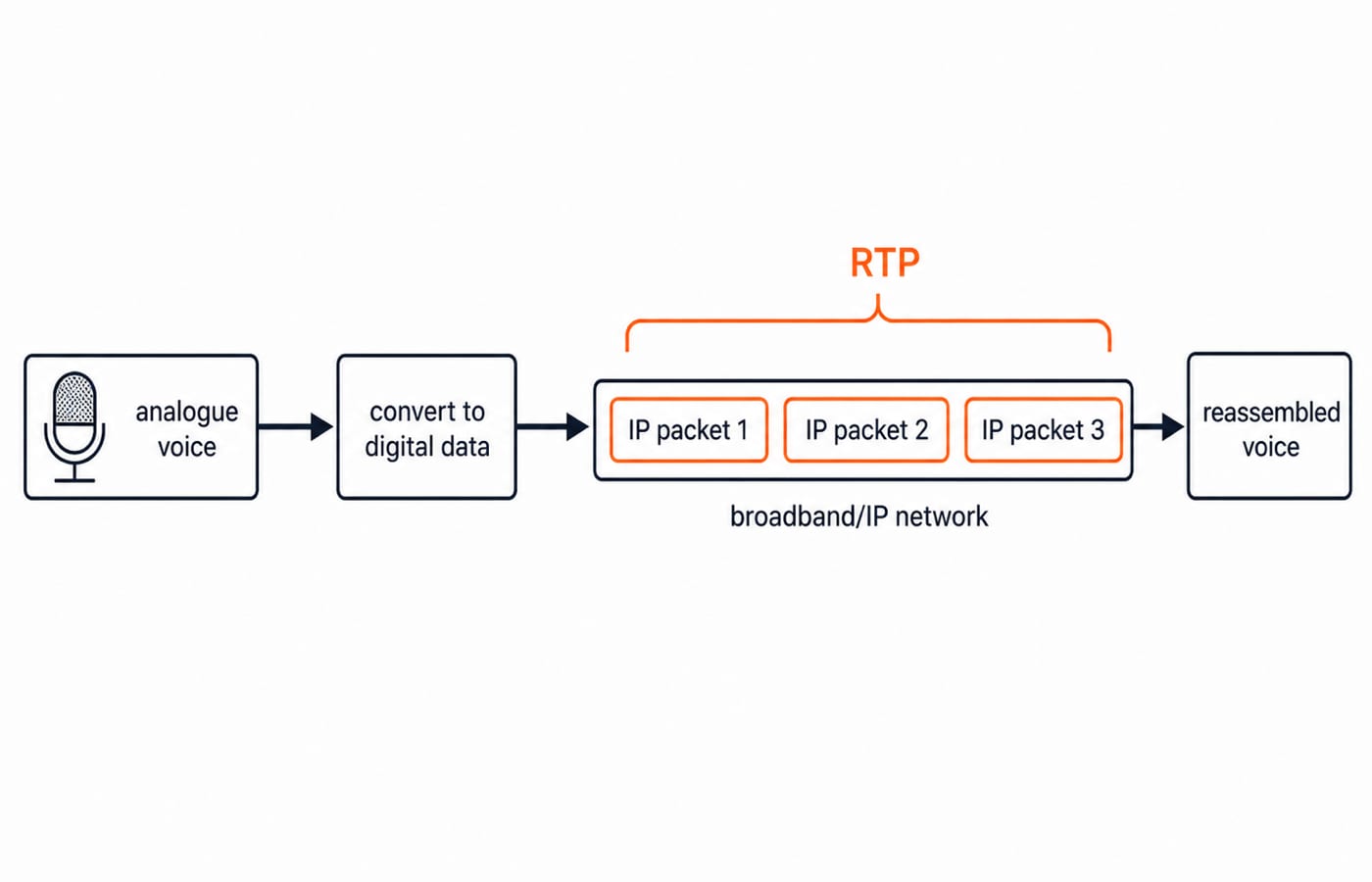
_____ converts the analogue voice signals into digital and then transmitting them over the broadband line.

A. Video conferencing
B. VOIP
C. Chatting
D. Website
Answer: B. VOIP. Trace three stages: analogue voice -> digital data -> broadband/IP transmission. Video conferencing may use this mechanism but is not the requested technology. Chatting and website name no voice conversion at all. Open the solved question.
Put PPP, TCP, IP and HTTP on the right layers: Questions 6 and 7
Question 6
Asked in UGC NET, Computer Science, 2017.
Match the following Layers and Protocols for a user browsing with SSL :

a. Application of layer     i.   TCP
b. Transport layer          ii.  IP
c. Network layer            iii. PPP
d. Datalink layer           iv.  HTTP

Codes :

A. a-iv, b-i, c-ii, d-iii
B. a-iii, b-ii, c-i, d-iv
C. a-ii, b-iii, c-iv, d-i
D. a-iii, b-i, c-iv, d-ii
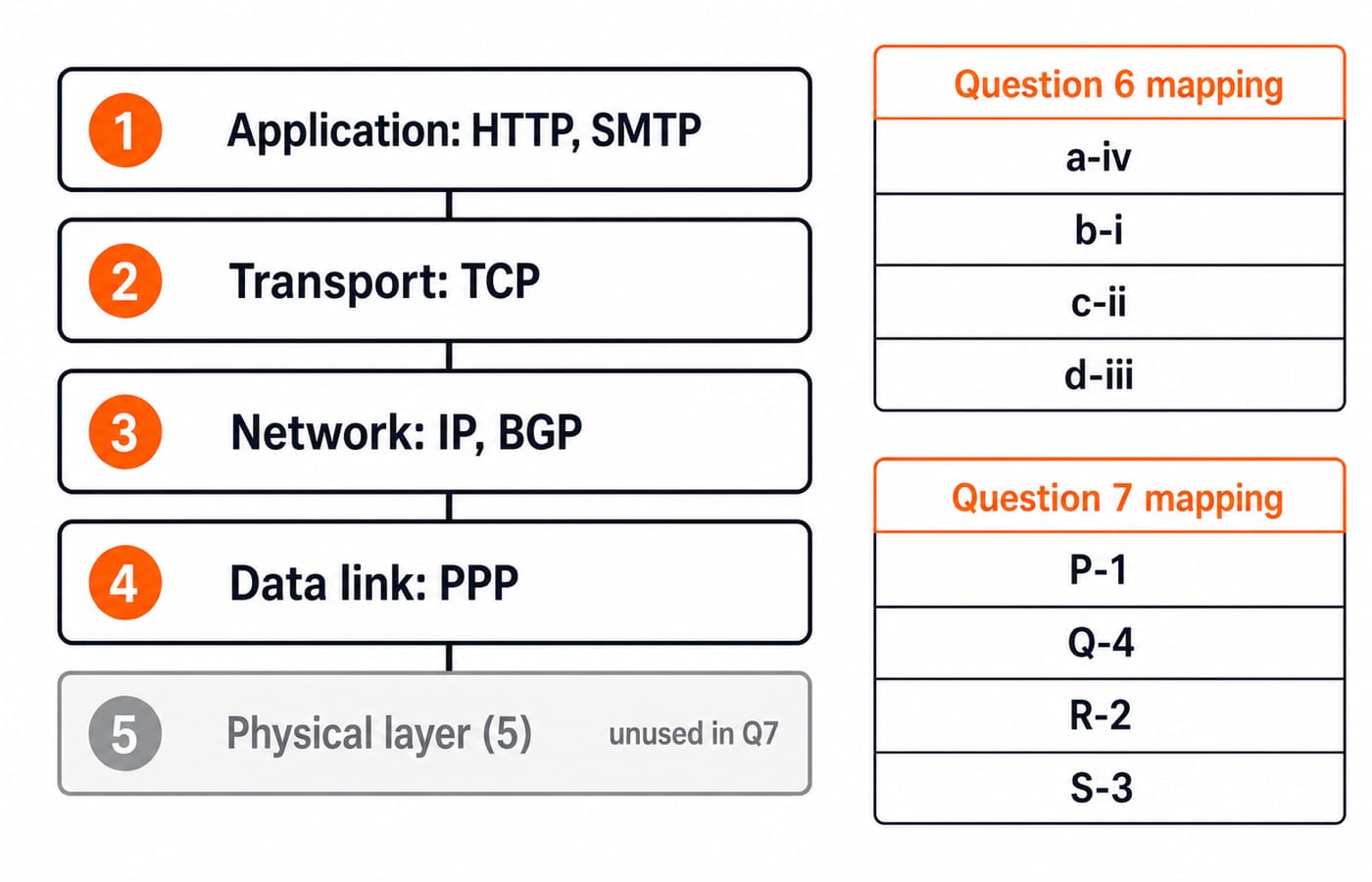
Answer: A. Work all four matches:
a -> iv -> HTTP, so the application-layer entry matches HTTP.b -> i -> TCP, because TCP is a transport protocol.c -> ii -> IP, because IP handles network-layer delivery.d -> iii -> PPP, because PPP is a data-link protocol.
That gives a-iv, b-i, c-ii, d-iii, exactly option A. SSL/TLS does not move TCP, IP or PPP to different layers. Do not invent a presentation-layer option that is absent. Open the solved question.
Question 7
Asked in GATE, Computer Science, 2007.
 Match the following:
(P) SMTP     (1) Application layer
(Q) BGP      (2) Transport layer
(R) TCP      (3) Data link layer
(S) PPP      (4) Network layer
             (5) Physical layer

A. P – 2 Q – 1 R – 3 S – 5
B.  P – 1 Q – 4 R – 2 S – 3
C. P – 1 Q – 4 R – 2 S – 5
D.  P – 2 Q – 4 R – 1 S – 3
Answer: B. Build the tuple by role: SMTP is application, P-1; BGP performs network-layer routing, Q-4; TCP is transport, R-2; and PPP is data link, S-3. Thus P-1, Q-4, R-2, S-3. Option C gets the first three right but wrongly moves PPP to physical. Open the solved question.
Broadcast discovery and TCP/IP model functions: Questions 8 and 9
Question 8
Asked in GATE, Computer Science, 2026.
Which one of the following protocols may need to broadcast some of its messages?

A. SMTP
B. FTP
C. DHCP
D. HTTP
Answer: C. DHCP. A new client may not know the DHCP server's address, so discovery can require a local broadcast. SMTP, FTP and HTTP normally target a specific endpoint. “May need” matters because not every DHCP message is broadcast. Open the solved question.
Question 9
Asked in UGC NET, Computer Science, 2019.
In the TCP/IP model (not the OSI model), encryption and decryption are functions of the ____ layer.

A. data link
B. network
C. transport
D. application
Answer: D. application. The model qualifier decides it. OSI has a presentation layer, but TCP/IP folds presentation-style responsibilities into application. Data link handles local delivery, network handles internetwork delivery, and transport provides end-to-end transport. Other security protocols do not change this model-level answer. Open the solved question.
Finish with protocol-purpose elimination: Question 10
Question 10
Asked in Kendriya Vidyalaya Sangathan, Computer Science, 2023.
Which of the following protocol is used to upload and download files from remote server/computers ?

A. SMTP
B. VoIP
C. HTTP
D. FTP
Answer: D. FTP. Use “dedicated job beats possible use”. HTTP can carry files, but FTP is designed for file transfer. SMTP handles email and VoIP handles voice. For supporting recall, FTP normally uses TCP port 21 for control, and active-mode data can use TCP port 20; these facts are not needed to choose D. Open the solved question.
For broader protocol-role drills, practise more application-layer MCQs, which run the same job-then-layer test across DNS, HTTP and the email protocols.
Score the set, fix the traps, and choose the next step
The answer key is 1-D, 2-A, 3-D, 4-A, 5-B, 6-A, 7-B, 8-C, 9-D, 10-D.
9-10correct: your role and layer map is stable.7-8correct: revisit the category behind each miss, such as VoIP purpose, protocol layer or model function.0-6correct: rebuild the stack before attempting another timed set.
Treat these bands as a diagnostic, not an exam prediction. Fix four traps before moving on: do not confuse a medium with a protocol in Q1; do not stop after checking only the truth values in Q2; do not put PPP at the physical layer in Q7; and do not ignore “TCP/IP model” in Q9. KnowledgeGate's PPP, TCP/IP and VoIP question set runs past 20 questions, so there is more to drill once these four traps are closed.
Choose by goal: build the full GATE preparation foundation, or revise core networks for placement interviews. Finally, redraw the stack from memory, application down to physical, and retry only the questions you missed.
Keep learning
Mobile Computing MCQs: Solved Questions on Concepts, Features and Applications
Work through 10 solved questions covering portability, cellular standards, Bluetooth, CDMA, Android, mobile cloud, and device constraints. Each answer has a concise explanation.
7 Oct 20267 min readComputer Networks MCQs
Computer Networks Basics & Criteria MCQs: 12 Solved Questions with Explanations
Solve 12 Computer Networks questions, then use clear explanations and worked criteria checks to separate similar terms confidently.
3 Oct 20268 min readComputer Networks MCQs
TCP Timers, RTT Estimation & SWS: 10 Solved MCQs and NATs
Solve 10 TCP exam questions covering timer roles, Silly Window Syndrome, recursive RTT estimates, Jacobson/Karels RTO and Karn's rule.
Updated 28 Sep 20267 min readComputer Networks MCQs
RSA Algorithm MCQs: 12 Solved Questions with Step-by-Step Explanations
Practise RSA key generation, modular inverses, encryption, signatures and defining equations, with concise working for conceptual and numerical answers.
25 Sep 20268 min readComputer Networks MCQs