

Power Set and Its Cardinality: Definitions, Worked Examples and Exam Traps
Learn what a power set contains, why its size is a power of two, and how to solve nested, reverse-count and special-subset questions without confusing membership and containment.
KnowledgeGate Team
Exam prep & CS education
Updated 21 Nov 20266 min read
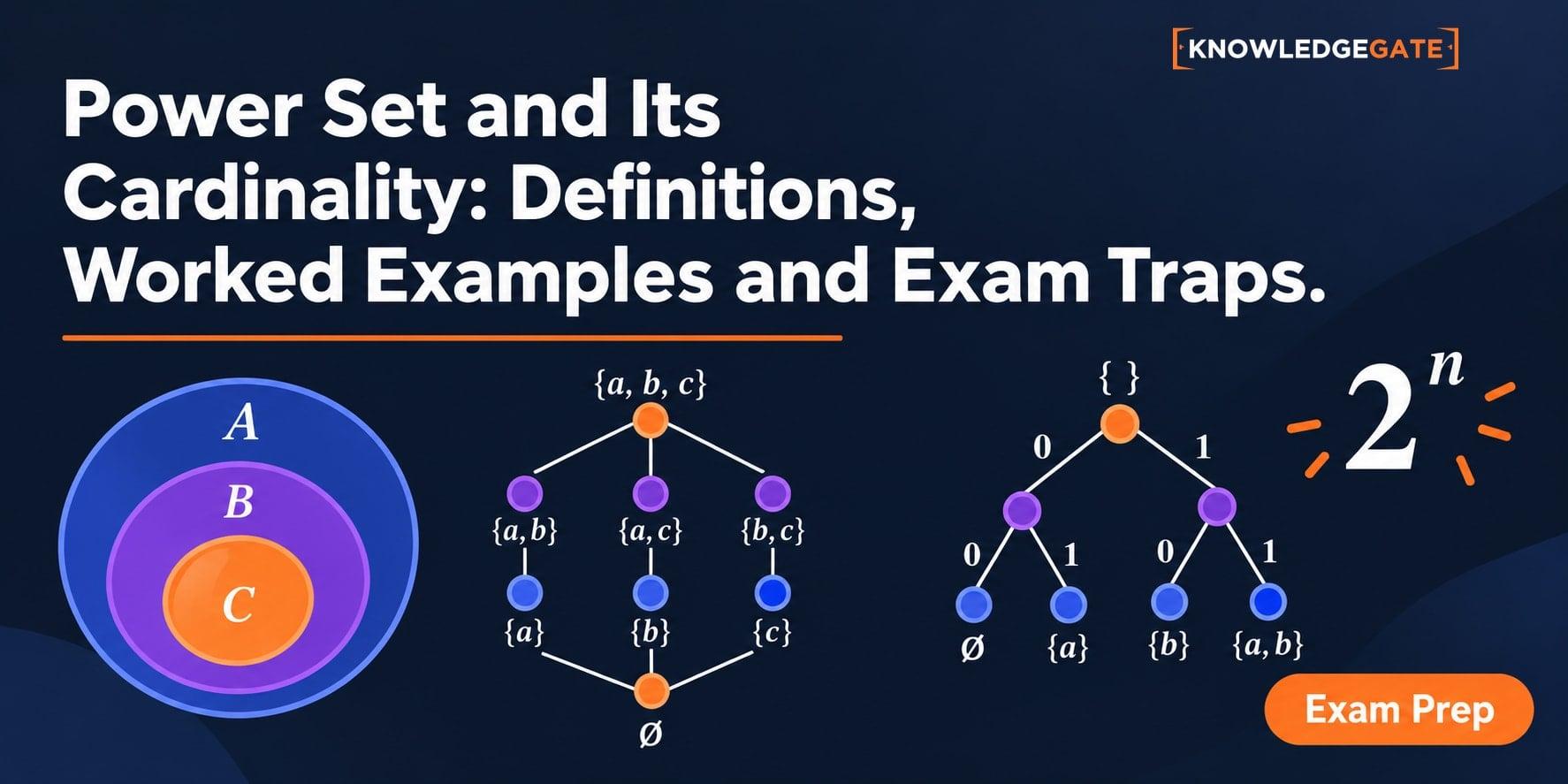
Power-set questions become easier once every member of P(A) is recognised as a subset of A, not as an original element. For A = {a,b,c}, group subsets by size or encode one include-or-exclude choice per element. That binary choice gives |P(A)| = 2^|A| and controls complete enumeration, nested power sets, reverse counts and the most common exam traps.
1. Power set means the set of every subset
The power set of A is the set containing every subset of A. In symbols, P(A) = {X : X ⊆ A}. Two members can never be omitted: ∅ belongs to P(A), and A itself belongs to P(A), because both are subsets of A.
For A = {1,2}, we have P(A) = {∅, {1}, {2}, {1,2}}. Now compare the statements carefully: 1 ∈ A is true, 1 ∈ P(A) is false, {1} ∈ P(A) is true, and {1} ⊆ A is true. Every element of a power set is itself a set.
The smallest edge case matters: P(∅) = {∅}, so |P(∅)| = 1, not 0. Set Theory in Discrete Mathematics connects subsets to operations, laws and inclusion-exclusion. Power-set cardinality and nested counts require two further moves: binary selection and repeated exponentiation.
2. Fully list the power set of a three-element set
Let A = {a,b,c}. Grouping subsets by their own cardinality gives:
Size 0:
∅Size 1:
{a},{b},{c}Size 2:
{a,b},{a,c},{b,c}Size 3:
{a,b,c}
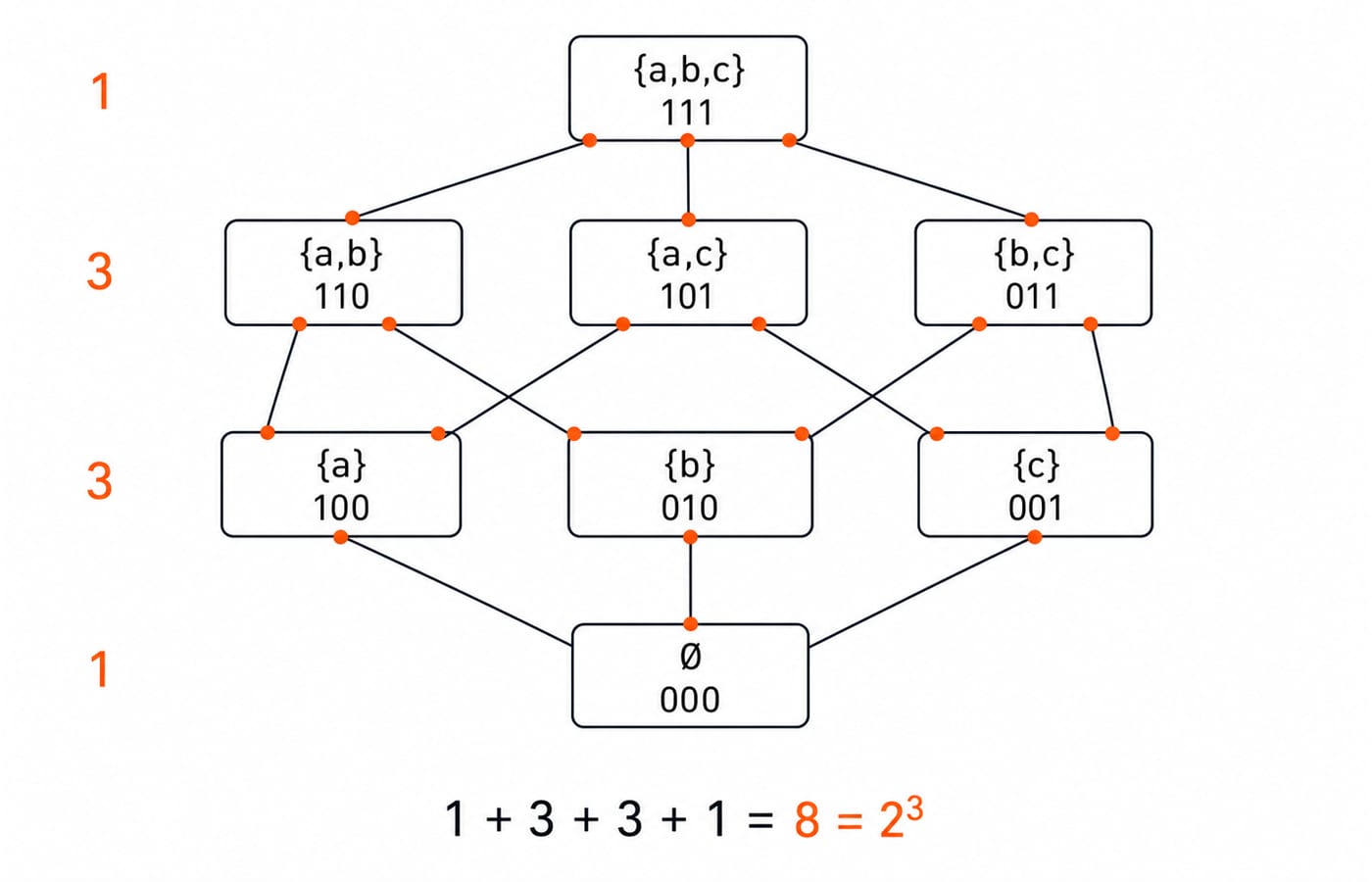
Therefore, P(A) = {∅, {a}, {b}, {c}, {a,b}, {a,c}, {b,c}, {a,b,c}}, and |P(A)| = 1 + 3 + 3 + 1 = 8 = 2^3.
This list is complete because every subset must have size 0, 1, 2 or 3, and every possible selection in each group appears once. Also, {a,b} and {b,a} are the same set. Order does not create another subset, and repeated elements cannot inflate a set's cardinality.
The group sizes also exactly match the relevant combinations: C(3,0) = 1, C(3,1) = 3, C(3,2) = 3 and C(3,3) = 1.
Using the fixed order (a,b,c), binary labels provide a second check: 000 → ∅, 100 → {a}, 010 → {b}, 001 → {c}, 110 → {a,b}, 101 → {a,c}, 011 → {b,c}, and 111 → {a,b,c}.
3. Why an n-element set has 2^n subsets
For each of n distinct elements, a subset makes exactly two independent decisions: include the element or exclude it. The multiplication rule gives 2 × 2 × ... × 2 = 2^n. Every decision string produces exactly one subset, so no subset is missed or counted twice.
The combinations view reaches the same result. There are C(n,k) subsets with exactly k elements, so the total is C(n,0) + C(n,1) + ... + C(n,n) = 2^n. For three elements, C(3,0) + C(3,1) + C(3,2) + C(3,3) = 1 + 3 + 3 + 1 = 8.
The formula also works in reverse for finite sets. If |P(T)| = 128, then 2^|T| = 128 = 2^7, so |T| = 7. For an infinite set, its power set has strictly greater cardinality than the original set.
4. Worked four-element example: count special subsets and a nested power set
Use S = {2,5,7,11}. Its subsets, grouped by size, are:
Size 0:
∅Size 1:
{2},{5},{7},{11}Size 2:
{2,5},{2,7},{2,11},{5,7},{5,11},{7,11}Size 3:
{2,5,7},{2,5,11},{2,7,11},{5,7,11}Size 4:
{2,5,7,11}
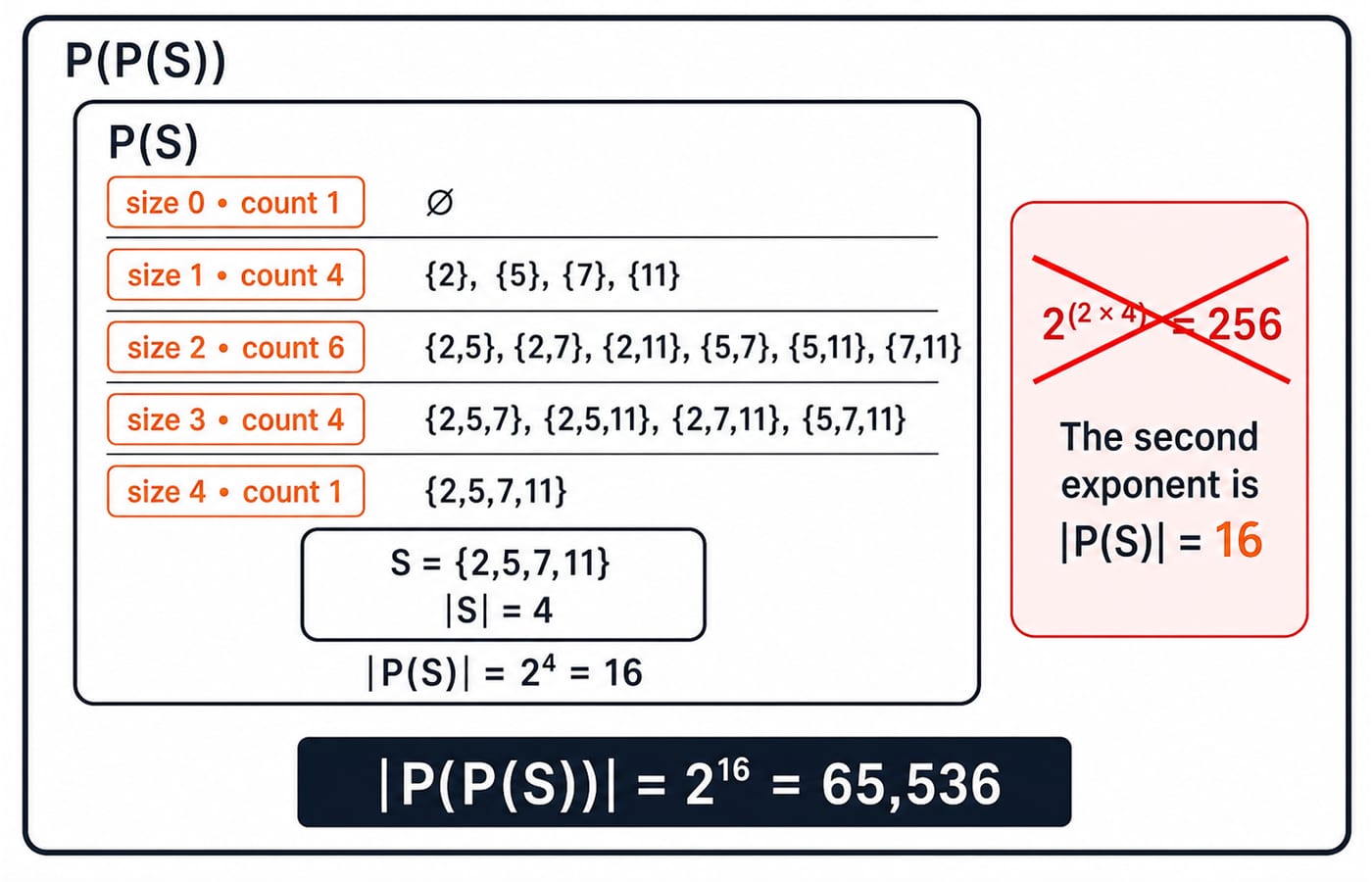
Thus |S| = 4 and |P(S)| = 1 + 4 + 6 + 4 + 1 = 16.
Now count common variations from the same set:
Proper subsets:
16 - 1 = 15Non-empty subsets:
16 - 1 = 15Non-empty proper subsets:
16 - 2 = 14Two-element subsets:
C(4,2) = 6Subsets containing
2:2^3 = 8Subsets containing
2but excluding11:2^2 = 4, because only5and7remain free
The first fixed-element count leaves 5, 7 and 11 free, producing eight choices. Excluding 11 leaves only two free elements, producing four choices.
For the nested step, P(S) has 16 elements, each a subset of S. Therefore, P(P(S)) has 2^16 = 65,536 elements. Its elements are collections of subsets of S, not original elements such as 2 or 5.
5. Related subset counts and the nested-element trap
For a finite n-element set:
Required subsets | Count |
|---|---|
All |
|
Proper |
|
Non-empty |
|
Non-empty proper, for |
|
Exactly |
|
Containing a fixed set of |
|
Proper and non-empty counts are equal, but exclude different subsets: the original set and ∅, respectively. At n = 0, ∅ has one subset, zero proper subsets and zero non-empty proper subsets. Do not use 2^n - 2 there, since it gives -1. Null Set, Universal Set, Subsets and Proper Subsets: Worked Examples classifies empty and universal sets and tests subset relations. Power-set counting begins only after the base set's distinct elements are settled.
Let B = {∅, {∅}}. Its two elements are distinct. Therefore P(B) = {∅, {∅}, {{∅}}, {∅, {∅}}}, so |P(B)| = 4. The singleton {∅} contains the element ∅; the singleton {{∅}} contains the element {∅}.
6. Exam-style questions test translation before arithmetic
An exam question may label the answer NAT or MSQ, but the calculation begins only after the set notation has been translated.
For a reverse-count NAT, suppose |P(X)| = 1024. Since 2^|X| = 1024 = 2^10, |X| = 10. For a nested count, if |Y| = 5, then |P(Y)| = 2^5 = 32 and |P(P(Y))| = 2^32 = 4,294,967,296, not 2^10.
For an MSQ truth test, use A = {1,2} and P(A) = {∅, {1}, {2}, {1,2}}:
Statement | Truth value |
|---|---|
| True |
| True |
| True |
| False |
| False |
The last two are false because P(A) contains sets, not the number 1, and the element 1 of {1} is not a member of P(A).
Power Set and Cardinality MCQs: 12 Solved Questions with Explanations applies the rules to 12 solved questions on enumeration, nesting, membership and restricted subsets. First-principles derivations come before question practice: list by subset size, solve reverse cardinality by matching powers of two, and recalculate the inner cardinality before an outer power set. The GATE CS Exam Preparation page connects this topic to the wider syllabus.
7. Common power-set traps and one-line repairs
Error: Write
2ninstead of2^n. Consequence: Wrong count. Repair: Name two independent choices for every element.Error: Omit
∅or the original set. Consequence: Incomplete list. Repair: Check size 0 and sizenfirst.Error: Count
{a,b}and{b,a}separately. Consequence: Double counting. Repair: Set order does not matter.Error: Read
|P(P(S))|as2^(2|S|). Consequence: For four elements, 256 replaces 65,536. Repair: Calculate inside first:|S| = n,|P(S)| = 2^n, then|P(P(S))| = 2^(2^n).Error: Confuse
x ∈ A,{x} ∈ P(A)and{x} ⊆ A. Consequence: Truth values flip. Repair: Identify each object's type.Error: Apply
2^n - 2atn = 0. Consequence: Count-1. Repair: Handle the empty set separately.
8. Power set short version and the next practice step
P(A)contains every subset ofA.A finite
n-element set has2^nsubsets.Exactly
kelements givesC(n,k).For nested power sets, recalculate the inner cardinality before taking another power of 2.
Reproduce all 16 subsets of S = {2,5,7,11}, then solve the 1024 and 2^32 checks without notes. Use Engineering Mathematics for GATE for wider mathematics revision.
Go deeper with the full courseEngineering Mathematics for GATE Exam
Keep learning
Power Set and Cardinality MCQs: 12 Solved Questions with Explanations
Solve 12 power set questions, from direct enumeration and nested sets to inclusion chains, ordered pairs and recurrence-based counting.
Updated 29 Oct 20267 min readDiscrete Mathematics MCQs
Safety of Expressions & Power MCQs: 10 Solved Relational Calculus Questions
Practise the active-domain test, De Morgan rewrites and the equivalence of relational algebra, safe TRC and safe DRC through ten fully explained questions.
Updated 29 Oct 20268 min readDBMS MCQs

SLR, CLR and LALR Parsers Compared for GATE: LR Item Sets, Conflicts and Parser Power
All three LR parsers built on one shared grammar: canonical item sets, why SLR(1) hits a shift/reduce conflict that CLR(1) and LALR(1) survive, the 10-vs-14 state count, the reduce/reduce drill grammar, and the exact question patterns GATE uses to test parser power.
Updated 30 Oct 20266 min read237 viewsCompiler Design
Finite, Infinite, Countable and Uncountable Sets: Definitions, Worked Examples and Exam Traps
Learn to classify sets by cardinality and one-to-one correspondence. Follow worked examples for rational enumeration, Cantor's diagonal method and common exam statements.
Updated 20 Nov 20265 min readEngineering Mathematics