

Null Set, Universal Set, Subsets and Proper Subsets: Worked Examples
Learn why the empty set can be both an element and a subset, why complements need a fixed universe, and how to count every kind of subset through worked examples.
KnowledgeGate Team
Exam prep & CS education
Updated 20 Nov 20265 min read

Most errors in basic set theory come from mixing up three small distinctions. The empty set can be a subset without appearing as an element, a set is always a subset of itself but never a proper subset of itself, and a complement is undefined until the universal set is fixed. In this notation, ⊆ allows equality, while ⊊ requires strict containment. These symbols separate element membership, containment, equality and universe-dependent complements.
Put the Four Ideas on One Set-Theory Map
A set is a well-defined collection of distinct objects. The null set, also called the empty set, has no elements. A universal set contains every object allowed in the current discussion. A ⊆ B means every element of A is in B, while A ⊊ B adds A ≠ B.
Keep membership and containment separate:
x ∈ Acompares an element with a set.X ⊆ Acompares one set with another set.
For A = {1, {2}}, 1 ∈ A is true, and {1} ⊆ A is true because its only element belongs to A. Also, {2} ∈ A is true because that set appears as an element, but 2 ∈ A is false. These examples isolate membership, strict containment and universe-dependent complements. The earlier Set Theory and Relations for GATE: Closures and Posets continues from this foundation into Cartesian products, closures, equivalence relations and posets.
Null Set and Universal Set: Empty Versus Everything in Scope
The empty set is written ∅ or {}. It must not be confused with {∅}, which is a set containing one element, namely the empty set.
Let E = {∅, 1}. Now compare the facts:
|∅| = 0, because nothing is inside the empty set.|{∅}| = 1, because the empty set is one listed object.∅ ∈ Eis true, because∅appears inE.∅ ⊆ Eis also true, because the empty set has no element that can violate the subset condition.
The last two statements use different reasons: membership first, containment second.
A universal set is contextual. For A = {2, 4} and U_1 = {1, 2, 3, 4}, A^c = {1, 3}. With U_2 = {1, 2, 3, 4, 5, 6}, A^c = {1, 3, 5, 6}. The complement changed because the universe changed. Relative to any named universe, ∅^c = U and U^c = ∅. A universal set is everything allowed in the current problem, not everything in existence.
Subset Versus Proper Subset
Let A = {2, 4, 6, 8}, B = {2, 4}, and D = {2, 4, 6, 8}. Every element of B occurs in A, so B ⊆ A. Since A also has 6 and 8, B ⊊ A.
Every element of A occurs in D, so A ⊆ D. But the sets are equal, so A ⊊ D is false.
Use these four facts for quick checks:
∅ ⊆ Sfor every setS.S ⊆ Sfor every setS.∅ ⊊ Sonly whenSis non-empty.No set is a proper subset of itself.
For a fast exam check, first test whether every left-side element occurs on the right. Then ask whether the right side has an extra element.
Fully Worked Example: Classify Nine Set Relations
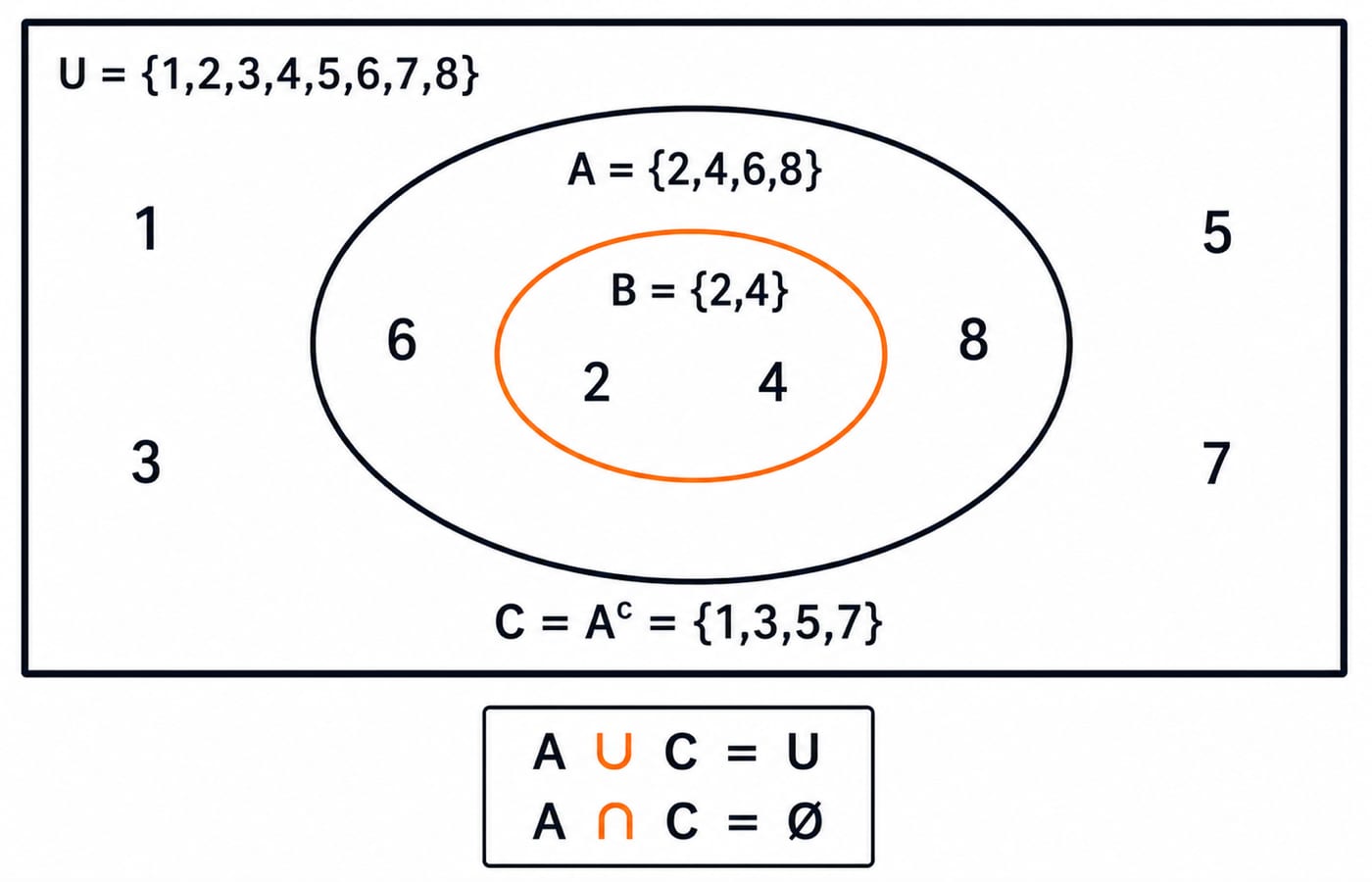
Fix the universe U = {1, 2, 3, 4, 5, 6, 7, 8}. Let A = {2, 4, 6, 8}, B = {2, 4}, C = {1, 3, 5, 7}, and D = {2, 4, 6, 8}. The same universe applies to each relation.
∅ ⊊ Bis true becauseBis non-empty.B ⊊ Ais true. Both elements ofBoccur inA, andAhas the extra elements6and8.A ⊊ Uis true becauseUalso contains1, 3, 5, 7.A ⊊ Dis false, whileA ⊆ Dis true. The two sets are equal.A ∩ C = ∅, because the sets do not overlap.A ∪ C = U, because together they contain1through8.A^c = C = {1, 3, 5, 7}.B^c = U - B = {1, 3, 5, 6, 7, 8}.A - B = {6, 8}.
Count Subsets Without Listing the Whole Power Set
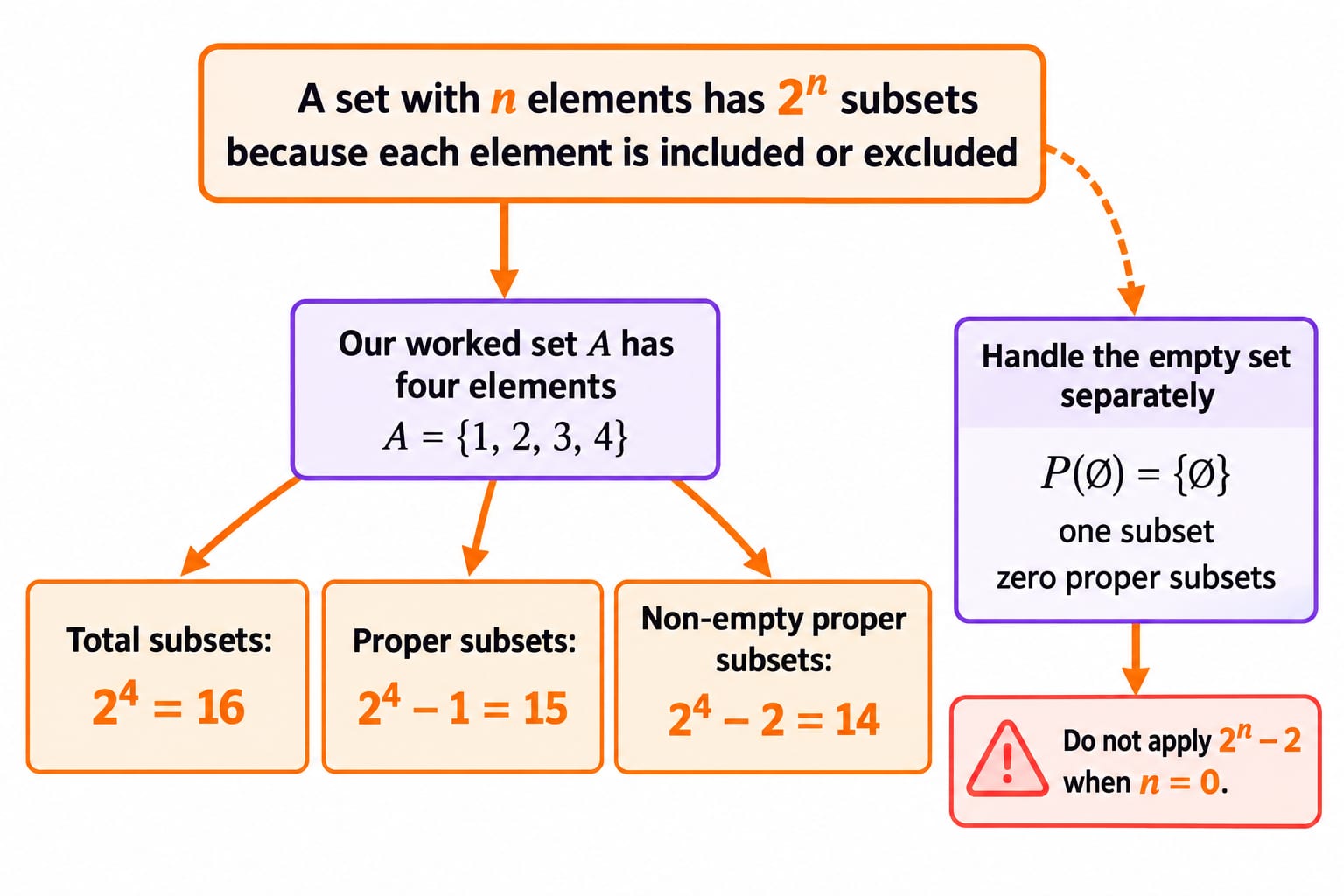
A set with n elements has 2^n subsets because each element is included or excluded. Removing the whole set leaves 2^n - 1 proper subsets. For n ≥ 1, removing both boundary sets leaves 2^n - 2 non-empty proper subsets.
Our worked set A has four elements. Therefore:
Total subsets:
2^4 = 16.Proper subsets:
2^4 - 1 = 15.Non-empty proper subsets:
2^4 - 2 = 14.
Handle the empty set separately. P(∅) = {∅}, so it has one subset and zero proper subsets. Do not apply 2^n - 2 when n = 0.
How GATE Can Test These Ideas
IIT Guwahati's official GATE 2026 CS syllabus lists sets, relations and functions under Discrete Mathematics. Try the three original checks below in MSQ, NAT and MCQ formats to practise membership, subset counting and complements.
MSQ: For
E = {∅, {1}}, consider∅ ∈ E,∅ ⊆ E,{∅} ⊆ E, and1 ∈ E. Their truth values are true, true, true, false. The first three statements are correct.NAT: If
|T| = 5, the number of non-empty proper subsets is2^5 - 2 = 32 - 2 = 30.MCQ: For
U = {1,2,3,4,5,6}andA = {2,4,6}, remove the elements ofAfromU. The complement is{1,3,5}.
These worked examples build the rules; the earlier Set Theory and Relations MCQs: 12 Solved (GATE) applies them across a full question set. The GATE CS Exam Preparation page places both inside the wider exam context.
Common Traps and the One-Line Repair for Each
Writing
{∅}when no elements are intended: Count the objects inside the outer braces.∅has zero elements;{∅}has one.Swapping
∈and⊆: Check whether the left side is an object or a set.Treating every subset as proper: Test containment first, then test equality.
Computing a complement without naming
U: Write the universe above the calculation before removing elements.Assuming
⊂always has one meaning: Read the question's notation note. Here,⊆allows equality and⊊forbids it.
The diagnostic pair is worth remembering: ∅ ⊆ ∅ is true, but ∅ ⊊ ∅ is false.
Short Version and Next Step
The null set has no elements. A complement requires a fixed universal set. A subset may equal the original set, while a proper subset may not. For a set of size n, the counts are 2^n total subsets, 2^n - 1 proper subsets, and, when n ≥ 1, 2^n - 2 non-empty proper subsets.
Redraw the U, A, B, C diagram from memory, then solve the three exam-style checks without looking at the answers. For wider mathematics revision, use the Engineering Mathematics for GATE course.
Go deeper with the full courseEngineering Mathematics for GATE Exam
Keep learning
Null Set, Universal Set, Subset and Proper Subset MCQs: 12 Solved Questions
Practise 12 MCQs on null sets, universal sets, subsets, proper subsets, complements and nested inclusion, with clear reasoning for every answer.
Updated 29 Oct 20267 min readDiscrete Mathematics MCQs

Universal and Existential Quantifiers Explained: Scope, Meaning and Worked Examples
Learn universal and existential quantifiers from zero, then evaluate finite domains, translations, negations and nested formulas with worked examples.
Updated 15 Sep 20266 min read187 viewsEngineering Mathematics

Spyware and System Monitoring Malware: How It Works, a Worked Trace and Exam Traps
Learn to separate spyware from legitimate monitoring by tracing delivery, persistence, collection, staging and transfer. The worked example calculates item counts, data volume and evidence limits.
Updated 5 Nov 20266 min readUGC NET Computer Science

Cache Mapping Techniques and Memory Units: Direct, Associative and Set-Associative Worked Example
Use one address to learn memory-unit conversion, cache organisation and the exact tag, index and offset fields for all three mapping techniques.
Updated 18 Sep 20266 min read149 viewsComputer Organization & Architecture