Power Set and Cardinality MCQs: 12 Solved Questions with Explanations
Solve 12 power set questions, from direct enumeration and nested sets to inclusion chains, ordered pairs and recurrence-based counting.
KnowledgeGate Team
Exam prep & CS education
25 Sep 20267 min read
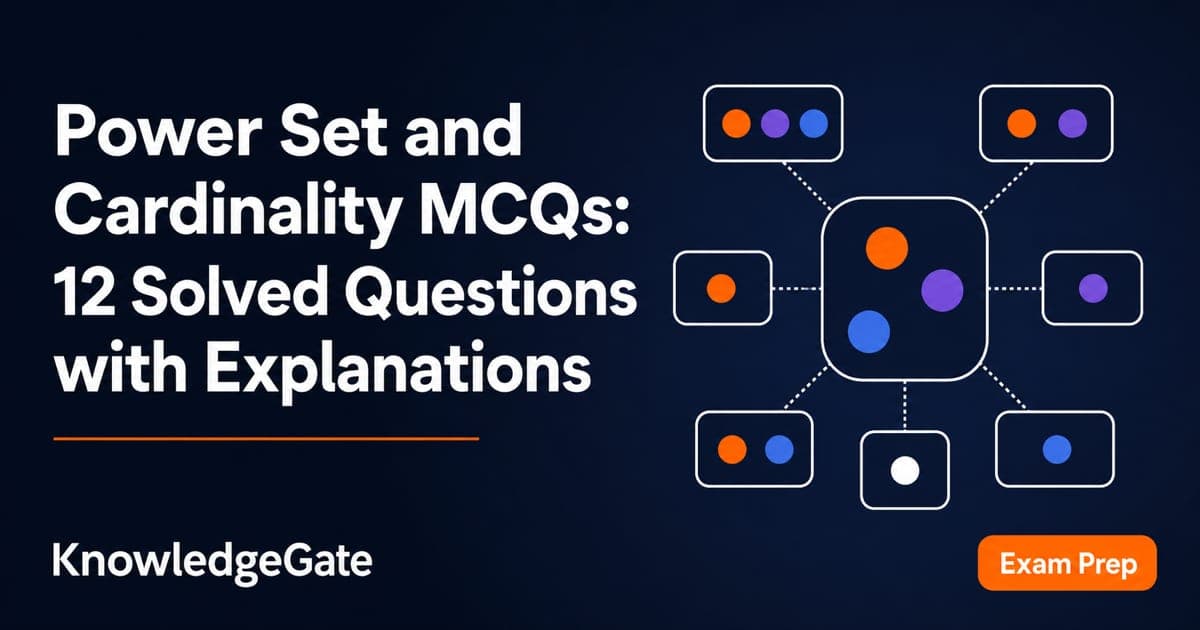
Most wrong power-set answers come from counting the objects inside the outer braces incorrectly, or from switching ∈ and ⊆ halfway through a question. The cure is one line of careful working before you touch the options.
Begin with direct enumeration, then work through nested sets and membership, chains and restricted-subset counting. Choose an answer and write that one line before reading each explanation. For more practice on this topic inside GATE CS Exam Preparation, work through the Power Set and its Cardinality PYQ Questions set. Individual links below open selected solved pages; this hub carries the remaining practice.
1. Power set rules to use before the MCQs
Rule | Meaning |
|---|---|
| The set of all subsets of |
Cardinality | If |
Boundary subsets | Both |
Nested objects | Each nested object counts as one outer element |
Repetition | Repeated elements inside a set collapse |
Membership and subset |
|
Let A = {a, {b}, ∅}. Its three elements are a, {b} and ∅, so |P(A)| = 2^3 = 8. The eight subsets are ∅, {a}, {{b}}, {∅}, {a, {b}}, {a, ∅}, {{b}, ∅} and {a, {b}, ∅}.
Now separate membership from subset notation. {b} ∈ A is true. Therefore {{b}} ⊆ A is also true. However, {b} ∈ P(A) is false because that would require {b} ⊆ A, which would require b ∈ A. Finally, {{b}} ∈ P(A) is true because {{b}} ⊆ A.
2. Power set MCQs 1-3: enumeration, cardinality and repeated power sets
Question 1
What is the power set of {1, 2}?
A. { { }, {1}, {2}, {1, 2} }
B. { { }, {1, 2} }
C. { {1}, {2} }
D. {1, 2}
Answer: A. { { }, {1}, {2}, {1, 2} }. A two-element set has 2^2 = 4 subsets. By size, they are the empty subset, two singleton subsets and the whole set. Option D is the original set, not a set of subsets.
Question 2
What is the cardinality of the power set of {1, 2, 3}?
A. 6
B. 7
C. 8
D. 3
Answer: C. 8. Each of the three distinct elements can be included or excluded independently. The count is 2 × 2 × 2 = 2^3 = 8.
Question 3
If ɸ is an empty set. Then | P(P(P(ɸ))) | =______?
A. 1
B. 2
C. 4
D. none of above
Answer: C. 4. Work from inside out. P(ɸ) = {ɸ} has cardinality 1. Therefore P(P(ɸ)) has cardinality 2^1 = 2, and the outer power set has cardinality 2^2 = 4. Do not assign cardinality zero to every expression containing the empty set.
3. Power set MCQs 4-6: nested elements and set equality
Question 4, UGC NET 1995
The number of elements in the power set P(S) of the set S = {{∅}, 1, {2,3}} is:
A. 2
B. 4
C. 8
D. None of the above
Answer: C. 8. The outer set has exactly three elements: {∅}, 1 and {2,3}. Contents of the nested sets do not become extra outer elements. Thus |S| = 3 and |P(S)| = 2^3 = 8. Open the solved question.
Question 5, NIMCET 2017
The number of elements in the power set P(S) of set S = {2, {1, 4}} is ?
A. 2
B. 4
C. 8
D. 10
Answer: B. 4. S has two elements, 2 and the single set {1, 4}. Its subsets are ∅, {2}, {{1, 4}} and {2, {1, 4}}, so |P(S)| = 2^2 = 4.
Question 6, ISRO 2017 December
The number of elements in the power set of {{1, 2}, {2, 1, 1}, {2, 1, 1, 2}} is:
A. 3
B. 8
C. 4
D. 2
Answer: D. 2. Sets ignore order and repeated entries, so {1, 2}, {2, 1, 1} and {2, 1, 1, 2} are equal. The outer set has one distinct element, giving 2^1 = 2 subsets. Open the solved question.
4. Power set MCQs 7-9: membership versus subset
Question 7
If S={a,b,c} and A1 and A2 are disjoint sets such that, A1∪A2=S. Number of Solutions for (A1,A2) is ____
This partition question also appears in Set Operations & Cartesian Product MCQs: 12 Solved Questions with Explanations, where it illustrates Cartesian decomposition. Here it tests the power-set state count: each element independently chooses one of two labelled subsets.
Answer: 8. Each of a, b and c must go to exactly one of the two labelled sets. That gives two independent choices per element, so the number of ordered pairs is 2^3 = 8. An empty A1 or A2 is allowed because the question does not forbid it.
Question 8, GATE 2015 Set 1
For a set 𝐴, the power set of 𝐴 is denoted by 2𝐴. If 𝐴 = {5,{6},{7}}, which of the following options are TRUE?
I. ∅ ∈ 2𝐴
II. ∅ ⊆ 2𝐴
III. {5,{6}} ∈ 2𝐴
IV. {5,{6}} ⊆ 2𝐴
A. I and III only
B. II and III only
C. I, II and III only
D. I, II and IV only
Answer: C. I, II and III only. Read 2𝐴 as P(A). I is true because ∅ ⊆ A, so ∅ ∈ P(A). II is true because the empty set is a subset of every set. III is true because {5, {6}} ⊆ A. IV is false: it would require both 5 and {6} to be elements of P(A), but neither is a subset of A. Open the solved question.
Question 9, UPPSC Polytechnic Lecturer 2022
If A = {1, {2}, 3}, the power set of A does NOT contain:
A. {1}
B. {2}
C. {1, 3}
D. {3}
Answer: B. {2}. The elements of A are 1, {2} and 3. The number 2 is not an element of A, so {2} is not a subset of A and cannot belong to P(A). The other options use actual elements of A. Open the solved question.
5. Power set MCQs 10-12: chains, ordered pairs and restricted subsets
Question 10, GATE 2005 Information Technology
Let A be a set with n elements. Let C be a collection of distinct subsets of A such that for any two subsets S₁ and S₂ in C, either S₁ ⊂ S₂ or S₂ ⊂ S₁. What is the maximum cardinality of C?
A. n
B. n + 1
C. 2^(n-1) + 1
D. n!
Answer: B. n + 1. The subsets form a strict inclusion chain. Every step increases cardinality by at least one, while possible sizes run only from 0 to n. Hence there are at most n + 1 members. The chain ∅ ⊂ {a1} ⊂ {a1, a2} ⊂ ... ⊂ A achieves that bound. Open the solved question.
Question 11, GATE 2021 Set 2
Let S be a set of consisting of 10 elements. The number of tuples of the form (A,B) such that A and B are subsets of S, and A⊆B is ___________ .
This question asks for a number, not a lettered option.
Answer: 59049. For each element, the allowed states are: in neither set, in B only, or in both A and B. Being in A but not B is forbidden. Ten elements therefore give 3^10 = 59049 ordered pairs. Open the solved question.
Question 12, ISRO 2025
How many subsets of {1, 2, 3, 4..... 12} can be formed such that no two elements in the subset are consecutive?
A. 144
B. 377
C. 610
D. 89
Answer: B. 377. Let f(n) count valid subsets of {1, ..., n}. If n is excluded, there are f(n-1) choices. If n is included, n-1 must be excluded, leaving f(n-2) choices. Thus f(n) = f(n-1) + f(n-2).
Start with f(0) = 1 and f(1) = 2. Then f(2) through f(12) are 3, 5, 8, 13, 21, 34, 55, 89, 144, 233, 377. The empty subset is included. Open the solved question.
6. Common traps in power-set questions
Check | Questions |
|---|---|
Count outer elements before applying | 2, 4 and 5 |
Collapse duplicate set elements | 6 |
Separate the empty set as an element from the empty subset | 1, 3 and 8 |
Distinguish | 8 and 9 |
Count permitted states per element | 7 and 11 |
Question 12 needs another check: split on the last element before writing the recurrence, then test f(0) = 1 and f(1) = 2. For Question 10, remember that a strict inclusion chain can use each subset size at most once.
For empty-set, universal-set and proper-subset boundary cases, use Null Set, Universal Set, Subset and Proper Subset MCQs: 12 Solved Questions. The questions here instead move into nested power sets, inclusion chains and restricted cardinality counts.
7. Power set and cardinality: the next practice step
Redo Questions 3, 6, 8, 10, 11 and 12 without looking at the answers. Nested power sets, set equality, membership notation, inclusion chains, three-state counting and recurrence counting are the skills involved. If any answer fails, write the decisive rule beside it and retry the question after a gap.
For a sequenced Discrete Mathematics route, continue with GATE Guidance by Sanchit Sir. The short version is simple: count distinct outer elements first; membership asks whether an object is present, while subset asks whether every element is present; and only an unrestricted n-element set gives the direct answer 2^n.
Keep learning
Graph Traversal MCQs: 12 Solved Questions on Walks, Paths, Trails, Circuits and Connectivity
Attempt 12 graph traversal and connectivity questions, then check each answer through definitions, reachability, degree conditions and edge-count arguments.
Updated 3 Oct 20267 min readDiscrete Mathematics MCQs
Planar Graphs MCQs: 12 Solved Questions on Kuratowski’s Theorem, Homeomorphism and Edge Bounds
Solve 12 planar graph questions, then check each answer through a forbidden-subdivision argument, a crossing-free redraw, or a short calculation.
Updated 28 Sep 20268 min readDiscrete Mathematics MCQs
Null Set, Universal Set, Subset and Proper Subset MCQs: 12 Solved Questions
Practise 12 MCQs on null sets, universal sets, subsets, proper subsets, complements and nested inclusion, with clear reasoning for every answer.
Updated 24 Sep 20267 min readDiscrete Mathematics MCQs
First-Order Predicate Logic MCQs: 10 Solved Questions with Explanations
Solve ten first-order logic questions, then check each answer through finite models, precise translations, countermodels, and valid inference rules.
23 Sep 20267 min readDiscrete Mathematics MCQs