

Polymorphism MCQs: 12 Solved Questions on One Interface, Multiple Implementations
Solve 12 polymorphism questions, then use clear explanations and one worked Java dispatch trace to separate compile-time selection from runtime behaviour.
KnowledgeGate Team
Exam prep & CS education
Updated 4 Nov 20267 min read
Polymorphism questions become easier when you separate overloading from overriding, early binding from late binding, and a reference type from the implementation selected at runtime. Commit to an option, then justify it in one sentence before checking the explanation. KnowledgeGate has over 20 more questions on one interface with multiple implementations for further practice. The Coding & DSA Courses for Placements page places Java, C++, object-oriented programming and placement coding in one learning track.
Polymorphism rules to fix before attempting the MCQs
Idea | Meaning | Usual selection time |
|---|---|---|
Overloading | Same method name, different parameter lists | Compile time |
Overriding | Subclass supplies a new implementation of an inherited method | Runtime when dynamically dispatched |
Early binding | Call target is resolved before the program runs | Compile time |
Late binding | Overridden implementation is selected from the actual object | Runtime |
Base or interface reference | One reference type can point to objects of multiple derived or implementing classes | Runtime object controls overridden calls |
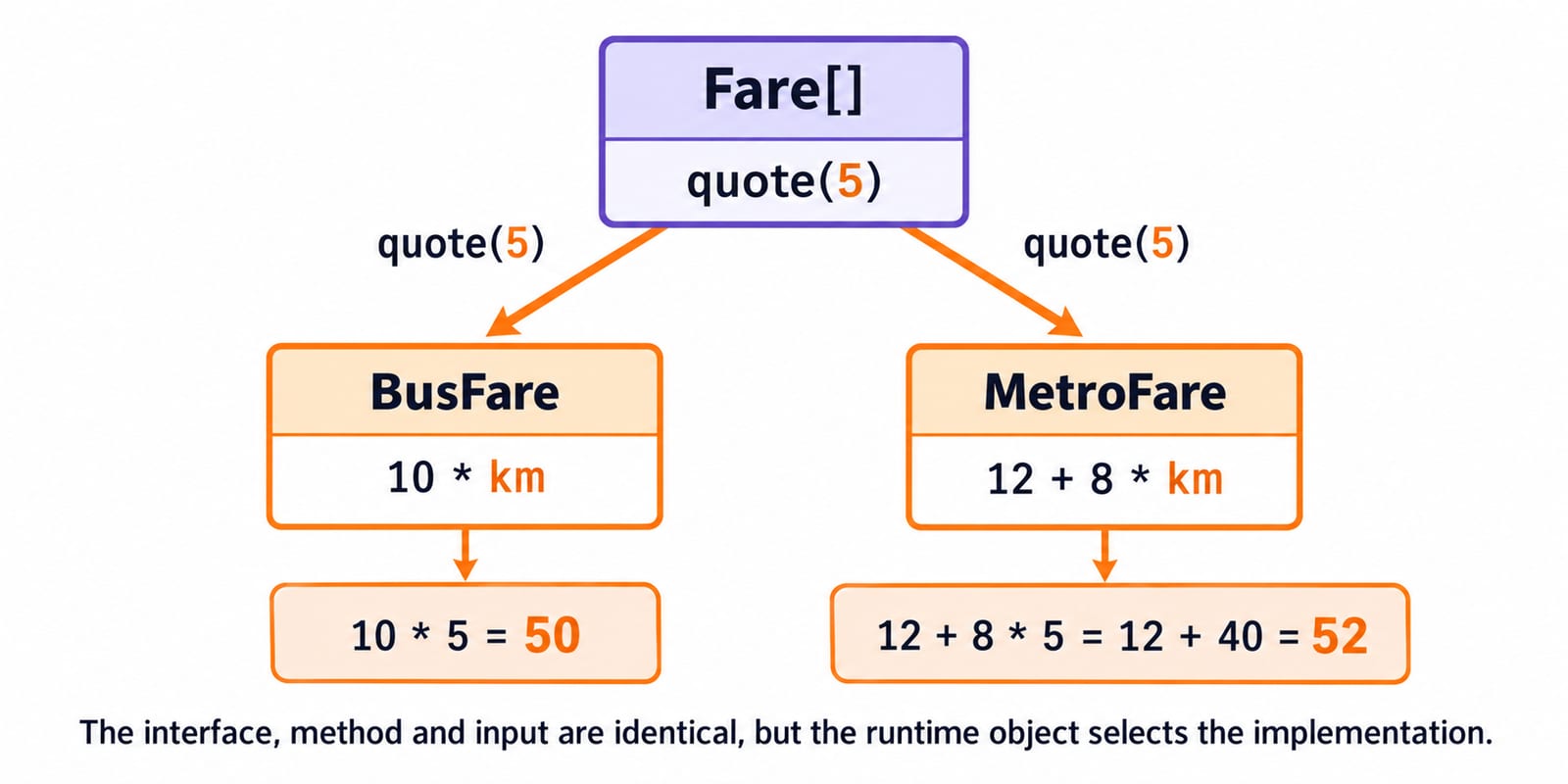
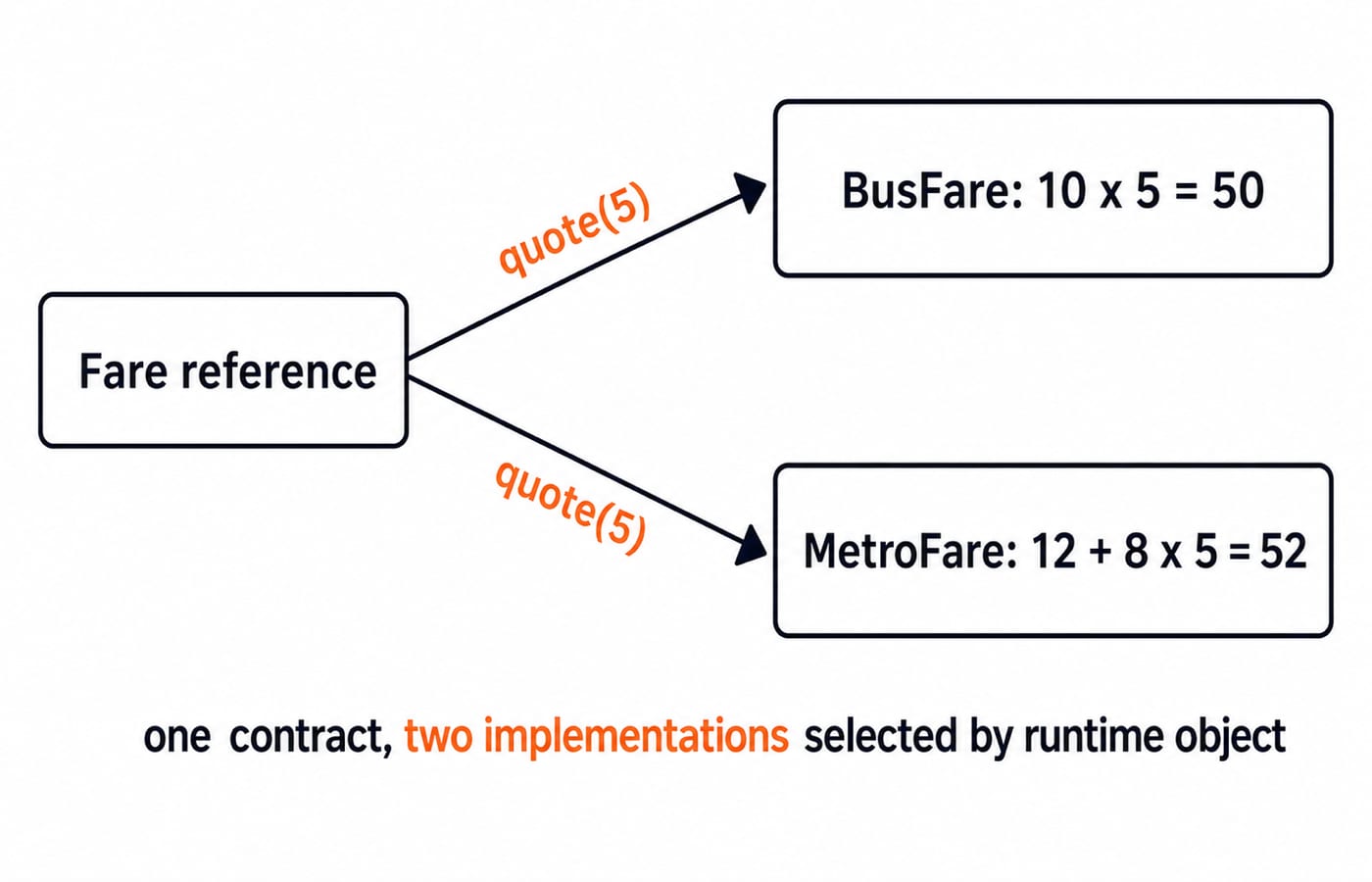
Consider interface Fare { int quote(int km); }. BusFare.quote(km) returns 10 * km, while MetroFare.quote(km) returns 12 + 8 * km. Put both objects into a Fare[] and call quote(5) on each. For the bus, 10 * 5 = 50. For the metro, 12 + 8 * 5 = 12 + 40 = 52. The interface, method and input are identical, but the runtime object selects the implementation.
That is different from overloads show(int value) and show(String value). The compiler selects the integer version for show(7) and the string version for show("7"). For a full class, inheritance and dispatch lesson, review OOP for Teaching CS Exams: Classes and Inheritance. Use a direct item page where one exists; otherwise return to that lesson for the same rule. Dynamic Binding MCQs: 8 Solved Questions and 4 Runtime Dispatch Drills isolates dispatch. Polymorphism is broader: overloads use declared arguments, overrides use runtime objects, subtype references share a contract, templates bind at compile time, and final methods block overriding.
Polymorphism MCQs 1-3: definition, multiple types and many forms
Question 1
ISRO 2009
The feature in object-oriented programming that allows the same operation to be carried out differently, depending on the object, is:
A. Inheritance
B. Polymorphism
C. Overfunctioning
D. Overriding
Correct answer: B. Polymorphism.
The clue is “same operation” behaving differently by object. Overriding can enable this behaviour, but polymorphism is the broader feature this question is asking about. Practice this question.
Question 2
Hexaware, Cognizant and CoCubes 2025
What do you call the concept where an object can have multiple types?
A. Encapsulation
B. Polymorphism
C. Inheritance
D. Composition
Correct answer: B. Polymorphism.
A MetroFare object has both MetroFare and Fare types. Implementation creates compatibility; polymorphism lets code use the object through either compatible type. Practice this question.
Question 3
Beltron Programmer 2025, Shift 3
Which of the following concepts allows an object to take many forms in object-oriented programming?
A. Polymorphism
B. Abstraction
C. Encapsulation
D. Inheritance
Correct answer: A. Polymorphism.
“Many forms” directly signals polymorphism. Abstraction hides detail, encapsulation protects state, and inheritance creates an is-a relationship; none names the many-forms property. Practice this question.
Polymorphism MCQs 4-6: overriding, subclass behaviour and overloading
Question 4
Hexaware, Cognizant and CoCubes 2025
What is method overriding?
A. Replacing a method in the parent class
B. Creating a new method in the child class
C. Using the method from the parent class in the child class
D. Providing a new implementation of a method that is already defined in its superclass
Correct answer: D. Providing a new implementation of a method that is already defined in its superclass.
Overriding keeps an inherited method contract but gives the subclass a matching implementation. It does not alter the parent’s source; dispatch selects the subclass version. Review the OOP lesson above.
Question 5
Bihar STET 2025
Which concept allows a subclass to provide a specific implementation of a method that is already defined in the superclass?
A. Overloading
B. Inheritance
C. Polymorphism
D. Overriding
Correct answer: D. Overriding.
A subclass giving its own body to an inherited method is overriding. Polymorphism is the wider behaviour observed when a base reference invokes that override. Review the OOP lesson above.
Question 6
DSSSB 2022
Which of the following statements is/are true about polymorphism in OOPs?
(i) It may be achieved by function overloading.
(ii) It is used for reusability.
A. Only (i)
B. Only (ii)
C. Both (i) and (ii)
D. Neither (i) nor (ii)
Correct answer: A. Only (i).
Function overloading is compile-time polymorphism, so (i) is true. Reusability is tied more directly to inheritance and composition, so only (i) is the expected answer here; polymorphism can still support reusable design. Review the OOP lesson above.
Polymorphism MCQs 7-9: binding, C++ templates and the final modifier
Question 7
UGC NET June 2025
Match List I with List II
List I List II
A. Overloading I. Since function call is resolved during run time, the execution is Slow.
B. Early binding II. Since function call is resolved during compilation time, the execution is much faster.
C. Overriding III. Supports compile-time polymorphism.
D. Late Binding IV. Supports run-time polymorphism.
Choose the correct answer from the options given below:
A. A → III, B → II, C → IV, D → I
B. A-IV, B-II, C-III, D-I
C. A-III, B-I, C-IV, D-II
D. A-IV, B-I, C-III, D-II
Correct answer: A. A → III, B → II, C → IV, D → I.
Overloading maps to compile-time polymorphism, early binding to compilation, overriding to runtime polymorphism, and late binding to runtime. Thus A-III, B-II, C-IV, D-I. The speed wording is a binding distinction, not a universal benchmark. Review the OOP lesson above.
Question 8
BPSC TGT 2023
How can one implement the compile-time polymorphism in the C++ programming language?
A. By using the template
B. By using the concepts of inheritance
C. By using both the virtual functions and inheritance
D. More than one of the above
E. None of the above
Correct answer: A. By using the template.
Templates use type information at compile time. Inheritance with virtual functions is the runtime route, so B and C fail and D has no second valid choice. Review the OOP lesson above.
Question 9
UGC NET August 2016
Method over-riding can be prevented by using final as a modifier at ______.
A. the start of the class.
B. the start of method declaration.
C. the start of derived class.
D. the start of the method declaration in the derived class.
Correct answer: B. the start of method declaration.
Declare the method final, for example final void show(), to prevent its override. A final class prevents all subclassing; adding final only in a later derived method cannot prevent the first override. Practice this question.
Polymorphism MCQs 10-12: Java behaviour, parent references and the OOP family
Question 10
RPSC Programmer 2024, Paper 2
What is Polymorphism in Java?
A. The ability of a single method to perform different tasks.
B. The ability of different methods to perform different tasks.
C. The ability of a class to inherit properties of another class.
D. The ability of a single variable to hold multiple values.
Correct answer: A. The ability of a single method to perform different tasks.
A captures one call producing implementation-specific behaviour, as quote(5) does. C is inheritance, while D is ordinary value storage; neither describes one interface with multiple behaviours. Review the OOP lesson above.
Question 11
Bihar STET 2025
Which term is used to describe the ability of different classes to be treated as objects of the same parent class?
A. Overloading
B. Polymorphism
C. Abstraction
D. Encapsulation
Correct answer: B. Polymorphism.
Both concrete objects can be stored and called through Fare. That substitutability is polymorphism; abstraction describes the contract but not the common treatment of several concrete classes. Review the OOP lesson above.
Question 12
Bihar STET 2019
Polymorphism is feature of:
A. Procedural programming
B. SQL
C. Non-procedural programming
D. Object Oriented Programming
E. None of these
Correct answer: D. Object Oriented Programming.
Polymorphism belongs to the core object-oriented feature set. SQL is declarative and procedural programming centres procedures, so neither is the intended family in this question. Practice this question.
How to review these polymorphism MCQs without memorising option letters
Use four quick tests when you review:
If the compiler chooses by parameter list, think overloading and compile time.
If the runtime object chooses an inherited implementation, think overriding and late binding.
If several concrete objects travel through one base or interface type, think subtype polymorphism.
If a question asks what prevents a Java method override, think
finalon that method declaration.
Now replay the Fare example with quote(8). BusFare returns 10 * 8 = 80. MetroFare returns 12 + 8 * 8 = 12 + 64 = 76. If you can predict both results and explain why the same call through Fare reaches different implementations, the central idea is secure.
For the wider concept map, read Object Oriented Technology Explained. Continue with Java Programming for a language-specific path that combines concepts, MCQs and coding practice.
The short version
Polymorphism is not merely “many forms” to memorise. It is a stable contract plus a choice of implementation. Argument types select an overload at compile time; the actual object selects an override at runtime. Re-solve the twelve questions without the answer lines and explain that selection point each time.
Keep learning
Data Abstraction Explained: Hide Implementation Details with a Worked Java Example
See how a stable Account contract protects its invariant while the Java implementation changes from a running balance to a transaction ledger.
Updated 16 Nov 20265 min readProgramming Languages Survey
Programming Paradigms Explained: Concepts, Classifications and Worked Examples
Learn how imperative, procedural, object-oriented, functional and declarative styles organise the same computation, and how to classify code from visible evidence.
Updated 15 Nov 20265 min readProgramming Languages Survey
Introduction to Visual Basic (VB): Concepts, Worked Code and Exam Patterns
Learn how a VB.NET form turns text-box input and a button click into a traced result. Then practise operators, loops, procedures, scope and debugging.
Updated 14 Nov 20266 min readProgramming Languages Survey
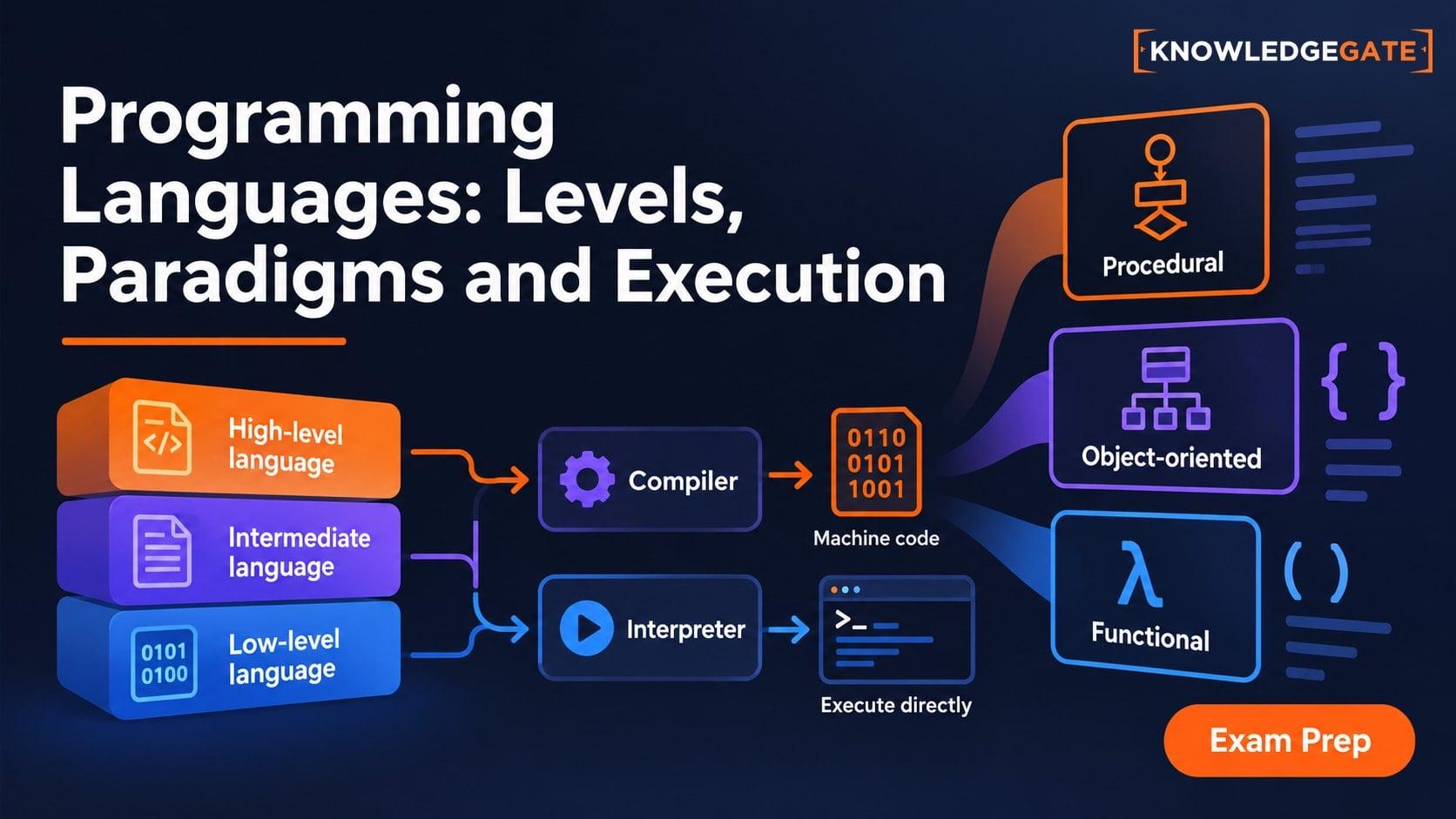
Types of Programming Languages: Levels, Paradigms and Execution Models
Learn why low-level, object-oriented, compiled and dynamically typed describe different axes. Build a clear classification map through one result expressed three ways.
Updated 13 Nov 20266 min readProgramming Languages Survey