

Modelling and UML Fundamentals MCQs and Short Answers: 10 Solved Questions
Attempt five MCQs and five short-answer questions on UML purpose, class state, relationships, structural and behavioural views, and model maintenance.
KnowledgeGate Team
Exam prep & CS education
Updated 3 Nov 20267 min read

Learners often remember the words "class diagram", "sequence diagram", "aggregation", and "composition", but lose marks when a question asks which diagram fits an objective or whether a diamond should be hollow or filled. UML meaning, notation, relationships, diagram types, and modelling practice appear across five MCQs and five short-answer questions. Exact wording matters in UML questions, especially for notation and relationships.
1. How to use this 10-question UML set
Attempt each item before reading its explanation. For an MCQ, record the option and the reason; for a subjective item, write a two-sentence answer. Then compare your reasoning, not just the final letter.
The MCQs test UML meaning, class-state notation, composition, aggregation notation, and tool matching, while the written questions address UML purpose, object-oriented modelling, diagram selection, view classification, and keeping models aligned with code. Object state is represented as an attribute, while aggregation uses an open diamond. For the remaining questions, work from the Modelling and UML Fundamentals topic hub.
2. Questions 1-3: UML meaning, purpose, and class state
Question 1: meaning of Unified Modeling Language
UML Meaning is

A. Unique modeling language
B. Unified Modeling language
C. Unified Modern language
D. Unified Master language
Correct answer: B. Unified Modeling language. U stands for Unified, M for Modeling, and L for Language. UML is a visual modelling language, not a programming language. The Object Management Group (OMG) stewards the standard. Each distractor replaces one word, so use exact acronym expansion rather than familiarity.
Question 2: UML as a system blueprint
Define UML and explain its fundamental purpose. Why is it considered a blueprint for system development?Expected answer: UML is a standardised visual modelling language used to specify, visualise, construct, and document a system. It acts like a blueprint by representing structure and behaviour before or alongside implementation.
A clinic's structural view can show Patient, Doctor, and Appointment; its behavioural view can show the messages exchanged when a patient books a slot. The four stated purposes follow the OMG UML specification.
Question 3: representing object state as attributes
ISRO 2007
In UML diagram of a class

A. state of object cannot be represented
B. state is irrelevant
C. state is represented as an attribute
D. state is represented as a result of an operation
Correct answer: C. state is represented as an attribute. Consider this class:
Order
-----------------------------
orderId: Integer = 204
status: String = "CONFIRMED"
itemCount: Integer = 2
-----------------------------
confirm()
cancel()
The stored values 204, "CONFIRMED", and 2 describe Order O204's state. The operations confirm() and cancel() describe behaviour that can change it. For a broader frame, see how object-oriented ideas fit within the wider programming-language landscape.
3. Questions 4-5: composition versus aggregation
Question 4: composition and dependent parts
During Object-Oriented Analysis, which relationship type implies that the 'child' object cannot exist independently of the 'parent' object ?

A. Generalization
B. Composition
C. Aggregation
D. Realization
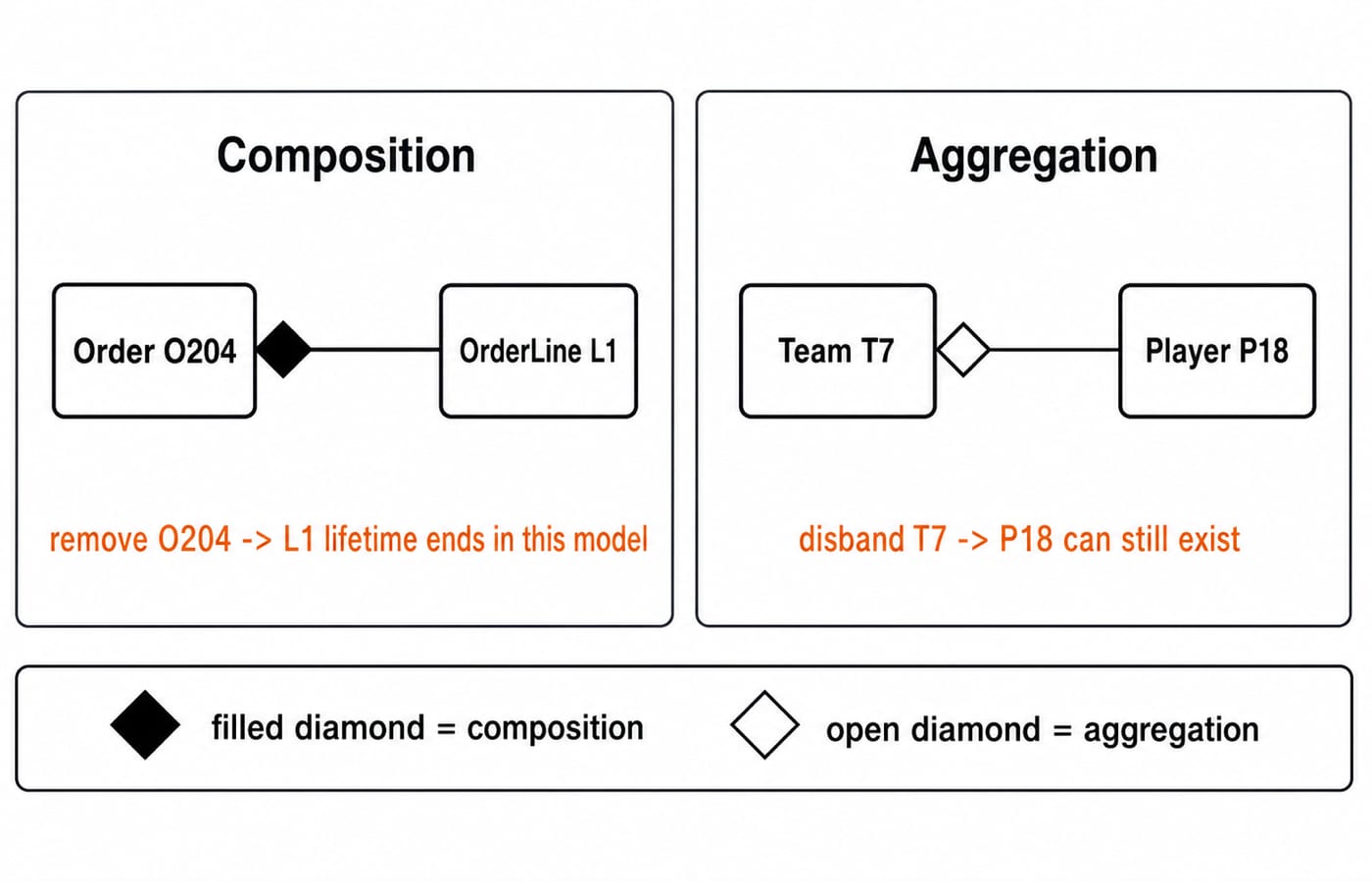
Correct answer: B. Composition. Order O204 is the whole and OrderLine L1 its part. Under this model, deleting O204 ends L1's modelled lifetime. Aggregation is also a whole-part relationship, but its part can exist independently of the whole, so it fails the stem's condition. Generalisation represents inheritance, while realisation commonly connects an implementation to an interface. Neither expresses whole-part lifetime ownership.
Question 5: the open diamond in aggregation
ISRO 2014
An aggregation association is drawn using which symbol?

A. A line which loops back on to the same table
B. A small open diamond at the end of a line connecting two tables
C. A small closed diamond at the end of a line connecting two tables
D. A small closed triangle at the end of a line connecting two tables
Correct answer: B. A small open diamond at the end of a line connecting two tables. The option says "tables", but UML class-diagram notation normally relates classes. If Team T7 aggregates Player P18, the open diamond sits at T7. P18 can exist after T7 disbands. A filled diamond shows composition.
4. Question 6: function-first versus object-centred modelling
A system analyst is modelling an online shopping platform. Two modelling strategies are considered:

- Strategy A focuses on identifying functions such as “processOrder”, “calculateBill”, and “updateInventory” without defining real-world entities.
- Strategy B identifies entities such as Customer, Order, and Product, and associates both data and behavior with these entities.

Evaluate which modelling strategy better aligns with object-oriented principles and justify the selection based on abstraction and system representation.
Expected answer: Strategy B. Customer C17 places Order O204 containing Product P9 with quantity = 2. The objects own relevant state; Order.placeOrder() and Product.reserve(2) attach behaviour to responsible domain concepts. This supports abstraction, encapsulation, and cohesive responsibility.
Strategy A's detached functions would share separate records, so it meets the object-oriented objective less directly. Function-based design is not always invalid, but Strategy B is the more maintainable answer here, a trade-off explored further where object-centred modelling meets programming languages.
5. Questions 7-8: structural views versus behavioural views
Behavioral and Interaction UML Diagrams owns activity, state-machine, sequence, and communication notation through one worked order flow. Questions 7 and 8 instead test the boundary between static system structure and runtime behaviour.
Question 7: class diagrams and sequence diagrams
A software architect is documenting a system using UML. Two diagram types are considered:
Diagram A represents the static structure of classes, attributes, and relationships.
Diagram B represents the sequence of interactions between objects over time during execution.
Evaluate which diagram type is more suitable for understanding system structure and which is more appropriate for analyzing runtime behavior. Justify the selection based on modelling objectives.
Expected answer: A class diagram captures classes, their attributes, and the relationships and multiplicities that connect them. It provides a static snapshot that holds regardless of execution and answers the question, "what exists and how is it connected?" A sequence diagram captures objects exchanging messages in time order along a timeline, showing who calls whom and in what sequence during one run. It answers the question, "who sends which message, in what order?" Diagram A is therefore the better fit for understanding structure, while Diagram B is better for analysing runtime behaviour.
Question 8: structural and behavioural system views
A system designer is documenting a library management system. Two modelling perspectives are prepared:
View A represents classes such as Book, Member, and Library, including their attributes and relationships.
View B represents how a Member issues a Book through a sequence of interactions over time.
Evaluate which view is appropriate for representing system architecture and which is suitable for capturing system behavior. Justify the selection based on the UML view classification.
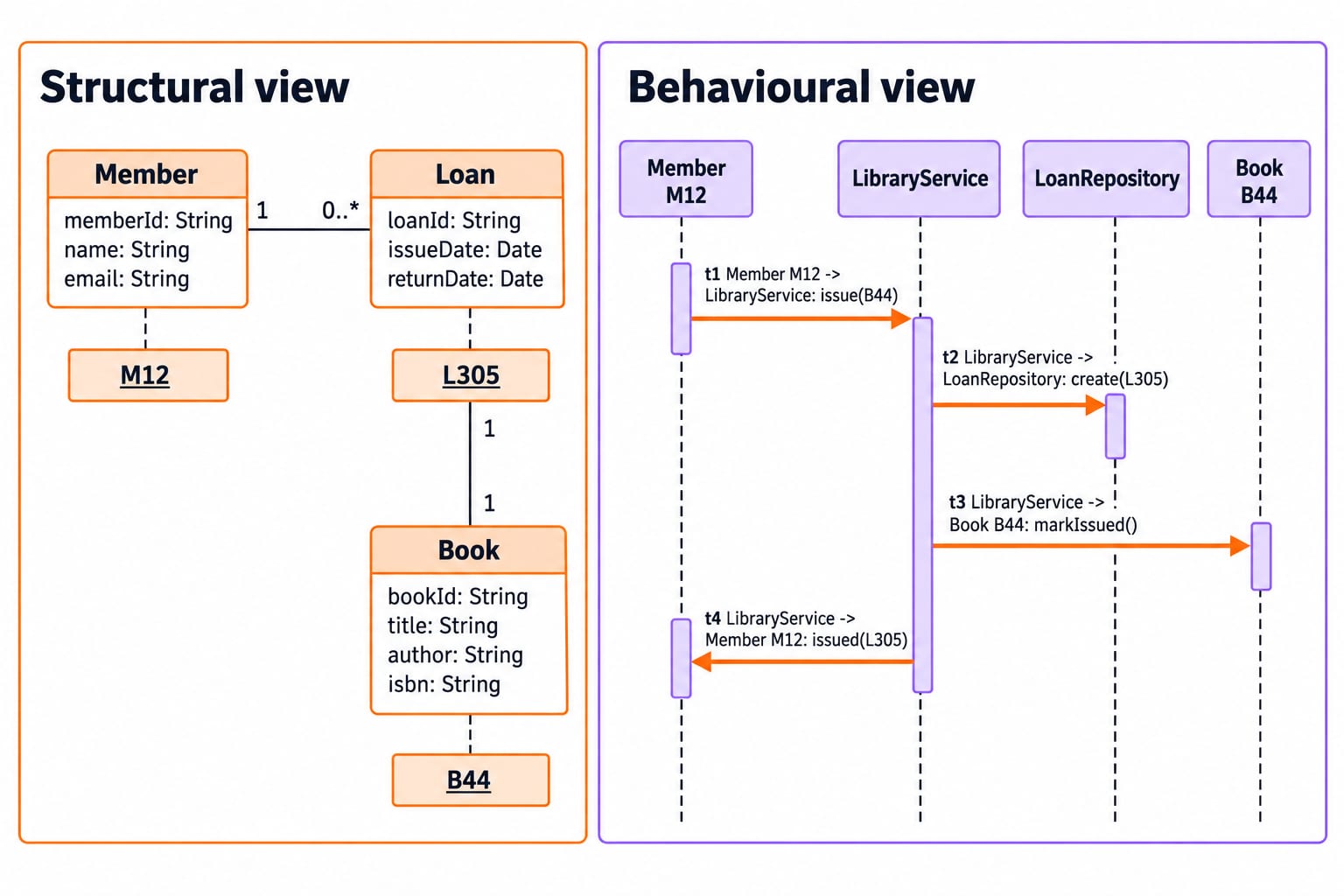
Expected answer: View A is structural and represents architecture. View B is behavioural and represents the issue-book interaction over time.
The structural view contains Member M12, Book B44, and Loan L305. Member 1 to 0..* Loan allows zero or more loans per member. Loan 1 to 1 Book links each loan to one book.
The behavioural view orders four messages:
t1 Member M12 -> LibraryService: issue(B44)t2 LibraryService -> LoanRepository: create(L305)t3 LibraryService -> Book B44: markIssued()t4 LibraryService -> Member M12: issued(L305)
6. Questions 9-10: living models and UML-tool matching
Question 9: keeping models in sync with code
A development team creates UML diagrams only during the initial design phase of a software project. After implementation begins, no further updates are made to the diagrams, even when requirements change or new functionality is added.

During system testing, inconsistencies arise between the documented design and actual system behavior.

Identify the underlying issue in this modelling approach and justify the resulting behavior based on UML modelling practices.
Expected answer: The diagrams became stale. That caused model-implementation divergence and broke traceability among requirements, design, code, and tests.
At version 1, diagram and code enforce maxBorrowedBooks = 3. In version 2, the code raises it to 5, but the model still checks 3. A tester using the stale model rejects loan four, although the implementation permits it because 4 <= 5. Update the relevant model in the same change review as the requirement, code, and tests. Not every diagram needs permanent detail, but a design or test reference must match the behaviour it documents.
Question 10: matching UML tools to vendors
Consider  Column-I  and  Column-II  in context of tools to support UML diagram for analysis modeling :
Column-I                              Column-II
 i. Power Designer               a. IBM
 ii. Rational Rose                  b. Microsoft
 iii. Visio                                c. Sybase
 iv. Argo UML                       d. Open source
Match of Column-I and Column-II is

A. i-b, ii-a, iii-d, iv-c
B. i-c, ii-a, iii-b, iv-d
C. i-d, ii-b, iii-c, iv-a
D. i-c, ii-d, iii-a, iv-b
Correct answer: B. i-c, ii-a, iii-b, iv-d. Match the item's keyed historical associations:
Power Designer -> Sybase, so
i-c.Rational Rose -> IBM, so
ii-a.Visio -> Microsoft, so
iii-b.Argo UML -> Open source, so
iv-d.
The tuple is i-c, ii-a, iii-b, iv-d, which only option B matches.
7. Answer key, traps, and the next practice step
Question | Answer |
|---|---|
1 | B |
2 | UML definition plus its blueprint purpose |
3 | C |
4 | B |
5 | B |
6 | Strategy B |
7 | A = class and structure; B = sequence and behaviour |
8 | A = architecture; B = behaviour |
9 | Stale models and model-implementation divergence |
10 | B |
Check three traps: open versus filled diamond, attributes versus operations, and structural versus behavioural objectives. Redraw both figures and explain each distinction aloud in one sentence.
If fewer than 8 of your 10 responses were correct, revisit the worked Order O204 and library M12/B44/L305 examples before attempting another set. Once the traps feel routine, continue the guided syllabus in the NTA UGC NET Paper 2 course and add timed practice from the NTA UGC NET Paper 2 Test Series.
Keep learning

Data Abstraction Explained: Hide Implementation Details with a Worked Java Example
See how a stable Account contract protects its invariant while the Java implementation changes from a running balance to a transaction ledger.
Updated 16 Nov 20265 min readProgramming Languages Survey

Programming Paradigms Explained: Concepts, Classifications and Worked Examples
Learn how imperative, procedural, object-oriented, functional and declarative styles organise the same computation, and how to classify code from visible evidence.
Updated 15 Nov 20265 min readProgramming Languages Survey
Introduction to Visual Basic (VB): Concepts, Worked Code and Exam Patterns
Learn how a VB.NET form turns text-box input and a button click into a traced result. Then practise operators, loops, procedures, scope and debugging.
Updated 14 Nov 20266 min readProgramming Languages Survey
Types of Programming Languages: Levels, Paradigms and Execution Models
Learn why low-level, object-oriented, compiled and dynamically typed describe different axes. Build a clear classification map through one result expressed three ways.
Updated 13 Nov 20266 min readProgramming Languages Survey