Philosophical and Theoretical Approaches to AI MCQs: 12 Solved Questions with Explanations
Solve 12 UGC NET, MPPSC, HTET and GATE MCQs on cognitive science, the Turing Test, rational agents, reinforcement learning and linear separability.
KnowledgeGate Team
Exam prep & CS education
Updated 11 Aug 20268 min read
Theoretical AI questions look soft, so students skim them. Close options such as Turing Test versus algorithm, cognitive science versus brain science, or rational action versus pure inference cost marks in UGC NET Paper 2, MPPSC, HTET and GATE papers. Attempt each linked question cold before reading its explanation, then continue with the Artificial Intelligence unit in NTA UGC NET Paper 2, and check your own topic list against the current official UGC NET CS syllabus at ugcnet.nta.nic.in.
How philosophical and theoretical AI is tested
Three shapes recur: direct definitions, Assertion-Reason or multi-statement items, and match-the-list questions connecting an AI technique to its application. The trap is usually a plausible near-synonym or one absolute word. If the format itself slows you down, settle the difference between MCQ, MSQ and NAT questions first, then come back to the concepts.
What counts as intelligence: definitions and the Turing Test
Question 1: Cognitive Science
Asked in: UPPSC Polytechnic Lecturer 2022
Stem: An interdisciplinary field that tries to construct precise and testable theories of the working of human mind is known as.
A. Brain Science
B. Cognitive Science
C. Artificial Neural Network
D. Behavioural Science
Correct answer: B. Cognitive Science
Cognitive science combines psychology, neuroscience, linguistics, computer science and philosophy to build testable theories of mind. Brain science studies the biological organ, while behavioural science studies observable behaviour. An artificial neural network is a computational model, not an interdisciplinary field.
Question 2: Turing Test and human-like behaviour
Asked in: UGC NET 2025, Paper 2 (December)
Stem: In artificial intelligence, the term "Turing Test" is primarily associated with:
A. Testing neural network convergence
B. Measuring computational efficiency of algorithm
C. Evaluating machine ability to exhibit human-like behavior
D. Verifying correctness of AI search algorithm
Correct answer: C. Evaluating machine ability to exhibit human-like behavior
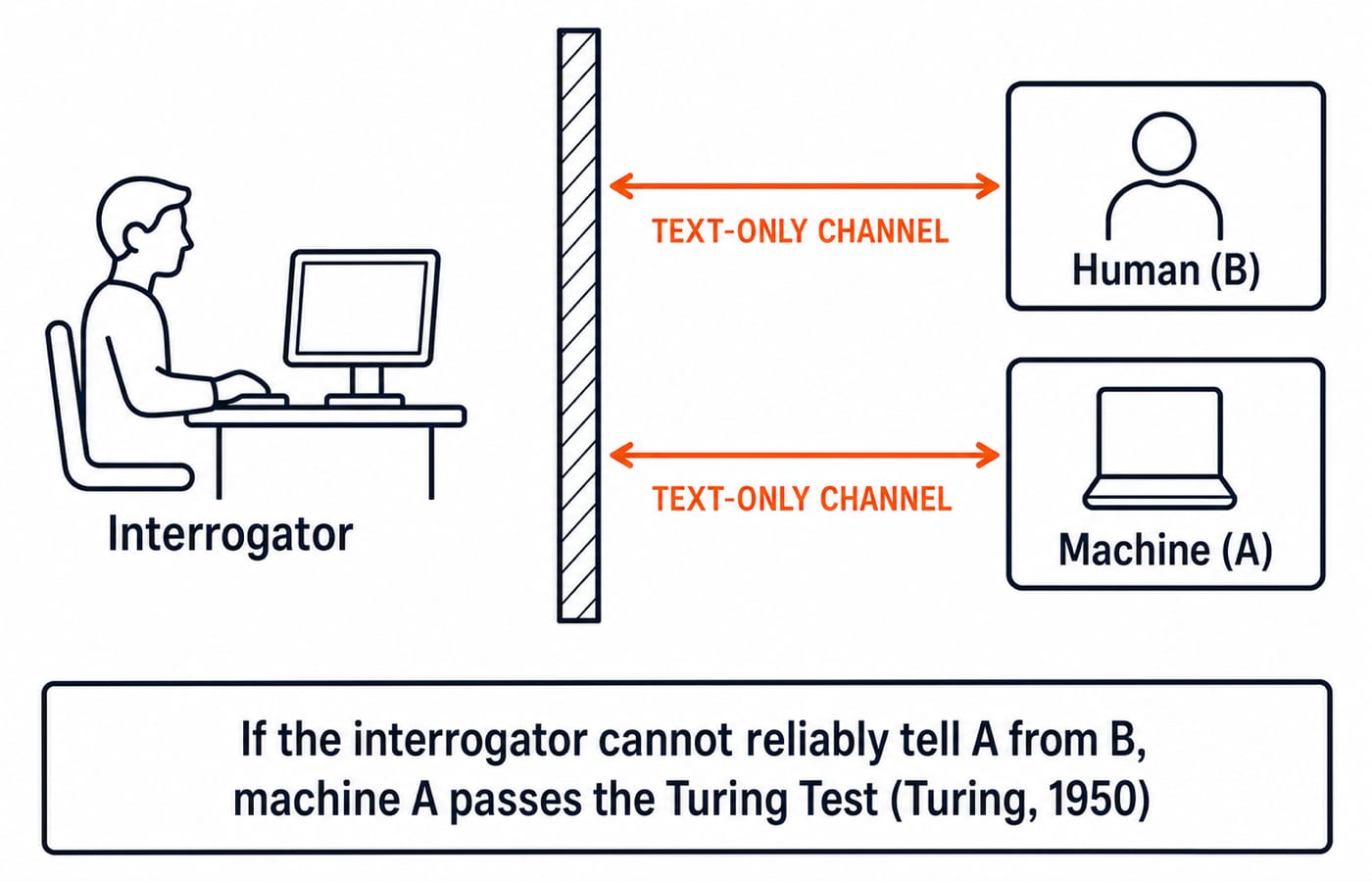
The Turing Test, proposed by Alan Turing in 1950, asks whether an evaluator can distinguish a machine’s conversation from a human’s. Convergence, efficiency and correctness are technical measures. The test assesses none of them.
Question 3: The named test for machine intelligence
Stem: A technique that was developed to determine whether a machine could or could not demonstrate artificial intelligence is known as the ___?
A. Algorithm
B. Logarithm
C. Turing Test
D. Boolean algebra
Correct answer: C. Turing Test
The Turing Test is the named technique for judging human-like machine behaviour. An algorithm, logarithm and Boolean algebra are tools or concepts, not intelligence tests. Questions 2 and 3 test the same fact from opposite directions.
The four approaches to AI, and the rational-agent view
AI is usually organised into four approaches: thinking humanly, acting humanly, thinking rationally and acting rationally. The first pair judges a system against human performance, the second pair against a standard of correct or optimal behaviour, and the rational-agent view is the last of the four. Both questions here sit in the acting column: one on why acting like a human helps an interactive system, one on how much of rationality is correct inference. For questions on the four categories themselves, work through Foundations of AI MCQs.
Question 4: Why human-like behaviour can matter
Asked in: MPPSC 2025
Stem: In AI systems that interact with people (e.g. expert systems), why is behaving like a human important?
A. To deceive the user into thinking the system is a person
B. To ensure the system can perform physical tasks
C. To make the system's reasoning processes transparent and understandable
D. To allow the system to pass the Turing Test automatically
Correct answer: C. To make the system's reasoning processes transparent and understandable
Human-like reasoning can make an interactive system’s process understandable and easier to trust. It does not aim to deceive users or guarantee physical ability. Nor does it automatically pass the Turing Test.
Question 5: Inference and rationality
Asked in: MPPSC 2025
Stem: According to the rational agent approach, what is the relationship between inference and rationality?
A. Inference is irrelevant to rationality
B. Rationality is entirely dependent on correct inference
C. Correct inference is the only way to act rationally
D. Making correct inference is sometimes part of being a rational agent
Correct answer: D. Making correct inference is sometimes part of being a rational agent
A rational agent maximises its expected performance measure. Inference can help, but a rational reflex such as pulling a hand from a hot stove need not use it. “Only” and “entirely” make B and C too absolute, while A wrongly dismisses inference.
Assertion-Reason: supervised vs unsupervised learning
For this format, evaluate the assertion, evaluate the reason, and only then decide whether the reason explains the assertion.
Question 6: Labelled data in supervised learning
Asked in: UGC NET 2025, Paper 2 (December)
Assertion A: In supervised learning, the model is trained using labelled data.
Reason R: Supervised learning algorithms find patterns in data to predict outcomes without any prior knowledge of the correct output.
A. Both A and R are correct, and R explains A
B. Both A and R are correct, but R is not the explanation of A
C. A is correct but R is not correct
D. A is not correct but R is correct
Correct answer: C. A is correct but R is not correct
The assertion is true because supervised learning uses labelled examples. The reason describes unsupervised learning, where correct output labels are absent. It is false, so C is the valid combination.
Question 7: Unlabelled data in unsupervised learning
Asked in: UGC NET 2025, Paper 2 (December)
Assertion A: Unsupervised learning algorithms are used for tasks like data summarization and exploratory data analysis.
Reason R: Unsupervised learning requires labelled dataset to find relationships and patterns in data.
A. Both A and R are correct, and R explains A
B. Both A and R are correct, but R is not the explanation of A
C. A is correct but R is not correct
D. A is not correct but R is correct
Correct answer: C. A is correct but R is not correct
Clustering, summarisation and exploratory analysis are unsupervised uses, so the assertion is true. The reason is false because unsupervised learning uses unlabelled data. In both questions, the reason flips the labelled versus unlabelled fact.
Multi-statement and match-the-list questions
Question 8: Reinforcement-learning statements
Asked in: UGC NET 2025, Paper 2 (December)
Statements:
A. Adaptive dynamic programming learns the transition model and solves the MDP by dynamic programming
B. Temporal difference needs a transition model
C. Prioritized sweeping adjusts states whose successors had significant utility changes
D. Modified policy iteration uses simplified value estimates after each model change
Options:
A. A,B,C Only
B. A,B,D Only
C. A,C,D Only
D. B,C,D Only
Correct answer: C. A,C,D Only
A is true because adaptive dynamic programming learns a model and applies dynamic programming. B is false because temporal-difference learning is model-free. C correctly describes prioritised sweeping, and D describes modified policy iteration. With B as the single false statement, A, C and D give option C.
Question 9: AI applications matched to fields
Asked in: UGC NET 2025, Paper 2 (December)
Match List-I with List-II:
List-I | List-II |
|---|---|
A. Expert systems | I. Medical Diagnosis |
B. NLP | II. Text Summarization |
C. Computer Vision | III. Image Classification |
D. ML | IV. Predictive Analysis |
Options:
A. A-I, B-II, C-III, D-IV
B. A-II, B-I, C-III, D-IV
C. A-II, B-III, C-I, D-IV
D. A-III, B-II, C-I, D-IV
Correct answer: A. A-I, B-II, C-III, D-IV
Expert systems map to medical diagnosis, NLP to text summarisation, computer vision to image classification, and ML to predictive analysis. This gives A-I, B-II, C-III and D-IV. Lock the pairing you know best, such as computer vision with image classification, then eliminate codes that break it.
Theory that leaks in from machine learning
Papers that set this unit fold core machine-learning definitions in beside the philosophical questions, so one page can move from the Turing Test to principal component analysis without changing topic.
Question 10: Logistic-regression forms
Asked in: HTET 2024
Stem: Logistic regression can be binomial, ___________ or multinomial.
A. Ordinal
B. Numbered
C. Unimial
D. Binary
Correct answer: A. Ordinal
The standard forms are binomial for two categories, ordinal for ordered categories, and multinomial for several unordered categories. The blank is “Ordinal”. Binary repeats the binomial case, while Numbered and Unimial are not logistic-regression types.
Question 11: Principal Component Analysis
Asked in: HTET 2024
Stem: It refers to a mathematical procedure that transforms a number of possibly correlated variables into a small number of uncorrelated variables.
A. Natural Language Analysis
B. Principle Component Analysis
C. Hidden Markov Model
D. Support Vector Machine
Correct answer: B. Principle Component Analysis
PCA transforms correlated variables into fewer uncorrelated principal components while retaining most of the variance. Option B keeps the paper's spelling; the standard form is principal component analysis, after the principal components it extracts. A hidden Markov model handles sequences, an SVM classifies, and natural language analysis processes language. None describes the stated transformation.
Question 12: Linear separability MSQ
Asked in: GATE 2024
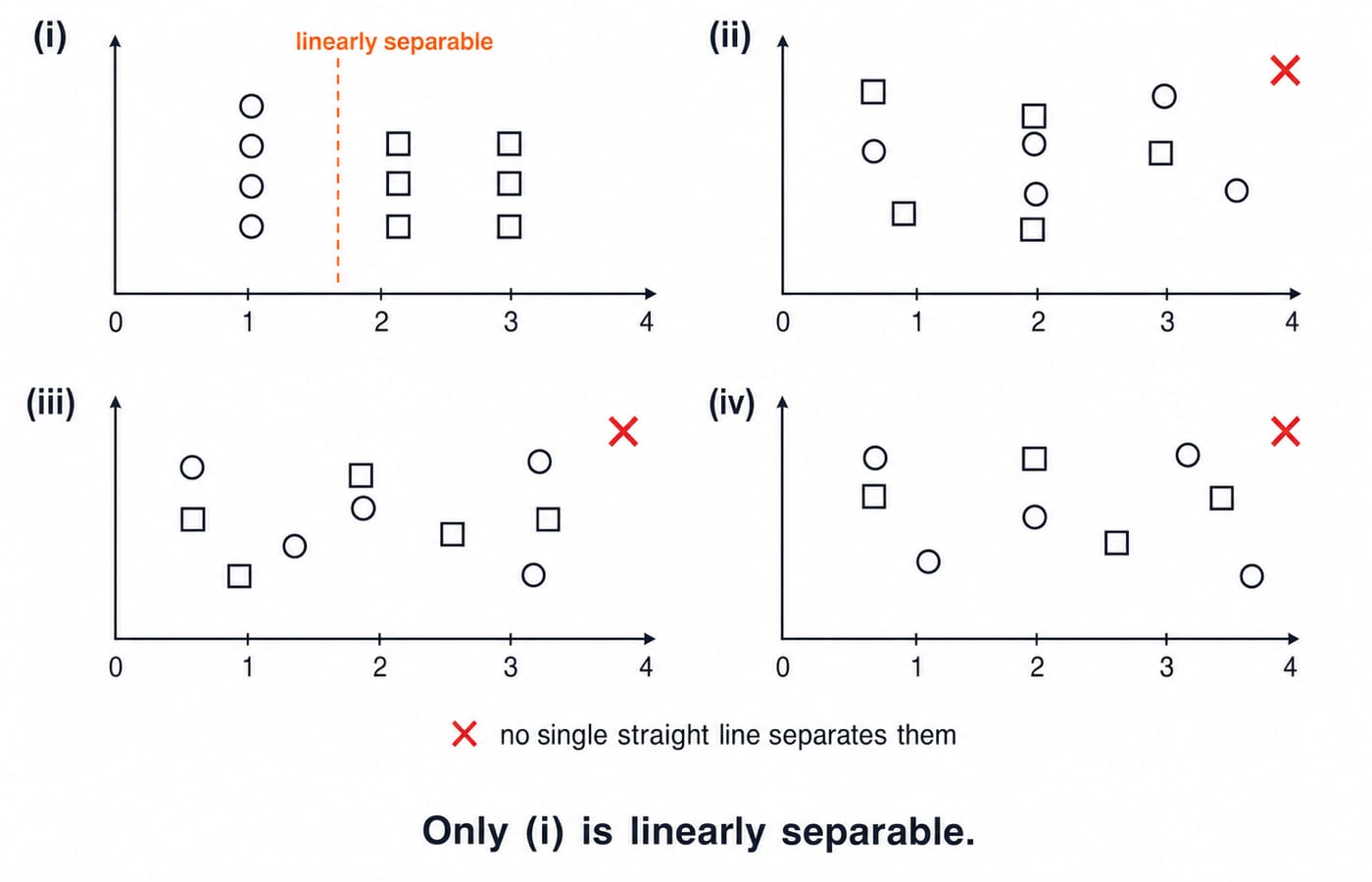
Stem: Consider the following figures representing datasets consisting of two-dimensional features with two classes denoted by circles and squares. Which of the following is/are TRUE?
A. (i) is linearly separable
B. (ii) is linearly separable
C. (iii) is linearly separable
D. (iv) is linearly separable
Correct answer: A only
In figure (i), circles sit near x=1 and squares near x=2 and x=3. The midpoint of x=1 and x=2 is x=1.5, so a vertical line there cleanly separates them. In (ii), (iii) and (iv), the classes are intermingled, including both around x=2 in (ii), so one straight line cannot separate them. In this MSQ, judge each option independently.
The short version and where to drill this next
These questions reward exact vocabulary and suspicion of “only”, “entirely” and “requires labelled”. For Assertion-Reason, hold onto labelled versus unlabelled data. For reinforcement learning, remember that temporal-difference learning is model-free. For the MSQ, ask whether one line separates both classes.
Attempt each question cold, then work the same items inside the NTA UGC NET Paper 2 course, where they sit beside the rest of the Artificial Intelligence unit. Build weak ML foundations through CS Fundamentals for Placements. Next, try Theory of Computation MCQs.
Keep learning
Ecosystem Fundamentals MCQs: 10 Solved Questions on Meaning and Ecological Organisation
Solve 10 ecosystem MCQs with clear explanations of ecological organisation, productivity, sustainability, environmental ethics, energy balance and conservation.
8 Sep 20268 min readMCQ Practice

Architectural and Component Design MCQs: 12 Solved Questions
Solve 12 bank MCQs on software architecture, component roles, repositories, MVC, DFDs, structure charts and UML, each with a direct worked explanation.
Updated 6 Sep 20268 min readMCQ Practice
C++ Constructors MCQs: 12 Solved Object-Initialization Questions
Solve 12 published C++ constructor questions by tracing object creation, copy semantics, arrays, access, virtual rules, and dynamic allocation.
Updated 5 Sep 20267 min readMCQ Practice
Clipping Algorithms MCQs: 11 Solved Cohen-Sutherland and Cyrus-Beck Questions
Solve 11 clipping questions with fresh explanations, checked outcodes, line classifications, boundary intersections and a practical revision routine.
Updated 3 Sep 20268 min readMCQ Practice