Philosophical and Theoretical Approaches to AI: Four Classical Views, Major Schools and a Worked Example
Separate the goals, engineering schools and philosophical claims behind AI. Then compare four classical approaches through one route-choice problem.
KnowledgeGate Team
Exam prep & CS education
Updated 27 Sep 20265 min read
An “approach to AI” may mean a criterion for intelligence, an engineering school, or a philosophical claim about machine understanding. The four classical approaches differ by whether they target reasoning or action and human likeness or rationality, as shown by a route-choice example.
Philosophical and theoretical approaches to AI: three different questions
A success criterion asks what counts as intelligent behaviour. An engineering school asks how a system produces it. A philosophical position asks what it implies about mind and understanding.
Layer | Question | Examples |
|---|---|---|
Success criterion | What counts as intelligence? | Thinking humanly, acting humanly, thinking rationally, acting rationally |
Engineering school | How is it produced? | Symbolic, connectionist, probabilistic, evolutionary, embodied, hybrid |
Philosophical position | What does it mean? | Weak AI, strong AI, functionalism, biological naturalism |
The Approaches to AI: Four Approaches and a Worked Example gives the full four-quadrant and Turing Test treatment. That quadrant answers only what counts as intelligence; engineering schools explain mechanisms, while philosophical positions examine machine understanding. A neural network can face an acting-humanly test or serve a rational agent, and a symbolic program does not imply strong AI.
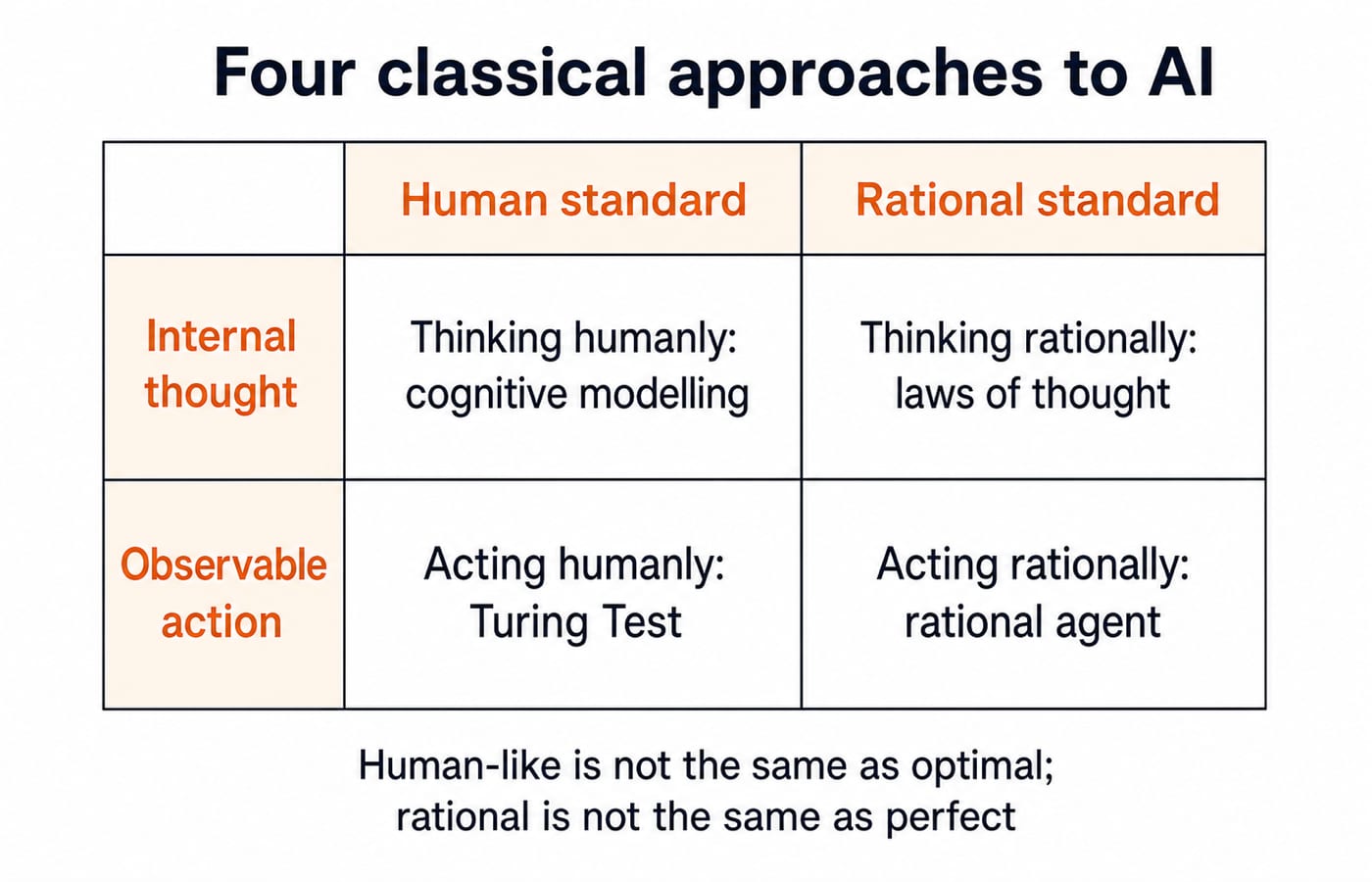
Four classical approaches to AI: human thought, human action, rational thought and rational action
Russell and Norvig arrange four approaches as a 2 × 2: internal reasoning versus observable action, and human likeness versus rationality.
Thinking humanly, or cognitive modelling: model how people think, using response times, errors or cognitive experiments. Psychological accuracy need not be optimal.
Acting humanly: produce behaviour a human judge cannot reliably distinguish from human behaviour. Alan Turing’s Turing Test is the classic reference, but performance does not prove consciousness.
Thinking rationally, or laws of thought: derive valid conclusions from explicit premises. Formal validity is transparent, but uncertainty, incomplete knowledge and computational cost trouble pure deduction.
Acting rationally, or the rational-agent approach: choose the action expected to best achieve the objective with available information and constraints. Rational does not mean omniscient or always successful.
Theoretical schools of AI: symbolic, connectionist, probabilistic, evolutionary and embodied
These schools describe mechanisms rather than targets.
School | Core representation | What it does well | Typical limitation |
|---|---|---|---|
Symbolic AI | Symbols and rules | Inspectable reasoning | Brittle with incomplete knowledge |
Connectionism | Distributed representations learned from examples | Learning patterns | Hard to interpret |
Probabilistic AI | Probabilities over events or states | Handles uncertainty | Depends on assumptions and estimates |
Evolutionary AI | Populations of candidate solutions | Searches irregular spaces | Computationally expensive |
Embodied or behaviour-based AI | Perception-action loops | Responsive situated behaviour | Hard to express as one abstract theory |
Hybrid AI | Two or more forms | Combines strengths | Adds integration complexity |
For a delivery robot, a symbolic controller applies if obstacle then detour; a connectionist model recognises camera data; a probabilistic planner uses P(corridor open)=0.70; and an embodied controller reacts to a sensed trolley. A hybrid agent connects them.
Symbolic AI uses formal representations and inference. Propositional and Predicate Logic: Truth Tables to Proofs teaches that foundation, but propositional logic is not all of symbolic AI.
Four AI approaches worked example: choosing a delivery route
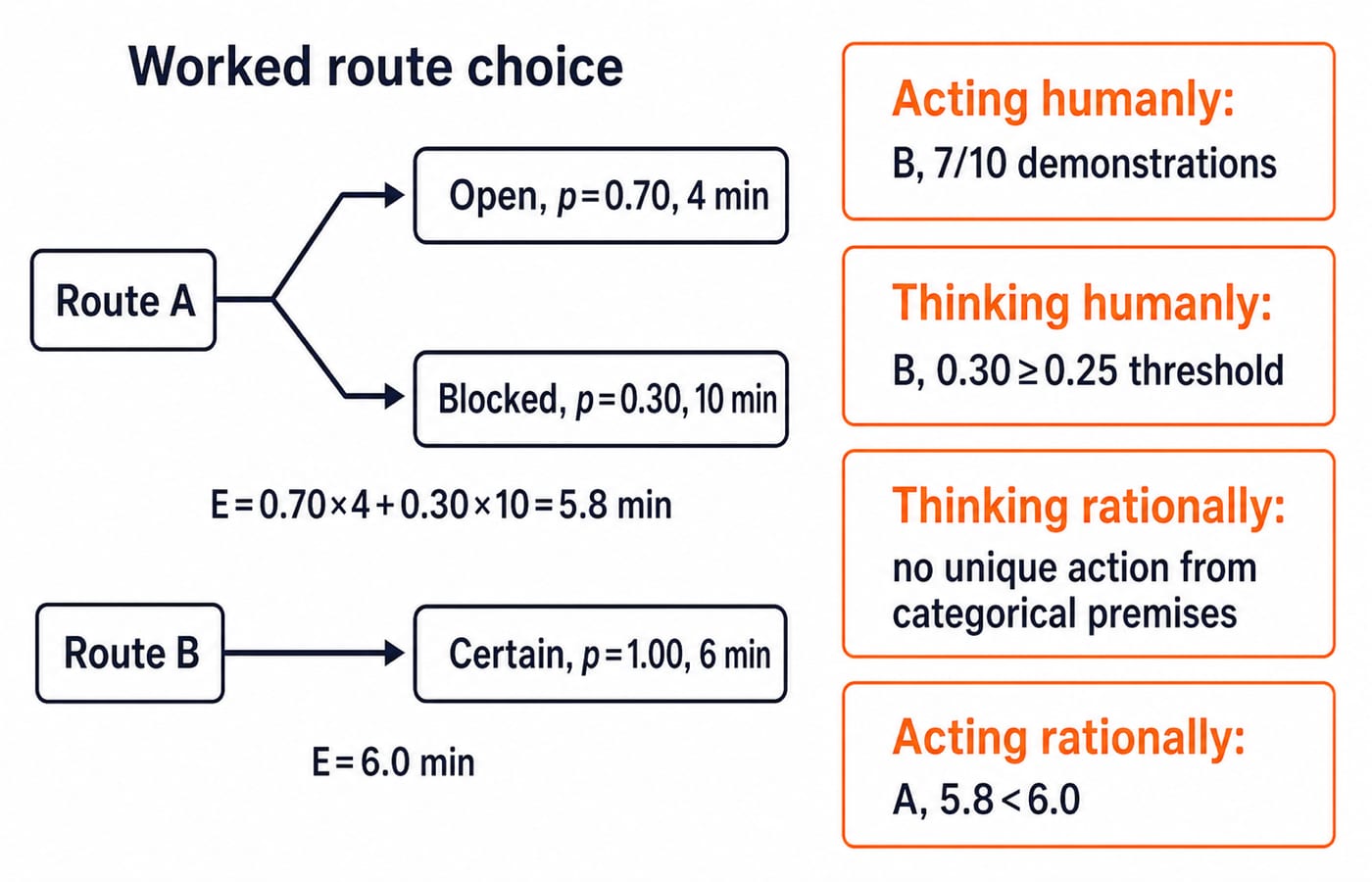
A campus delivery robot must choose before entering either corridor. Route A takes 4 minutes when open with probability 0.70, and 10 minutes when blocked with probability 0.30. Route B always takes 6 minutes. In 10 human demonstrations, 3 people chose A and 7 chose B.
The novice model says, “Choose the guaranteed route when blockage probability is at least 0.25.” The rational agent minimises expected delivery time.
Acting humanly: imitate the majority. Since 7 of 10 people chose B, predict B.
Thinking humanly: apply the novice model’s threshold rule. Since
0.30 ≥ 0.25, predict B. This tests fidelity to the stipulated model, not a rule followed by every person.Thinking rationally: use
Open(A) → time(A)=4 < 6 → choose AandBlocked(A) → time(A)=10 > 6 → choose B. Neither condition is known categorically before entry, so deduction alone selects no route without an uncertainty rule.Acting rationally: compute expected time:
E[time(A)] = 0.70 × 4 + 0.30 × 10 = 2.8 + 3.0 = 5.8 minutesE[time(B)] = 1.00 × 6 = 6.0 minutesSince
5.8 < 6.0, choose A, with an expected advantage of6.0 - 5.8 = 0.2 minute.
B fits imitation and the cognitive model. A fits the expected-time objective. Logic needs uncertainty machinery. A heavy penalty for delay variability could rationally change the action under a different utility function.
Philosophical debates in AI: simulation, understanding and machine minds
Weak AI says machines can perform apparently intelligent tasks. Strong AI makes the stronger claim that an appropriately built machine could possess genuine understanding or mind. Narrow versus general AI instead distinguishes capability breadth.
Functionalism defines mental states by their causal roles, so the same functional organisation might exist in different physical substrates. Biological-naturalist objections argue that computation or symbol manipulation alone may not be sufficient for understanding.
John Searle’s Chinese Room examines syntax without semantics. The symbol-grounding problem asks how symbols gain meaning beyond relations to other symbols. These arguments remain open, not settled proof. Passing the Turing Test settles neither question.
Philosophical approaches to AI in exam questions
Recurring questions match scenarios to approaches, distinguish Turing Test performance from cognitive modelling, separate symbolic from connectionist systems, or evaluate weak AI, strong AI, the Chinese Room and rational agents.
Use this self-check:
“Copy the 7/10 human majority.” Acting humanly.
“Choose A from 5.8 versus 6.0.” Acting rationally.
“Apply implications but lack the required fact.” Thinking rationally.
For exam revision, classify each stem by layer before choosing an answer: success criterion, engineering mechanism or philosophical claim.
Common mistakes when comparing AI approaches
Mistake | Why it fails | Correct test |
|---|---|---|
Turing Test means thinking humanly | It observes behaviour, not process | Acting humanly |
Rational behaviour must copy humans | Preference and objective may differ | Ask what best serves the objective |
Symbolic versus connectionist settles strong AI | Implementation is not a philosophical verdict | Separate mechanism from mind claims |
A rational agent always wins | Information and constraints are limited | Judge the choice from available inputs |
Deep learning means all AI | It is one connectionist family | Identify the representation and method |
For quadrant questions, ask whether the target is internal process or external action, then whether the standard is human likeness or rationality. Machine-mind claims are positions or arguments, not factual verdicts.
Philosophical and theoretical approaches to AI: the short version and next step
Thinking humanly models human cognition.
Acting humanly targets human-like behaviour.
Thinking rationally applies valid inference.
Acting rationally serves a stated objective.
Symbolic, connectionist, probabilistic, evolutionary and embodied schools provide mechanisms, while hybrids combine them.
Weak AI and strong AI make different claims about performance and genuine mind.
In the example, imitation and the cognitive model choose B, expected-time rationality chooses A, and categorical deduction is under-specified.
Move into application with AI & ML for Placements | Generative AI Placement Course or browse Skill Development Courses. For a broader Computer Science foundation, use Zero to Hero Complete CS Course.
Redraw the 2 × 2, recompute 5.8 versus 6.0, then classify three scenarios without looking at the labels.
Keep learning
Intelligent and Rational Agents in AI: PEAS, Worked Decisions and Exam Traps
Learn what makes an AI agent rational, specify its task with PEAS, update a belief using Bayes' rule, and see why coordination matters in multi-agent systems.
Updated 7 Oct 20266 min readML & Data Science
A* Search Algorithm: Step-by-Step Worked Example, Heuristics and Exam Traps
Learn A* from first principles, follow every relaxation on a weighted graph, and test optimality, tie-breaking, parent updates and heuristic quality.
Updated 2 Oct 20266 min readML & Data Science
Artificial Intelligence for GATE: An 8-Week Topic-by-Topic Study Plan
Turn a 12-hour weekly budget into an eight-week AI study cycle with dependency-led concepts, hand-solved traces, timed sets, and error-driven revision.
25 Sep 20265 min readML & Data Science
Artificial Intelligence for ICT Exams: Concepts, Tools and Worked Examples
Build a clear AI concept ladder, learn the main learning types, calculate classifier metrics step by step, and apply a practical tool-checking routine.
Updated 23 Sep 20266 min readML & Data Science