Approaches to AI: The Four Approaches, a Worked Rational-Agent Example, and How Exams Test Them
Separate the four classic approaches to AI, score a rational vacuum agent step by step, and learn the distinctions that matter in exams and interviews.
KnowledgeGate Team
Exam prep & CS education
Updated 26 Jul 20265 min read105 views
Every AI syllabus starts with approaches to artificial intelligence, and most standard textbooks open with the same two-by-two map. Yet students lose easy questions because thinking rationally and acting rationally sound almost identical. One axis separates them: thinking rationally is judged on whether the reasoning obeys the laws of thought, while acting rationally is judged only on whether the chosen action maximises a stated performance measure.
The map: four approaches on two axes
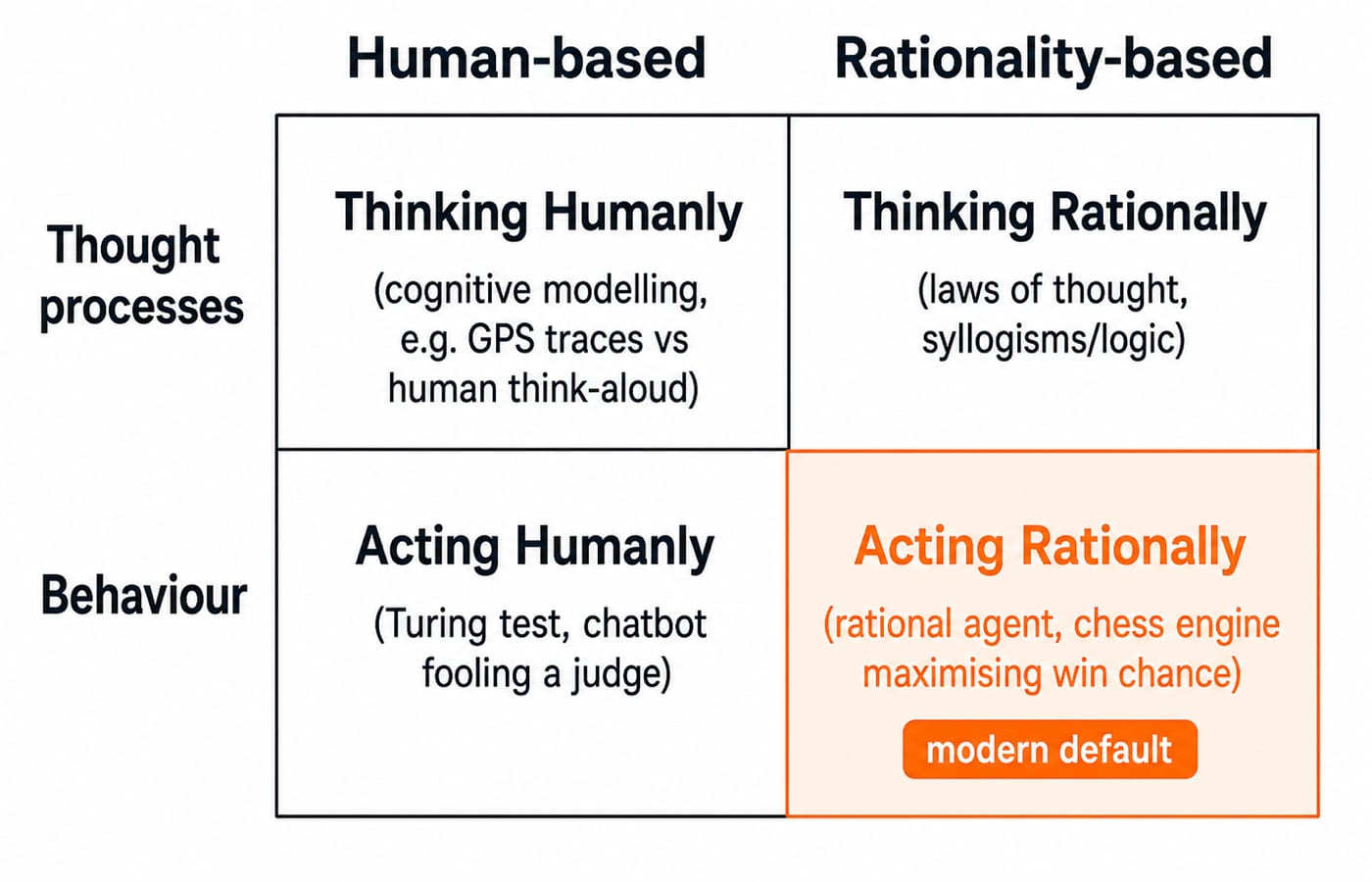
Russell and Norvig organise AI definitions along two axes. The first contrasts human performance with ideal rational performance. The second contrasts internal thought processes with observable behaviour.
The two choices on each axis create exactly four approaches:
Approach | One-line slogan |
|---|---|
Thinking humanly | Model how humans actually think |
Acting humanly | Behave in a way that appears human |
Thinking rationally | Derive correct conclusions through laws of thought |
Acting rationally | Choose actions that maximise expected performance |
Modern AI mainly uses acting rationally, the rational-agent approach. Rationality can be defined through performance and expected outcomes, while human likeness changes with context.
Acting humanly: the Turing test, precisely
In the standard Turing test, an interrogator exchanges text with a hidden human and a hidden program. The program passes if the interrogator cannot reliably distinguish them.
A program needs four capabilities for the standard test. Multiple-select questions quote this list verbatim, and MCQ, MSQ or NAT? GATE Question Types Explained sets out how each question format is answered and scored. Memorise all four:
Natural language processing
Knowledge representation
Automated reasoning
Machine learning
The total Turing test adds computer vision for perception and robotics for manipulation. Computer vision does not belong to the standard text-only version.
Passing the test is not the main goal of most AI research. Aircraft came from studying aerodynamics, not copying every movement of a pigeon. AI likewise values underlying principles over surface imitation.
Thinking humanly and thinking rationally
Thinking humanly means cognitive modelling: make a program's reasoning steps resemble human reasoning, then test the resemblance through introspection, psychological experiments, and brain imaging. Researchers compared traces from the General Problem Solver, or GPS, with human think-aloud records for the same problems.
Thinking rationally follows the logicist tradition, from Aristotle's syllogisms to first-order logic. Facts are written formally, and valid rules derive conclusions. For example:
All GATE toppers practise PYQs.
Riya is a GATE topper.
Therefore, Riya practises PYQs.
A theorem prover derives this mechanically, but two obstacles remain. Informal or uncertain knowledge is hard to express in strict logic. Inference can also grow combinatorially, making a solution that exists in principle impractical to find.
Acting rationally: a worked two-square vacuum agent
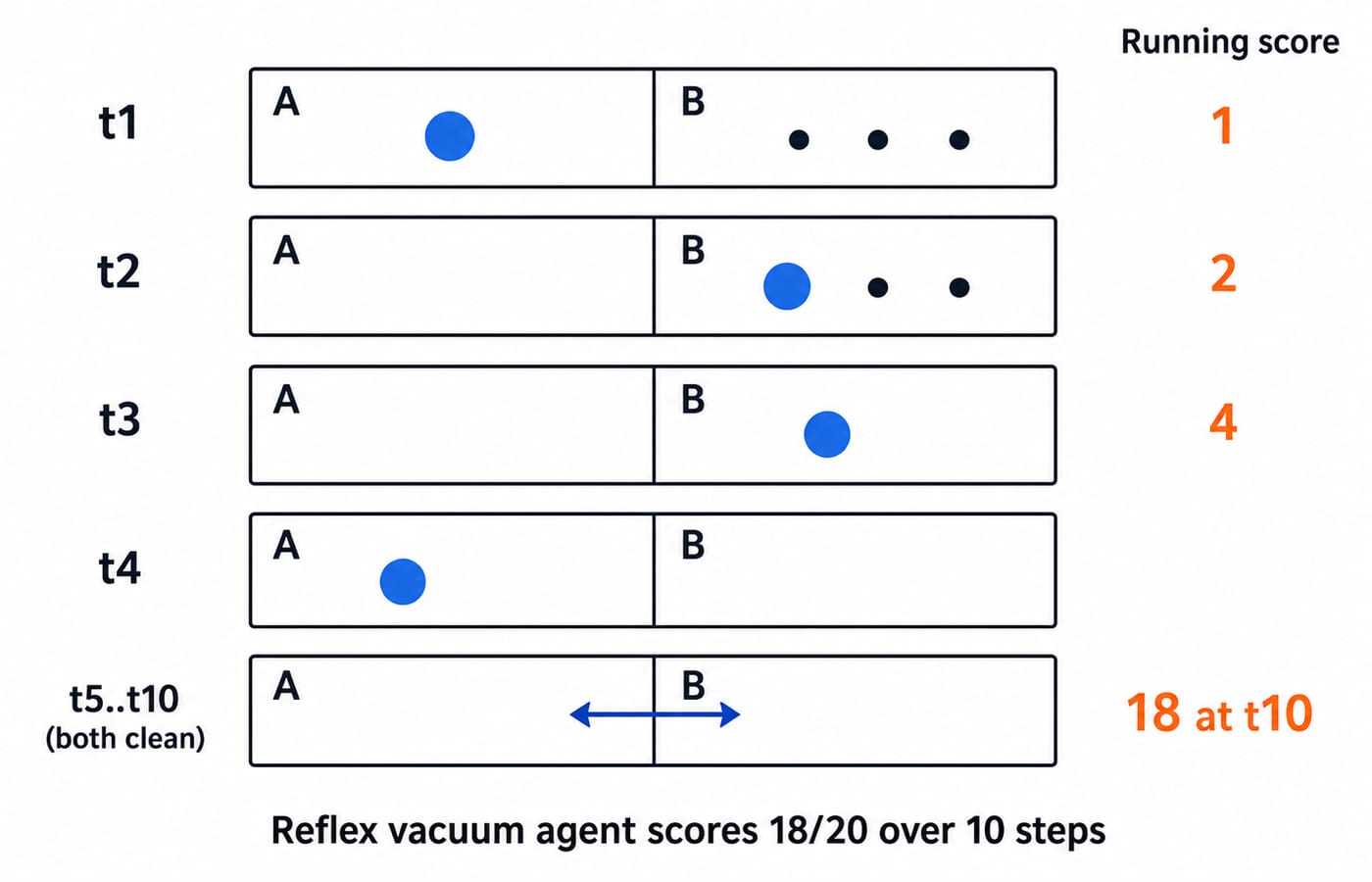
Consider a vacuum world with square A on the left and square B on the right. At each step the agent perceives its current location and whether that square is Dirty or Clean. Its actions are Suck, Left, and Right. It earns 1 point for each clean square after each action, over 10 time steps. Initially, the agent is in A and both squares are dirty.
The simple reflex agent uses two rules: if the current square is Dirty, Suck; otherwise, move to the other square.
Percept | Action |
|---|---|
(A, Dirty) | Suck |
(A, Clean) | Right |
(B, Dirty) | Suck |
(B, Clean) | Left |
Now score the environment after every action:
Time | Action and resulting state | Step score | Running total |
|---|---|---|---|
t1 | Suck in A, so A is clean and B is dirty | 1 | 1 |
t2 | Move Right, with A clean and B still dirty | 1 | 2 |
t3 | Suck in B, so both squares are clean | 2 | 4 |
t4 to t10 | Both squares remain clean for 7 steps | 7 x 2 = 14 | 18 |
The final score is 18 out of a theoretical maximum of 20. The two missing points occur at t1 and t2: starting with both squares dirty and needing a separate move means only one square can be clean at those steps. An agent that only shuttles Left and Right and never Sucks leaves both squares dirty, so it scores 0 over the same 10 steps.
This is rational behaviour because the agent chooses actions that maximise the expected performance measure given its percept sequence and built-in knowledge.
The wider AI vocabulary
Symbolic AI, or GOFAI, represents explicit knowledge and applies logical rules, as expert systems do. It can be interpretable, but hand-encoding broad knowledge is difficult.
Connectionist or sub-symbolic AI learns representations from data, usually with neural networks. It handles raw inputs well but can be harder to explain. Statistical and probabilistic AI supports learning and action under uncertainty and dominates much current work.
Strong AI claims that a machine can genuinely possess a mind. Weak AI only says it can act as if intelligent. Exam options often swap these definitions.
An agent perceives through sensors and acts through actuators. Rationality selects the action expected to perform best from available evidence. Omniscience knows every actual outcome. A rational agent is not omniscient, so a sound choice can still end poorly.
Traps that cost marks
Thinking rationally versus acting rationally: both use rationality, so students choose logic for an agent question. Fix the thought-versus-behaviour axis first, then the human-versus-rational axis.
Standard versus total Turing test: computer vision and robotics belong only to the total test. The standard test needs the four text-conversation capabilities.
Turing test versus rationality: a program might imitate typos or arithmetic slips to appear human. That can support acting humanly without being rational.
Strong versus weak AI: strong AI makes the genuine-mind claim; weak AI only requires intelligent-looking performance.
Rational means always wins: rational action maximises expected performance. It cannot guarantee an outcome when information is incomplete or the environment is uncertain.
How GATE-style papers and interviews test this
Expect definition matching, an MSQ on Turing test capabilities, or assertion-reason items on rationality versus omniscience. Try this drill:
A chess engine chooses the move that maximises its winning probability: acting rationally.
A chatbot is judged by whether a text interrogator can distinguish it from a person: acting humanly.
GPS traces are compared with human think-aloud records: thinking humanly.
A program derives conclusions from premises through first-order logic: thinking rationally.
These foundations appear in GATE-style AI sections, notably the Data Science and AI paper, plus semester exams and teaching or PSC recruitment papers. For wider planning, see GATE CS Subject Weightage: Where Hours Pay Off.
In interviews, "Define AI" and "What is a rational agent?" are common warm-ups. Name all four approaches, then give the rational-agent definition. The AI & ML for Placements | Generative AI Placement Course develops the wider application context.
The short version and the next step
Two axes produce four approaches: thinking humanly, acting humanly, thinking rationally, and acting rationally. The Turing test is about acting humanly and its standard version needs four capabilities. Modern AI mostly follows rational agents, and the vacuum agent scored 18/20 because its actions maximised the stated performance measure.
For structured GATE CS preparation, GATE Guidance by Sanchit Sir provides the larger learning path. Next, read Artificial Intelligence for GATE: Syllabus Areas, Weightage Pattern and Prep Order to see where these foundations sit in the wider AI syllabus.
Keep learning
Agent Architecture and Program Types in AI: A Worked Warehouse Example and Exam Traps
Separate architecture, program and agent function, then compare four program types through one fully worked warehouse routing problem.
Updated 25 Oct 20266 min readML & Data Science
Problem Representation in AI: State Space, Worked Water-Jug Example and Exam Traps
Learn how states, operators, goals and costs turn a verbal task into a search problem. The worked water-jug trace separates valid states from reachable ones.
Updated 23 Oct 20265 min readML & Data Science
Foundations and Evolution of AI: Approaches, Timeline and a Worked Rational-Agent Example
Build a connected map of AI foundations, historical shifts and major paradigms, then calculate how a rational agent chooses under uncertainty.
Updated 19 Oct 20266 min readML & Data Science
Natural Language Processing Explained: Pipeline, TF-IDF Worked Example and Exam Patterns
Start from raw text, build BoW and TF-IDF vectors, compute cosine similarity, examine ambiguity, and finish with evaluation and exam-style checks.
Updated 15 Oct 20266 min readML & Data Science