Expert Systems and Uncertainty MCQs: 11 Solved Questions
Solve 11 previous-year MCQs on expert-system roles, inference strategies, Bayesian networks, conditional probability, and certainty-factor calculations.
KnowledgeGate Team
Exam prep & CS education
Updated 13 Aug 20268 min read
Expert systems questions crowd four near-identical labels into a single paper: the knowledge engineer, the knowledge editor, the knowledge base and the inference engine. Uncertainty questions then swap vocabulary for arithmetic, and the two methods on the syllabus, Bayesian updating and certainty factors, do not combine evidence the same way. One vocabulary error can spoil an architecture answer, while a skipped denominator can spoil a probability answer.
Eleven previous-year questions follow, ordered from architecture through inference strategies to Bayesian probability and certainty factors. Each one carries its exam and year, its full option set, and a worked explanation. Architecture items turn on vocabulary, so naming the wrong role loses the mark outright. Uncertainty items turn on arithmetic, and both Bayesian questions here are decided by the denominator rather than the numerator. Expert systems sit inside the artificial intelligence unit of UGC NET Paper 2, next to search and knowledge representation, and those courses are listed under NET courses and preparation.
Expert System Architecture and Roles MCQs
Questions 1 and 2 contrast an editor, the knowledge-entry tool, with an engineer, the human who elicits and structures that knowledge. Questions 3 and 4 then move to the modules themselves and to what separates an expert system from an ordinary reporting system.
Question 1, DSSSB 2021.
Browse the Expert Systems and Uncertainty PYQ set.
_____ act as an interface between a domain expert and an expert system.
A. Language Editor
B. K editor
C. Intelligent editor
D. Knowledge Editor
Answer and explanation: D, Knowledge Editor. This interface captures and maintains domain knowledge. The human who elicits and models that knowledge is the knowledge engineer.
Question 2, DSSSB 2021.
Attempt this DSSSB 2021 question in the PYQ practice set.
Which of the following acts as an intermediary between the specialist and the expert system?
A. Knowledge base
B. Inference engine
C. Data dictionary
D. Knowledge engineer
Answer and explanation: D, Knowledge engineer. This person converts a specialist's expertise into usable representations. The knowledge base stores them, while the inference engine reasons over them. A complete CS concept course places both roles in the full lesson sequence.
Question 3, UGC NET 2014.
Attempt this UGC NET 2014 question in the PYQ practice set.
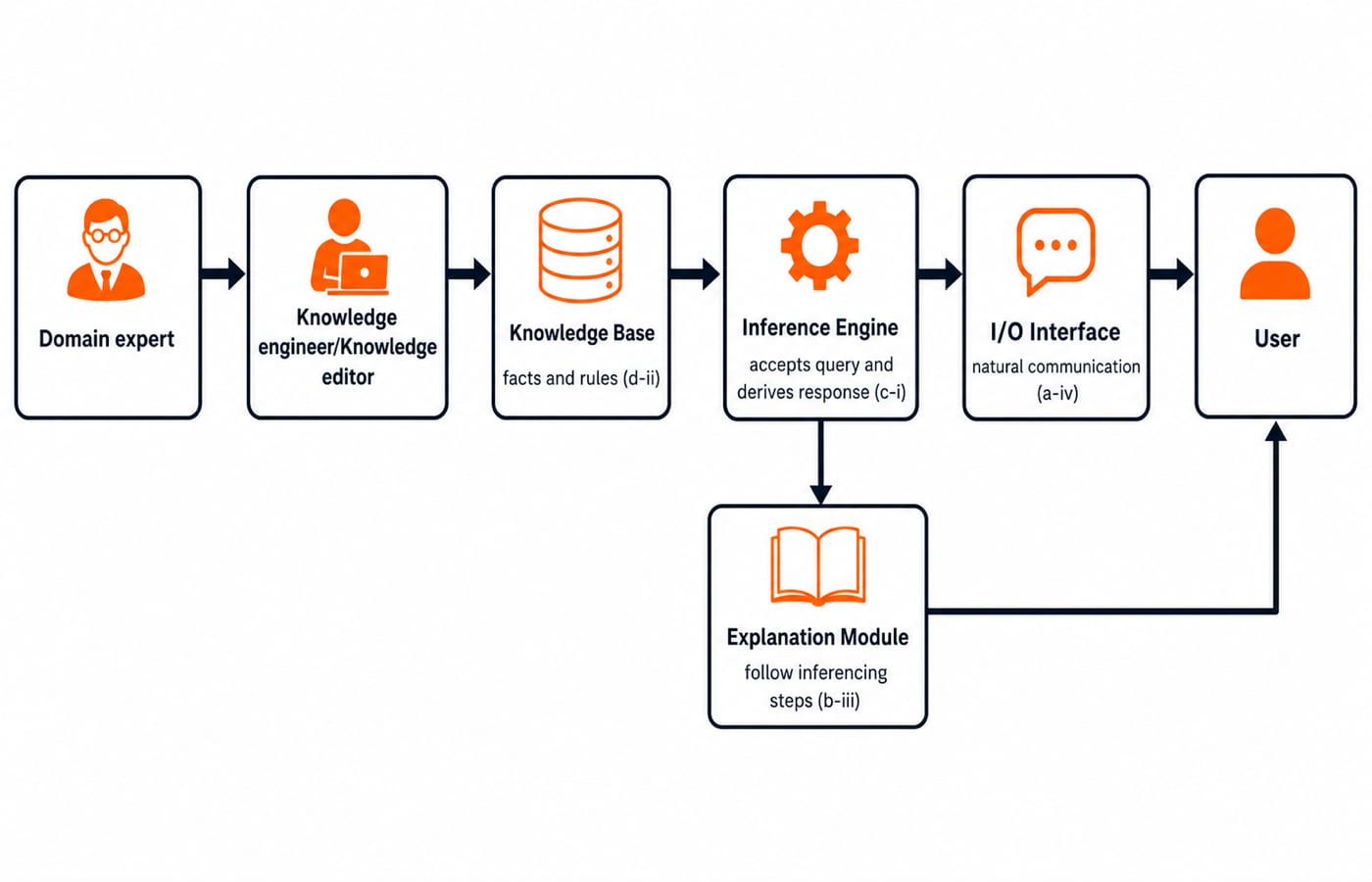
Match the following components of an expert system :
List – I | List – II |
|---|---|
a. I/O Interface | i. Accepts user’s queries and responds to question through I/O interface |
b. Explanation Module | ii. Contains facts and rules about the domain |
c. Inference Engine | iii. Gives the user, the ability to follow inferencing steps at any time during consultation |
d. Knowledge Base | iv. Permits the user to communicate with the system in a natural way |
Codes :
A. a-i, b-iii, c-iv, d-ii
B. a-iv, b-iii, c-i, d-ii
C. a-i, b-iii, c-ii, d-iv
D. a-iv, b-i, c-iii, d-ii
Answer and explanation: B, a-iv, b-iii, c-i, d-ii. I/O gives natural communication, explanation shows inference steps, the engine derives responses, and the base stores facts and rules. Lock d-ii and b-iii first, then check the code.
Question 4, DSSSB 2021.
Attempt this DSSSB 2021 question in the PYQ practice set.
Which of the following characteristic(s) of expert systems is/are correct? I. The direction of interaction is from machine to the user. II. Its domain of knowledge is narrow. III. Information is produced by analysis of operational and external data.
A. I and III
B. Only II
C. I and II
D. I, II and III
Answer and explanation: C, I and II. An expert system pushes advice out to the user, and it does so only inside a narrow, deep domain such as blood-infection diagnosis or mineral prospecting. Statement III describes a management information system, which summarises operational and external data; an expert system instead reasons over rules elicited from a human expert.
Inference Engine and Reasoning Strategy MCQs
The inference engine is a component. Forward chaining, backward chaining and problem reduction are the strategies it runs. Examiners swap those two categories deliberately, so read whether the stem is asking for a part of the system or for a way of searching it.
Question 5, UGC NET 2016.
Attempt this UGC NET 2016 question in the PYQ practice set.
A software program that infers and manipulates existing knowledge in order to generate new knowledge is known as :
A. Data dictionary
B. Reference mechanism
C. Inference engine
D. Control strategy
Answer and explanation: C, Inference engine. It applies rules to facts and derives conclusions. A data dictionary describes data, while a control strategy selects rules.
Question 6, UGC NET 2015.
Attempt this UGC NET 2015 question in the PYQ practice set.
Reasoning strategies used in expert systems include ________ .
A. Forward chaining, backward chaining and problem reduction
B. Forward chaining, backward chaining and boundary mutation
C. Forward chaining, backward chaining and back propagation
D. Forward chaining, problem reduction and boundary mutation
Answer and explanation: A, Forward chaining, backward chaining and problem reduction. Forward chaining is data-driven; backward chaining is goal-driven. Back propagation trains neural networks, while boundary mutation is not the tested expert-system strategy.
Question 7, UGC NET 2014.
Attempt this UGC NET 2014 question in the PYQ practice set.
Match the following :
List – I | List – II |
|---|---|
a. Expert systems | i. Pragmatics |
b. Planning | ii. Resolution |
c. Prolog | iii. Means-end analysis |
d. Natural language processing | iv. Explanation facility |
Codes :
A. a-iii, b-iv, c-i, d-ii
B. a-iii, b-iv, c-ii, d-i
C. a-i, b-ii, c-iii, d-iv
D. a-iv, b-iii, c-ii, d-i
Answer and explanation: D, a-iv, b-iii, c-ii, d-i. Match expert systems with explanation, planning with means-end analysis, Prolog with resolution, and NLP with pragmatics. Lock Prolog-resolution first. Revise predicate logic and its inference foundations if that pair is unfamiliar.
Bayesian Networks and Conditional Probability MCQs
A Bayesian network stores uncertainty as structure: a directed graph of dependencies, plus a conditional probability table at each node. Questions 9 and 10 then turn on the same single step, dividing by the total probability of the evidence.
Question 8, BPSC 2024.
Attempt this BPSC 2024 question in the PYQ practice set.
What does the Bayesian network provide?
A. Partial description of the domain
B. Complete description of the problem
C. Complete description of the domain
D. More than one of the above
E. None of the above
Answer and explanation: C, Complete description of the domain. The graph records dependencies, while tables supply local probabilities. Together they specify the represented domain's full joint distribution.
Question 9, UGC NET 2021.
Attempt this UGC NET 2021 question in the PYQ practice set.
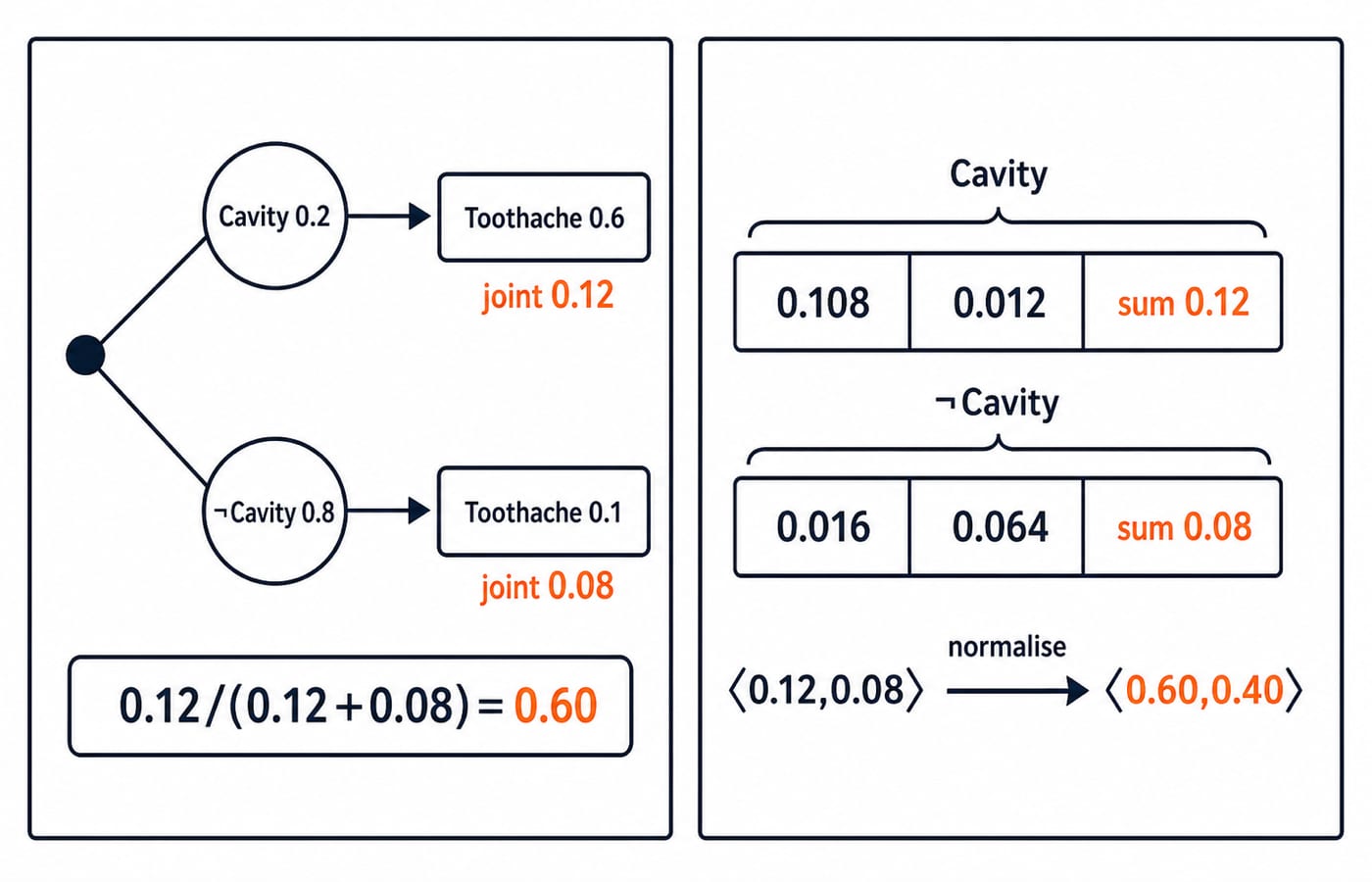
A diagnostic model relates a dental cavity to the symptom toothache. The following probabilities are given: P(cavity) = 0.2, P(toothache | cavity) = 0.6, and P(toothache | ¬cavity) = 0.1. Using these values, the probability of a cavity given evidence of a toothache, P(cavity | toothache), is __________.
A. 0.400
B. 0.600
C. 0.280
D. 0.216
Answer and explanation: B, 0.600. P(cavity and toothache) = 0.2 x 0.6 = 0.12. P(no cavity and toothache) = 0.8 x 0.1 = 0.08, giving denominator 0.12 + 0.08 = 0.20. Thus P(cavity | toothache) = 0.12 / 0.20 = 0.60.
Question 10, UGC NET 2018.
Attempt this UGC NET 2018 question in the PYQ practice set.
A full joint distribution for the Toothache, Cavity and Catch is given in the table below
Toothache, Catch | Toothache, ¬Catch | ¬Toothache, Catch | ¬Toothache, ¬Catch | |
|---|---|---|---|---|
Cavity | 0.108 | 0.012 | 0.072 | 0.008 |
¬Cavity | 0.016 | 0.064 | 0.144 | 0.576 |
What is the probability of Cavity, given evidence of Toothache?
A. ⟨0.2,0.8⟩
B. ⟨0.4,0.8⟩
C. ⟨0.6,0.8⟩
D. ⟨0.6,0.4⟩
Answer and explanation: D, ⟨0.6,0.4⟩. Sum over Catch: Cavity gives 0.108 + 0.012 = 0.12; ¬Cavity gives 0.016 + 0.064 = 0.08. The denominator is 0.20. Normalising ⟨0.12,0.08⟩ gives ⟨0.60,0.40⟩.
Certainty Factor Calculation MCQ
Certainty factors are the MYCIN-style alternative to probability. Premises combine with min for AND and max for OR, and nothing is normalised, so no denominator appears anywhere in the working.
Question 11, UGC NET 2022.
Attempt this UGC NET 2022 question in the PYQ practice set.
In a database, a rule is defined as (P1 and P2) or P3 → R1(0.8) and R2(0.3), where P1, P2, P3 are premises and R1, R2 are conclusions of rules with certainty factors (CF) 0.8 and 0.3 respectively. If any running program has produced P1, P2, P3 with CF as 0.5, 0.8, 0.2 respectively. Find the CF of results on the basis of premises.
A. CF(R1=0.8),CF(R2=0.3)
B. CF(R1=0.40),CF(R2=0.15)
C. CF(R1=0.15),CF(R2=0.35)
D. CF(R1=0.8),CF(R2=0.35)
Answer and explanation: B, CF(R1=0.40), CF(R2=0.15). AND gives min(0.5, 0.8) = 0.5. OR with P3 gives max(0.5, 0.2) = 0.5. Therefore, 0.5 x 0.8 = 0.40 and 0.5 x 0.3 = 0.15.
Eleven-Question Answer and Concept Map
Question | Answer | Concept |
|---|---|---|
Q1 | D | Knowledge editor |
Q2 | D | Knowledge engineer |
Q3 | B | Component mapping |
Q4 | C | Expert-system characteristics |
Q5 | C | Inference engine |
Q6 | A | Reasoning strategies |
Q7 | D | AI-area matching |
Q8 | C | Bayesian-network description |
Q9 | B | Posterior 0.600 |
Q10 | D | Posterior vector ⟨0.6,0.4⟩ |
Q11 | B | Certainty factors 0.40 and 0.15 |
Classify each miss as a role, component, strategy, or uncertainty calculation. That bucket sets your next revision.
Common Traps and a Fast Revision Method
Watch three traps:
Confusing the human knowledge engineer with the knowledge editor tool.
Treating an inference strategy as the inference engine itself.
Calculating a posterior numerator but skipping the normalising denominator.
For certainty factors: AND takes the minimum, OR takes the maximum, then multiply by each rule's own CF. Revise in two passes. First redraw the architecture from memory. Then redo Questions 9 to 11 with the options covered. Where this subtopic ranks against the rest of the paper is set out in UGC NET Computer Science high-yield topics.
Short Version and Next Step
Architecture questions test who stores, enters, explains, or infers. Uncertainty questions test numerical evidence. For the full learning and PYQ path, follow the NTA-UGC-NET Paper - 2 course. If only this subtopic is weak, revise these eleven questions directly. After a 24-hour gap, redo both Bayesian calculations and the certainty-factor calculation without checking the choices. Write the three final values, both denominators, and the min-max premise value from memory before reopening this page.
Keep learning
Ecosystem Fundamentals MCQs: 10 Solved Questions on Meaning and Ecological Organisation
Solve 10 ecosystem MCQs with clear explanations of ecological organisation, productivity, sustainability, environmental ethics, energy balance and conservation.
8 Sep 20268 min readMCQ Practice

Architectural and Component Design MCQs: 12 Solved Questions
Solve 12 bank MCQs on software architecture, component roles, repositories, MVC, DFDs, structure charts and UML, each with a direct worked explanation.
Updated 6 Sep 20268 min readMCQ Practice
C++ Constructors MCQs: 12 Solved Object-Initialization Questions
Solve 12 published C++ constructor questions by tracing object creation, copy semantics, arrays, access, virtual rules, and dynamic allocation.
Updated 5 Sep 20267 min readMCQ Practice
Clipping Algorithms MCQs: 11 Solved Cohen-Sutherland and Cyrus-Beck Questions
Solve 11 clipping questions with fresh explanations, checked outcodes, line classifications, boundary intersections and a practical revision routine.
Updated 3 Sep 20268 min readMCQ Practice