Foundations and Evolution of AI MCQs: 12 Solved Questions with Explanations
Solve 12 foundations of AI MCQs from DSSSB, HTET, UGC NET and state PSC papers. Each answer explains the definition, founder, test or subfield being examined.
KnowledgeGate Team
Exam prep & CS education
Updated 25 Jul 20267 min read
Foundations and Evolution of AI looks simple until an exam asks you to separate the founder from the test, or the field from one of its subfields. DSSSB, HTET, UPPSC, UGC NET and state PSC papers keep returning to this compact pool of facts.
Eleven of the twelve questions below carry a named exam and year, so you are practising on wording that has already been set. Attempt each one before reading its explanation. Where a question heading is a link, it opens that exact solved page; the remaining four are worked inside the Paper 2 Unit 10 Artificial Intelligence module. If you are mapping the wider paper first, begin with UGC NET Computer Science Syllabus Areas.
What AI actually is: the three definitions exams reuse
Exams repeatedly use three framings. AI is the branch of computer science that builds intelligent machines, Rich and Knight define it through tasks people currently do better, and Russell and Norvig arrange its definitions as thinking or acting, crossed with humanly or rationally. When a stem echoes one of these, identify the framing instead of treating it as an opinion.
Q1. Which of the following is a branch of computer science by which we can create intelligent machines that can behave like a human?
DSSSB 2022
(a) Natural Language Processing
(b) Soft Computing
(c) Artificial Intelligence
(d) Neural Computing
Answer: (c) Artificial Intelligence. The phrases "branch of computer science" and "intelligent machines that can behave like a human" define AI as the field. NLP, soft computing and neural computing are techniques or subareas within that field, so each is too narrow.
Q2. The study of how to make computers do things which, at the moment, people do better:
HTET 2023
(a) Machine Learning
(b) Artificial Intelligence
(c) Cloud Computing
(d) Natural Language Processing
Answer: (b) Artificial Intelligence. This is the Rich and Knight definition of AI, so the answer is the whole field rather than one technique. Machine learning and NLP are subfields, while cloud computing is a way of delivering computing resources.
Q3. Definitions of ___ are organized into the following four categories, namely Thinking Humanly, Thinking Rationally, Acting Humanly, Acting Rationally
UGC NET 2025
(a) Machine Learning
(b) Deep Learning
(c) Artificial Intelligence
(d) Neural Network
Answer: (c) Artificial Intelligence. Russell and Norvig use this four-category grid to organize definitions of AI by thought versus behaviour and human-based versus rationality-based standards. Machine learning, deep learning and neural networks are not organized this way; Acting Humanly is the Turing test approach tested below.
The birth of the field: McCarthy, Dartmouth and LISP
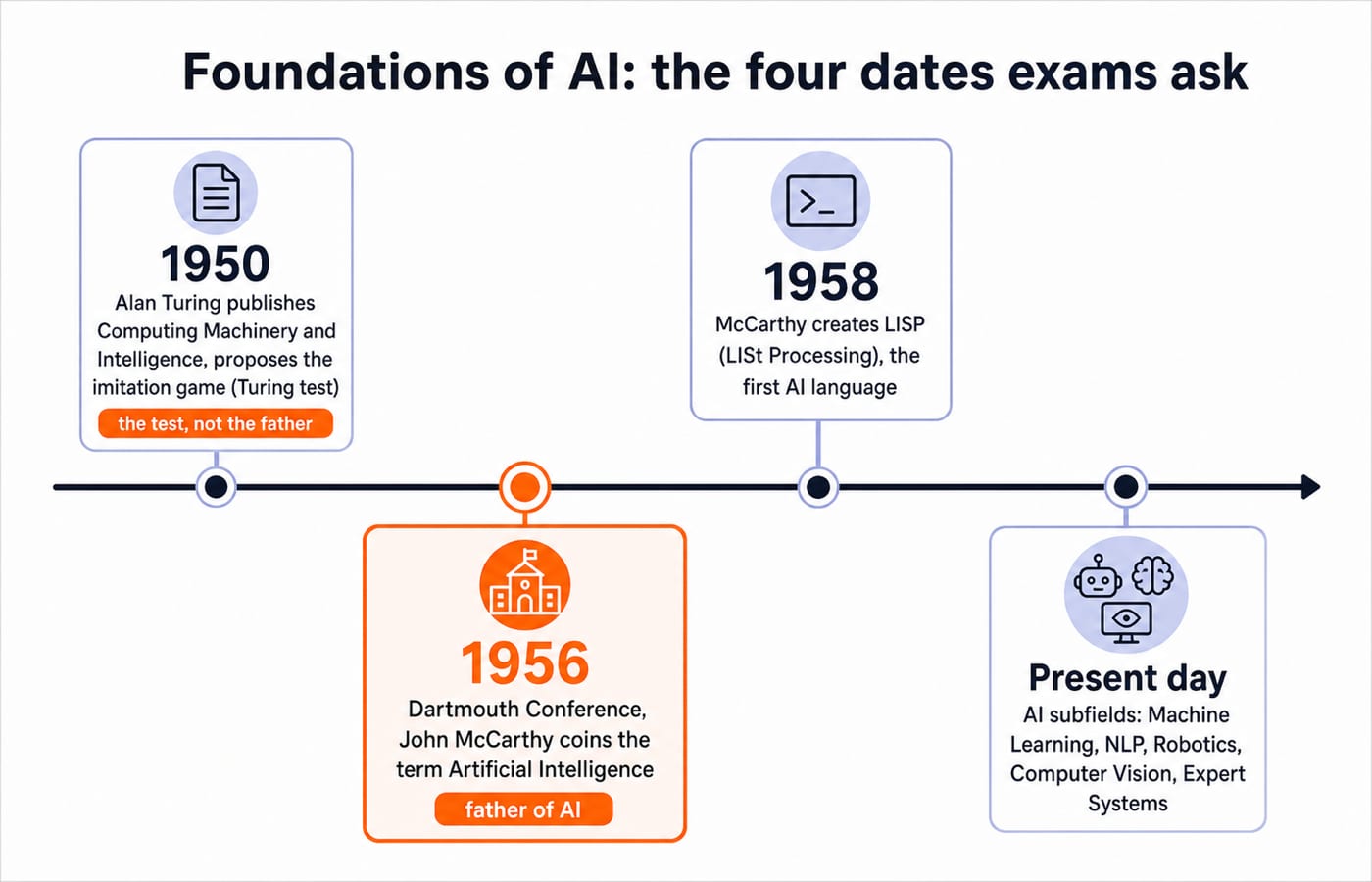
John McCarthy coined the term Artificial Intelligence and organized the 1956 Dartmouth Conference associated with the field's founding. He created LISP in 1958 for symbolic computation. Alan Turing is strong distractor material because his 1950 work and imitation game came before the field received its name.
Q4. Who is known as the father of Artificial Intelligence (AI)?
RSSB 2022
(a) Ada Fisher
(b) Alan Turing
(c) John McCarthy
(d) Allen Newell
Answer: (c) John McCarthy. McCarthy coined the term and convened the Dartmouth meeting, which is why he is called the father of AI. Turing proposed the famous test, while Allen Newell helped build early AI programs but did not name the field.
Q5. What is the full form of LISP Programming Language?
DSSSB 2021
(a) Language Processing
(b) List Processing
(c) Least Processing
(d) Limited Processing
Answer: (b) List Processing. LISP expands to LISt Processing, also written as LISt Processor, and was developed by John McCarthy for work with symbolic lists. Link Q4 and Q5 in memory: the father of AI also developed its early working language.
The Turing test: the operational definition of intelligence
Turing replaced the fuzzy question of whether machines can think with an operational test. A human interrogator communicates without seeing the participants, and the machine passes if its responses cannot be reliably distinguished from a human's. In exam language, both "satisfactory operational definition of intelligence" and "acting humanly" point to this test.
Q6. A test that was designed to provide satisfactory operational definition of intelligence is known as:
UPPSC 2022
(a) Litmus test
(b) T-test
(c) Turing test
(d) Chi-square test
Answer: (c) Turing test. An operational definition specifies a procedure for judging a concept, and the imitation game supplies that procedure for intelligence. Litmus is a chemistry test, while the T-test and chi-square test are statistical tests.
Q7. The Turing Test approach of AI says:
(a) AI is viewed as the study and construction of rational agents. Which acts rationally means acting so as to achieve one's goals, given one's beliefs
(b) The ability to achieve human-level performance in all cognitive tasks, which is sufficient to fool an interrogator is Intelligence of Machine
(c) Both A and B
(d) None of the above
Answer: (b). The Turing test belongs to the Acting Humanly category, so fooling an interrogator through human-level cognitive performance matches it. Option (a) describes Acting Rationally, a separate approach, which also makes option (c) incorrect.
Goals and subfields: what sits inside AI
AI aims both to reproduce aspects of human intelligence and to solve knowledge-intensive tasks. The field contains machine learning, robotics, NLP, computer vision and expert systems. Exams test this container-and-contents relationship in both directions.
Q8. Which of the following is/are goal(s) of Artificial Intelligence? (i) To replicate human intelligence. (ii) To solve knowledge-intensive tasks.
DSSSB 2022
(a) Only (i)
(b) Only (ii)
(c) Both (i) and (ii)
(d) Neither (i) nor (ii)
Answer: (c) Both (i) and (ii). Replicating human intelligence is a broad ambition of AI, while solving knowledge-intensive tasks is a practical goal of AI systems. Since both statements are standard goals, there is no reason to rank one above the other.
Q9. Which of the following is a subfield of AI?
BPSC 2024
(a) Machine Learning
(b) Robotics
(c) Natural Language Processing
(d) More than one of the above
(e) None of the above
Answer: (d) More than one of the above. Machine learning, robotics and NLP are all recognized AI subfields, so several listed choices are correct. In five-option state-commission questions, read through the "more than one" choice before selecting the first individually true option.
Q10. What subsystem of artificial intelligence comprises algorithms that use data to learn on their own and make predictions?
MPPSC 2022
(a) Big Data
(b) Machine Learning
(c) Cloud Computing
(d) Turing Machine
Answer: (b) Machine Learning. Learning from data and making predictions directly defines machine learning. Big data describes the datasets, cloud computing supplies resources, and a Turing machine is a theoretical model of computation rather than an AI subsystem.
Domains and terms: the UGC NET pattern
UGC NET commonly asks you to spot a non-member of an AI-domain list or match terms to short definitions. For efficient revision across the paper, use UGC NET Computer Science High-Yield Topics to decide which neighbouring areas to practise next.
Q11. Which of the following is not considered a domain or application area of Artificial Intelligence?
UGC NET 2020
(a) Computer Vision
(b) Machine Learning
(c) Deep Learning
(d) Text
Answer: (d) Text. Computer vision is an AI application area, machine learning is a core AI approach, and deep learning sits within machine learning. Text by itself is data; the AI field that processes and generates it is natural language processing.
Q12. Match List I with List II
UGC NET 2024
List I (Term) | List II (Definition) |
|---|---|
(A) Natural language processing | (I) A method of training an algorithm by rewarding desired behaviour and punishing undesired behaviour. |
(B) Reinforcement learning | (II) System designed to emulate the decision-making abilities of a human expert. |
(C) Support vector machine | (III) A branch of AI focused on understanding and generating human language. |
(D) Expert system | (IV) A machine-learning technique that finds the hyperplane that best separates different classes in a feature space. |
Choose the correct answer from the options given below:
(a) (A)-(I), (B)-(II), (C)-(IV), (D)-(III)
(b) (A)-(III), (B)-(II), (C)-(I), (D)-(IV)
(c) (A)-(III), (B)-(I), (C)-(IV), (D)-(II)
(d) (A)-(II), (B)-(IV), (C)-(III), (D)-(I)
Answer: (c). Start with the clearest anchors: NLP means human language, giving A-III, and an expert system emulates a human expert, giving D-II. Only option (c) has both; checking the other pairs confirms that reinforcement learning is B-I and the SVM separator is C-IV.
How exams test this subtopic, and your next step
These questions reduce to four repeatable patterns: definitions of AI in Q1 to Q3, founding facts in Q4 and Q5, the Turing test in Q6 and Q7, then goals, subfields and term matching in Q8 to Q12. Learn the distinctions, particularly field versus subfield and Acting Humanly versus Acting Rationally, and unfamiliar wording becomes much easier to decode.
Founders, tests and subfields are the three axes these papers keep reusing, so keep them separate in revision. Continue with the solved pages inside the NTA UGC NET Paper 2 course, then browse the wider set of UGC NET preparation courses and test series. Attempt first, explain why every distractor fails, and use the four-pattern map above for your next revision round.
Keep learning
Ecosystem Fundamentals MCQs: 10 Solved Questions on Meaning and Ecological Organisation
Solve 10 ecosystem MCQs with clear explanations of ecological organisation, productivity, sustainability, environmental ethics, energy balance and conservation.
8 Sep 20268 min readMCQ Practice
Architectural and Component Design MCQs: 12 Solved Questions
Solve 12 bank MCQs on software architecture, component roles, repositories, MVC, DFDs, structure charts and UML, each with a direct worked explanation.
Updated 6 Sep 20268 min readMCQ Practice
C++ Constructors MCQs: 12 Solved Object-Initialization Questions
Solve 12 published C++ constructor questions by tracing object creation, copy semantics, arrays, access, virtual rules, and dynamic allocation.
Updated 5 Sep 20267 min readMCQ Practice
Clipping Algorithms MCQs: 11 Solved Cohen-Sutherland and Cyrus-Beck Questions
Solve 11 clipping questions with fresh explanations, checked outcodes, line classifications, boundary intersections and a practical revision routine.
Updated 3 Sep 20268 min readMCQ Practice