

Philosophical and Theoretical Approaches to AI: Interview Questions, Model Answers and a Worked Example
Use one suspicious-email case to connect the four definitions of AI with rational agents, the Turing Test, functionalism, the Chinese Room, and hybrid AI. Includes 12 concise interview answer frameworks.
KnowledgeGate Team
Exam prep & CS education
Updated 5 Nov 20265 min read
Many candidates can recite “thinking humanly, acting humanly, thinking rationally, acting rationally” but stall when asked why the definitions differ or why a rational choice can look bad afterwards. The same email-filter decision makes the four definitions concrete, then exposes how the Turing Test, functionalism, the Chinese Room, and symbolic versus connectionist systems answer different questions.
1. Four ways to define AI, using one suspicious email
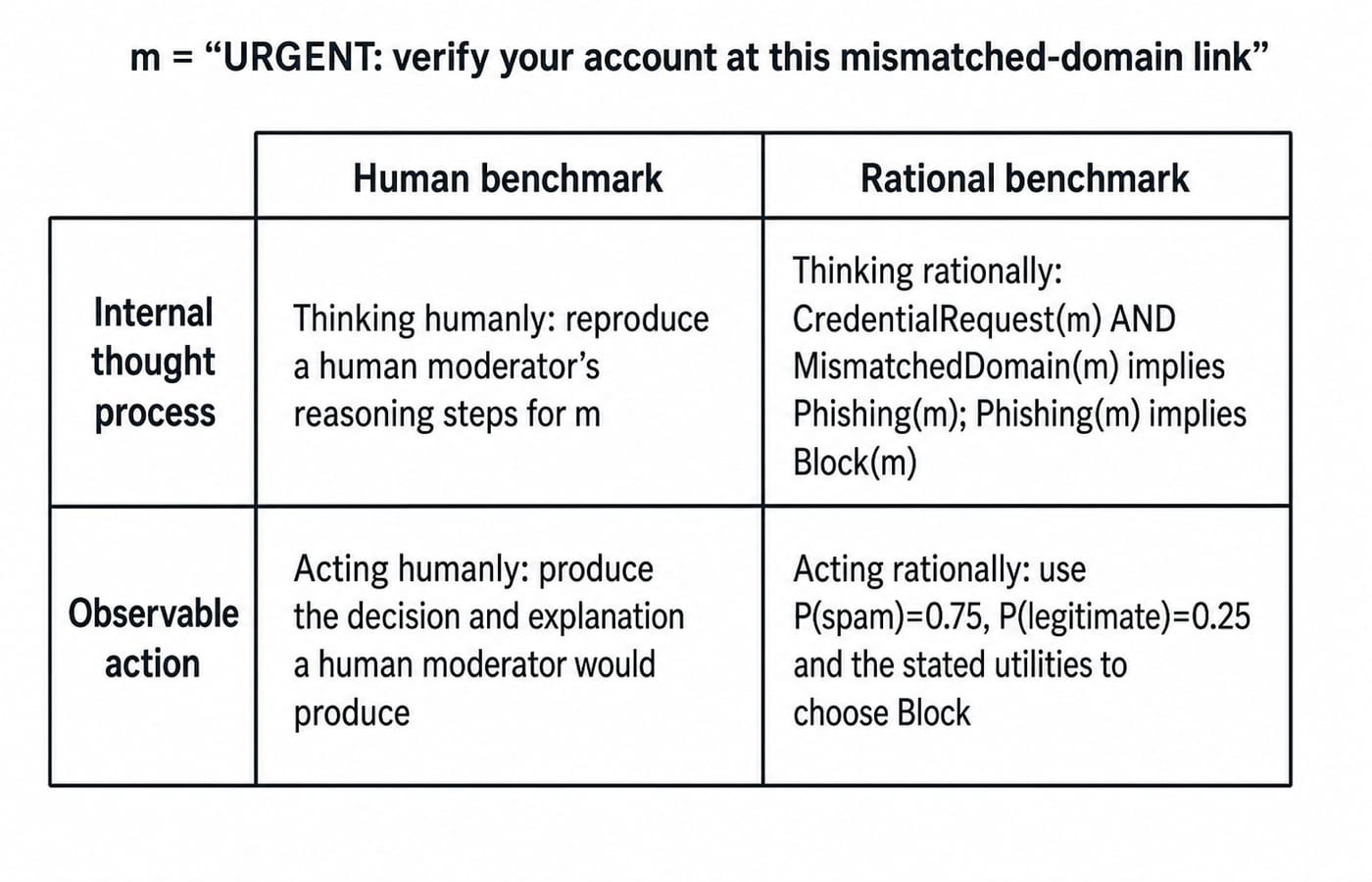
A 2 x 2 distinction separates internal thought from observable action and human performance from rationality. One message stays fixed: m = “URGENT: verify your account at this mismatched-domain link”. The earlier four approaches to AI article owns the four-way map and a vacuum-agent example; this page applies the distinctions to a suspicious email and derives the utility threshold.
Q1. What are the four approaches to AI? Thinking humanly models how people reason. Acting humanly reproduces human-like behaviour. Thinking rationally derives valid conclusions from represented knowledge. Acting rationally selects the action expected to best satisfy a performance measure. These are success criteria, not mutually exclusive software packages.
Q2. How is thinking humanly different from acting humanly? The first concerns internal process; the second judges visible behaviour. A system could copy a moderator's decision without reproducing their reasoning.
Q3. How is thinking rationally different from acting rationally? Rational thought focuses on valid inference. Rational action chooses under uncertainty, so it may use probabilities and approximations rather than formal deduction alone.
2. Worked interview problem: when is blocking rational?
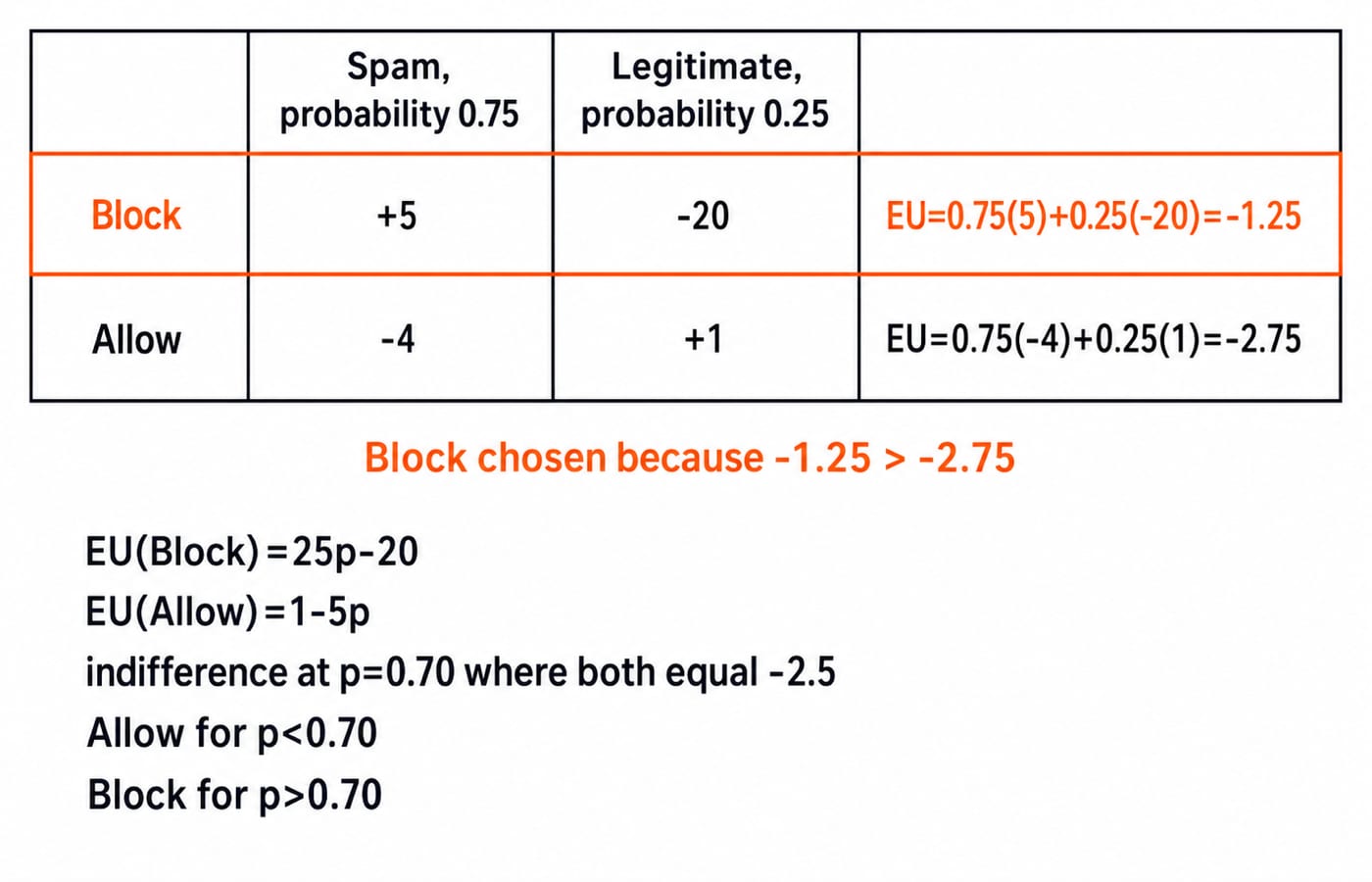
Prompt: “A classifier assigns the email P(spam)=0.75 and P(legitimate)=0.25. The available actions are Block and Allow. Utilities are U(Block, spam)=+5, U(Block, legitimate)=-20, U(Allow, spam)=-4, and U(Allow, legitimate)=+1. Which action is rational?” The interviewer supplies the probabilities and utility scale.
Calculate the expected utility of each action:
EU(Block)=0.75(5)+0.25(-20)=3.75-5=-1.25
EU(Allow)=0.75(-4)+0.25(1)=-3+0.25=-2.75
Choose Block because -1.25 > -2.75. Negative utility means both options are costly under this scale; Block is less harmful in expectation.
Now let p=P(spam):
EU(Block)=5p-20(1-p)=25p-20
EU(Allow)=-4p+1(1-p)=1-5p
Block is preferred when 25p-20 > 1-5p. Therefore 30p>21, so p>0.70. At p=0.70, both expected utilities equal -2.5.
Verify the boundary directly. For Block, 25(0.70)-20=17.5-20=-2.5. For Allow, 1-5(0.70)=1-3.5=-2.5. Below it, Allow has higher expected utility; above it, Block does. Changing utilities changes the threshold, so state the probability model and performance measure.
Q4. What is a rational agent? It chooses the action expected to maximise its performance measure given its percepts, knowledge, and actions.
Q5. Does rational mean omniscient or always correct? No. Rationality depends on the available evidence, model, actions, and objective. A poor estimate or utility function can produce harm.
3. Turing Test, cognitive modelling, and laws of thought
Q6. What does the Turing Test establish? It operationalises acting humanly in conversation: a machine succeeds when an evaluator cannot reliably distinguish it from a human. This does not prove consciousness, truthfulness, general intelligence, or human-like reasoning.
Q7. How would you test thinking humanly? Compare process-level predictions with evidence such as human error patterns, response times, or observed reasoning steps. Ask whether the model explains human thought, not merely similar answers.
Q8. Why are laws-of-thought systems not enough for all intelligent behaviour? Formal logic works with explicit premises and rules. Environments add uncertainty, incomplete knowledge, conflicting goals, and limited computation. Here, a rule derives Block only after receiving its predicates; expected utility handles the uncertain label and asymmetric cost.
4. Strong AI, weak AI, functionalism, and computationalism
Q9. What is the difference between weak and strong AI? Philosophically, weak AI performs intelligent tasks without assuming genuine understanding. Strong AI claims an appropriately organised machine could possess mental states or understanding. Because the terms also describe narrow versus general capability, state the intended meaning.
Q10. Why does functionalism matter to AI? Functionalism characterises mental states by causal roles among inputs, states, and outputs. Different physical substrates could realise the same organisation. Computationalism more specifically explains cognition as computation over representations. Functionalism concerns causal organisation; computationalism proposes a mechanism.
These positions motivate machine intelligence, but functional equivalence does not settle consciousness, subjective experience, or semantic understanding.
5. The Chinese Room and the symbol-grounding challenge
Q11. What does the Chinese Room argument challenge? First, John Searle's thought experiment argues that formal symbol manipulation can produce appropriate outputs without understanding. Second, the systems reply locates understanding in the whole system, not one rule-follower. Third, the argument challenges syntax as sufficient for semantics, not whether programs can produce useful behaviour.
Symbol grounding asks how an internal token such as CredentialRequest(m) gains meaning beyond other tokens. Answers connect symbols to perception, action, interaction, or learned worldly relations. Grounding and conscious understanding remain separate claims.
The Chinese Room challenges one account of machine understanding and has well-known replies; it does not prove AI impossible.
6. Symbolic, connectionist, probabilistic, and hybrid approaches
Q12. Compare symbolic and connectionist AI. Why build a hybrid? In the same email pipeline, a symbolic component encodes CredentialRequest(m) AND MismatchedDomain(m) -> Phishing(m). Explicit state-space reasoning, as shown in this worked graph for AI search algorithms, likewise represents states, transitions, and goals. A connectionist classifier supplies the score P(spam)=0.75 from learned patterns. A probabilistic decision layer combines 0.75/0.25 with stated utilities.
A hybrid combines the learned score, explicit rule, and decision policy: the learned component handles varied wording, the rule preserves an inspectable domain condition, and the decision layer makes the cost trade-off explicit. The price is architectural simplicity: symbolic rules are inspectable but brittle when knowledge is incomplete; connectionist models learn flexible patterns but have harder-to-interpret representations; probabilistic models expose uncertainty but depend on their probability and utility assumptions.
7. How to shape the answer for different interview depths
For a short screening answer: define the term, distinguish it, apply it to the email, and name one limitation.
For a deeper scenario or design follow-up, cover six moves in order: objective, observations, beliefs or probabilities, actions, utilities or constraints, then the decision and failure mode.
A 45-second answer could be: “There are four benchmarks for AI: human thought, human behaviour, rational thought, and rational action. The rational-agent view selects the best expected action from available evidence and a performance measure. In our email case, Block has EU -1.25 versus -2.75 for Allow. The result is only as good as the probability and utility assumptions.”
For broader CS subject-answer practice, study definitions and scenarios across core CS topics. Then rehearse delivery with the Interview & Resume Preparation Course and use the Placement Preparation category to organise the next stage of practice.
8. Traps, a 12-question recap, and the next step
Repair these shortcuts:
Turing Test proves consciousness -> it tests conversational behaviour.
Rational means always successful -> it means best expected action under stated information and objective.
Thinking rationally equals acting rationally -> inference differs from action selection.
Neural networks reason exactly like brains -> inspiration is not process identity.
Chinese Room disproves AI -> it challenges syntax-only understanding.
Strong and weak mean general and narrow -> state philosophical sense first.
Answer the questions aloud. Recalculate -1.25, -2.75, and 0.70 without notes. Compress answers into definition, distinction, example, and limitation.
The short version: know the benchmark, state assumptions, compute the choice, and name the limitation. Build with the Artificial Intelligence (AI) course, then practise aloud.
Keep learning
Philosophical and Theoretical Approaches to AI: Four Classical Views, Major Schools and a Worked Example
Separate the goals, engineering schools and philosophical claims behind AI. Then compare four classical approaches through one route-choice problem.
Updated 27 Sep 20265 min readML & Data Science

Philosophical and Theoretical Approaches to AI MCQs: 12 Solved Questions with Explanations
Solve 12 UGC NET, MPPSC, HTET and GATE MCQs on cognitive science, the Turing Test, rational agents, reinforcement learning and linear separability.
Updated 11 Aug 20268 min readMCQ Practice

Foundations and Evolution of AI: Approaches, Timeline and a Worked Rational-Agent Example
Build a connected map of AI foundations, historical shifts and major paradigms, then calculate how a rational agent chooses under uncertainty.
Updated 30 Oct 20266 min readML & Data Science

Approaches to AI: The Four Approaches, a Worked Rational-Agent Example, and How Exams Test Them
Separate the four classic approaches to AI, score a rational vacuum agent step by step, and learn the distinctions that matter in exams and interviews.
Updated 26 Jul 20265 min read200 viewsML & Data Science