NIACL AO Job Profile: Underwriting, Claims and the Administrative Career Track
What might an Administrative Officer actually own after joining? Map the work through evidence, judgement, documentation and service without assuming a fixed desk.
KnowledgeGate Team
Exam prep & CS education
Updated 7 Aug 20266 min read
The syllabus explains how to enter NIACL, but not what an Administrative Officer may own after joining. Three kinds of work sit behind the designation: judging a proposal before it becomes a policy, moving a claim to its next justified state, and keeping a branch's queues, grievances and audits answerable. Your desk, authority and first posting follow NIACL's allocation and service rules.
NIACL AO job profile: officer ownership, not one fixed desk
Across functions, an officer examines evidence, makes or refers decisions within delegated authority, records the reasoning and communicates outcomes. Underwriting, claims and administration are functional buckets, not a promised rotation.
An issued recruitment notice names the AO designation, the Generalist or Specialist stream, and the eligibility, stages and service conditions you apply against. An earlier question comes first: whether the qualification you hold points at Administrative Officer or Assistant. NIACL Eligibility: AO vs Assistant Qualification Checklist works through that split, and KnowledgeGate's NIACL AO IT Specialist Preparation coverage is the study side of the same decision.
NIACL AO underwriting work: decide, document and escalate
An underwriting workflow checks a proposal, identifies the risk, compares evidence with policy and authority boundaries, seeks clarification, decides or refers, and records why. This is controlled judgement, not form checking.
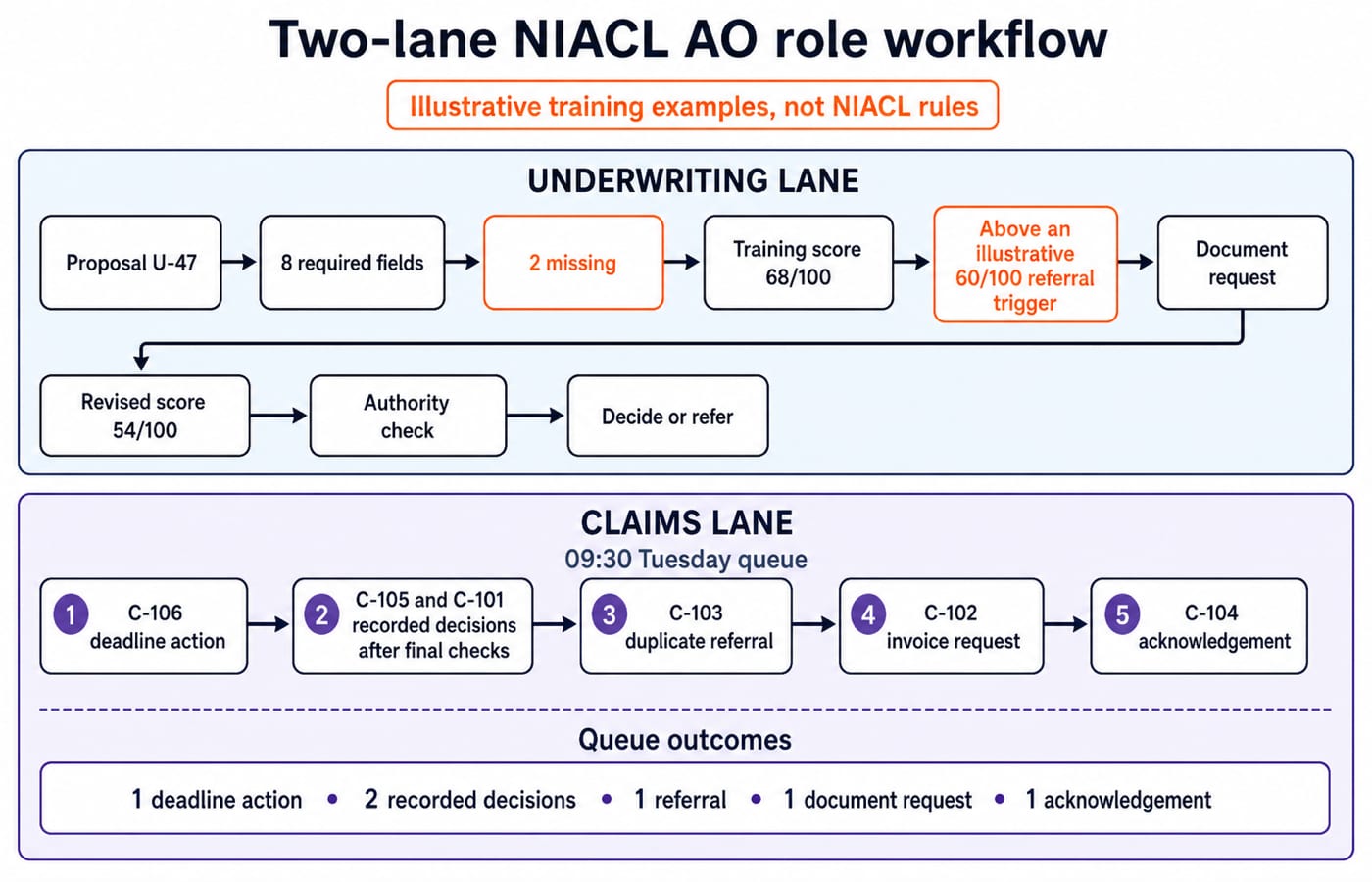
Take a training case with invented numbers, chosen to show where the decisions sit. Proposal U-47 has 8 required fields and six are complete, so 8 - 6 = 2 fields are missing: the fire-safety certificate and the three-year loss history. The file scores 68/100 on a scale that rises with risk, against a 60/100 referral trigger. Since 68 - 60 = 8, the file sits above the trigger, so the officer holds it and requests both records.
The records show installed fire controls and no prior reported loss. The score falls to 54/100, a 68 - 54 = 14 point change that puts the file under the trigger. Under the trigger is not an approval. Recheck the coverage terms and your own authority limit, record what changed and why, then decide or refer. A score organises evidence, while proof, exclusions and authority decide the outcome.
NIACL AO claims work: coverage, evidence and service
Claims work follows a sequence: register the intimation, review the policy and incident, collect documents and survey or technical inputs, test inconsistencies, decide or refer within authority, and communicate the next step.
At 09:30 on a Tuesday the queue holds six files. Handle C-106 first because its documented deadline is 15:00. Move approval-ready C-105 and complete-survey C-101, whose customer has waited 2 days, to recorded decisions after final checks. Refer C-103 for possible duplication, request C-102's missing invoice, then acknowledge and register fresh intimation C-104.
The outputs reconcile: 1 deadline action + 2 recorded decisions + 1 referral + 1 document request + 1 acknowledgement = 6. Good handling moves every file to its next justified state with an auditable reason, rather than paying or rejecting fastest.
NIACL AO administrative work: keep the branch auditable and moving
"Administrative" does not mean only paperwork. Depending on allocation, an officer may own queues, review exceptions, coordinate with customers or intermediaries, follow up grievances, answer audits, report status and manage hand-offs.
A half-day starts at 09:30 by splitting 18 pending items into 7 due today, 6 tomorrow and 5 later. Check: 7 + 6 + 5 = 18. At 10:00, clear 2 approvals within authority; at 11:00, complete 3 grievance callbacks; at 12:00, resolve or assign 1 audit exception; at 14:30, confirm an owner and a next action for all 7 due-today items. That leaves nothing due today unowned, which is the real test of the desk.
Task | Officer question | Evidence left behind |
|---|---|---|
Proposal decision | Can I decide this within authority? | Decision note |
Claim movement | What is the next justified state? | Document request or referral |
Customer exception | What must the customer know next? | Communication record |
Audit item | Is it resolved, or who now owns it? | Closure or assignment record |
NIACL AO Generalist vs Specialist: limits of inference
Question | Generalist candidate | IT Specialist candidate |
|---|---|---|
What the written stages test | Quantitative aptitude, reasoning, English, general and insurance awareness, plus a descriptive essay and letter paper | The same, plus a notified professional-knowledge section on core computer science |
Where the extra study hours go | Depth on insurance principles, policy terms and current affairs in banking and insurance | Operating systems, DBMS, networks, OOPs, compiler design, C, Java, Python and SQL, software engineering, web technology, computer architecture, and AI, ML and NLP |
Stream-specific eligibility | The graduation route stated in the issued notice | The stated technical qualification, in the same notice |
What the stream still cannot tell you | Nothing about which of the three functions you are allocated to, or where | The title does not prove a day spent coding, and an IT Specialist can still own claims or branch queues |
On the study side, the NIACL AO 2026 IT SPECIALIST course covers those prelims and mains sections for the specialist stream, professional knowledge and descriptive paper included. If you are still weighing a specialist title against a generalist one, IBPS SO IT Officer vs IBPS PO runs the same trade-off in banking, where the stages and posting rules are not NIACL's.
NIACL AO career track: responsibility can widen
Responsibility widens in a recognisable order: handling defined cases under review, then deciding inside your own authority, then coordinating exceptions and checking other people's quality, then carrying team, branch or functional responsibility. Read that as a change in what you are trusted to decide alone, not as a public ladder with dates.
Rank your sources accordingly. An issued notice confirms the entry designation and the service conditions attached to it. An appointment or posting order is what actually fixes your allocation. Grade names, promotion criteria and timelines sit in internal policy you will only read after joining. A senior's account is one path, and a coaching-forum claim about NIACL promotions is the weakest tier.
NIACL AO role fit: score the work, not the prestige
Rate yourself from 1 to 5 on comfort with documentary evidence, judgement under rules, explaining a decision to a customer who dislikes it, deadline ownership, and openness to varied postings or functions.
Say those come out 4, 5, 3, 4 and 2: 4 + 5 + 3 + 4 + 2 = 18/25. There is no pass band, and the lowest number matters more than the total. Here the 2 is on mobility, so read the posting and service conditions before you apply: that single item decides whether work you would enjoy fits the life you want. If you are comparing officer routes more widely, the Banking Exams hub collects them, though bank operations are not general-insurance workflows.
NIACL AO job profile: the short version and next step
Strip the designation back and the job is four repeated moves: read the evidence, decide or refer inside your authority, leave a record a later reader can follow, and tell the customer what happens next. Underwriting, claims and branch administration are where those moves land. Check the current notice on NIACL's official Recruitment page for the designation, stream, stages, posting and service conditions.
For IT Specialist candidates the practical next step is one study week that carries professional knowledge and the descriptive paper alongside reasoning, quantitative aptitude and insurance awareness, because mains asks for all of them. The allocation itself arrives with the posting order, not with a course.
Keep learning

NIACL AO Cutoff Trends: Set a Practical Target Score
Read NIACL published Generalist and IT Specialist cutoffs without mixing stages or streams. Apply declared buffers and sectional checks to set a practical mock target.
Updated 21 Aug 20264 min readNIACL
NIACL Assistant Regional Language Test: 14-Day Preparation Plan
Build regional-language confidence through a clear diagnostic, daily drills, an error log, and a light final-day review. Use this plan alongside your current NIACL call letter.
Updated 20 Aug 20265 min readNIACL
NIACL AO vs Assistant: Choose by Role, Mobility and Exam Track
Compare NIACL's AO and Assistant routes using past official notices, then choose with mobility filters, preparation deltas and a five-point fit test.
Updated 18 Aug 20265 min readNIACL

NIACL AO Role: Underwriting, Claims and Career Paths Explained
NIACL AO work before you choose the exam: underwriting, claims and administration, the Generalist and Specialist routes, and where a career can go.
Updated 16 Aug 20265 min readNIACL