A* Search Algorithm: Step-by-Step Worked Example, Heuristics and Exam Traps
Learn A* from first principles, follow every relaxation on a weighted graph, and test optimality, tie-breaking, parent updates and heuristic quality.
KnowledgeGate Team
Exam prep & CS education
Updated 2 Oct 20266 min read
You may remember that A* combines path cost with a heuristic, yet lose track of which node leaves OPEN next, when a parent must change, or why the first generated goal is not automatically final. A* ranks a frontier node n by f(n)=g(n)+h(n), balancing cost already paid with estimated cost still remaining. Admissibility prevents h from overestimating; consistency constrains h across every edge; relaxation replaces a parent when a cheaper g appears.
A* search algorithm: what g, h and f mean
An A* problem has a start, goals, directed weighted edges and non-negative costs. g(n) is the cheapest discovered start-to-n cost, h(n) estimates the remaining goal cost, and f(n)=g(n)+h(n) estimates total cost through n. OPEN stores frontier nodes; CLOSED stores expanded nodes.
Put the start in OPEN with g(start)=0. Pop the minimum-f node. If it is a goal, reconstruct through parents. Otherwise relax its outgoing edges: insert an unseen neighbour, or lower its g and update its parent for a cheaper route. Break ties by lower f, lower h, then alphabetical label.
Search Algorithms in AI: BFS, DFS, UCS and A* on One Graph compares five strategies on the same weighted graph. A* adds goal direction through h, while a reliable deep trace must preserve g, f and parent changes as frontier costs improve.
A* heuristics: admissibility, consistency and the greedy boundary
An admissible heuristic satisfies 0 <= h(n) <= h*(n), where h*(n) is the true cheapest remaining cost. A consistent heuristic satisfies h(n) <= c(n,n')+h(n') on every directed edge, with h(goal)=0. Consistency implies admissibility for nodes that can reach a goal and makes f non-decreasing along a path. An admissible but inconsistent heuristic can require reopening a CLOSED node after a better g is found.
Search method | Priority |
|---|---|
Uniform-cost or Dijkstra | Lowest |
Greedy best-first | Lowest |
A* | Lowest |
Fundamentals of Heuristic Search: A* Worked Example and Exam Traps compares Greedy Best-First and A* on one frontier and explains why their returned costs differ. A deeper A* trace must also retain every relaxation, parent change, OPEN/CLOSED state and expansion-count effect of heuristic strength. Take S->X=1, X->G=100, S->Y=10, Y->G=10, with h(X)=1, h(Y)=5, h(G)=0. Greedy chooses X, then G, and returns cost 101. A* explores X first at f=2, but retains Y at f=15. It expands Y before the expensive goal at f=101, improves G to cost 20, and returns optimal path S-Y-G.
A* worked graph: exact edges and heuristic values
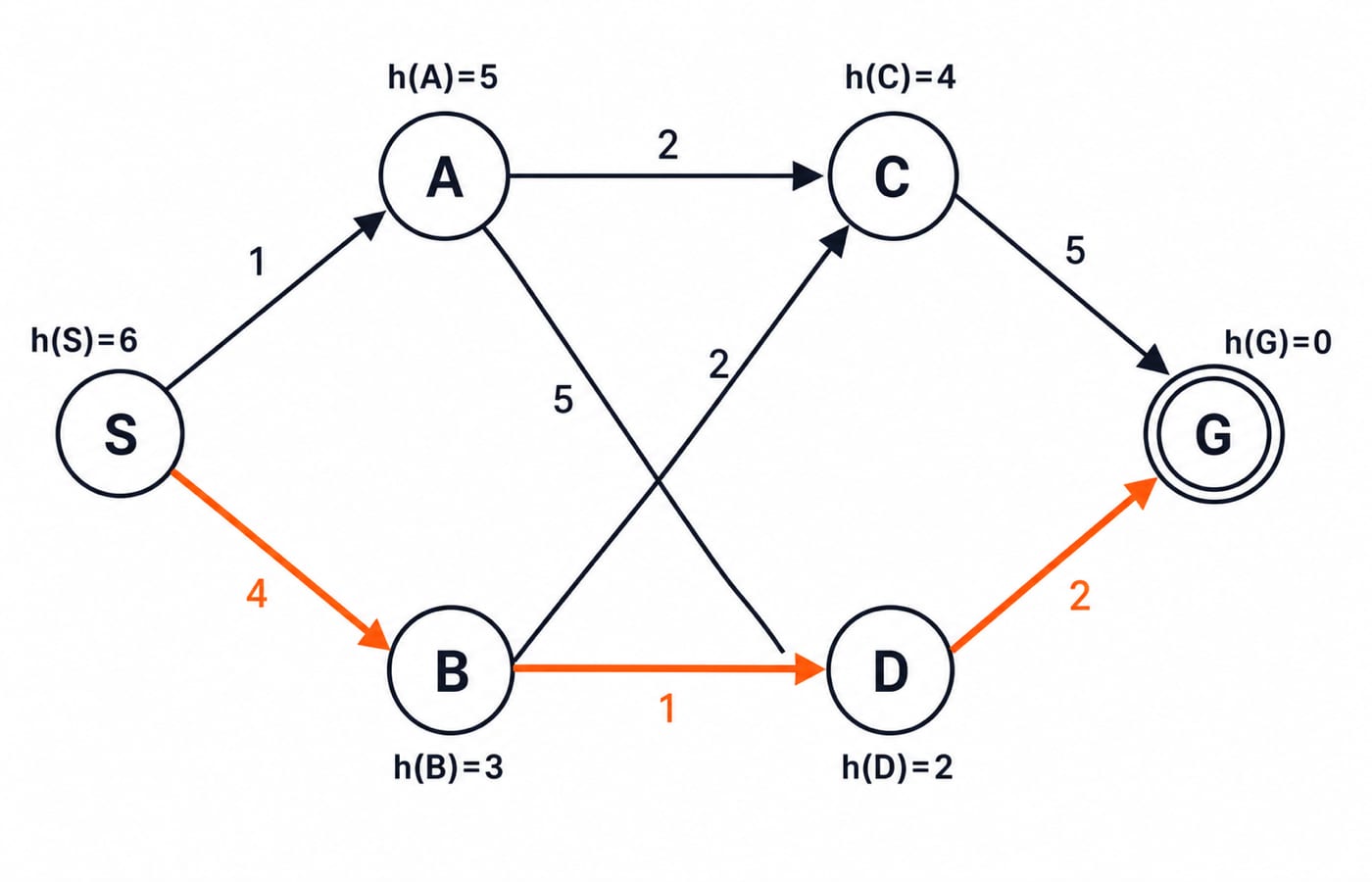
The graph is directed and weighted. Its edges are S->A=1, S->B=4, A->C=2, A->D=5, B->C=2, B->D=1, C->G=5 and D->G=2. The start is S, the only goal is G, and every cost is non-negative.
Node |
|
|
|
|
|
|
|---|---|---|---|---|---|---|
| 6 | 5 | 3 | 4 | 2 | 0 |
True | 7 | 7 | 3 | 5 | 2 | 0 |
Keep these values fixed while following OPEN, CLOSED and every parent update.
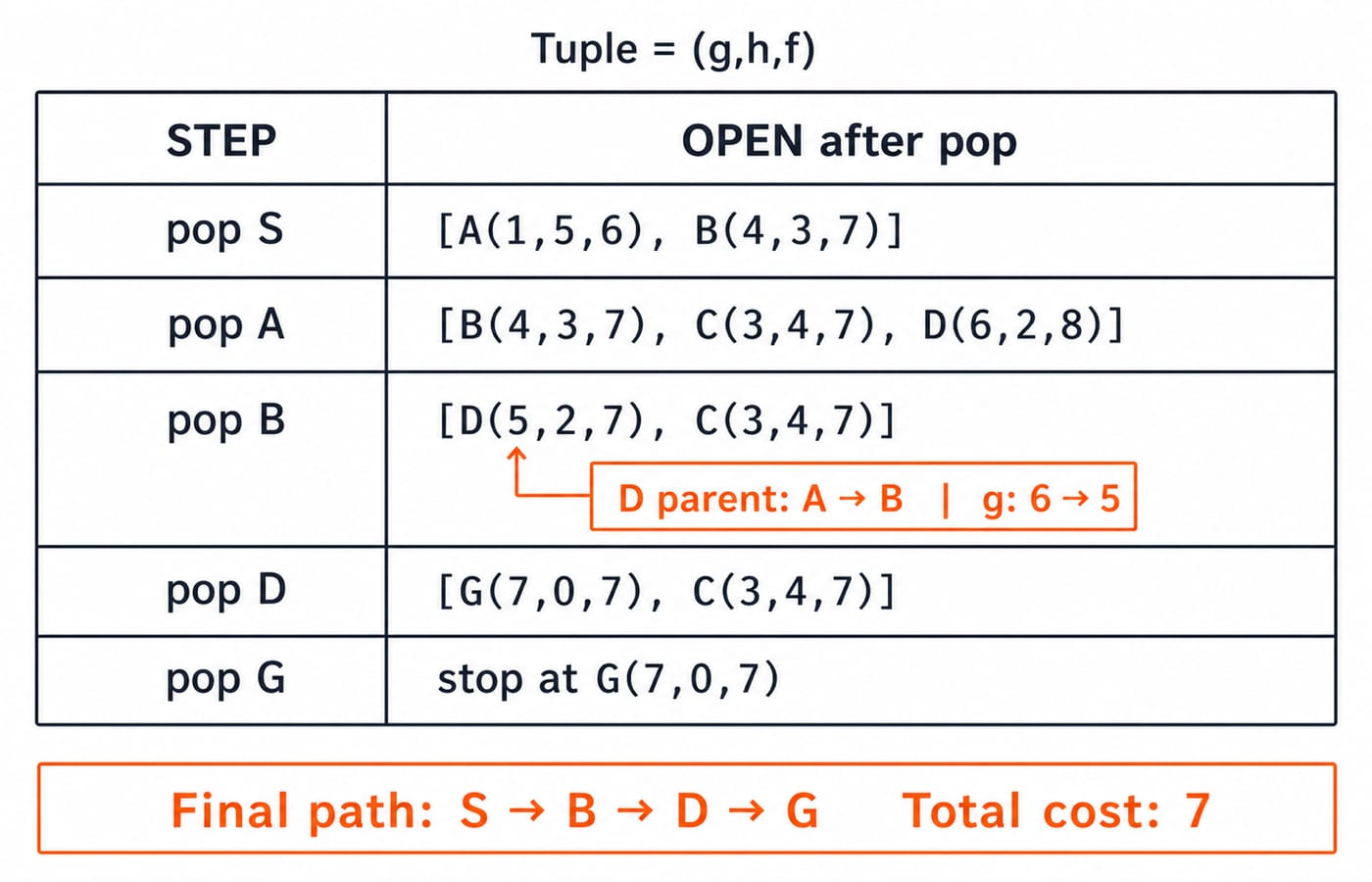
A* search worked example: OPEN, CLOSED and parent updates
Each (g,h,f) tuple uses the fixed tie-break.
Step | Node popped |
| Edge relaxation | OPEN after expansion | CLOSED |
|---|---|---|---|---|---|
0 | None | None | Initialise |
|
|
1 |
|
|
|
|
|
2 |
|
|
|
|
|
3 |
|
|
|
|
|
4 |
|
|
|
|
|
5 |
|
| Stop: goal removed from OPEN |
|
|
Lower h resolves the f=7 ties as B before C, then D before C. Parents G<-D<-B<-S produce S-B-D-G, cost 4+1+2=7; C stays OPEN.
Every complete route confirms it: S-A-C-G=1+2+5=8, S-A-D-G=1+5+2=8, S-B-C-G=4+2+5=11, and S-B-D-G=4+1+2=7. Thus S-B-D-G is uniquely cheapest.
Why A* is optimal here, and what a stronger heuristic changes
Admissibility follows directly: 6<=7, 5<=7, 3<=3, 4<=5, 2<=2, 0<=0. Consistency also holds on all eight edges: 6<=1+5, 6<=4+3, 5<=2+4, 5<=5+2, 3<=2+4, 3<=1+2, 4<=5+0, and 2<=2+0. Because the heuristic is consistent and we stop only when the goal is popped, CLOSED nodes need not reopen and the returned cost is 7.
Under the same tie rule, setting every h to zero makes uniform-cost search pop S,A,C,B,D,G, six nodes. The heuristic values above make A* pop S,A,B,D,G, five nodes. The perfect heuristic h=h* gives S,B,D,G, four nodes. A more informed admissible heuristic can reduce work, although A* can still require exponential time and memory in difficult state spaces. Tie-breaking may change which equal-f nodes expand without changing the least-cost result under these conditions.
A* search algorithm traps: where a correct formula still goes wrong
Trap | What goes wrong | Correction |
|---|---|---|
Use only | This runs greedy best-first | Rank by |
Accept a generated goal | A cheaper frontier route may remain | Accept the goal when popped under the stated conditions |
Skip relaxation for seen nodes | A better route is lost | Compare every candidate |
Lower only | Path reconstruction stays wrong | Change |
Close a node when generated | Its best route is not settled | Move it to CLOSED when popped |
Treat admissible and consistent as synonyms | Reopening requirements are missed | Test both definitions separately |
Use unchanged A* with negative edges | Its cost assumptions fail | Require non-negative edge costs |
The trace shows C at g=3 and D at g=5, but their f=7 tie sends lower-h D first. Update OPEN after every improved g.
If h is admissible but inconsistent, never reopening CLOSED can lose optimality. Require consistency or reopen on a lower g. Any overestimate breaks admissibility, even if the path found is optimal.
A* search exam patterns: calculations and concept checks
Assessments can ask you to calculate g,h,f, choose the next OPEN node under a tie-break, relax a cheaper route, reconstruct parents, test a heuristic, or distinguish A*, uniform-cost and greedy best-first search. UGC NET CS Exam Preparation is a broader study route, not an official syllabus source.
Test the worked graph immediately:
After
Aexpands, what is OPEN?B(4,3,7), C(3,4,7), D(6,2,8).Does
B->CimproveC? No. Candidateg=6is worse than3.What changes on
B->D?g:6->5,f:8->7, parentA->B.Is
h(B)=4admissible? No, becauseh*(B)=3.What remains when every
his zero? Uniform-cost search, equivalent to Dijkstra's selection rule for non-negative edges.
Practise until you can rebuild OPEN, CLOSED and every parent pointer for this graph without looking back at the trace table.
A* search algorithm: the short version and next step
Remember: g is paid cost, h is estimated remaining cost, and f=g+h ranks OPEN. Admissibility forbids overestimation. Consistency enforces the edge triangle inequality. Relaxation can change both cost and parent. Under the stated optimality conditions, the goal is final when removed from OPEN.
For mastery, redraw all eight edges and six heuristic labels, reproduce S,A,B,D,G, explain the D update, derive S-B-D-G, and compare cost 7 with the other routes. Then use NTA-UGC-NET Paper - 2 for a curriculum that includes Artificial Intelligence and Search Algorithms, or AI & ML for Placements | Generative AI Placement Course for a broader applied AI route.
Keep learning

Intelligent and Rational Agents in AI: PEAS, Worked Decisions and Exam Traps
Learn what makes an AI agent rational, specify its task with PEAS, update a belief using Bayes' rule, and see why coordination matters in multi-agent systems.
Updated 7 Oct 20266 min readML & Data Science

Philosophical and Theoretical Approaches to AI: Four Classical Views, Major Schools and a Worked Example
Separate the goals, engineering schools and philosophical claims behind AI. Then compare four classical approaches through one route-choice problem.
Updated 27 Sep 20265 min readML & Data Science
Artificial Intelligence for GATE: An 8-Week Topic-by-Topic Study Plan
Turn a 12-hour weekly budget into an eight-week AI study cycle with dependency-led concepts, hand-solved traces, timed sets, and error-driven revision.
25 Sep 20265 min readML & Data Science

Artificial Intelligence for ICT Exams: Concepts, Tools and Worked Examples
Build a clear AI concept ladder, learn the main learning types, calculate classifier metrics step by step, and apply a practical tool-checking routine.
Updated 23 Sep 20266 min readML & Data Science