Artificial Neural Networks MCQs: 10 Solved Questions with Explanations
Attempt ten practice questions on artificial neural networks, check your answers against the explanations, and use one worked neuron to connect inputs, weights, bias, and activation.
KnowledgeGate Team
Exam prep & CS education
Updated 26 Jul 20268 min read
Terms such as neuron, weight, dendrite, and synapse are easy to mix up with network properties and with the AI vocabulary sitting next to them. The ten questions below are drawn from UGC NET, UPPSC Polytechnic Lecturer, DSSSB, MPPSC and IBPS papers, and every explanation says why the official answer is right and why the near misses fail. The last two reach past ANN anatomy into reinforcement-learning policy and generative-AI latent space, where the same confusion between a representation and a rule loses marks.
ANN questions: attempt first, then read the explanation
Choose an option before reading its explanation. Record each miss under capability, network structure, biological analogy, or adjacent AI vocabulary. Place these areas inside the wider UGC NET Computer Science topic map when planning revision.
ANN capabilities and defining characteristics: Questions 1 to 3
Question 1
Asked in UGC NET (Computer Science), January 2026
Given below are two statements: one is labelled as Assertion A and the other is labelled as Reason R.
Assertion A: Neural networks are capable of approximating any continuous function to an arbitrary degree of accuracy.
Reason R: This is explained by the universal approximation theorem.
In the light of the above statements, choose the most appropriate answer from the options given below:
A. Both A and R are correct and R is the correct explanation of A
B. Both A and R are correct but R is NOT the correct explanation of A
C. A is correct but R is not correct
D. A is not correct but R is correct
Answer: A
The universal approximation theorem provides the basis for the assertion, so R correctly explains A. Under the theorem's conditions, a suitable network can approximate continuous functions to arbitrary accuracy. This does not mean every architecture learns every function automatically.
Question 2
Asked in UGC NET (Computer Science), December 2022
Choose the correct option describing the features of Artificial neural network
A. It is essentially machine learning algorithm.
B. It is useful when solving the problems for which the data set is very large.
C. They are able to extract features without input from the programmer.
D. These are systems modeled on the human brain and nervous system
Choose the correct answer from the options given below:
A. All the statements are correct.
B. Only B & C are correct.
C. Only A & D are correct.
D. All the statements are not correct.
Answer: A
Each statement captures an ANN feature: ANNs are machine-learning models, often benefit from large datasets, can learn representations instead of relying only on hand-engineered features, and use terminology inspired by biological nervous systems. More data can help, but does not guarantee better performance.
Question 3
Asked in UGC NET (Computer Science), January 2025
Which of the following are correct for the neural network?
A. The training time depends upon the size of network.
B. Neural network can be simulated on the conventional computer.
C. Neural network mimic the same way as that of the humans brain.
D. A neural network include feedback.
Choose the correct answer from the options given below:
A. A and B only
B. A, C and D only
C. A, B and C only
D. A and C only
Answer: B
The official answer key treats A, C, and D as the intended characteristics. Network size affects training time, C refers to biological inspiration, and D covers networks with feedback. B is also true in practice, because conventional computers do run neural networks, so this question is ambiguous as set.
ANN layers, weights, and learning: Question 4
Question 4
Asked in UGC NET (Computer Science), August 2024
Read the below passage and answer the questions.
Artificial Neural Networks (ANNs) are computational models inspired by the human brain's neural networks. They consist of inter-connected nodes, or neurons, organized into layers: an input layer, one or more hidden layers, and an output layer. Each connection between neurons has a weight that adjusts as learning progresses, allowing the network to adapt and improve its performance. ANNs are particularly effective in recognizing patterns, making them valuable for tasks such as image and speech recognition, Natural language processing, and predictive analytics. Learning in ANNs typically involves training algorithms like backpropagation, which minimize the error by adjusting the weights. As a subset of machine learning, ANNs have revolutionized the field of Artificial Intelligence by providing solutions to complex problems that traditional algorithms struggle with.
Artificial Neural Networks (ANNs) are inspired by:
A. Quantum mechanics
B. Human brain's neural network
C. Computer Hardware architecture
D. Genetic algorithm.
Answer: B
The passage answers itself in its opening sentence, so the inspiration is the human brain's neural network. The rest of the passage is the structure worth carrying into the exam: neurons are organised into an input layer, one or more hidden layers, and an output layer; every connection between them holds a weight; and backpropagation is what changes those weights, nudging them in the direction that reduces error on the training data. Quantum mechanics, hardware architecture, and genetic algorithms are all real ideas in computing, but none of them is what the passage names. Hold the analogy at the right strength: the brain supplies the metaphor of connected units, not a working account of cognition. For related concepts, review the broader Paper 2 syllabus areas.
Biological-neuron vocabulary behind ANN terminology: Questions 5 to 8
Question 5
Asked in UPPSC Polytechnic Lecturer (Computer Science), 2022
What are dendrites in Neural Network?
A. Nuclear projections
B. Fibers of nerves
C. Other name of nucleus
D. None of the above
Answer: B
Dendrites are branching nerve fibres that receive signals and carry them towards the cell body. In the ANN analogy, numerical inputs play this receiving role, but are not literal dendrites.
Question 6
Asked in UPPSC Polytechnic Lecturer (Computer Science), 2022
Signal transmission at a typical synapse in a neural network is a –
A. Chemical Process
B. Physical Process and Chemical Process both
C. Physical Process
D. None of the above
Answer: A
At a typical biological synapse, a neurotransmitter crosses the synaptic cleft and triggers the next neuron. Electrical synapses do exist and pass current directly, but at introductory level the answer key takes the chemical route. An ANN weight represents connection strength as a single number, with none of this chemistry behind it.
Question 7
Asked in DSSSB (Computer Science), 2021
What is a neuron in Neural Networks?
A. A neuron is a small cell that receives electrochemical signals from various sources and transmits electrical impulses to other neurons.
B. A neuron is a cell that sends electromagnetic signals to axons.
C. A neuron is a small cell that sends electric impulses to ions.
D. A neuron is a cell which has the capability to predict the situation from past trends.
Answer: A
The other options confuse the signal type, destination, or behaviour of a trained system with one biological neuron's function. An artificial neuron instead combines weighted inputs and a bias, then applies an activation function.
Question 8
Asked in DSSSB (Computer Science), 2021
What is axon in Neural Networks?
A. It is a long cylindrical connection that carries impulses from the neurons.
B. It is a small cell used to perform basic logical operations.
C. It is a small cell which contains electric signal.
D. It is a collection of neurons.
Answer: A
An axon is the long projection carrying an impulse away from a neuron's cell body. An artificial neuron's computed output has the analogous outgoing role.
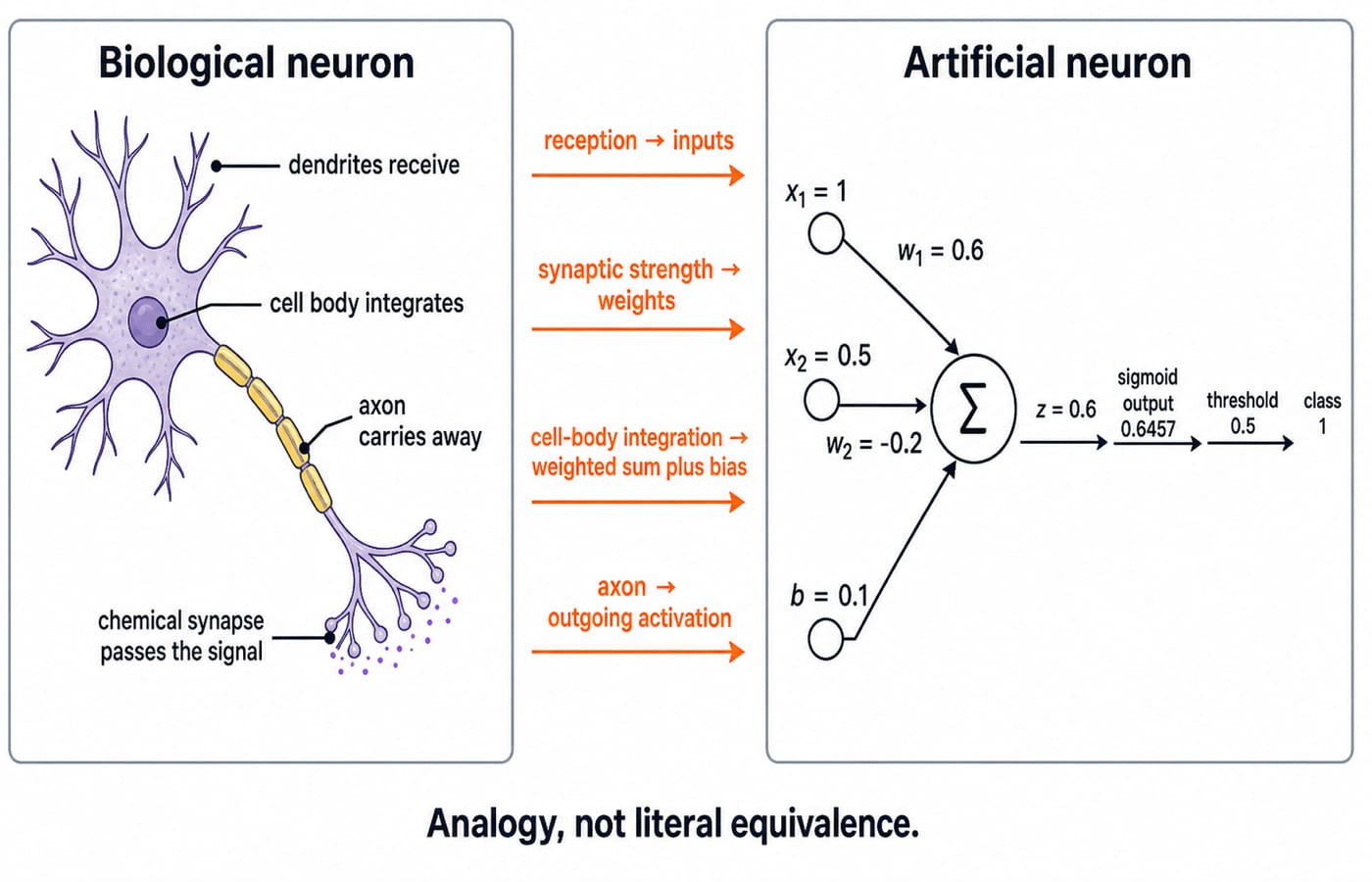
Keep the biological chain in signal order: dendrites receive, the cell body integrates, the axon carries away, and a synapse passes the signal to the next cell.
Adjacent AI vocabulary, policy and latent space: Questions 9 and 10
Examiners rarely keep ANN vocabulary sealed off from the rest of the AI syllabus, and the two questions here sit right on that boundary: what a policy does in reinforcement learning, and what latent space means in generative AI. Both trip candidates on the same distinction the neuron questions above train, that between a representation of data and a rule applied to it.
Question 9
Asked in MPPSC (Computer Science), 2025
What is the primary role of a policy in a reinforcement learning system?
A. To define the long term goals of the agent
B. To predict future rewards based on the current state
C. To map from perceived states of the environment to actions
D. To model the environments behaviour
Answer: C
A policy maps a state to an action. For battery = low, it may choose move to charger. A reward defines desirability, a value function estimates future return, and an environment model predicts consequences, eliminating A, B, and D.
Question 10
Asked in IBPS, 2025
What is latent space in Generative AI?
A. Structured input features directly fed into the model
B. Intermediary abstract space
C. Final output space generated after decoding
D. Pre-processed training dataset
E. Hidden memory layer used for storing learned weights
Answer: B
Follow the flow: 28 × 28 image = 784 inputs -> encoder -> 16-value latent vector -> decoder -> reconstructed image. The latent vector is the intermediary abstract representation, not the input, output, dataset, or weights. A policy chooses actions; latent space represents data.
Fully worked bridge: one artificial neuron with actual values
Take x1 = 1, x2 = 0.5, w1 = 0.6, w2 = -0.2, and b = 0.1.
Compute the weighted sum:
z = x1w1 + x2w2 + b = (1)(0.6) + (0.5)(-0.2) + 0.1 = 0.6.Apply the sigmoid:
sigmoid(z) = 1 / (1 + e^-0.6) ≈ 0.6457.Compare with threshold
0.5:0.6457 > 0.5, so the predicted class is1.
The inputs are incoming signals, weights express connection strength, bias shifts the sum, and activation produces the output. Larger networks repeat this unit across layers; training changes the weights.
If only x2 changes from 0.5 to 2:
z = (1)(0.6) + (2)(-0.2) + 0.1 = 0.3
sigmoid(0.3) ≈ 0.5744, so the class remains 1. The output falls because the negative weight makes a larger x2 reduce the sum.
Answer pattern, scorecard, and the next step
Answer strip: 1-A, 2-A, 3-B, 4-B, 5-B, 6-A, 7-A, 8-A, 9-C, 10-B
If you score 8-10, move forward. At 5-7, revise the missed category. At 0-4, rebuild the neuron, layer, weight, and activation picture. Correct these recurring traps: literal biological equivalence, exam-key ambiguity, policy versus value, and latent representations versus parameters.
For the complete subject sequence, continue with NTA UGC NET Paper 2, which covers Artificial Intelligence within Paper 2. Use Zero to Hero for the broader CS route containing the ANN module, or browse CS Fundamentals across related topics.
Keep learning
Repeater, Hub, Bridge & Switch MCQs: 12 Solved Questions with Explanations
Solve 12 exam questions on device layers, MAC forwarding, VLANs, collision and broadcast domains, port mirroring, bridges and crosspoint counting.
Updated 20 Oct 20267 min readComputer Networks MCQs
Ethernet IEEE 802.3 MCQs: 12 Solved Questions with Explanations
Solve 12 Ethernet questions on IEEE 802.3, speed generations, hubs, MAC addresses, multicast, CSMA/CD and the first binary backoff race.
Updated 16 Oct 20267 min readComputer Networks MCQs
OSI Model & Layers MCQs: 12 Solved Questions on PDUs and Encapsulation
Test OSI layers, PDUs, encapsulation and router traversal through solved MCQs, with explanations, a byte-by-byte frame trace and a layer-visit method.
12 Oct 20267 min readComputer Networks MCQs

Mobile Computing MCQs: Solved Questions on Concepts, Features and Applications
Work through 10 solved questions covering portability, cellular standards, Bluetooth, CDMA, Android, mobile cloud, and device constraints. Each answer has a concise explanation.
7 Oct 20267 min readComputer Networks MCQs