MPPSC Computer Science: Computer Networks and Operating Systems Worked Guide
Follow one web request across a subnet and one three-process workload across the CPU. Each step shows which model applies, what to calculate and which trap to avoid.
KnowledgeGate Team
Exam prep & CS education
Updated 31 Jul 20266 min read

Subnet masks, protocol names, process states and scheduling formulae look familiar separately. A mixed question is harder because you must decide which model applies before you calculate anything. Here a workstation addressed 10.24.8.78/27 fetches one web page, while three processes share one CPU under a two-unit Round Robin quantum. Every address, port and burst time is illustrative.
1. Build the network map and the process map before calculating
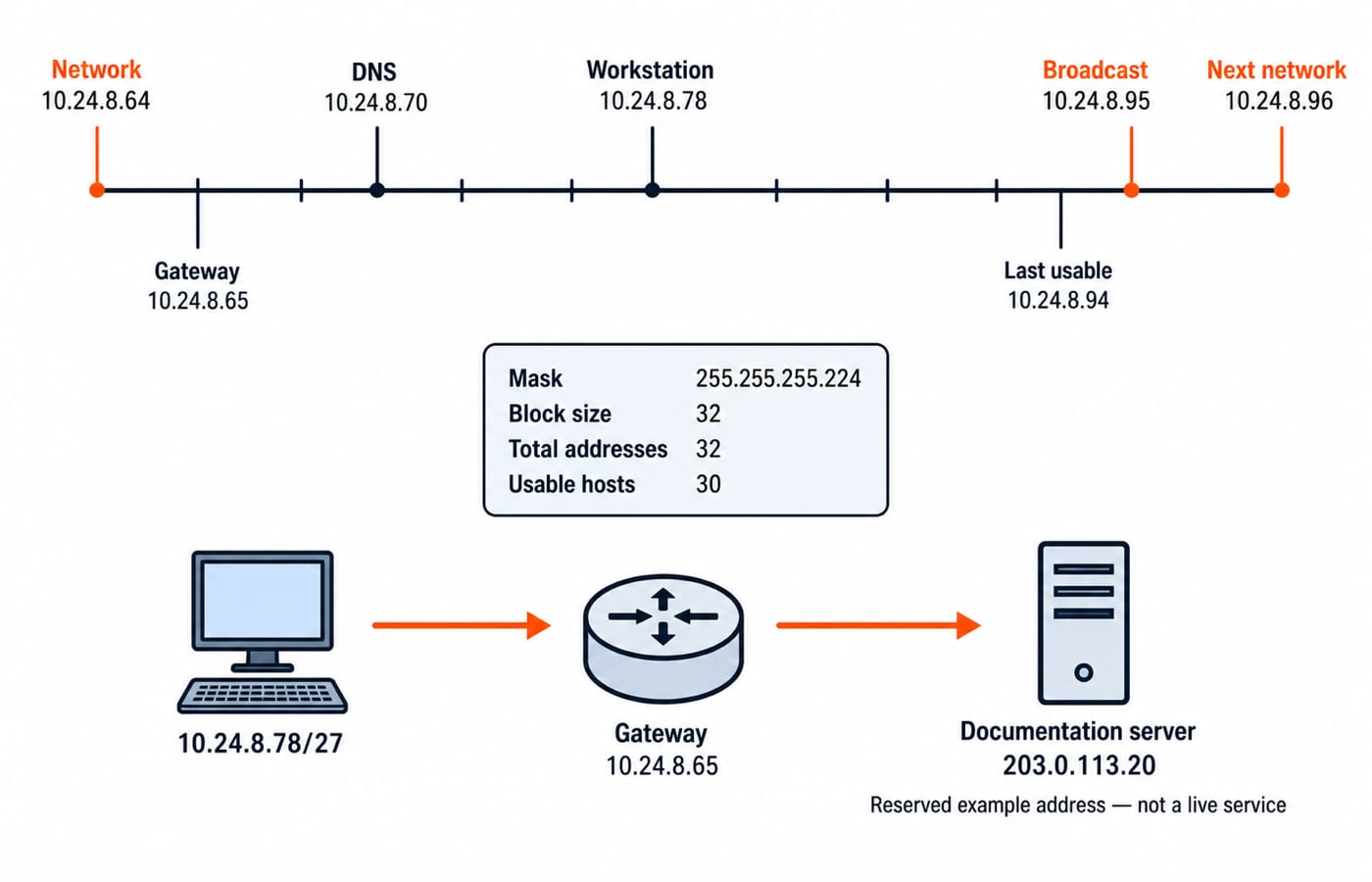
Our workstation is 10.24.8.78/27, with gateway 10.24.8.65 and local DNS resolver 10.24.8.70. It opens https://portal.example/status; DNS returns documentation address 203.0.113.20.
The OS schedules P1, P2 and P3 by Round Robin, q=2. Keep the maps apart:
The network map asks where data is named, transported, routed and framed. Think HTTP, TLS, TCP or UDP, IP, Ethernet and ARP.
The process map tracks New, Ready, Running, Blocked or Terminated, then the next dispatch.
Paper-2 course and test-series routes for this exam sit in the MPPSC Assistant Professor (CS) preparation category.
2. Solve the /27 subnet from block size to usable hosts
A /27 prefix leaves 32 - 27 = 5 host bits.
Total addresses:
2^5 = 32.Subnet mask:
255.255.255.224.Last-octet block size:
256 - 224 = 32.Block starts:
0, 32, 64, 96, ....Since
78lies from64to95, the network is10.24.8.64and the broadcast address is10.24.8.95.The conventional usable range is
10.24.8.65to10.24.8.94, which contains32 - 2 = 30host addresses.
The gateway .65, resolver .70 and workstation .78 share the /27 link. The server 203.0.113.20 does not, so its frame goes to the gateway's MAC address. Decide by masking source and destination, not by visually comparing octets.
Do not confuse 32 total addresses with 30 usable hosts. Here .64 and .95 are reserved, /27 is not 27 hosts, and .96 starts the next block. Rehearse with Subnetting MCQs: 12 Solved IP Addressing Questions.
3. Assign each protocol one job in the same web request
The workstation asks resolver 10.24.8.70 for portal.example using UDP destination port 53 in this lookup, although DNS also uses TCP in defined cases. After receiving 203.0.113.20, it opens TCP from illustrative port 49160 to port 443, completes TLS and sends HTTP request GET /status inside the protected stream.
ARP maps on-link next hop 10.24.8.65 to a MAC address, and Ethernet carries the local frame. IP carries source 10.24.8.78 and destination 203.0.113.20; TCP identifies 10.24.8.78:49160 -> 203.0.113.20:443 and supplies an ordered stream. TLS protects it, while HTTP expresses the request. Routers replace link headers hop by hop; NAT is outside this example.
Trap | Correction |
|---|---|
DNS routes the packet | DNS resolves a name to an address |
ARP finds the server's end-to-end MAC | ARP finds an on-link next hop |
TCP port | A port identifies a transport endpoint |
HTTPS replaces all lower layers | HTTP over TLS still relies on transport and network layers |
DNS used UDP, so HTTPS also uses UDP | This example's HTTPS connection uses TCP |
4. Work the Round Robin queue, process states and timing metrics
Use zero context-switch cost and this workload:
Process | Arrival | CPU and I/O sequence |
|---|---|---|
P1 | 0 | CPU |
P2 | 1 | CPU |
P3 | 2 | CPU |
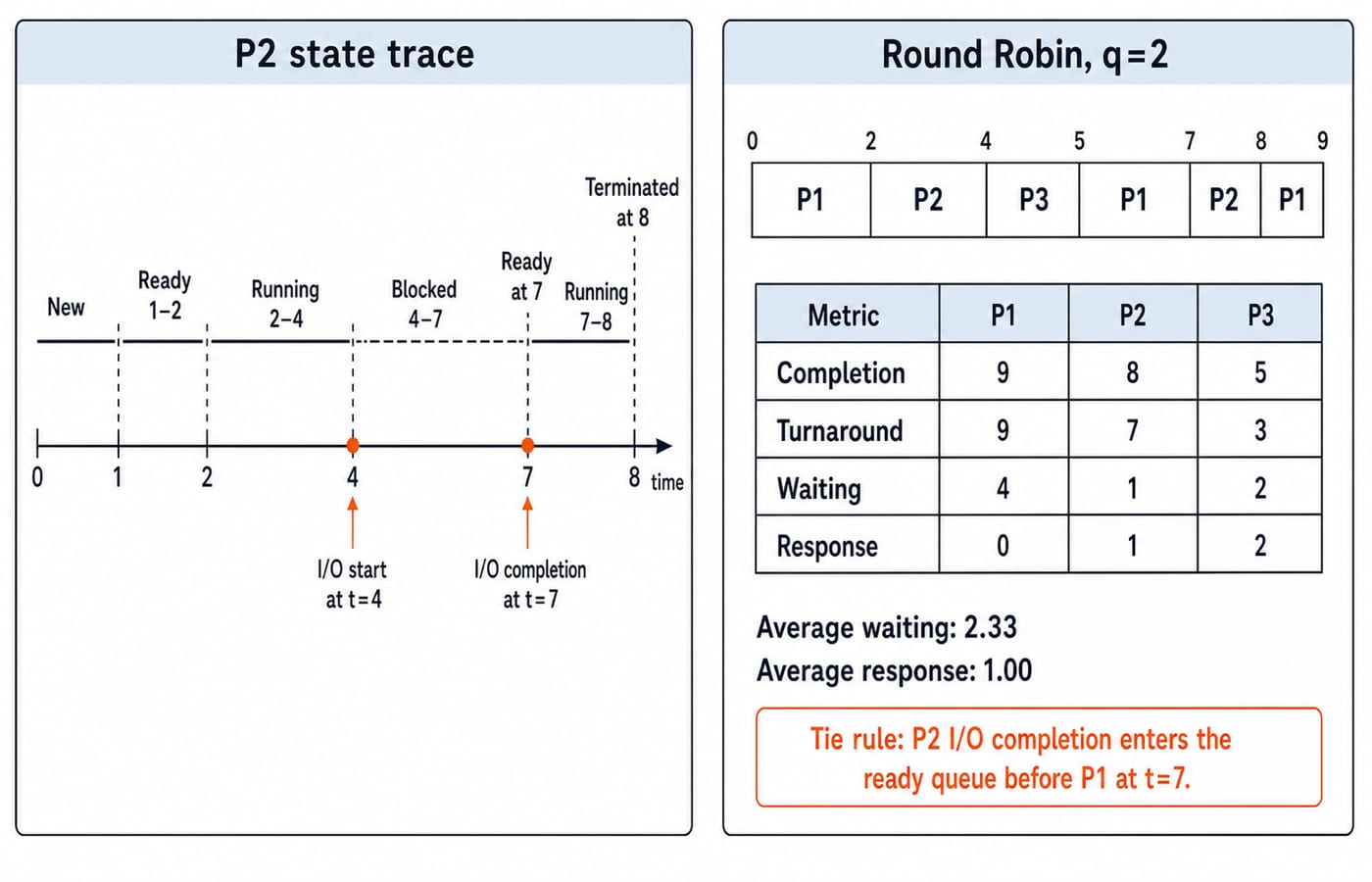
With q = 2, P1 runs 0-2; P2, which arrived at 1, runs 2-4 and blocks for I/O. P3 runs 4-5, then P1 runs 5-7. At t=7, enqueue I/O-complete P2 before quantum-expired P1. Thus P2 runs 7-8, then P1 runs 8-9.
The Gantt chart is 0-2 P1 | 2-4 P2 | 4-5 P3 | 5-7 P1 | 7-8 P2 | 8-9 P1. P2 is New before arrival, Ready 1-2, Running 2-4, Blocked 4-7, Ready at 7, Running 7-8, then Terminated. A Blocked process cannot run.
Completion times are C1 = 9, C2 = 8, C3 = 5. Turnaround is completion minus arrival, giving 9, 7 and 3. Waiting excludes CPU and I/O time:
P1: 9 - 5 = 4P2: 7 - 3 CPU - 3 I/O = 1P3: 3 - 1 = 2
Average waiting time is (4 + 1 + 2) / 3 = 7/3 = 2.33. First response times are 0 - 0 = 0, 2 - 1 = 1 and 4 - 2 = 2, so their average is (0 + 1 + 2) / 3 = 1.00. Continue with the Process Scheduling MCQs: 12 Solved set.
5. Connect network waiting to CPU scheduling without merging the models
A network or disk request can move a process from Running to Blocked, letting another Ready process run. Here P2 blocks at t=4; P3 and P1 use the CPU before P2 becomes Ready at t=7. The I/O event explains the wait, while the ready queue explains CPU allocation.
TCP connection establishment is not a process state. A context switch does not route packets. A port is an endpoint, not a state transition. I/O completion can make a process Ready without running it immediately.
Four checks: ARP targets which address for remote traffic? 10.24.8.65. Which process is Blocked at t=5? P2. Which layer sees port 443? Transport. Who runs 5-7? P1.
6. Use an exam-safe method and a trap checklist
Use four lines: write the given values; identify the model and invariant; calculate one event at a time; verify boundaries. The network chain is /27 -> block 32 -> .64/.95 -> gateway .65. The OS chain is state changes, queue order, Gantt chart, then timing metrics.
Before accepting an answer, check that you have not:
forgotten the network and broadcast addresses;
used ARP for the remote server rather than the next hop;
mixed DNS, ARP and routing roles;
treated TCP state and process state as one diagram;
left a Blocked process in the ready queue;
ignored simultaneous-event order;
counted I/O as waiting time;
calculated response from completion rather than first dispatch.
Frequency, marks, dates, cutoffs and question counts for your cycle come from the current syllabus and notices on the official MPPSC website. For timed practice across both areas under one clock, work through the MPPSC Assistant Professor (CS) 2026 Paper-2 Test Series.
7. Short version and the next worked variation
From memory: 10.24.8.78/27 is in network .64 with broadcast .95, and remote traffic uses gateway .65. DNS resolves the name, TCP connects 49160 -> 443, TLS protects the stream, and HTTP carries GET /status. Round Robin runs P1, P2, P3, P1, P2, P1; average waiting is 2.33, response 1.00.
Now change only the quantum to 3. The order is 0-3 P1 | 3-5 P2 | 5-6 P3 | 6-8 P1 | 8-9 P2, so completion times are 8, 9, 6. Waiting times are 8 - 5 = 3, 8 - 3 CPU - 3 I/O = 2, and 4 - 1 = 3; average waiting is (3 + 2 + 3) / 3 = 2.67. Response times are 0, 3 - 1 = 2 and 5 - 2 = 3; average response is (0 + 2 + 3) / 3 = 1.67.
For a sequenced route through both areas, the MPPSC Assistant Professor Computer Science Paper 2 2026 course teaches Computer Networks and Operating Systems in order. Pair it with targeted practice: the KnowledgeGate question bank holds over 4,000 Computer Networks and Operating System questions.
Keep learning

MPPSC Eligibility Criteria 2026: Age Limit, Qualification & Nationality
A practical eligibility checklist for MPPSC Assistant Professor Computer Science Advertisement 28/2025, separating age, nationality, domicile, subject equivalence, marks, qualifying routes and the revised deadline.
23 Oct 20266 min readMPPSC Teaching

MPPSC Application Form 2026: Apply Online, Last Date, Fees & Registration Process
An application-focused guide for MPPSC Assistant Professor Computer Science Advertisement 28/2025, covering revised deadlines, base and late fees, photo/signature preparation, submission, payment proof and corrections.
23 Oct 20266 min readMPPSC Teaching

MPPSC Assistant Professor CS Exam 2026: Notification, Eligibility, Exam Pattern, Syllabus & Selection Process
A Computer Science-specific guide to MPPSC Advertisement 28/2025: revised application windows, the 1 October qualification cutoff, 29 November exam, eligibility, syllabus preparation and selection.
23 Oct 20266 min readMPPSC Teaching
MPPSC vs HPSC Teaching: A Decision Rule for CS Graduates
Compare MPPSC and HPSC teaching routes with a qualification gate, a syllabus portability map and a weighted fit score before committing your study hours.
Updated 7 Aug 20266 min readMPPSC Teaching