MPPSC Teaching CS Weightage: Build Defensible Priority Bands from PYQs
Build a personal MPPSC Computer Science revision order from official syllabus scope, source-checked PYQs and prerequisite reach, then turn it into a weekly plan.
KnowledgeGate Team
Exam prep & CS education
Updated 5 Aug 20265 min read
Search for MPPSC Computer Science weightage and you get percentage tables that never say which advertised post, which paper or which syllabus year produced them. Three separate inputs replace that guesswork: the applicable official syllabus fixes what is in scope, source-verified past papers fix how often a topic has actually appeared in the sample you audited, and prerequisite links fix the order you revise in. Scored together they hand every topic a number you can defend and a weekly minute budget that follows from it. For the course-level view of both papers, start at the MPPSC Assistant Professor (CS) Preparation page.
1. Separate official scope, observed recurrence and personal priority
The applicable, already-issued MPPSC syllabus sets the scope.
Source-verified papers and keys show recurrence only in the audited sample.
Your unfinished breadth and dependencies set your revision order.
Never call the result "MPPSC official weightage". It is a personal revision order, not a marks forecast. Marks per paper, question counts, stage structure, negative marking, dates and the exact wording of every syllabus unit come from the current advertisement and exam plan on the MPPSC official website, and only from there. Do not carry GATE topic weights or another state commission's paper pattern across either, because the syllabus boundary and the question style both differ.
2. Build two auditable sheets before counting a single topic
Syllabus sheet columns:
official unit | source document and page | unfinished subunits | downstream topic groups unlocked | last revised | confidence out of 5
Count distinct unfinished syllabus lines or subunits, never course lessons.
PYQ ledger columns:
paper ID | advertised post and paper | source URL/file | source status | question number | primary topic | secondary dependency | answer-key status | duplicate check
Only a paper verified against an MPPSC publication affects recurrence. Mark third-party scans unofficial, keys provisional or final, and deduplicate reposts. Give each question one primary tag. Coaching-memory questions score zero unless verified. This paper-first discipline explains why PYQs beat buying another question bank.
3. Turn the evidence into three priority bands
S: unfinished official-syllabus breadth from 1 to 5, capped at 5.R: recurrence in the audited PYQ sample. Use0 hits = 0,1-2 = 1,3-4 = 2,5-6 = 3,7-8 = 4, and9+ = 5.D: prerequisite reach from 0 to 3; 3 unlocks at least three later topic groups.U: 2 for an official-syllabus topic with zero audited hits; otherwise 0.
Priority = 2S + 2R + D + U
Repair Band A (17+) first, consolidate Band B (12-16), and protect Band C (0-11). The cut points are yours to move: if Band A ends up holding more than three topics, raise its threshold until it holds only what you can genuinely repair this month.
Never delete an official topic because R=0. Break ties by lower confidence, then older last revised. Recalculate when evidence changes.
4. Worked example: score six CS blocks with actual values
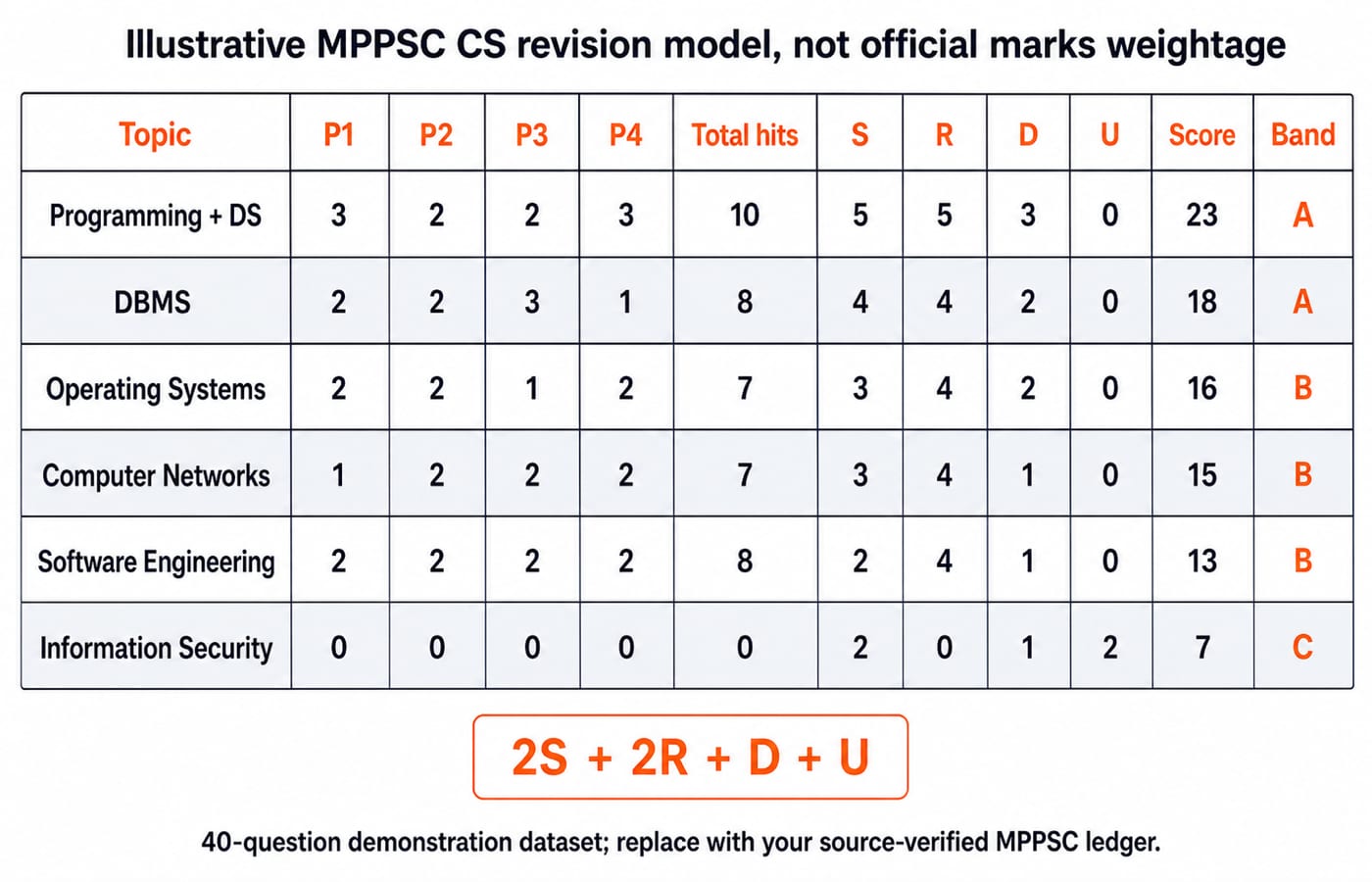
The numbers below are one candidate's own illustrative 40-question audit, not real MPPSC paper history. P1 to P4 are four 10-question slices of that sample, labelled neutrally so nothing here reads as a real paper.
Topic | P1 | P2 | P3 | P4 | Total hits | S | R | D | U | Score | Band |
|---|---|---|---|---|---|---|---|---|---|---|---|
Programming and Data Structures | 3 | 2 | 2 | 3 | 10 | 5 | 5 | 3 | 0 | 23 | A |
DBMS | 2 | 2 | 3 | 1 | 8 | 4 | 4 | 2 | 0 | 18 | A |
Operating Systems | 2 | 2 | 1 | 2 | 7 | 3 | 4 | 2 | 0 | 16 | B |
Computer Networks | 1 | 2 | 2 | 2 | 7 | 3 | 4 | 1 | 0 | 15 | B |
Software Engineering | 2 | 2 | 2 | 2 | 8 | 2 | 4 | 1 | 0 | 13 | B |
Information Security | 0 | 0 | 0 | 0 | 0 | 2 | 0 | 1 | 2 | 7 | C |
Column checks are P1 3+2+2+1+2+0=10, P2 2+2+2+2+2+0=10, P3 2+3+1+2+2+0=10 and P4 3+1+2+2+2+0=10. Thus 10+10+10+10=40.
Programming and Data Structures:
2(5)+2(5)+3+0 = 23, Band A.DBMS:
2(4)+2(4)+2+0 = 18, Band A.Operating Systems:
2(3)+2(4)+2+0 = 16, Band B.Computer Networks:
2(3)+2(4)+1+0 = 15, Band B.Software Engineering:
2(2)+2(4)+1+0 = 13, Band B.Information Security:
2(2)+2(0)+1+2 = 7, Band C.
Programming and Data Structures outranks DBMS through breadth and dependency reach, not recurrence alone. Information Security retains time because the official syllabus sets the boundary.
Six blocks is a slice, not the whole subject. A full Paper 2 audit also scores discrete structures, computer organisation and architecture, programming languages and OOP, Python, theory of computation, compiler design and current trends, and dependency order runs roughly in that sequence: the mathematics and the machine first, then the core systems, then the formal and applied areas. Add one row per official area you are still carrying, then re-total and re-band.
5. Convert 92 score points into a 12-hour revision week
The scores total 23+18+16+15+13+7=92. Allocate 720 minutes proportionally, rounded to 20-minute blocks.
Topic | Weekly minutes |
|---|---|
Programming and Data Structures | 180 |
DBMS | 140 |
Operating Systems | 120 |
Computer Networks | 120 |
Software Engineering | 100 |
Information Security | 60 |
For the top block, 720x23/92=180. Check: 180+140+120+120+100+60=720.
Split 180 into 90 minutes for concept repair, 60 for source-tagged questions and 30 for error-log recall. Split Information Security's 60 into 20 for recall, 25 for fresh questions and 15 for review.
Use MPPSC Assistant Professor Computer Science Paper 2 2026 when a Band A block needs rebuilding in taught order, and the MPPSC Assistant Professor (CS) 2026 Paper-2 Test Series when that same block needs timed sets and an accuracy figure for the refresh step below. Practice output moves your minutes; only verified past papers move R.
6. Refresh the bands without turning practice data into paper history
After the week, update unfinished subunits, confidence and errors. If DBMS yields 11/20 = 55% and Operating Systems 16/20 = 80% on fresh questions, move one 40-minute application block from OS to DBMS. DBMS becomes 180 minutes and OS 80, while the total stays 720.
Recalculate after every 40 newly tagged, source-verified PYQs or an official syllabus revision, whichever comes first. Mock and question-bank results change confidence and time. Only verified past-paper questions change recurrence.
Keep these corrections visible:
Duplicate scans: deduplicate by paper ID and question number.
Mixed papers or exams: keep one ledger per advertised post and paper.
Percentages without a denominator: show the audited question count.
Dropped zero-hit units: retain
U=2and protected time.Lesson volume as breadth: count official syllabus lines instead.
7. Short version and the next evidence-led step
Verify scope, tag each trustworthy PYQ once, score breadth, recurrence and dependency, and protect zero-hit syllabus areas. Ground current MPPSC claims in applicable Commission documents.
Upkeep costs about 30 minutes a week: ten minutes to log new PYQ tags, ten to update S and confidence, and ten to redraw the minute table. Skip that half hour and the bands go stale while the plan still looks tidy. For how often to sit a full timed set alongside it, follow the teaching-exam mock cadence and review plan.
Spend the next 60 minutes creating both sheets and tagging one source-verified paper slice. Then assign bands.
Keep learning

MPPSC Eligibility Criteria 2026: Age Limit, Qualification & Nationality
A practical eligibility checklist for MPPSC Assistant Professor Computer Science Advertisement 28/2025, separating age, nationality, domicile, subject equivalence, marks, qualifying routes and the revised deadline.
23 Oct 20266 min readMPPSC Teaching

MPPSC Application Form 2026: Apply Online, Last Date, Fees & Registration Process
An application-focused guide for MPPSC Assistant Professor Computer Science Advertisement 28/2025, covering revised deadlines, base and late fees, photo/signature preparation, submission, payment proof and corrections.
23 Oct 20266 min readMPPSC Teaching

MPPSC Assistant Professor CS Exam 2026: Notification, Eligibility, Exam Pattern, Syllabus & Selection Process
A Computer Science-specific guide to MPPSC Advertisement 28/2025: revised application windows, the 1 October qualification cutoff, 29 November exam, eligibility, syllabus preparation and selection.
23 Oct 20266 min readMPPSC Teaching
MPPSC vs HPSC Teaching: A Decision Rule for CS Graduates
Compare MPPSC and HPSC teaching routes with a qualification gate, a syllabus portability map and a weighted fit score before committing your study hours.
Updated 7 Aug 20266 min readMPPSC Teaching