Computer Networks Subnetting MCQs: 12 solved IP addressing questions (GATE, ISRO, state exams)
Subnetting and IP addressing MCQs solved: 12 previous-year GATE, ISRO and state-exam questions on address classes, masks, hosts per subnet, CIDR and VLSM.
KnowledgeGate Team
Exam prep & CS education
Updated 25 Jul 20266 min read140 views
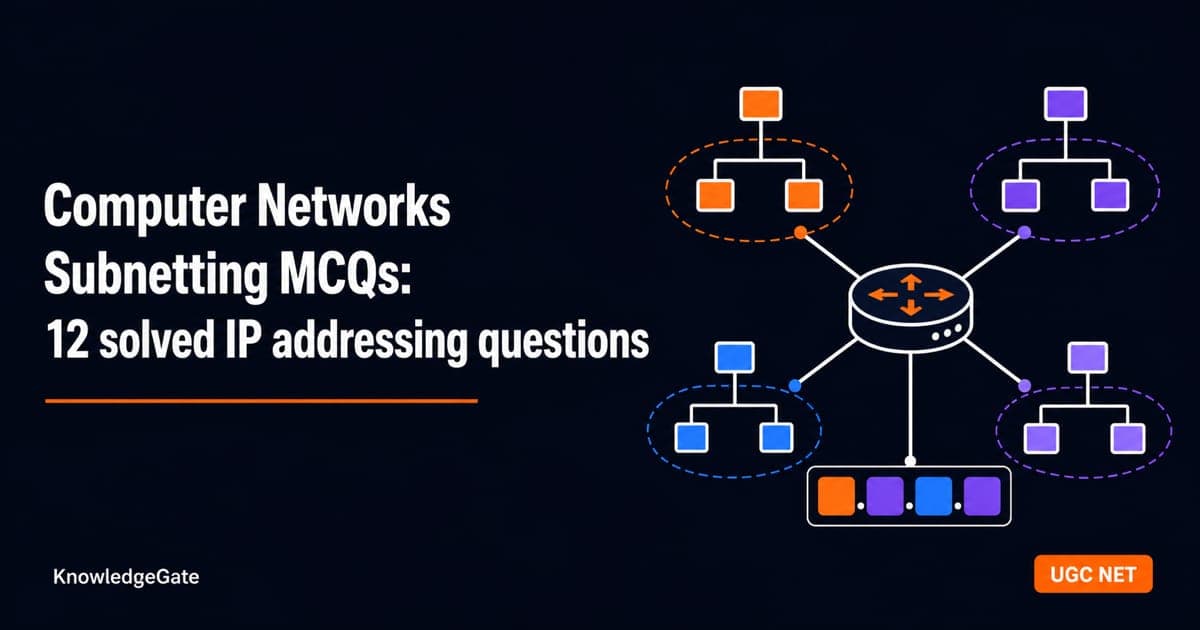
Subnetting is where Computer Networks marks are decided in GATE and PSU papers, because the questions are arithmetic: convert a mask to a prefix, count host bits, find a block boundary, decide whether a candidate prefix is even legal. One miscounted bit and the answer changes.
All 12 are previous-year questions, and each carries its exam and year so you can see which boards recycle which idea. Attempt one on paper before reading its explanation. If a step is unclear, the full theory sits in the Computer Networks learn module.
IP addressing and classes
Q1. In IPv4, the number of networks allowed under Class C addresses is (UPPSC Polytechnic Lecturer 2022)
(a) 2 to the 14
(b) 2 to the 7
(c) 2 to the 21
(d) 2 to the 24
Answer: (c). A Class C address uses 24 bits for the network ID, but the leading three bits are fixed as 110 to mark the class. That leaves 21 bits free to vary, so 2 to the 21 distinct Class C networks are possible (see the worked solution).
Q2. What is an IP address? (UP Police 2018)
(a) it is the Internet Protocol
(b) it is an internet posting address used to authenticate networks
(c) it is the unique number given to each device on the network
(d) it is the same as the URL
Answer: (c). An IP address is a numeric label assigned to each device on a network, letting it be located and addressed like a postal address. It is not the protocol itself, nor a URL, which is a human-readable resource name. Only (c) describes the address.
Q3. The network 198.78.41.0 is a (ISRO 2008)
(a) Class A network
(b) Class B network
(c) Class C network
(d) Class D network
Answer: (c). In classful addressing the first octet fixes the class: 1 to 126 is A, 128 to 191 is B, and 192 to 223 is C. Since 198 falls in the 192 to 223 range, this is a Class C network.
Q4. IPv4 addresses have a size of (RSSB 2022)
(a) 32 bit
(b) 64 bit
(c) 128 bit
(d) 256 bit
Answer: (a). IPv4 uses a 32-bit address space, which yields roughly 4.3 billion unique addresses. That exhaustion pressure is exactly why IPv6 with its 128-bit space exists. The size to remember here is 32 bits.
Q5. IPv6 uses an address of (Navodaya Vidyalaya Samiti 2017)
(a) 128 bit
(b) 64 bit
(c) 32 bit
(d) variable
Answer: (a). IPv6 expands the address to 128 bits, four times the width of IPv4. That enormous space removes the address-scarcity problem and the heavy reliance on NAT. The value to memorize is 128 bits.
Subnetting and fixed-length masks
Q6. A subnetted Class B network has broadcast address 144.16.95.255. Its subnet mask (GATE 2006)
(a) is necessarily 255.255.224.0
(b) is necessarily 255.255.240.0
(c) is necessarily 255.255.248.0
(d) could be any one of 255.255.224.0, 255.255.240.0, 255.255.248.0
Answer: (d). Each candidate mask (/19, /20, /21) has a block containing 95 whose broadcast ends at 95.255: the /19 block 64 to 95, the /20 block 80 to 95, and the /21 block 88 to 95. Without knowing the subnet ID you cannot single one out, so any of the three is possible (see the worked solution).
Q7. An organization with a Class B network wants subnets for 64 departments. The subnet mask would be (GATE 2005)
(a) 255.255.0.0
(b) 255.255.64.0
(c) 255.255.128.0
(d) 255.255.252.0
Answer: (d). To make 64 subnets you need the smallest n with 2 to the n at least 64, which is n equal to 6. Borrowing 6 bits from a Class B /16 gives a /22 prefix, and /22 in dotted decimal is 255.255.252.0 (see the worked solution).
Q8. For a Class B network with subnet mask 255.255.248.0, the maximum number of hosts per subnet is (GATE 2008)
(a) 1022
(b) 1023
(c) 2046
(d) 2047
Answer: (c). The mask 255.255.248.0 is /21, since 248 is 11111000. That leaves 32 minus 21, or 11 host bits, giving 2 to the 11 equal to 2048 addresses. Subtracting the network and broadcast addresses leaves 2046 usable hosts (see the worked solution).
Q9. A subnet has mask 255.255.255.192. The maximum number of hosts it can hold is (GATE 2004)
(a) 14
(b) 30
(c) 62
(d) 126
Answer: (c). The mask 255.255.255.192 is /26, because 192 is 11000000. Host bits are 32 minus 26, that is 6, so 2 to the 6 equals 64 addresses. Removing the network and broadcast addresses leaves 62 usable hosts (see the worked solution).
CIDR, VLSM and supernetting
Q10. Which CIDR prefix exactly represents the range 10.12.2.0 to 10.12.3.255? (GATE 2024)
(a) 10.12.2.0/23
(b) 10.12.2.0/24
(c) 10.12.0.0/22
(d) 10.12.2.0/22
Answer: (a). The range spans 512 addresses, which needs 9 host bits, so the prefix is 32 minus 9 equal to /23 with mask 255.255.254.0. Starting at 10.12.2.0, a 512-block runs up to broadcast 10.12.3.255. That is exactly 10.12.2.0/23 (see the worked solution).
Q11. C1 has IP 203.197.2.53 with mask 255.255.128.0, and C2 has IP 203.197.75.201 with mask 255.255.192.0. Which is true? (GATE 2006)
(a) both assume they are on the same network
(b) C2 assumes C1 is on the same network, but C1 assumes C2 is on a different one
(c) C1 assumes C2 is on the same network, but C2 assumes C1 is on a different one
(d) both assume they are on different networks
Answer: (c). C1 with /17 sees network 203.197.0.0/17, which covers 0 to 127 in the third octet, so C2's 75 falls inside it. C2 with /18 sees network 203.197.64.0/18, covering 64 to 127, so C1's third octet 2 falls outside. Each applies its own mask, giving the asymmetric answer (c) (see the worked solution). That asymmetry is the everyday hazard of variable-length masks: one address block, two prefix lengths, and the two hosts disagree about who is local.
Q12. An ISP serving from 202.61.0.0/17 must allot a block for 1500 hosts using route aggregation. From I: 202.61.84.0/21, II: 202.61.104.0/21, III: 202.61.64.0/21, IV: 202.61.144.0/21, the valid candidates are (GATE 2020)
(a) I and II only
(b) II and III only
(c) III and IV only
(d) I and IV only
Answer: (b). A /21 gives 2048 addresses, enough for 1500 hosts, but a valid /21 boundary needs the third octet to be a multiple of 8, and the block must sit inside 202.61.0.0/17 (third octet 0 to 127). Only 104 and 64 satisfy both: 84 is not a multiple of 8, and 144 lies outside the /17. So II and III (see the worked solution).
How subnetting is examined
Three question shapes carry the marks here. The addressing block (Q1 to Q5) is quick recall: class ranges, the 32-bit and 128-bit sizes, and the fixed leading bits that shrink the Class C network count. The fixed-length mask block (Q6 to Q9) is the core drill, and every question reduces to the same three moves: mask to prefix, count host bits, then 2 to the host bits minus 2 for usable hosts.
The CIDR block (Q10 to Q12) is where the two-mark questions live. Q10 and Q12 both turn on block boundaries: a prefix is legal only when its network number is a multiple of the block size, which is why 202.61.84.0/21 fails and 202.61.64.0/21 passes. Q12 carries the supernetting point too, since folding a customer into one advertised route is the whole reason the ISP cares about the boundary. Q11 is the variable-length mask case, where two prefix lengths over one address block give two different answers to the same question.
For the method behind every conversion, work through our IP Addressing and Subnetting Explained deep dive, then drill the numericals in the Computer Networks learn module. GATE aspirants get the full networks sequence inside GATE Guidance by Sanchit Sir, and you can see where it fits across the paper on the GATE CS Exam page. Solve, redo the arithmetic by hand, and the speed follows on the second pass.
Keep learning
Repeater, Hub, Bridge & Switch MCQs: 12 Solved Questions with Explanations
Solve 12 exam questions on device layers, MAC forwarding, VLANs, collision and broadcast domains, port mirroring, bridges and crosspoint counting.
Updated 20 Oct 20267 min readComputer Networks MCQs
Ethernet IEEE 802.3 MCQs: 12 Solved Questions with Explanations
Solve 12 Ethernet questions on IEEE 802.3, speed generations, hubs, MAC addresses, multicast, CSMA/CD and the first binary backoff race.
Updated 16 Oct 20267 min readComputer Networks MCQs
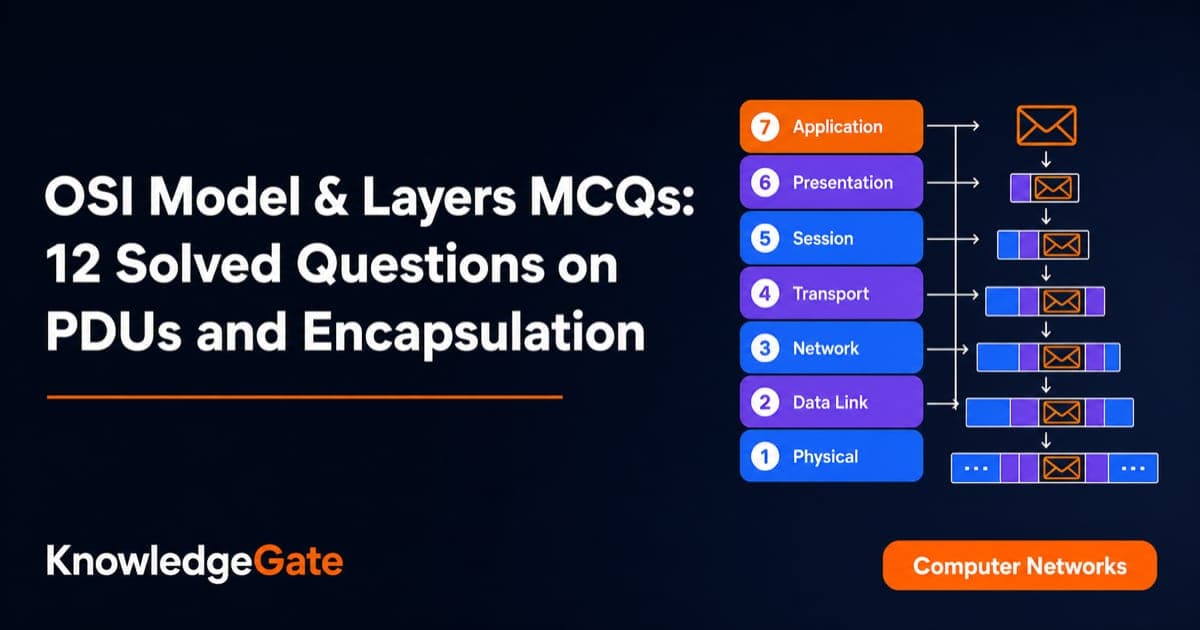
OSI Model & Layers MCQs: 12 Solved Questions on PDUs and Encapsulation
Test OSI layers, PDUs, encapsulation and router traversal through solved MCQs, with explanations, a byte-by-byte frame trace and a layer-visit method.
12 Oct 20267 min readComputer Networks MCQs
Mobile Computing MCQs: Solved Questions on Concepts, Features and Applications
Work through 10 solved questions covering portability, cellular standards, Bluetooth, CDMA, Android, mobile cloud, and device constraints. Each answer has a concise explanation.
7 Oct 20267 min readComputer Networks MCQs