MPPSC Assistant Professor CS: 16-Week Study and Revision Plan
Build a realistic 16-week study cycle with a protected buffer day, cumulative revision, timed practice, mock analysis, and a clear rule for recovering lost time.
KnowledgeGate Team
Exam prep & CS education
Updated 28 Jul 20265 min read
Many candidates keep collecting material until revision becomes an afterthought. Others plan an impossible daily streak, miss one week, and abandon the schedule. This 16-week route uses 14 hours per week, a protected buffer day, cumulative revision, and a clear missed-week recovery rule.
The 224 hours below buy Paper 2, your Computer Science lane. Paper 1 is Madhya Pradesh general studies and runs on its own track, so budget for it separately. The MPPSC Assistant Professor Computer Science syllabus map sets out both lanes in study order, and separates the Assistant Professor route from MP SET and the school-level teaching recruitments.
1. Set the 14-hour weekly frame before choosing topics
Day | Work |
|---|---|
Monday to Thursday | 90 minutes daily: 45 concept study, 30 questions, 15 closed-book recall |
Friday | Unallocated recovery day |
Saturday | 4 hours: 120 minutes deep study, 90 questions, 30 error-log work |
Sunday | 4 hours: 60 cumulative recall, 90 timed set, 60 analysis, 30 planning |
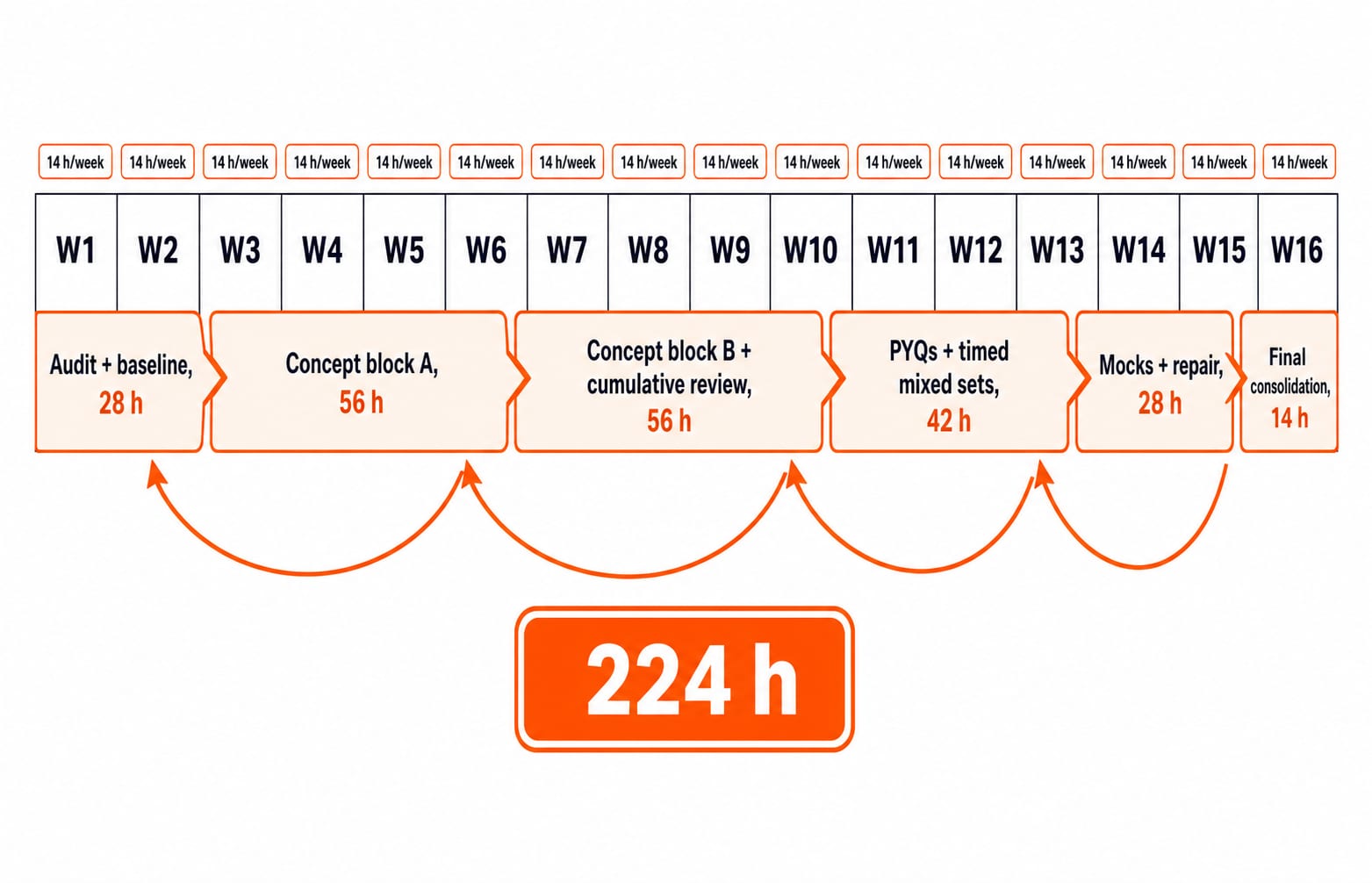
The weekdays total 6 hours and the weekend 8, giving 14 per week and 224 across 16 weeks.
The MPPSC Assistant Professor CS category page collects the courses and test series built for this route. Take the unit list from the official Paper 2 syllabus for your cycle and map it into the phases below.
Maintain three records: a syllabus tracker with unit | confidence 0-3 | questions attempted | accuracy | last revised | next action; an error log tagged concept | recall | misread | time; and one one-page recall sheet per completed unit.
2. Weeks 1-2: audit the syllabus and establish a baseline
Spend the first 28 hours exactly: 6 on syllabus audit and baseline, 14 on the two weakest high-priority units, 4 correcting baseline errors, and 4 on spaced re-testing. Mark every unit 0 not started, 1 fragile, 2 workable, or 3 can explain and solve.
Attempt an 80-question mixed set as a planning diagnostic. Say it comes back 42 correct, 30 incorrect and 8 unattempted. Classify all 38 wrong or blank items by cause: on that reading, 16 concept gaps, 12 recall gaps, 6 misreads and 4 time losses. Prioritise the units behind the 16 concept gaps. Diagnose in counts, not in marks.
By Week 2's end, name eight weekly unit slots, correct every wrong or blank item once, and re-solve about four in five of them without notes. Anything below that stays open.
3. Weeks 3-6: complete concept block A with questions attached
For each of four weeks, use 8 hours for concepts, 3 for examples or relevant PYQs, 2 for cumulative recall, and 1 for a quiz. This gives 56 hours. Select units by gap count and prerequisite value, not comfort. Where your cycle's Paper 2 syllabus lists them, Operating Systems, DBMS, Computer Networks, and C with data structures carry the most prerequisite weight, so they earn the early slots.
A finished unit has one recall sheet, at least 25 attempted questions, every error tagged, and two closed-book explanations of its central ideas. Watching every lesson is not completion. The MPPSC Assistant Professor Computer Science Paper 2 course supplies ordered lessons and question practice; this plan supplies pacing.
4. Weeks 7-10: finish concept block B and keep old units alive
Repeat the 8 + 3 + 2 + 1 split for 56 hours. Every Sunday set mixes the current unit with at least two earlier units. If an old unit scores below 70% in recall, return it to the next week's 2-hour recall block.
A Week 8 timetable could be:
Monday: 90 minutes on DBMS normalisation.
Tuesday: 90 minutes on SQL queries.
Wednesday: 90 minutes on Operating Systems scheduling.
Thursday: 90 minutes on deadlocks.
Saturday: 120 minutes on the current priority unit, 90 on mixed questions, and 30 on the error log.
Sunday: 60 minutes closed-book recall, a 30-question set in 45 minutes, 45 minutes checking and re-solving, 60 minutes analysis, and 30 minutes planning.
With 21 correct, 7 incorrect, and 2 unattempted, attempted accuracy is 21 / 28 = 75%; overall completion is 21 / 30 = 70%. Tag the seven errors as 3 concept, 2 recall, 1 misread, and 1 time error. Keep two blanks separate, and repair the three concept errors first.
5. Weeks 11-13: convert coverage into timed-set performance
Divide 42 hours into 15 for mixed or PYQ-based sets, 9 for analysis, 12 for weak-unit repair, and 6 for cumulative recall. Each week includes two 40-question timed sets and one 20-question sprint. Take the per-question pace from your cycle's official Paper 2 plan and hold every set to it.
Use one correction loop: attempt, label the cause, study the missing idea, re-solve without notes, then re-test 48 hours later. Close errors after two clean re-solves. A lucky correct stays open if you cannot explain it.
Start the MPPSC Paper 2 test series here. Its unit tests and full-length mocks are the MPPSC-specific practice layer, and these three weeks are where they belong in the timetable.
6. Weeks 14-16: simulate, repair, then taper
In Weeks 14 and 15, reserve one 4-hour mock-and-initial-review block weekly. Use the live test's timer and the remaining block for initial analysis. Add 4 hours of weak-unit repair, 4 of mixed-set work and analysis, and 2 of error-log re-testing. Keep mock days fixed even if a unit remains incomplete.
If a mock has 18 wrong or blank responses, classify them as 8 concept, 5 recall, 3 misread, and 2 time errors. Use the next 4-hour repair block as 120 minutes on concept gaps, 60 on recall gaps, 40 re-solving misreads, and 20 on time errors. That totals 240 minutes. Convert a mock to marks only against your cycle's official marking scheme; until then, diagnose in counts.
Week 16 has 14 hours: 4 on the highest-priority weak units, 3 re-solving the error log, 3 recalling from one-page sheets, 2 on two short mixed sets plus review, and 2 as buffer. Use the teaching-exam mock strategy for fuller analysis mechanics. Begin no broad new unit.
7. Use the missed-day and missed-week recovery rule
Move a missed 90-minute weekday block to Friday. Otherwise, replace a lower-priority 90-minute weekend block. Never double the next day. Protect sleep, Sunday review, and mock days.
If Week 6 loses all 14 hours, recover only the 8 highest-value hours. In Week 7, do 10 original hours plus 4 backlog hours. Repeat in Week 8. Defer the remaining 6 hours of duplicate explanations and low-priority questions, so Week 11 starts on time.
For a busy week, complete four 45-minute sessions: one recall, one error-log re-solve, and two on the highest-priority concept. This is a 3-hour maintenance week, not a normal week. Apply the recovery rule next.
8. The short version: protect the loop, not a perfect streak
The checkpoints are 28 hours for audit and baseline, 56 for concept block A, 56 for concept block B, 42 for PYQs and timed sets, 28 for mocks and repair, and 14 for final consolidation. Total: 224 planned hours.
Open the current syllabus, create the tracker, reserve four 90-minute sessions, and take the baseline before collecting more material. Place course lessons, unit tests, and mocks inside this schedule, not beside it.
Keep learning

MPPSC Eligibility Criteria 2026: Age Limit, Qualification & Nationality
A practical eligibility checklist for MPPSC Assistant Professor Computer Science Advertisement 28/2025, separating age, nationality, domicile, subject equivalence, marks, qualifying routes and the revised deadline.
23 Oct 20266 min readMPPSC Teaching

MPPSC Application Form 2026: Apply Online, Last Date, Fees & Registration Process
An application-focused guide for MPPSC Assistant Professor Computer Science Advertisement 28/2025, covering revised deadlines, base and late fees, photo/signature preparation, submission, payment proof and corrections.
23 Oct 20266 min readMPPSC Teaching

MPPSC Assistant Professor CS Exam 2026: Notification, Eligibility, Exam Pattern, Syllabus & Selection Process
A Computer Science-specific guide to MPPSC Advertisement 28/2025: revised application windows, the 1 October qualification cutoff, 29 November exam, eligibility, syllabus preparation and selection.
23 Oct 20266 min readMPPSC Teaching

MPPSC vs HPSC Teaching: A Decision Rule for CS Graduates
Compare MPPSC and HPSC teaching routes with a qualification gate, a syllabus portability map and a weighted fit score before committing your study hours.
Updated 7 Aug 20266 min readMPPSC Teaching