MP Cooperative Bank Preparation Strategy: Which Subjects Carry the Marks and How Bank-PO Prep Transfers
Reuse your bank PO foundation, add cooperative banking and MP awareness, then move through a ten-week plan whose weekly hours add up and end in analysed mocks.
KnowledgeGate Team
Exam prep & CS education
Updated 4 Aug 20266 min read
If you are aiming at the MP Cooperative Bank and already studying for IBPS or SBI exams, most of that work can count twice. The trap is treating this as a fresh syllabus and restarting subjects you have already built. Keep the bank-exam core, add the MP and cooperative-banking layer deliberately, and give that layer real weeks rather than the last one.
What transfers from bank PO preparation
Quantitative aptitude transfers at the skill level: arithmetic, data interpretation, simplification, number series and calculation speed. So does reasoning work on puzzles, seating arrangements, syllogisms and inequalities, and English work on comprehension, grammar, vocabulary and time control. Revise and test those areas rather than restarting them from zero.
Your error log is the most valuable thing you carry over: it already shows whether calculation, puzzle setup, reading speed or question selection is costing you attempts.
The overlap is closest in quant. Percentage, ratio and proportion, averages, profit and loss, simple and compound interest, time and work, speed time and distance, mixture and alligation and data interpretation are the areas our MP Cooperative Bank material drills, and the same list that Bank PO quantitative aptitude high-yield topics tells you to clear first.
MP Cooperative Bank subjects: which ones get the most time
Five sections decide this exam, and our own MP Cooperative Bank course is built on the same five: reasoning ability, English language, general awareness including financial awareness, quantitative aptitude and computer knowledge. Those names are stable across cycles. Marks, question counts, sectional timing and negative marking are not, so copy them from the current notice at apexbankmp.bank.in for your post, Computer Operator or Society Manager, before you set any mark target.
Rank them by how fast a section moves, not by which looks hardest. Recall sections convert with revision alone; method sections take weeks, so they earn the largest early blocks.
Section | What it rewards | Hours a week, weeks 1 to 4 | Hours a week, weeks 5 to 7 |
|---|---|---|---|
Quantitative aptitude | Method and calculation speed | 6 | Inside the 4-hour mixed speed block |
Reasoning ability | Setup and constraint handling | 6 | Inside the 4-hour mixed speed block |
English language | Maintenance once comprehension holds | 3 | Inside the timed sectional |
General and financial awareness | Recall, so gaps close fastest | From week 5 | 4, shared with computer knowledge |
Computer knowledge | A short syllabus you finish once | From week 5 | Inside that 4-hour awareness block |
The MP Cooperative Bank exam pattern study map works the same five sections as five separate weekly jobs and orders them from a diagnostic you sit yourself. Your own diagnostic beats any general ranking.
The MP-specific layer you cannot skip
The first part of that layer is the cooperative structure itself. Short-term cooperative credit runs on three tiers, and each tier does a different job.
Primary agricultural credit societies, the PACS, sit at village level and deal directly with farmer members: member deposits in, short-term crop loans out, and often seed, fertiliser and other inputs supplied as well.
District central cooperative banks sit at district level. They finance and supervise the societies in their district, hold their surplus deposits, and run their own banking business with individuals and cooperative institutions.
The state cooperative bank is the apex tier. In Madhya Pradesh that is the MP Rajya Sahakari Bank, the Apex Bank: it channels funds down to the district banks, holds their reserves, and links the structure to NABARD and the Reserve Bank.
NABARD is the national development bank for agriculture and rural development. It refinances cooperative banks and regional rural banks and inspects the district and state cooperative banks, which is why its name turns up in questions that look purely about credit.
Learn the flow upward from the society and the abbreviations stop being a list to memorise. Long-term investment credit runs through a separate wing, the cooperative agriculture and rural development banks, not through these crop-loan tiers.
The second part is MP static general knowledge and current affairs, against the syllabus the notice states. Keep one small revisable notebook rather than an unlimited PDF collection: state geography and economy, governance and institutions, important schemes, current developments. Update the current-affairs pages weekly and leave the structural notes alone once they are right.
Give this layer protected weekly blocks. Left to the last week, it forces you to memorise disconnected facts when you should be analysing mocks. The MP Cooperative Bank preparation hub keeps its lessons under the same five sections, so a weak area points straight at its material.
The 10-week MP Cooperative Bank plan at about 15 hours a week
The plan runs on 15 study hours a week for ten weeks, so 10 x 15 = 150 hours in total: 4 x 15 = 60 in the foundation phase, 3 x 15 = 45 in the add-on phase and 3 x 15 = 45 in the mock phase, and 60 + 45 + 45 = 150.
Weeks 1 to 4, foundation: 6 hours of quantitative aptitude, 6 hours of reasoning and 3 hours of English, since 6 + 6 + 3 = 15. Learn one topic, solve a focused set, then record the errors before you change topics.
Weeks 5 to 7, add-on and speed: 4 hours of MP general knowledge and cooperative structure, 4 hours of general, financial and computer awareness, 4 hours of mixed quant-reasoning speed sets and 3 hours for one timed sectional plus its analysis, since 4 + 4 + 4 + 3 = 15.
Weeks 8 to 10, mocks: three 3-hour blocks, each a full mock and its immediate review, giving 9 hours, plus 3 hours of error-log revision and 3 hours of targeted repair on your two weakest sections, since 9 + 3 + 3 = 15.
Computer Operator candidates should move that section forward rather than wait for week 5. Take its 2 hours out of the foundation English block: 6 quant, 6 reasoning, 1 English and 2 computer knowledge still comes to 15.
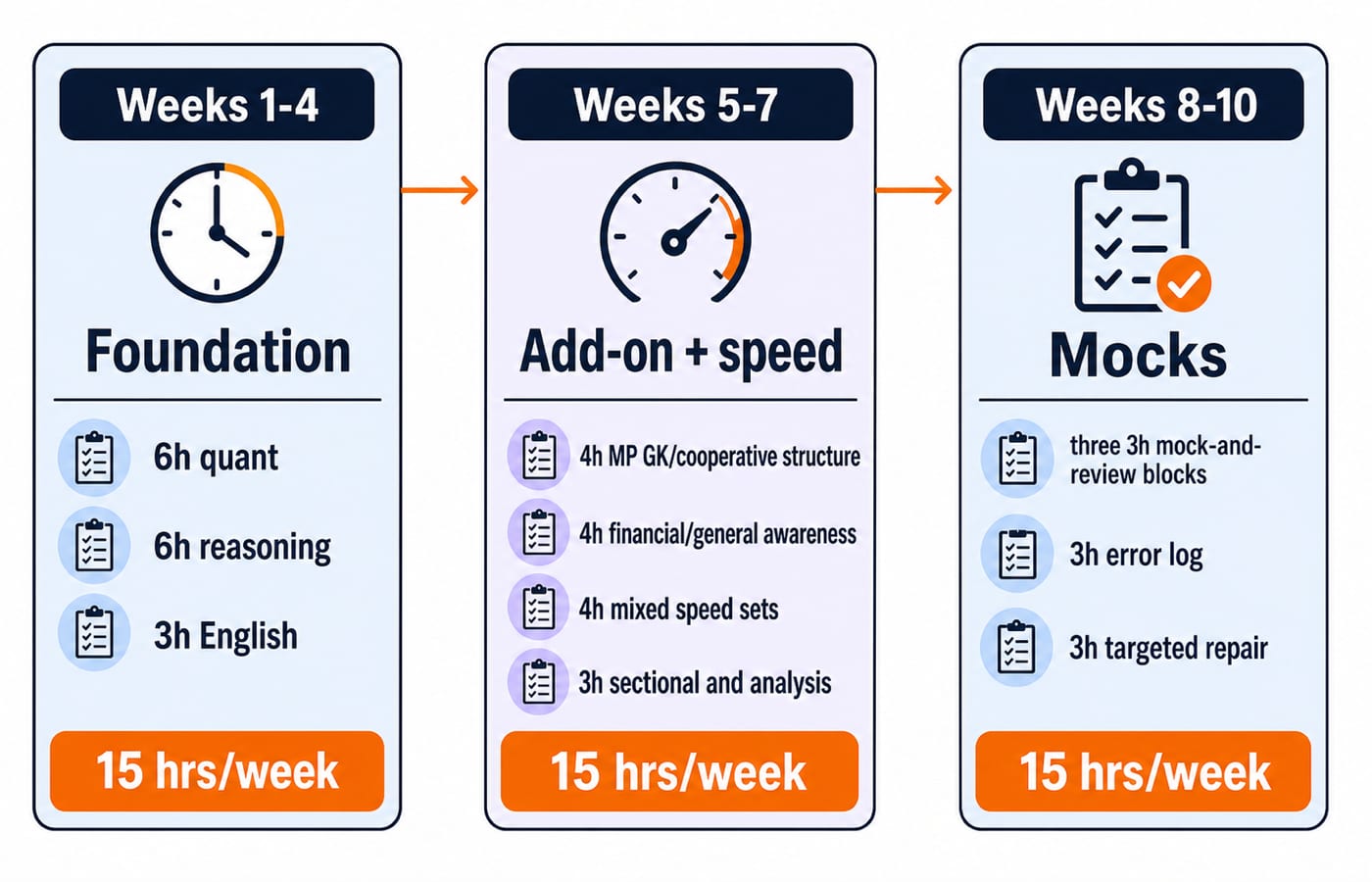
Fifteen hours is about two focused hours on five weekdays plus five across the weekend. Place the blocks where they survive, and protect analysis before adding mock volume.
What to do when you miss days
You will miss days. Do not answer two missed sessions with a five-hour catch-up marathon that eats the next weekend and damages the following week.
Protect the next timed sectional or mock, because it produces fresh evidence. Keep the session that repairs whichever error type is losing the most marks. Drop the lowest-yield rereading block, resume at the next planned slot, and carry one unfinished task forward rather than the whole day.
The rule is test, analyse, repair, resume. The aim is an intact feedback loop, not a perfect calendar.
If missed days are the rule because you work full time, the 12-week MP Cooperative Bank plan for working candidates rebuilds the same five sections around an 11-hour week rather than a 15-hour one.
Turning bank PO mocks into cooperative-bank practice
Keep using IBPS-style quantitative and reasoning sets for the shared skill base. Then add the block an IBPS set cannot give you: about 20 questions on cooperative structure and MP awareness, and about 10 on office tools and shortcuts, scored separately so neither layer hides inside one total.
Do not copy an old IBPS Clerk table into your MP plan. Two recruitments can share a skill and still differ in section count, timing and marking, so what transfers is the pressure and the method, never the numbers.
KnowledgeGate's question bank carries over 8,000 quantitative-aptitude questions and over 6,000 reasoning questions, enough depth to drill by weakness instead of by chapter.
Short version and next step
Reuse your quantitative aptitude, reasoning and English base. Add protected work for the cooperative structure, MP awareness, financial awareness and computer knowledge. Across ten weeks that is 60 foundation hours, 45 add-on hours and 45 mock-phase hours, 150 in all.
The MP Cooperative Bank 2026 course has the whole sequence already built for the Computer Operator and Society Manager papers, taught in Hindi and English. Before you apply, confirm the eligibility, pattern and dates in the current recruitment notice.
Keep learning

Mensuration and Geometry for Competitive Exams: Formulas, Shortcuts and Solved Examples
Learn how to choose the right mensuration formula, avoid common geometry traps, and solve 2D path and 3D recasting problems step by step.
Updated 6 Oct 20266 min readAptitude & Reasoning
Age Comparison and Multiple-Condition Problems: 12 Solved MCQs
Practise 12 age-problem MCQs with equations, timelines, back-checks, relation chains, changing ratios, birth years, and family conditions.
1 Oct 20268 min readAptitude & Reasoning
True, False and Cannot Say Questions: 10 Solved Passage MCQs
Learn how to separate contradictions from missing evidence, then apply the method to 10 previous-year passage MCQs with concise, evidence-led solutions.
26 Sep 20268 min readAptitude & Reasoning

TCS Aptitude Questions: High-Yield Quant and Reasoning Topics, Solved Step by Step
Learn the first move for common quant and reasoning question families through solved examples on ratios, work, trains, data, remainders, and seating.
Updated 25 Sep 20266 min read104 viewsAptitude & Reasoning