IBPS PO Interview Questions and Preparation: What the Panel Actually Asks
Turn the IBPS PO interview into five manageable question buckets, prepare answers from your own form, and use mocks to make short, honest responses routine.
KnowledgeGate Team
Exam prep & CS education
1 Aug 20265 min read
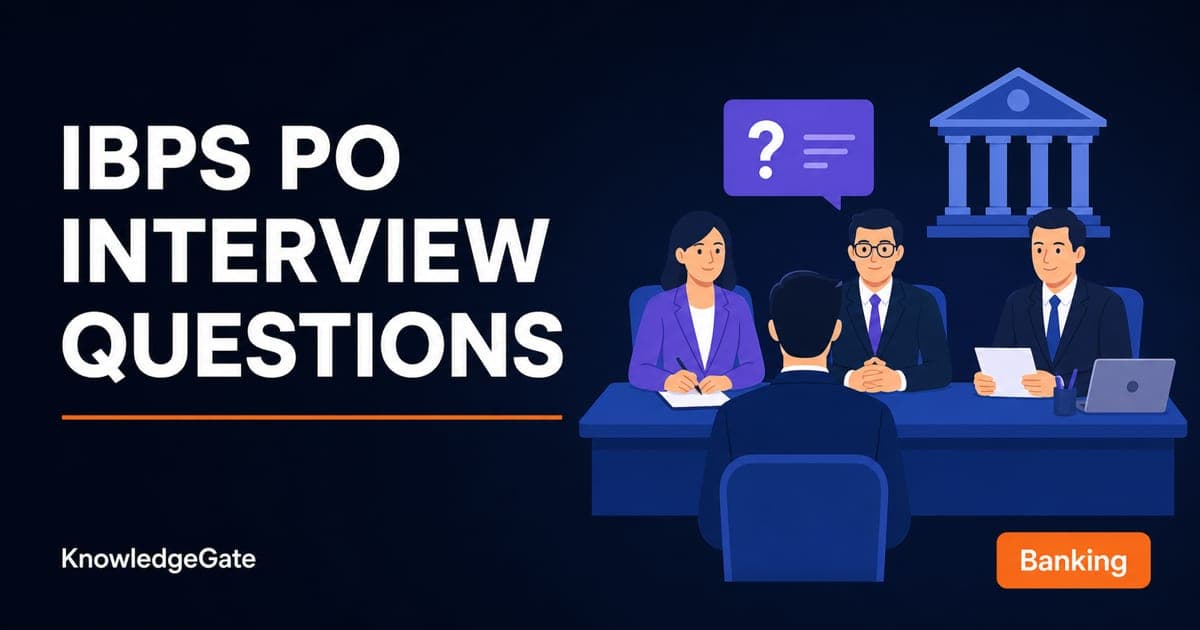
You clear Mains and suddenly face a stage that written-test practice did not rehearse: a panel asking short questions about you, banking, and the world around you. Strong written performance does not remove the need to communicate calmly and accurately. The interview is predictable in shape, so you can prepare its five question buckets and walk in with answers that sound like you.
How the IBPS PO interview counts after Mains
The interview contributes separately to the final selection process after Mains. That means a strong written score helps, but it does not make composure, clarity, or banking awareness optional. The panel also needs to understand why your education, interests, and career choice point towards a banking role.
The exact interview marks, the minimum qualifying standard, the call-letter date, and your reporting time change from one cycle to the next. Read them off the current PO notification and your own call letter on the official IBPS website. Do not build a plan from an old coaching graphic.
The Banking and Insurance preparation category covers the prelims and mains work that comes before this stage. The shift at the interview is real: written preparation tests selection under time pressure, while the interview tests whether you can explain your knowledge and judgement aloud.
The five buckets the panel draws from
Personal and HR questions
Expect a request to introduce yourself, explain why you want banking after your degree, and discuss a strength, weakness, hobby, home town, or state. These questions are simple only when the answer is specific. "Banking is a growing sector" says little about you. A useful answer connects your skills, motivation, and the work of a PO.
Banking awareness
Prepare repo and reverse repo, CRR and SLR, account types, non-performing assets, priority-sector lending, financial inclusion, and digital banking. For each term, know a one-line definition, why it matters, and one current connection. Any live rate or ratio must come from the latest RBI source.
Current affairs
Read six months back, weighted towards banking, the economy, and RBI action: a policy-rate decision, a regulatory circular or penalty, a bank merger or a new licence, a government scheme that runs through bank branches, and the headline fiscal and trade numbers. The panel is not looking for a newsreader. For each item, be ready with what changed, who it affects, and one trade-off you can see, because that is the follow-up you will actually get.
Academic and work background
Your graduation subjects, project, internship, and work experience remain fair ground. Explain them in plain language. A commerce graduate may be asked for a core concept; an engineer may be asked how problem solving transfers to banking operations.
Situational judgement
A question such as "How would you handle an angry customer?" tests sequence and judgement. Listen, verify the issue, explain what can be done, escalate within process when necessary, and keep the customer informed. Avoid promising an outcome outside your authority.
Prepare your form answers cold
Your application form is the panel's easiest starting point because every field belongs to you. Print a copy and turn each item into a possible question: degree, marks, city, hobby, gap, work history, job change, achievement, and preference.
Write a two-line answer for each. Then add one follow-up question underneath. If your hobby is cricket, the follow-up could concern a recent development or what the game taught you. If you left engineering work, prepare a direct explanation that does not insult the old role or romanticise banking.
Your introduction should usually cover present position, relevant education or experience, one useful strength, and the reason for the role. Name only what you can talk about for another two minutes, because every item in it is an invitation. Do not insert an impressive-sounding hobby you cannot defend.
Banking awareness and the model-answer skeleton
Use a three-part structure for factual banking questions:
Define the term. One accurate sentence.
Explain its function. What changes when the tool or process is used?
Add the current context. Quote a live value only when you have checked an RBI source.
For "What is the repo rate?", the safe shape is: it is the rate at which the RBI lends short-term funds to commercial banks under the relevant policy framework; it influences liquidity and borrowing conditions; the current value should be quoted from the latest RBI monetary-policy communication. In the interview, state the checked value. In preparation, never preserve an old value as permanent.
Use the same skeleton for CRR, SLR, reverse repo, and policy changes. If you forget a current figure, say that you do not recall the exact value, then give the correct definition. A clean limit is better than a confident guess.
For question practice, KnowledgeGate carries about 3,000 general-awareness questions and about 1,700 IBPS previous-year questions. Use them to locate weak areas, but practise answering aloud. Recognition on an MCQ does not automatically become a clear interview response.
A 3 to 4 week plan from Mains result to interview
Week 1: build the base
Revise RBI functions, monetary-policy tools, bank and account types, NPA, priority-sector lending, and financial inclusion. Draft every form-based answer. By the end of the week, you should be able to explain each core term in one sentence before adding detail.
Week 2: connect current affairs and start mocks
Build a six-month current-affairs digest focused on banking and the economy. For each event, note what happened, why it matters, and one likely interview question. Take your first two mocks and ask the reviewer to flag vagueness, not just factual errors.
The Bank PO prelims versus mains preparation split helps you see what should already be stable before this stage. For the banking content itself, use the Banking Awareness static-plus-current split to keep definitions and live developments connected.
Weeks 3 and 4: make delivery routine
Run four to five mocks in total, with at least two different reviewers if possible. Work on answer length, pace, eye contact, and recovery after an unknown question. Prepare the document set against your call letter. In the final week, revise what you built instead of opening large new topics.
What loses marks and how to avoid it
Bluffing a half-known term: Say "I am not sure" cleanly, then answer the part you know.
Quoting a stale rate: Check RBI material close to the interview and date your notes.
Giving an essay for a one-line question: Lead with the answer, then add detail only if invited.
Defensive body language: Pause, breathe, and treat a correction as part of the conversation.
Memorised personality answers: Keep the structure, but use examples that are genuinely yours.
Short and structured does not mean robotic. It means the panel can identify your answer before you bury it under background.
The short version and next step
Prepare five buckets: HR, banking awareness, current affairs, your background, and situational judgement. Know every field on your form, build banking answers as definition-function-current context, and complete about five mocks. Confirm every official mark and date in the current IBPS notification before acting on it.
Pair written-stage depth with interview readiness through the IBPS PO Mains Preparation Course. For the complete exam journey, continue through the full IBPS PO track.
Keep learning
Mensuration and Geometry for Competitive Exams: Formulas, Shortcuts and Solved Examples
Learn how to choose the right mensuration formula, avoid common geometry traps, and solve 2D path and 3D recasting problems step by step.
Updated 6 Oct 20266 min readAptitude & Reasoning
Age Comparison and Multiple-Condition Problems: 12 Solved MCQs
Practise 12 age-problem MCQs with equations, timelines, back-checks, relation chains, changing ratios, birth years, and family conditions.
1 Oct 20268 min readAptitude & Reasoning
True, False and Cannot Say Questions: 10 Solved Passage MCQs
Learn how to separate contradictions from missing evidence, then apply the method to 10 previous-year passage MCQs with concise, evidence-led solutions.
26 Sep 20268 min readAptitude & Reasoning
TCS Aptitude Questions: High-Yield Quant and Reasoning Topics, Solved Step by Step
Learn the first move for common quant and reasoning question families through solved examples on ratios, work, trains, data, remainders, and seating.
Updated 25 Sep 20266 min read104 viewsAptitude & Reasoning