Memory Management in Operating Systems: Paging, Virtual Memory and Worked Examples
Connect allocation, paging, segmentation and virtual memory through one address-translation system, two access-time calculations and a full replacement trace.
KnowledgeGate Team
Exam prep & CS education
Updated 22 Aug 20265 min read99 views
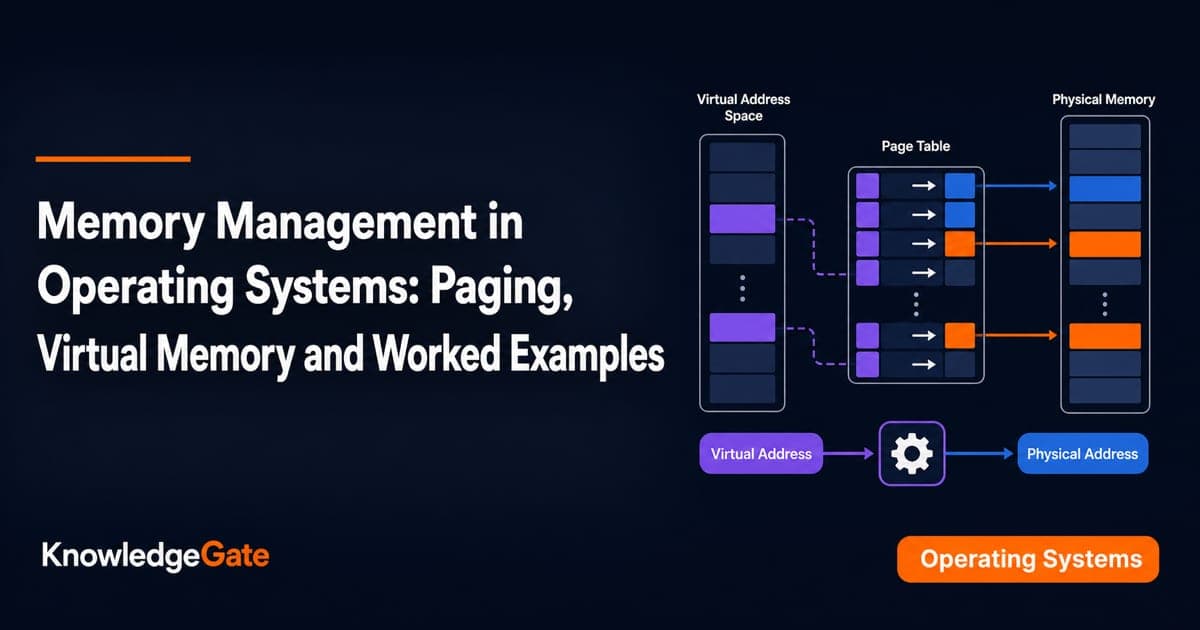
Memory management feels like unrelated terms until one address must pass through a page number, page table, frame and offset, or one reference string must be traced without losing the replacement order. Allocation and fragmentation connect to paging, segmentation, the TLB, demand paging and replacement. A reliable method is to write the address split, preserve the offset, trace every frame after each reference, and convert access times to one unit before averaging.
Related reading: Paging MCQs and Virtual memory.
Memory management in an OS: what the hardware and kernel solve
Memory management provides relocation for flexible placement, protection between processes, and controlled sharing of selected code/data across address spaces.
The CPU generates a logical address, RAM uses a physical address, and the memory management unit (MMU) translates. Compile-time binding fixes addresses; load-time adjusts at loading; execution-time enables dynamic relocation.
Contiguous allocation uses one region; paging maps equal pages to frames; segmentation preserves units; virtual memory keeps needed pages resident; replacement selects a victim. For a focused comparison, Memory management in OS: paging and segmentation explained distinguishes the two schemes; fit choices, TLB time and replacement traces complete the broader problem-solving map.
Contiguous allocation: first fit, best fit, worst fit and fragmentation
Fixed partitions cause internal fragmentation: 212 KiB in 256 KiB leaves 256 - 212 = 44 KiB. Variable partitions cause external fragmentation, where total free space suffices but no hole does.
For holes [100, 500, 200, 300, 600] KiB in address order and process P = 212 KiB:
Strategy | Chosen hole | Space left |
|---|---|---|
First fit |
|
|
Best fit |
|
|
Worst fit |
|
|
These are alternatives, not simultaneous allocations. Best fit guarantees neither zero waste nor better future use. Compaction joins holes but requires relocation. Paging removes external fragmentation but adds table overhead and possible last-page waste.
Paging and page tables: complete address translation
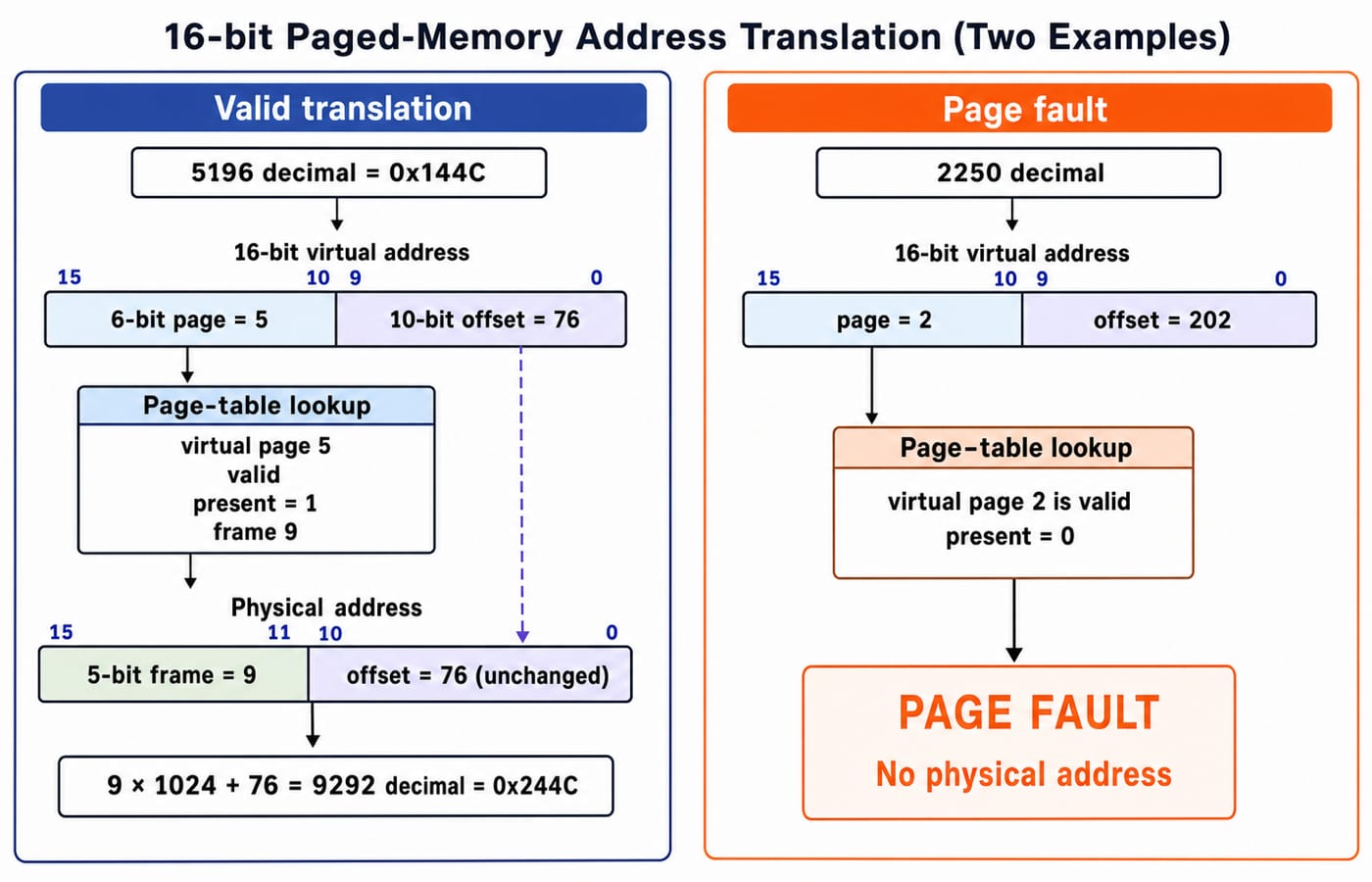
System: 16-bit logical addresses, 1 KiB = 2^10 bytes pages, 32 KiB physical memory. The logical split is a 6-bit page and 10-bit offset. Its 32 frames (0 to 31) need a 5-bit frame and the same offset.
Page-table frame mappings: 0 -> 3, 1 -> 14, 2 -> present 0, 3 -> 27, 4 -> 6, 5 -> 9.
For logical address 5196 decimal (0x144C):
5196 = 5 x 1024 + 76: page5, offset76.Page
5 -> frame 9.Physical address
= 9 x 1024 + 76 = 9292decimal (0x244C).
The offset is unchanged. 2250 = 2 x 1024 + 202 reaches valid page 2 with present = 0, causing a page fault, not frame 2 translation. The OS loads it, updates the table and retries. An illegal page traps.
There are 2^16 / 2^10 = 64 pages. With specified 4-byte entries, the table is 64 x 4 = 256 bytes. A PTE also stores status and protection, not only five frame bits.
Segmentation versus paging: logical units and limit checks
A segmented address is (segment, offset). Its entry holds base and limit. When 0 <= offset < limit, physical address = base + offset.
Segments (base, limit) are 0: (4000, 1000), 1: (9000, 600), 2: (12000, 1500). (2, 1220) is valid: 12000 + 1220 = 13220. (1, 650) traps because 650 >= 600, not 9650. Equality with the limit is invalid.
Property | Paging | Segmentation |
|---|---|---|
Unit | Fixed size | Variable logical unit: code, stack or data |
Programmer view | Transparent | Preserves units |
Waste | Final-page internal waste | External fragmentation |
Sharing/protection | Per page | Per logical unit |
Segmented paging gives each segment its own page table.
Virtual memory, demand paging and the TLB: access-time arithmetic
Demand paging keeps a page on secondary storage until referenced. On fault, the OS validates, finds a frame or victim, writes a dirty victim if needed, reads, updates table and TLB state, then restarts.
With serial TLB lookup 10 ns, memory access 100 ns and hit ratio 0.90, a hit costs 10 + 100 = 110 ns; a non-faulting miss costs 10 + 100 + 100 = 210 ns:
EAT = 0.90 x 110 + 0.10 x 210 = 99 + 21 = 120 ns.
Parallel lookup differs. Memory Hierarchy and Virtual Memory: Paging, the TLB, and Address Translation covers the hardware connection.
Separately, ordinary access is 100 ns, fault service 8 ms = 8,000,000 ns, and fault probability 10^-6:
EAT = (1 - 10^-6) x 100 + 10^-6 x 8,000,000 = 99.9999 + 8 = 107.9999 ns, approximately 108 ns.
This is separate from the TLB assumptions.
Page replacement and thrashing: trace frames, not intuition
FIFO removes the oldest loaded page; LRU the least recently used; Optimal the one needed farthest ahead. Optimal is a benchmark because an OS cannot know the future stream.
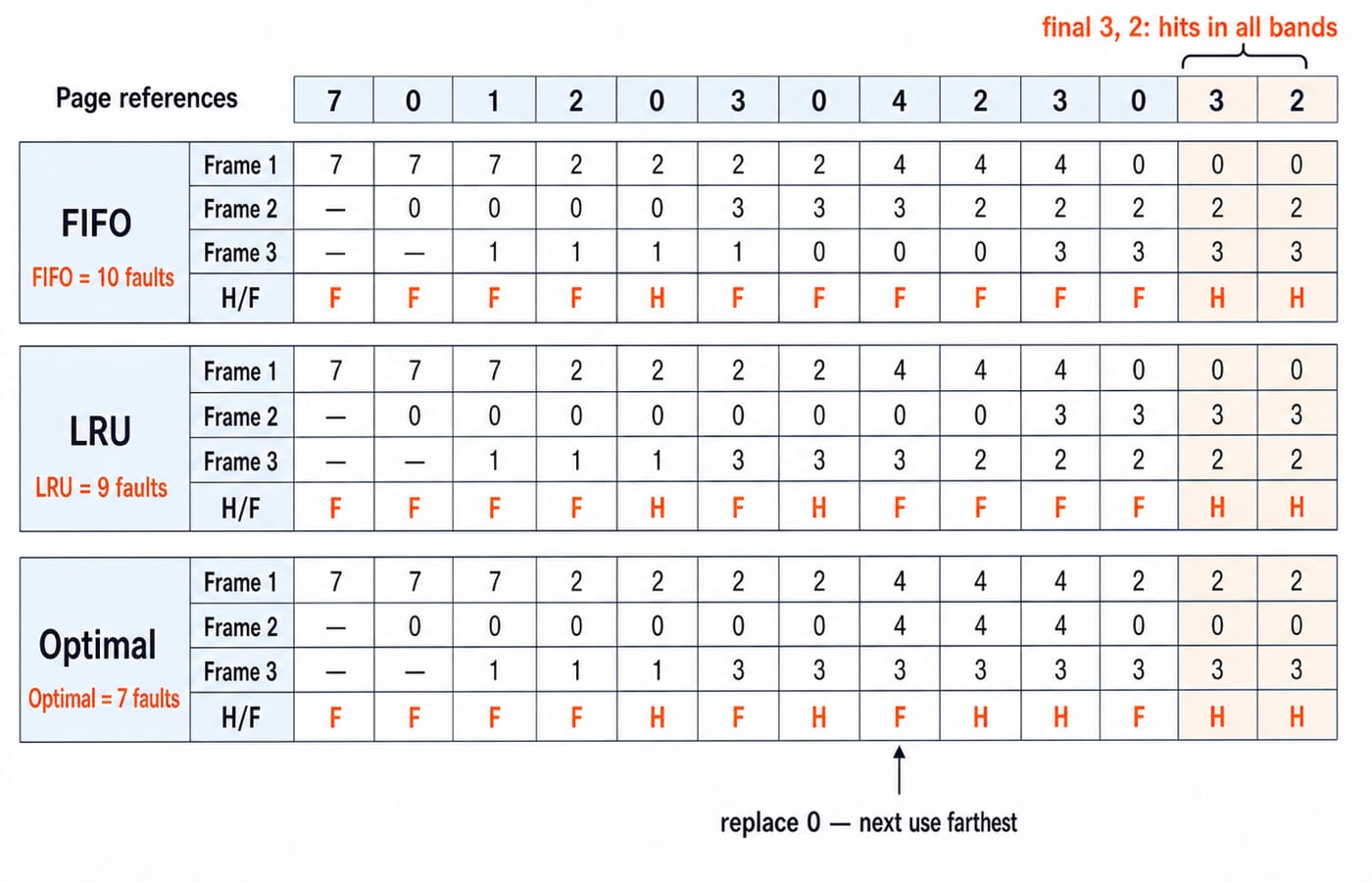
Trace 7,0,1,2,0,3,0,4,2,3,0,3,2 through three empty frames. Each comma position aligns with that reference; ∅ means empty.
Policy | Row | State after each reference |
|---|---|---|
All | Reference |
|
FIFO | Frame 1 |
|
FIFO | Frame 2 |
|
FIFO | Frame 3 |
|
FIFO | H/F |
|
LRU | Frame 1 |
|
LRU | Frame 2 |
|
LRU | Frame 3 |
|
LRU | H/F |
|
Optimal | Frame 1 |
|
Optimal | Frame 2 |
|
Optimal | Frame 3 |
|
Optimal | H/F |
|
Totals: FIFO 10, LRU 9, Optimal 7 faults. All fault four times in the first four references. At 4, Optimal replaces 0, used later than 2 or 3. Final 3,2 hit for all.
A dirty victim needs write-back; reference bits enable Clock-like recency estimates. Thrashing means faults overtake useful work because working sets do not fit. Reduce multiprogramming pressure or allocate frames; changing policy alone is not a cure.
Memory-management questions: patterns and traps
Practise address splits, page/frame counts, table sizes, translations, TLB time, fit choices and replacement.
Trap | Wrong move | Correction |
|---|---|---|
Page-size units | Apply | Convert to bytes first |
Offset bits | Use address-space size | Use |
Page count | Count frames | Divide logical space by page size |
PTE width | Equal frame bits | Use specified PTE width |
TLB miss | Declare page fault | Page table may show present |
FIFO and LRU | Equate order and recency | Track each separately |
Segment limit | Accept | Require |
For focused practice, continue with Page Replacement Algorithms MCQs: FIFO, LRU, Optimal, or use GATE CS Exam Preparation for wider study.
Memory management in Operating Systems: the short version and next step
Recall: allocation chooses a hole; paging maps page to frame, preserving the offset; segmentation checks a limit; a TLB caches translations; demand paging may fault; replacement chooses a victim.
Paper check: 5196 gives page 5, offset 76, frame 9, physical 9292; (2, 1220) is valid at 13220; replacement totals are 10, 9, 7. If one fails, revisit its trace before timed work.
The GATE Test Series is an optional timed step. For only this topic, use the linked page-replacement MCQs.
Keep learning

Critical Section in Process Synchronization: Race Conditions and Correctness Worked Step by Step
See how two sensible updates to x can finish at 6, 7, or 8. The worked trace connects race conditions to mutual exclusion, progress, bounded waiting, and safe synchronization choices.
Updated 21 Oct 20266 min readOperating Systems

System Calls and Dual Mode in OS: Mode-Bit Trace, Worked Example and Exam Traps
Follow one read() call across the user-kernel boundary, calculate its stated overhead, and learn the distinctions that make system-call questions easier.
Updated 17 Oct 20265 min readOperating Systems
Semaphores and Process Ordering in OS: P/V Traces, Worked Examples and GATE Traps
Learn one consistent semaphore convention, then trace ordering constraints, shared-variable updates, bounded-buffer permits, rendezvous, and deadlock step by step.
Updated 13 Oct 20265 min readOperating Systems
Round Robin Scheduling Explained: Gantt Charts, Waiting Time and GATE Traps
Learn a fixed Round Robin queue convention, trace staggered arrivals, calculate CT, TAT, WT and RT, and see how quantum size and context-switch cost change results.
Updated 9 Oct 20265 min read66 viewsOperating Systems