CDAC C-CAT Preparation: A 60-Day, Section-wise Study Plan
Turn 60 days into three clear phases: CS foundations, aptitude plus advanced CS, and a protected mock-and-revision block. The schedule includes recovery space for missed days.
KnowledgeGate Team
Exam prep & CS education
Updated 19 Aug 20265 min read
Sixty days is enough for a serious C-CAT attempt if you spend them by need, not by mood. Many candidates keep revising the section they already enjoy and postpone the one that costs them time in mocks.
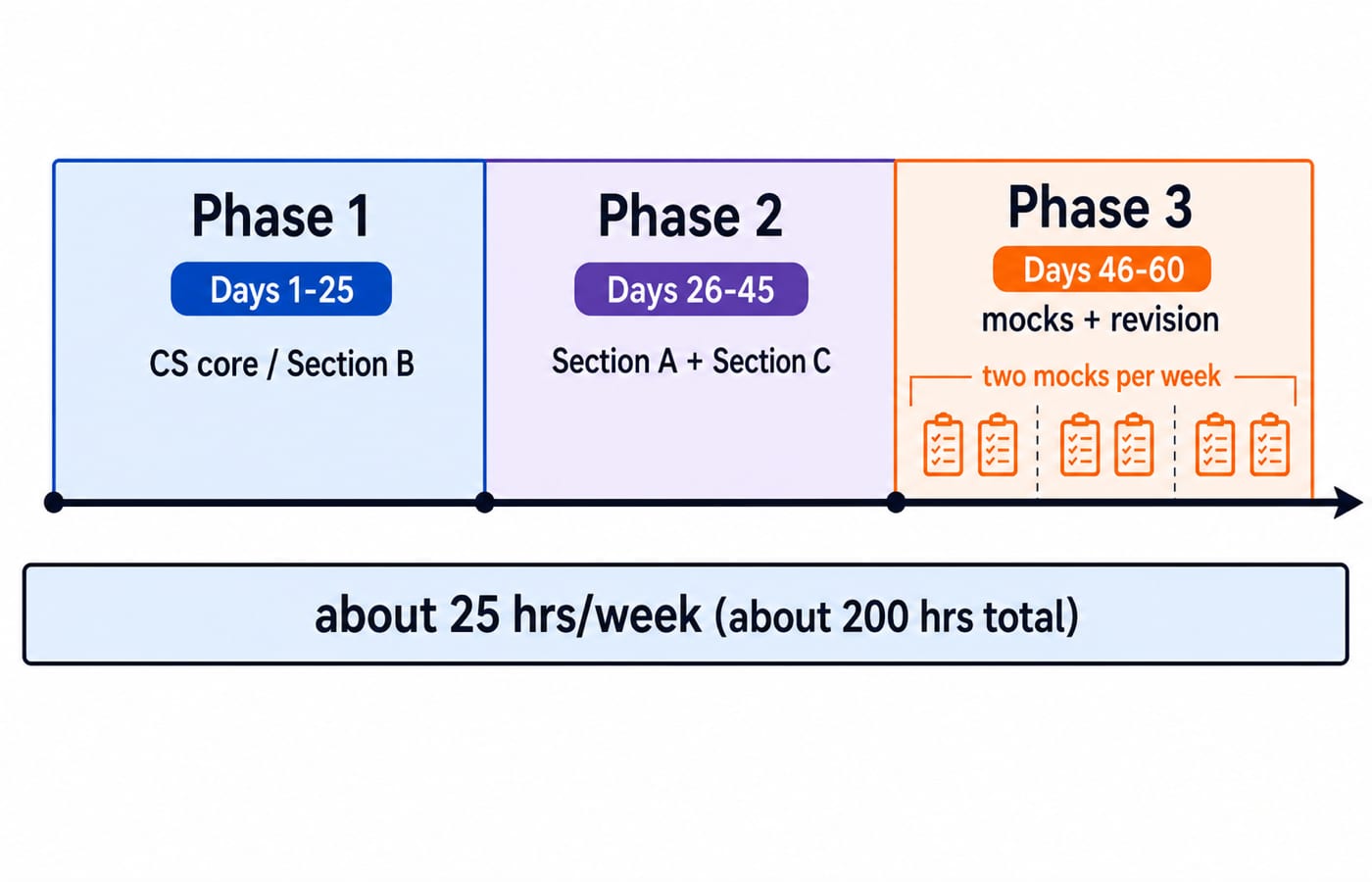
Days 1 to 25 go to the CS core, Days 26 to 45 add aptitude and any advanced CS your course needs, and Days 46 to 60 stay reserved for mocks and revision. Before starting, confirm which sections your target course requires.
Set an honest 60-day time budget
Use about 25 focused hours in each complete study week. A clean weekly calculation is:
Five weekdays at 3 hours each:
5 x 3 = 15 hoursTwo weekend days at 5 hours each:
2 x 5 = 10 hoursWeekly total:
15 + 10 = 25 hours
Eight complete study weeks give 8 x 25 = 200 hours. A 60-day window contains those 56 study days plus four calendar days. Keep those four as setup, recovery and phase-transition buffers instead of quietly counting work that you may not finish.
If your weekdays reach 3 to 3.5 hours and your weekend days reach 6 to 7 hours, treat the extra time as a ceiling for backlog or mock review. Doing the upper schedule every day would exceed 25 hours a week, so do not pretend both totals are the same.
Split the usable hours by preparation need:
Section B, the CS core: the largest early share because C, data structures and OOP need repeated problem solving.
Section A: a steady share because quantitative aptitude, reasoning and English improve through daily practice.
Section C: include it only if your target course requires it, then give its core subjects uninterrupted blocks.
Mocks and revision: reserve time before the plan begins. Do not leave it to whatever remains.
Check the required section combination and current test rules in the official C-DAC C-CAT brochure. Do not copy another candidate's Section C workload without confirming that your target diploma needs it.
Phase 1, Days 1 to 25: build the Section B core
For the first 25 days, use a three-hour weekday block:
First 90 minutes: learn or revise one concept with short handwritten traces.
Next 90 minutes: solve topic-wise questions and review every wrong answer.
On weekends, extend the question block and revisit the week's error log. The sequence should move from C foundations into data structures, then OOP:
Days 1 to 10: C programming
Cover data types and operators quickly, then spend most of the block on functions, arrays, strings and pointers. Trace expressions and pointer movement on paper. By Day 10, you should be able to explain array-pointer decay, pass an array to a function and follow a nested expression without guessing.
Days 11 to 20: data structures
Move through linked lists, stacks, queues and trees. For each structure, know its representation, basic operations and cost. Write small dry runs for insertion, deletion and traversal rather than memorising final code.
Days 21 to 25: OOP and consolidation
Learn the purpose of encapsulation, inheritance, polymorphism and abstraction, then revisit the weakest C and data-structures topics. Use Day 25 as a checkpoint: one mixed Section B test, followed by an error classification into concept gap, careless reading, slow method or blind guess.
The C++ Programming Course: Concepts, MCQs & Coding can give this phase one continuous route instead of a collection of disconnected videos.
Phase 2, Days 26 to 45: Section A plus Section C
The next 20 days broaden the plan without abandoning Section B. Keep a short CS-revision slot every alternate day, then divide the main work according to your required sections.
For Section A, use about two hours a day. Alternate the larger focus:
Quantitative aptitude on one day
English and logical reasoning on the next
A mixed timed set after every two focused days
Do not judge aptitude progress by how familiar a solution looks. Record the time taken, the method used and the reason for each mistake. The Aptitude for Placements: Section Topics and Weekly Plan guide helps organise these three areas without letting one disappear from the timetable.
For Section C, if required, use blocks of about 90 minutes. Study one subject at a time: Operating Systems, then DBMS, then Computer Networks, with Computer Architecture and related topics placed according to your gap analysis. A focused subject block creates better connections than switching among four subjects every evening.
Finish each subject block with mixed questions. A definition that feels clear during reading may still fail when two close options appear together.
Phase 3, Days 46 to 60: mocks, revision and weak areas
The final 15 days are for measuring preparation, not decorating notes. Take one sectional test each day and schedule two full-length mocks in each complete week. Use the remaining time for analysis.
After every mock, make four lists:
Questions you did not know
Questions you knew but misread
Questions solved with a slow method
Guesses that happened to be correct
The fourth list matters. A lucky answer is not mastery and should still enter revision.
Choose only the two or three weakest chapters exposed by repeated mock evidence. Re-drill those chapters, then test them again. Do not start a large new subject because one difficult question shook your confidence.
Later testing must feed the next revision decision, the same rule that shapes the Final Year Placement Plan: 90-Day Aptitude to Interview. A mock without analysis is only a score report.
When you miss a day
You will probably lose a day to college, work, travel or fatigue. Do not respond by forcing six tired hours into the next evening.
Use one of the four calendar buffers or the next weekend's extra capacity. Move only the unfinished task, not the entire timetable. If two tasks compete, keep question review and remove low-value rereading.
Protect Phase 3. If the plan slips, reduce new-topic coverage in Phase 2 and prioritise the topics your required sections actually test. Never solve the delay by cancelling the mock block. Untested preparation hides both timing problems and false confidence.
A simple recovery rule is: recover one lost weekday in one buffer block, then return to the original date labels. Constantly shifting all later phases makes the plan impossible to track.
The short version and next step
Use eight 25-hour study weeks, build Section B first, add Section A and required Section C work next, then protect Days 46 to 60 for mocks and revision. Confirm the sections for your target course before dividing the hours.
KnowledgeGate's question bank includes over 900 C-programming questions, 1,500+ data-structures questions, 8,000+ quantitative-aptitude questions, 6,000+ reasoning items and 6,000+ English items. Use the CS Fundamentals for Exams & Placements route to turn that volume into topic-wise drills, not random solving.
For the complete section sequence, start with CDAC C-CAT 2026: Complete Preparation. Put the three phases on a calendar today, reserve the mock dates first, and begin Day 1 with the C topic you are most tempted to postpone.
Keep learning

Mensuration and Geometry for Competitive Exams: Formulas, Shortcuts and Solved Examples
Learn how to choose the right mensuration formula, avoid common geometry traps, and solve 2D path and 3D recasting problems step by step.
Updated 6 Oct 20266 min readAptitude & Reasoning
Age Comparison and Multiple-Condition Problems: 12 Solved MCQs
Practise 12 age-problem MCQs with equations, timelines, back-checks, relation chains, changing ratios, birth years, and family conditions.
1 Oct 20268 min readAptitude & Reasoning

True, False and Cannot Say Questions: 10 Solved Passage MCQs
Learn how to separate contradictions from missing evidence, then apply the method to 10 previous-year passage MCQs with concise, evidence-led solutions.
26 Sep 20268 min readAptitude & Reasoning

TCS Aptitude Questions: High-Yield Quant and Reasoning Topics, Solved Step by Step
Learn the first move for common quant and reasoning question families through solved examples on ratios, work, trains, data, remainders, and seating.
Updated 25 Sep 20266 min read104 viewsAptitude & Reasoning