Age Problems for Competitive Exams: Concepts, Shortcuts and Solved Examples
Learn a reliable method for age problems using timelines, equations, ratio units and group totals, with fully checked examples for timed practice.
KnowledgeGate Team
Exam prep & CS education
Updated 24 Aug 20266 min read

Everyone grows older by the same number of years, but age ratios keep changing. A memorised ratio trick can fail when a question shifts from present to past or future. Instead, convert the words into an equation, choose a shortcut after the model is clear, and check the result. The Aptitude Courses for Exams & Placements page places age problems within a broader preparation path that also includes reasoning and verbal ability.
The three rules behind every age problem
First, define present ages as A and B. After t years they are A + t and B + t; t years ago, they were A - t and B - t.
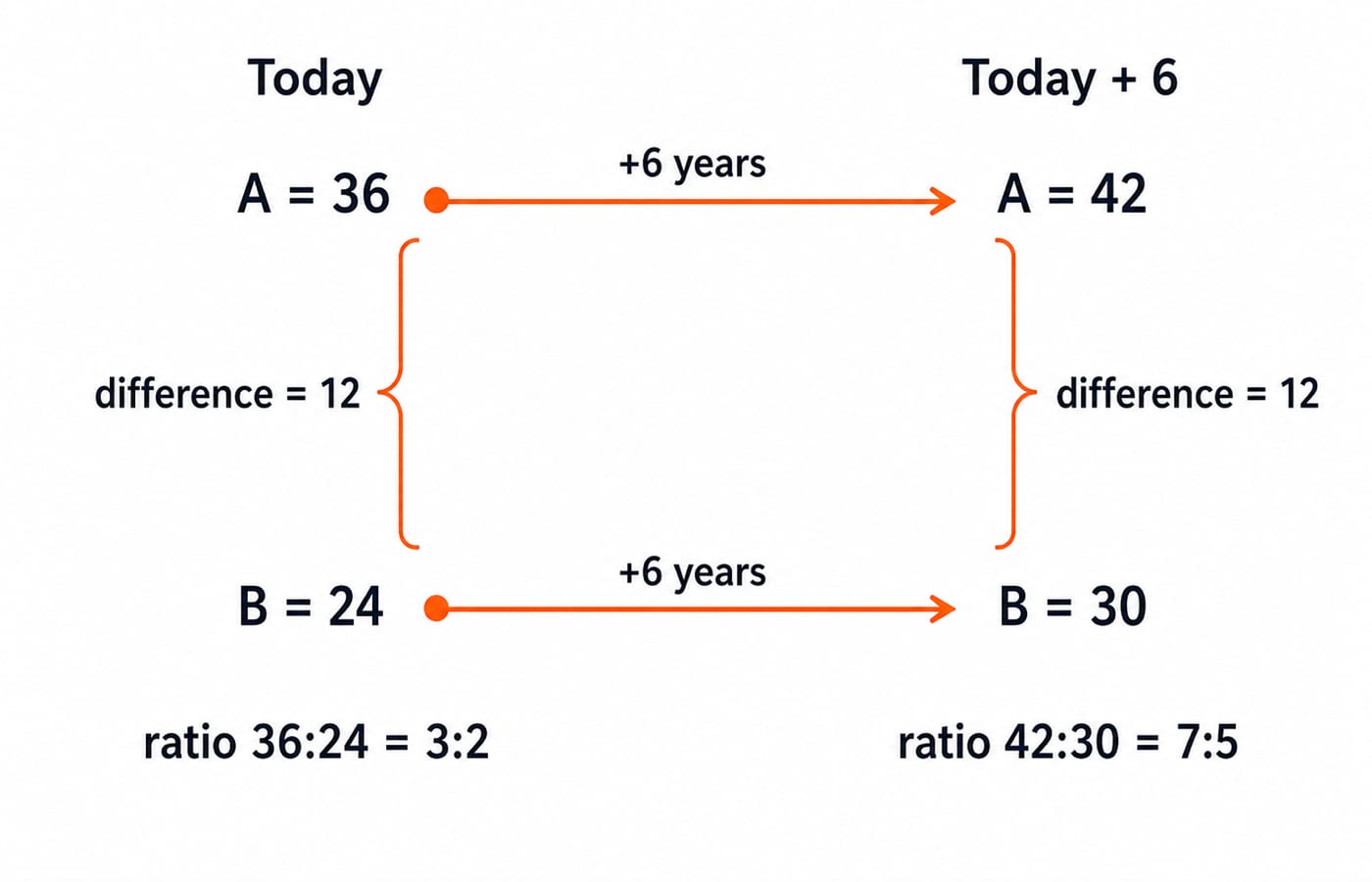
Second, an age difference never changes. If Riya is 12 years older than Meera, the gap stays 12 in the past and future. Ages 36 and 24 have ratio 3:2. After 6 years, 42 and 30 have ratio 7:5, but their difference is still 12. Shift ages, never the numbers written in a ratio.
Third, translate each sentence before calculating:
"A is 8 years older than B" means
A = B + 8."A was three times B 5 years ago" means
A - 5 = 3(B - 5)."Their ages total 50" means
A + B = 50.
The aptitude for placements guide shows how quantitative aptitude fits with reasoning and verbal preparation.
Method 1: build one equation from a times statement
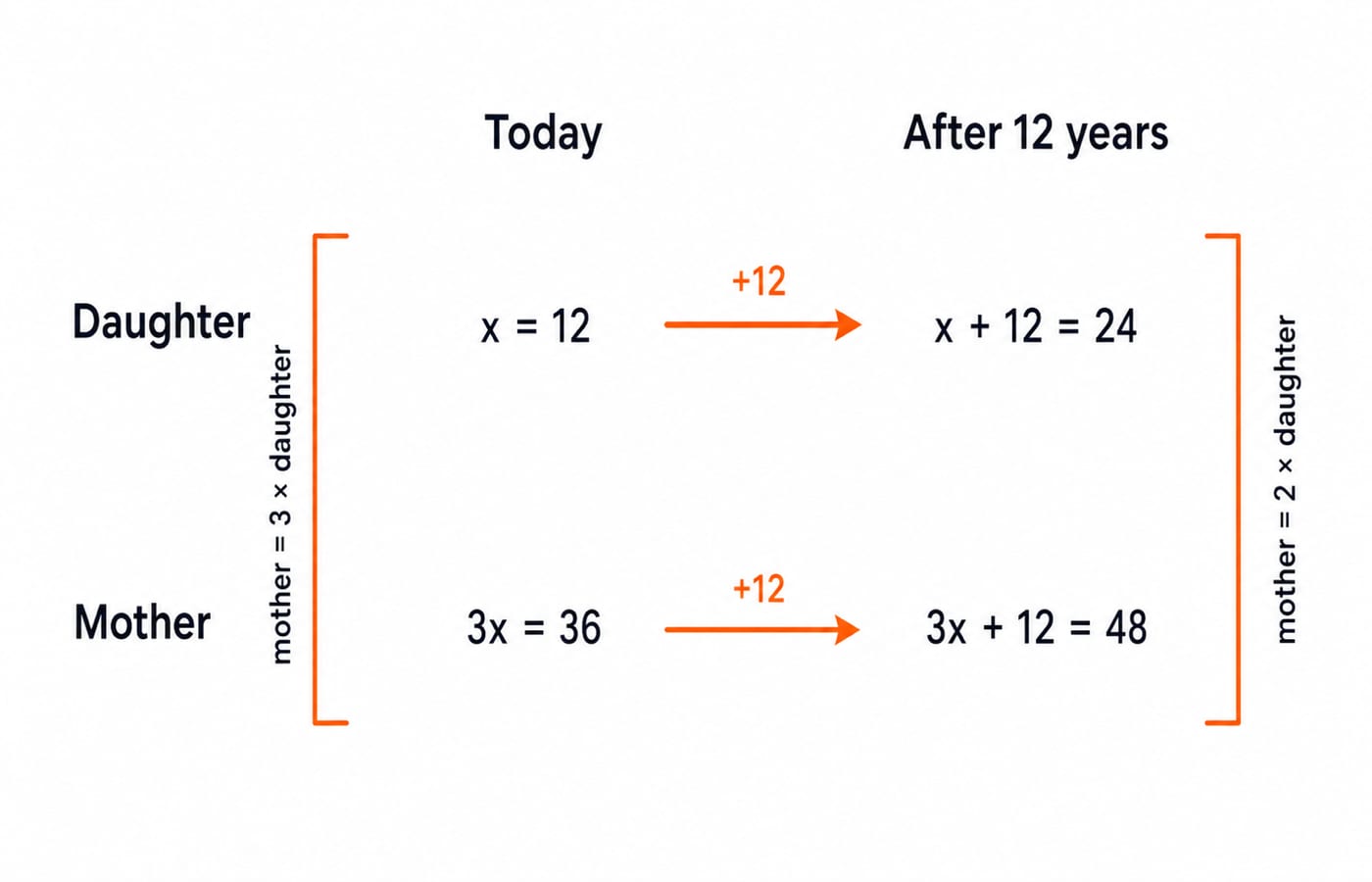
Suppose a mother is three times her daughter's present age. After 12 years, the mother will be twice the daughter's age.
Let the daughter's present age be x. The mother's present age is 3x. Shift both ages by 12 for the future condition:
3x + 12 = 2(x + 12)
3x + 12 = 2x + 24
x = 12
The daughter is 12 and the mother is 36. Check both statements: 36 = 3 × 12. After 12 years, 48 = 2 × 24. Substitution is safer than trusting algebra alone.
The reusable sequence is simple: choose one present-age variable, express the other age, shift both to the named time, solve, and substitute back.
Method 2: solve changing ratios with ratio units
The present ages of Arun and Beena are in the ratio 5:3. Eight years ago, their ages were in the ratio 3:1. Set their present ages to 5k and 3k:
(5k - 8)/(3k - 8) = 3/1
5k - 8 = 9k - 24
4k = 16, so k = 4
Their present ages are 20 and 12. Eight years ago, they were 12 and 4, which is 3:1.
The present ratio has a two-unit difference, 5k - 3k = 2k. The past ratio 3:1 does too, so write the past ages as 3k and k. Beena moved from k to 3k in 8 years. Thus 2k = 8 and k = 4. This is clean because the ratio differences match. Otherwise, use the equation method.
Method 3: move totals correctly in family-age questions
For n people, a shift of t years changes their total by n × t if the group stays fixed. Births, deaths, joining, or leaving require separate handling.
Suppose a father and son have a present combined age of 66. Six years ago, the father was five times the son's age. Six years ago, their combined age was:
66 - 2 × 6 = 54
Let the son's past age be x and the father's past age be 5x. Then 6x = 54, so x = 9. Their past ages were 9 and 45. Their present ages are therefore 15 and 51.
Check: 15 + 51 = 66, and six years earlier, 45 = 5 × 9. The wrong move 66 - 6 forgets that two people each became six years younger.
Which shortcut to choose under time pressure
Use this decision guide:
Clue in the question | Safe method |
|---|---|
One age is a multiple of another | Direct linear equation |
A ratio is paired with a difference or another time-based ratio | Ratio units, with an equation as backup |
A fixed group's sum or average shifts in time | Change the total by |
A shortcut compresses arithmetic, not modelling. If ages are in ratio 7:4 and differ by 15, three units equal 15, so one unit is 5. The ages are 35 and 20. After 5 years they are 40 and 25, with ratio 8:5, not 7:4.
On scratch paper, draw four columns: time | Person A | Person B | condition. Fill the time column first. That keeps "ago", "now", and "after" from slipping into the same equation.
How competitive exams reshape the same age model
An unknown-time question may say: present ages are 40 and 16. After how many years will their ages be in the ratio 2:1?
(40 + t)/(16 + t) = 2
40 + t = 32 + 2t, so t = 8
The future ages are 48 and 24, which verifies the 2:1 ratio.
A three-person chain uses the same translation habit. A is 4 years older than B, C is twice B, and their present total is 60. Let B = b, so A = b + 4 and C = 2b:
(b + 4) + b + 2b = 60
4b + 4 = 60, so b = 14
Therefore, A is 18, B is 14, and C is 28. The sum is 60. After 3 years, three people add 3 × 3 = 9 years to the total, giving 69.
Questions can ask for a present age, elapsed time, a third person, or a ratio combined with a sum or difference. The SSC CGL Quant Strategy: High-Yield Topics and Weekly Plan shows how to combine the same modelling habit with a broader quantitative aptitude routine.
Traps that make a correct-looking solution wrong
Changing ratio numbers instead of ages: Eight years ago,
5k:3kbecomes(5k - 8):(3k - 8), not(5 - 8):(3 - 8).Shifting only one person: Everyone named at that time receives the same signed shift.
Treating a difference as a ratio: A 12-year gap stays 12, but
36:24does not stay3:2.Moving a two-person total by only
t: Move it by2t.
Every stated age must also be non-negative. A negative past age makes the setup or solution invalid. Test the result against every sentence, not only the last equation.
Special-case formulas are risky when their conditions are forgotten. A clearer speed habit is one timeline, one equation, and a ten-second substitution check.
Short version, practice checks, and the next step
Anchor all ages to one time, shift everyone by the same amount, translate ratio, multiple, sum, or difference information, solve, and verify the original words.
Try these before reading the answers:
Ages in ratio
4:3become7:6after 6 years. Present ages: 8 and 6.A is twice B now and was three times B 10 years ago. Present ages: 40 and 20.
Two ages have sum 72 and difference 12. The ages are 42 and 30.
For continued timed practice, follow Aptitude for Placements: A 30-Day Practice Routine. Learners who want concept lessons across quantitative aptitude, reasoning, and verbal ability can continue with the Aptitude Course for Placement.
Keep learning
Number System Concepts and Shortcuts: Solved Examples for Competitive Exams
Learn how to classify numbers, choose the right divisibility or prime-factor method, and verify remainders, factors, HCF, LCM, and unit digits.
Updated 22 Oct 20266 min readAptitude & Reasoning
Age Ratio-Based Problems: 12 Questions with Step-by-Step Solutions
Solve 12 age ratio-based questions from the KnowledgeGate practice bank. Each fresh solution shows how to form the equation, shift every age correctly, and verify the answer.
18 Oct 20267 min readAptitude & Reasoning

Mixture and Alligation: Rules, Shortcuts and Solved Examples for Exams
Learn how concentration, alligation and the retention factor solve the main mixture question types, with step-by-step examples and arithmetic checks.
Updated 14 Oct 20265 min readAptitude & Reasoning

Mental Ability Concepts and Shortcuts: Solved Examples for Competitive Exams
Learn a four-step reasoning process, then apply it to number patterns, mirror coding, directions, syllogisms, blood relations and ranking problems.
Updated 10 Oct 20267 min readAptitude & Reasoning