

Linear Equations Questions with Solutions: 12 Solved MCQs
Practise 12 linear-equation MCQs that move from direct one-variable equations to ratios, systems and integer constraints, with a check after every solution.
KnowledgeGate Team
Exam prep & CS education
Updated 13 Nov 20267 min read
Translating a sentence into the correct linear equation is often harder than the final arithmetic. These questions move from one-variable equations to two-number systems and integer constraints, with a substitution check after every answer. Read Linear Equations: Methods, Formulas and Solved Problems for the underlying methods, then practise translating and checking each equation here.
Translate words into one-variable equations
Choose the unknown, translate the comparison, solve, then answer what was actually asked.
Question 1
If 12 is added to twice of a number, then the result is 38 less than seven times of that number. Find the square of this number.
(a) 289/4
(b) 169/4
(c) 81
(d) 100
Solution: Let the number be x:
12 + 2x = 7x - 38
Then 50 = 5x, so x = 10. The requested square is 10² = 100.
Check: 12 + 20 = 32, while 70 - 38 = 32. Both sides match. Correct answer: (d) 100.
Question 2
There are an equal number of boys and girls in a class. If 12 girls leave the class, the number of boys becomes twice the number of girls remaining. What was the total number of students in the class originally?
(a) 36
(b) 48
(c) 78
(d) 62
Solution: Let the original number of boys and girls each be x. After 12 girls leave:
x = 2(x - 12)
Thus, x = 2x - 24, so x = 24. The original total was 2x = 48.
Check: after 12 of the 24 girls leave, 12 remain, and 24 boys are twice 12. Correct answer: (b) 48.
Recover the hidden multiplier or total
The unknown may be a multiplier or group size used to recover the requested total.
Question 3
A person had to multiply two numbers. Instead of multiplying by 35, he multiplied by 53 and the product went up by 540. What was the raised product?
(a) 1908
(b) 1467
(c) 1590
(d) 1123
Solution: Let the other number be x. The increase is:
53x - 35x = 540
So 18x = 540, giving x = 30. The raised product is 53 × 30 = 1590.
Check: the original product is 35 × 30 = 1050, and 1590 - 1050 = 540. Correct answer: (c) 1590.
Question 4
Free notebooks were distributed equally among the children of a class. The number of notebooks each child got was one-eighth of the number of children. Had the number of children been half, each child would have got 16 notebooks. Total how many notebooks were distributed?
(a) 256
(b) 432
(c) 512
(d) 640
Solution: Let the original number of children be n. The total is n(n/8) = n²/8. With half as many children, it is (n/2) × 16 = 8n.
Equate totals: n²/8 = 8n. For positive n, n = 64. Each child gets 64/8 = 8, so the total is 64 × 8 = 512.
Check: in the hypothetical case, 32 × 16 = 512. Correct answer: (c) 512.
Convert percentages and fractions into coefficients
Convert percentages into fraction coefficients, and bracket sequential operations.
Question 5
If the difference between the two numbers is 75 percent of their sum, then what is the ratio of larger number and smaller number?
(a) 7 : 2
(b) 5 : 2
(c) 7 : 1
(d) 7 : 3
Solution: Let the larger number be L and the smaller be S. Since 75% = 3/4:
L - S = (3/4)(L + S)
Multiply by 4: 4L - 4S = 3L + 3S. Thus, L = 7S, so L:S = 7:1.
Check with 7 and 1: their difference is 6, which is 75% of their sum, 8. Correct answer: (c) 7 : 1.
Question 6
If 1/2 is subtracted from a number and then it is multiplied by 1/2, the number converts into 1/8. The number is
(a) 3/4
(b) 1/4
(c) 4/5
(d) 3/5
Solution: Let the number be x. Preserve the operation order with brackets:
(x - 1/2)(1/2) = 1/8
Multiply by 2: x - 1/2 = 1/4. Hence, x = 3/4.
Check: (3/4 - 1/2) × 1/2 = 1/4 × 1/2 = 1/8. Correct answer: (a) 3/4.
Solve two-number systems and integer constraints
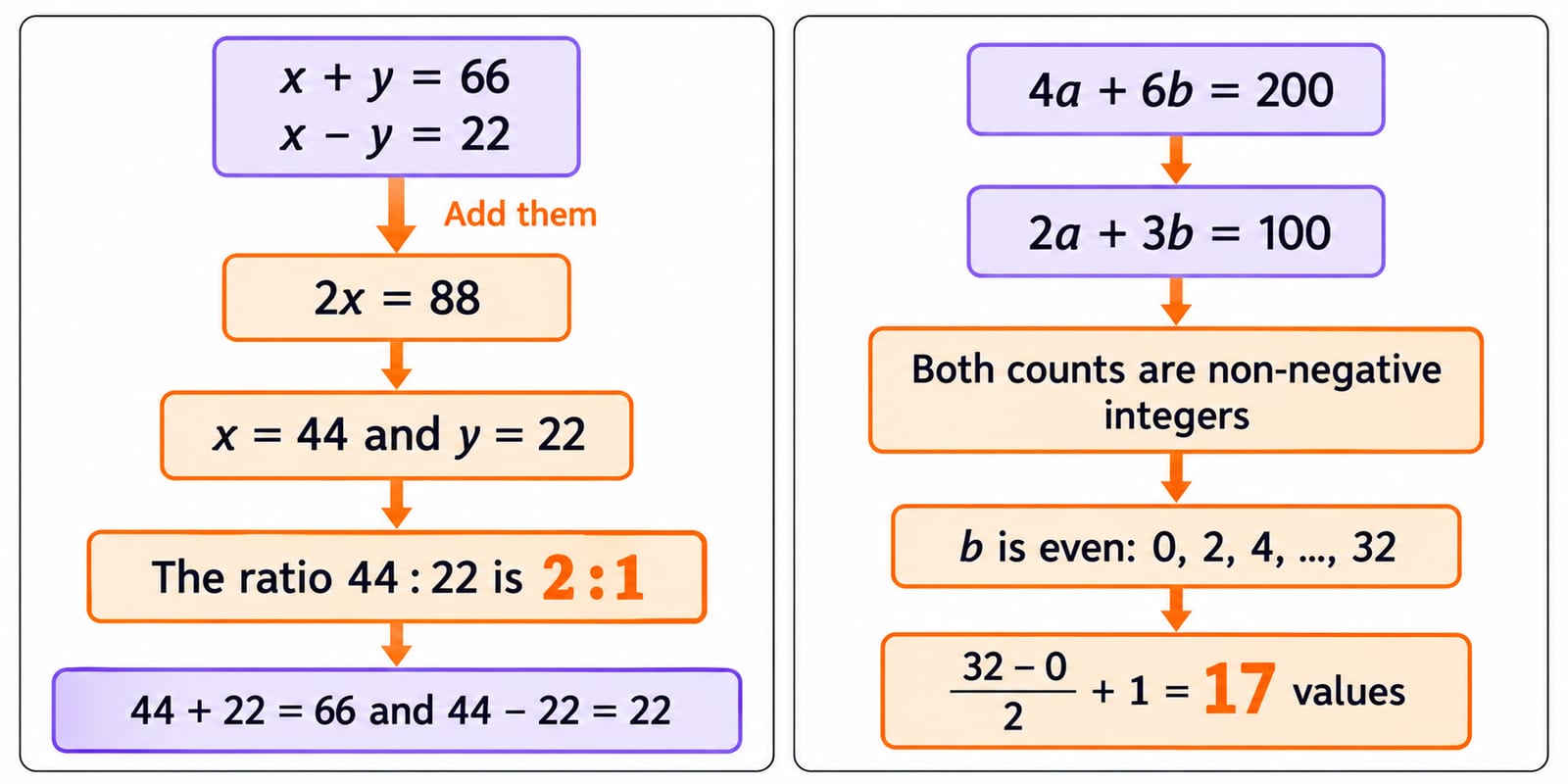
Use two equations for a sum and difference. For a counting equation, enforce non-negative integer solutions.
Question 7
The sum of two numbers is 66 and their difference is 22. What is the ratio of the two numbers?
(a) 2 : 1
(b) 6 : 5
(c) 17 : 5
(d) 5 : 1
Solution: Let the larger number be x and the smaller number be y:
x + y = 66
x - y = 22
Add them: 2x = 88, so x = 44 and y = 22. The ratio 44:22 is 2:1.
Check: 44 + 22 = 66 and 44 - 22 = 22. Correct answer: (a) 2 : 1.
Question 8
How many ways can a batsman score a double century using only 4s and 6s?
(a) 16
(b) 17
(c) 18
(d) Cannot be determined
Solution: Let a be the number of fours and b the number of sixes. Then 4a + 6b = 200, or:
2a + 3b = 100
Both counts are non-negative integers. Since 100 - 3b must be even, b is even: 0, 2, 4, ..., 32. This gives (32 - 0)/2 + 1 = 17 values, each with a = (100 - 3b)/2.
Check the endpoints: b = 0 gives a = 50, while b = 32 gives a = 2. Both score 200. Correct answer: (b) 17.
The CAT Quant Preparation: Arithmetic and Algebra First study order explains the foundation behind these mixed models.
Model consecutive values and self-referential quantities
Place consecutive even integers two units apart. Equal-weight objects use the same variable.
Question 9
Sum of four consecutive even numbers is 60. Find the product of second and third numbers.
(a) 192
(b) 168
(c) 224
(d) 288
Solution: Use n, n + 2, n + 4, n + 6. Then 4n + 12 = 60, so n = 12. The numbers are 12, 14, 16, 18, and 14 × 16 = 224.
Check: 12 + 14 + 16 + 18 = 60. Correct answer: (c) 224.
Question 10
Several bags have the same weight. One bag weighs 5 kg plus four-fifths of another bag's weight. What is the weight of a bag?
(a) 20
(b) 25
(c) 15
(d) 30
Solution: Let every bag weigh w kg. The other bag also weighs w, so:
w = 5 + (4/5)w
Thus, w/5 = 5, giving w = 25 kg.
Check: 5 + (4/5 × 25) = 5 + 20 = 25. Correct answer: (b) 25.
Finish with fraction differences and direct substitution
Finish with clean fraction subtraction and direct substitution.
Question 11
1/3 of a number is 6 more than 1/6 of that number. What is the number?
(a) 12
(b) 36
(c) 24
(d) 48
Solution: Let the number be x: x/3 = 6 + x/6. Subtract x/6:
x/3 - x/6 = 6
Thus, x/6 = 6, so x = 36.
Check: 36/3 = 12, and 6 + 36/6 = 6 + 6 = 12. Correct answer: (b) 36.
Question 12
If 2a + 4 = 8, then find the value of 3a + 6.
(a) 13
(b) 14
(c) 12
(d) 16
Solution: From 2a + 4 = 8, get 2a = 4 and a = 2. Substitute into the requested expression:
3a + 6 = 3(2) + 6 = 12
Check the original equation: 2(2) + 4 = 8. Correct answer: (c) 12.
Turn wrong answers into a translation checklist
Four errors recur here: answering for the wrong quantity, confusing original and remaining totals, dropping brackets, and ignoring non-negative integer constraints.
Before you calculate, use this compact checklist:
Define the unknown and attach units where needed.
Write one equation for each condition.
Solve without changing the meaning of the variables.
Substitute the result back into the original condition.
Return to the exact quantity requested.
Volume helps only when you inspect why an equation was wrong. Use each mistake to find the missing setup step.
The short version and the next practice step
Linear equations become manageable when you translate before calculating. Substitution catches sign and interpretation errors. After direct equations, practise mixed word problems involving totals, multipliers and valid integer solutions.
For placement-focused work, the Aptitude Course for Placement is the closer fit. For GATE-focused preparation, use Aptitude for GATE Exam, Complete Course. If you first need a broader weekly structure, follow Aptitude for Placements: Section Topics and Weekly Plan.
Now redo all 12 questions without looking at the equations above. Compare only your translation step first, then check the arithmetic.
Keep learning
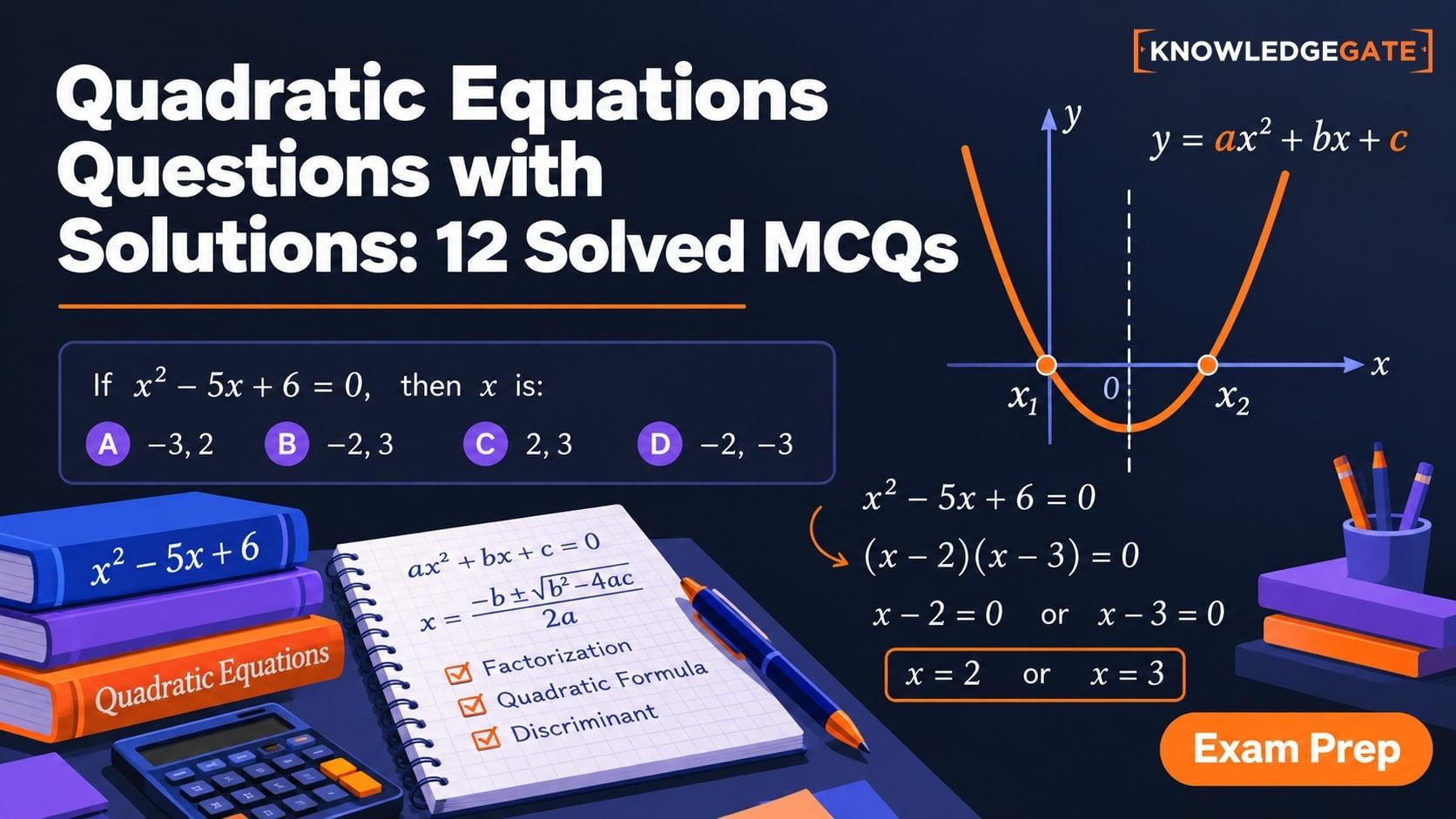
Quadratic Equations Questions with Solutions: 12 Solved MCQs
Attempt 12 quadratic-equation MCQs, then check complete solutions covering the formula, discriminants, graphs, Vieta's relations, modelling, and radix notation.
Updated 30 Oct 20268 min read57 viewsDiscrete Mathematics MCQs
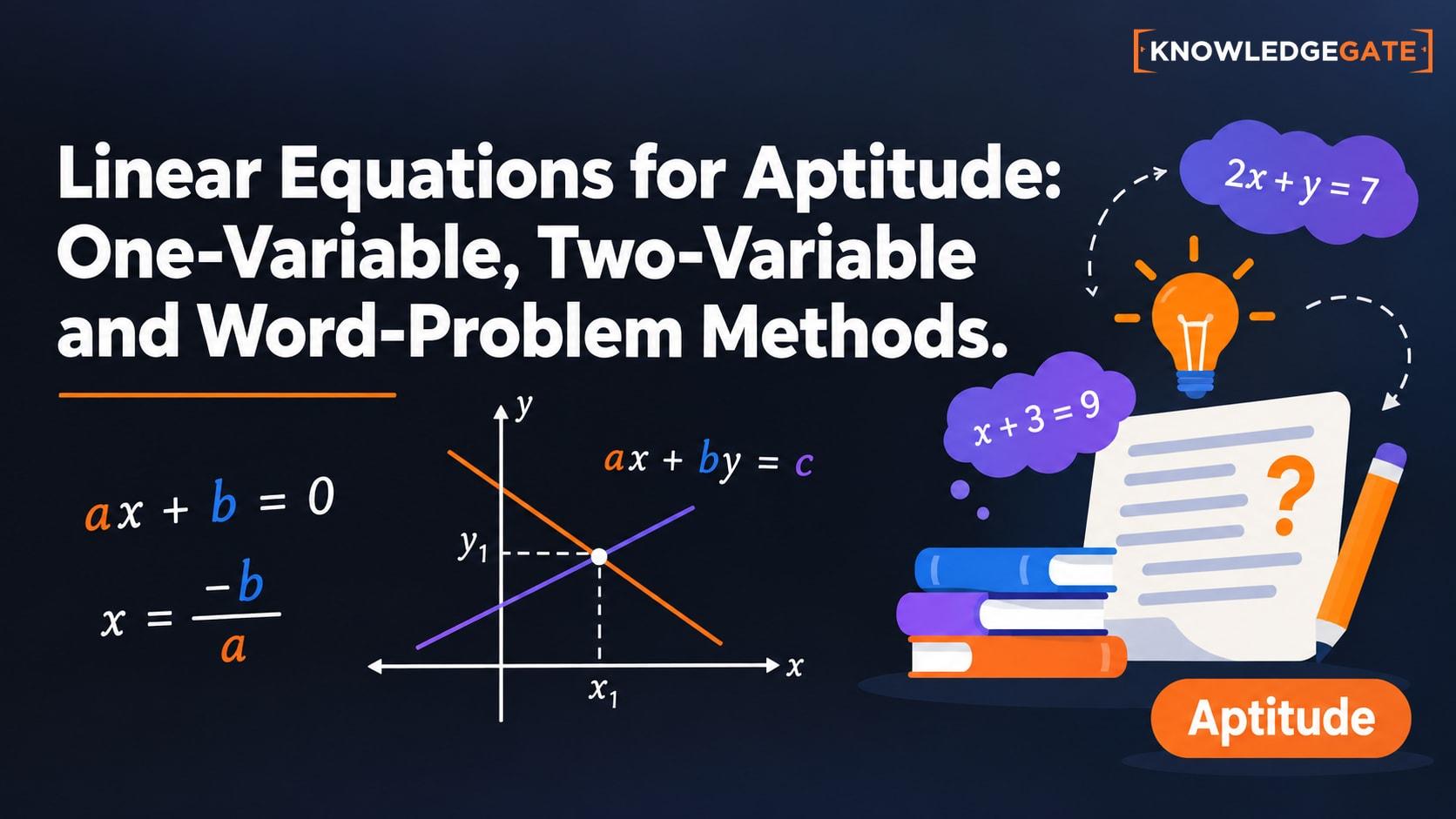
Linear Equations for Aptitude: One-Variable, Two-Variable and Word-Problem Methods
Learn a reliable method for one-variable equations, two-variable systems and word problems, then check every answer against the original condition.
Updated 12 Sep 20266 min read59 viewsAptitude & Reasoning
Linear Inequalities and Modulus Questions with Solutions: 11 Solved MCQs
Work through 11 linear inequalities and modulus MCQs with complete solutions. Each answer shows the case, graph feature, endpoint or algebraic step that decides it.
Updated 14 Nov 20266 min readAptitude & Reasoning

Basic Terminologies in Linear Programming: Feasible Solutions, BFS and an Optimal Solution Worked Step by Step
Separate feasible, basic feasible and optimal solutions through geometry, slack variables, vertex enumeration and concise counterexamples.
Updated 25 Sep 20265 min read82 viewsEngineering Mathematics