Regex Design and Algebra Explained: Identities, Arden's Theorem, and Worked Examples
Build regular expressions from language constraints, simplify them with safe identities, prove the result, and solve a recursive equation with Arden's theorem.
KnowledgeGate Team
Exam prep & CS education
Updated 24 Oct 20265 min read
Recognising a regular expression after seeing it is much easier than building one from a language condition. The real difficulty is deciding what each part must guarantee, then proving that the finished expression accepts all and only the required strings. This method starts with language constraints, applies a small set of valid identities, checks boundary strings, and solves one recursive equation. It covers classical regular expressions over finite alphabets, a foundation within core computer science subjects.
Read a regex as a language before manipulating it
Fix the alphabet as Sigma = {0,1}. The atomic expression empty-set denotes no strings, while epsilon denotes the language containing exactly one string, the length-zero string. The atoms 0 and 1 each denote a one-symbol language. Larger expressions use union R|S, concatenation RS, and Kleene star R*. Star permits zero or more repetitions, so (empty-set)* = {epsilon} even though empty-set itself contains nothing.
The usual precedence is star first, concatenation second, and union last. Thus 0|10* means 0|(1(0*)) and denotes {0, 1, 10, 100, 1000, ...}. By contrast, (0|1)0* also contains 00. That shortest witness proves the two expressions are not equivalent.
The regex algebra that is safe to use
Each valid identity is an equality between languages, not a rule for rearranging symbols by appearance.
Law | Language meaning | Example |
|---|---|---|
| Union with nothing adds nothing |
|
| Repeating a choice adds no strings |
|
| The empty string changes no concatenation |
|
| Concatenation needs a word from both sides |
|
| Left concatenation distributes over union |
|
| Right concatenation distributes over union |
|
| Two sequences of |
|
| Grouping sequences of blocks adds nothing |
|
Concatenation is associative but not commutative. With R=0 and S=1, RS=01, whereas SR=10. There is also no general cancellation law. Removing a common-looking fragment can change which strings the expression denotes.
Now simplify E=(epsilon|00*)0*10*10*. First, 00* represents every non-empty all-zero string, so epsilon|00* = 0*. Next, 0*0* = 0*. Therefore E=0*10*10*.
Design from constraints: exactly two 1s
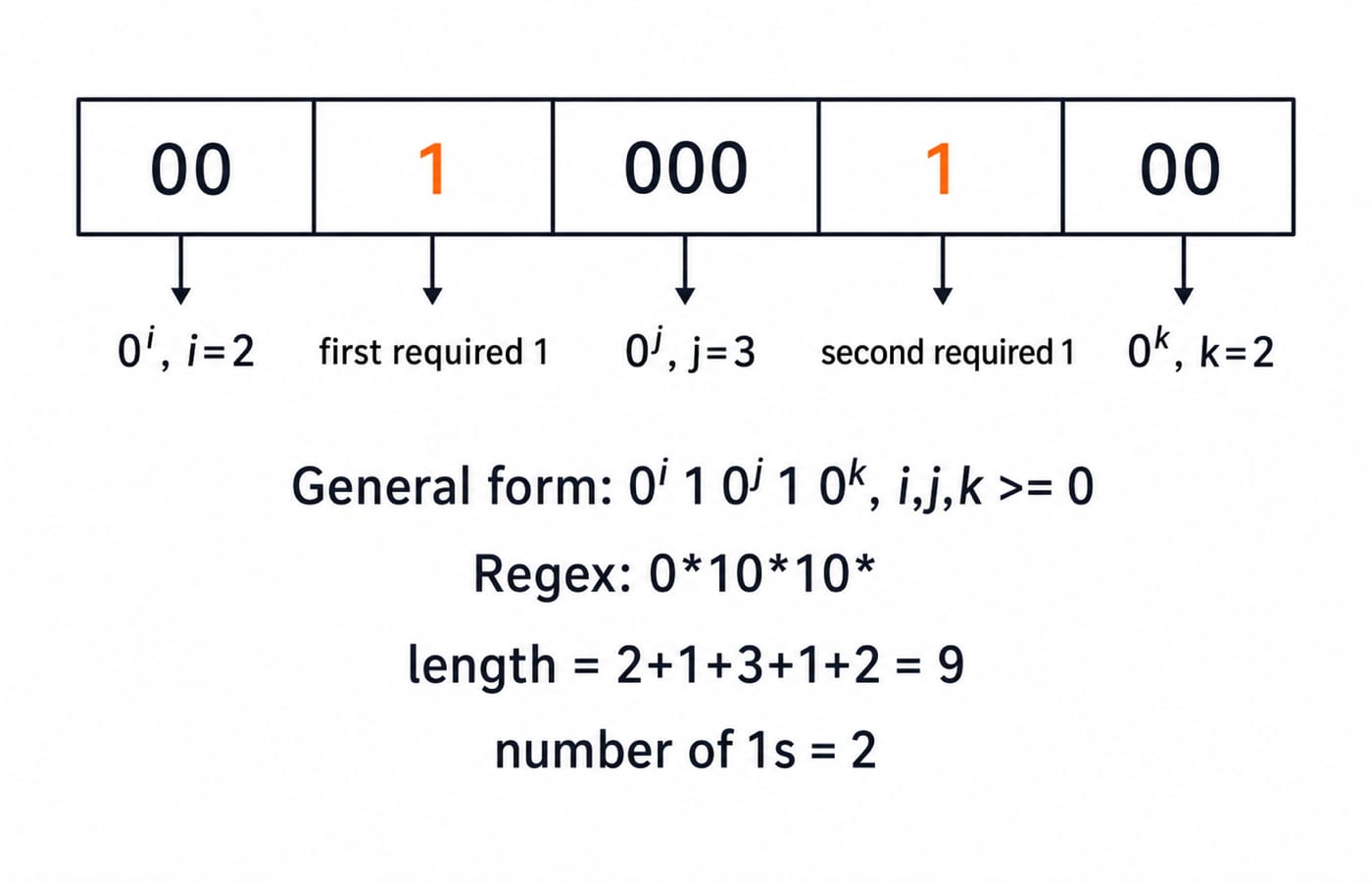
Let L={w in {0,1}* : w contains exactly two occurrences of 1}. Any word in L has three ordered regions of zeros: before the first 1, between the two 1s, and after the second 1. Every region may be empty, so each becomes 0*. The two required events stay as literal 1s. This gives R=0*10*10*.
Test the boundaries. The string 11 uses zero-block counts (i,j,k)=(0,0,0). The string 101 uses (0,1,0), and 001000100 uses (2,3,2). All three match. The strings epsilon and 000 have no 1, while 10101 has three, so none of them match.
Prove the worked regex and trace one full string
For soundness, every word generated by 0*10*10* has the form 0^i 1 0^j 1 0^k for some i,j,k >= 0. The three variable blocks contain only zeros, and the two fixed symbols are 1, so the word belongs to L. For completeness, any binary word with exactly two 1s has a unique split into the zeros before, between, and after those positions. It therefore matches 0*10*10*.
Parse 001000100 from left to right as 00 | 1 | 000 | 1 | 00. Hence i=2, j=3, and k=2; its total length is 2+1+3+1+2=9, and it contains exactly two 1s. The same form cannot represent 10101: its three 1 positions cannot fit into two fixed 1s and zero-only blocks.
Solve a recursive regex equation with Arden's theorem
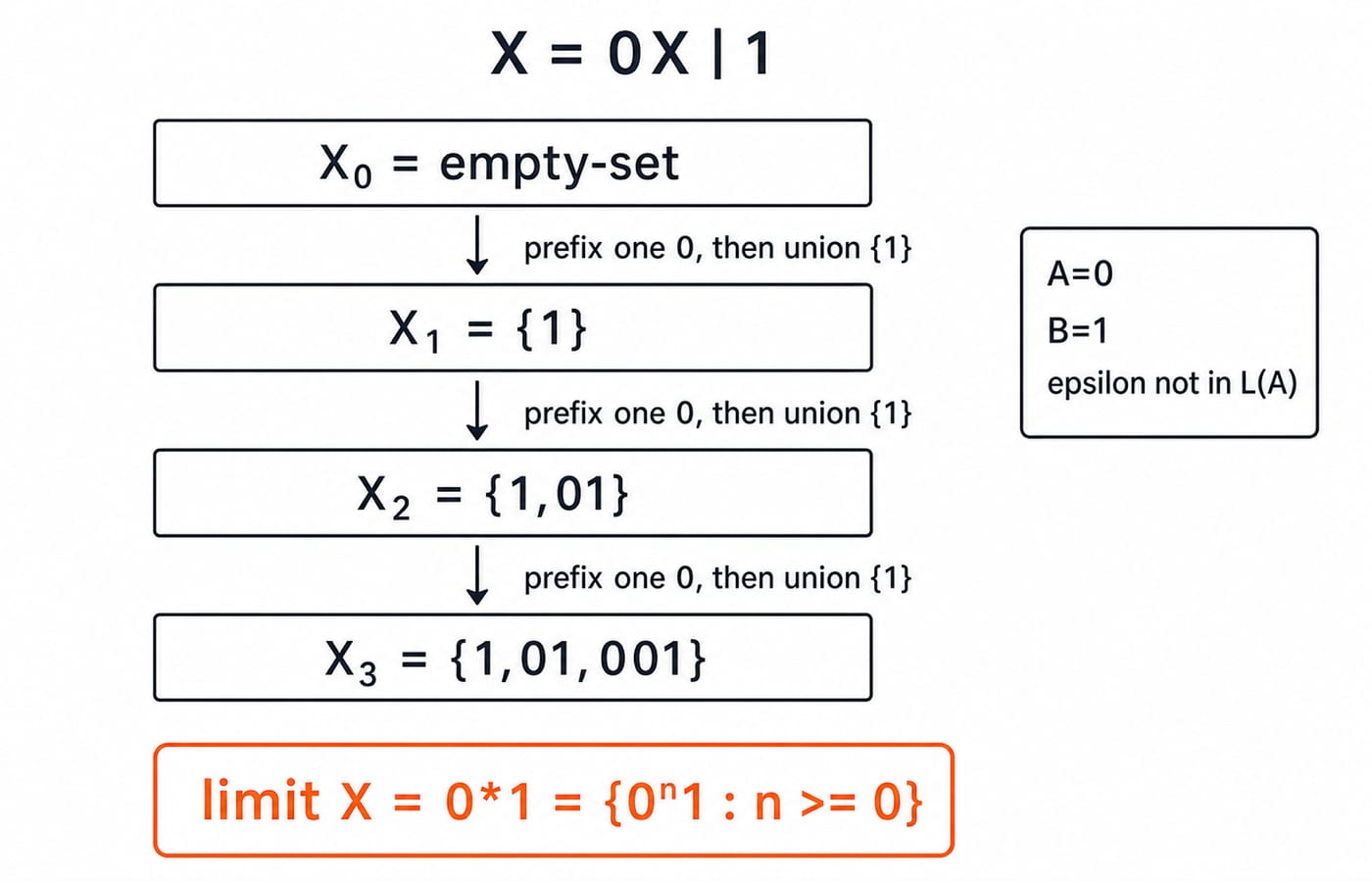
Arden's theorem has a direction. If X=AX|B and epsilon is not in L(A), the unique solution is X=A*B. For the right-recursive form X=XA|B, the corresponding solution is X=BA*. Swapping those results would reverse the order of concatenation.
For X=0X|1, take A=0 and B=1. Since epsilon is not in {0}, Arden's theorem gives X=0*1. Starting from X_0=empty-set, substitution produces X_1={1}, X_2={1,01}, and X_3={1,01,001}. Continuing adds one more leading zero each time, so the limit is {0^n1 : n>=0}.
Disprove false equivalence with a short witness
Proving equality requires both language inclusions. Disproving it needs only one string in one language but not the other. For 0*1 and 10*, the witness 01 belongs only to the first. For (0|1)* and 0*|1*, the same witness belongs to the first but to neither the all-zero nor the all-one branch of the second.
Star scope causes another common error. The string 0011 is accepted by 0*1*, but not by (01)*, whose words must repeat the complete block 01. Parentheses determine exactly which expression the star repeats.
An automata-based equivalence check is the natural next method in Finite Automata: DFA vs NFA and Subset Construction. For proof-oriented practice, continue with regular expressions and the pumping lemma.
How exam-style questions test regex design and algebra
Exam-style questions usually take one of four reusable forms: translate a verbal constraint, simplify with named identities, separate two expressions with a witness, or solve X=AX|B or X=XA|B using Arden's theorem. For example, among 0*10*10*, (0|1)*11(0|1)*, and 0*1(0|1)*1, only the first enforces exactly two 1s. The others can accept strings with additional 1s.
After learning the method, use solved regex and finite-automata equivalence questions to practise translation, equivalence, and witness selection. Treat each expression semantically before trying to manipulate its symbols.
Short version and the next practice step
Translate constraints into ordered regions, manipulate expressions only with valid language identities, and verify the result with a proof plus boundary strings. The anchor result is 0*10*10* for exactly two 1s. Arden's theorem gives 0*1 for X=0X|1.
For a complete subject path, use the Theory of Computation / Automata Theory course. The Zero to Hero complete CS course provides the broader computer science sequence.
Keep learning
Regex Basics and Definitions: Operators, Worked Examples and Exam Patterns
Learn how regular expressions denote languages, how their three core operators bind, and how to build and check expressions with exact binary examples.
Updated 21 Oct 20265 min readTheory of Computation
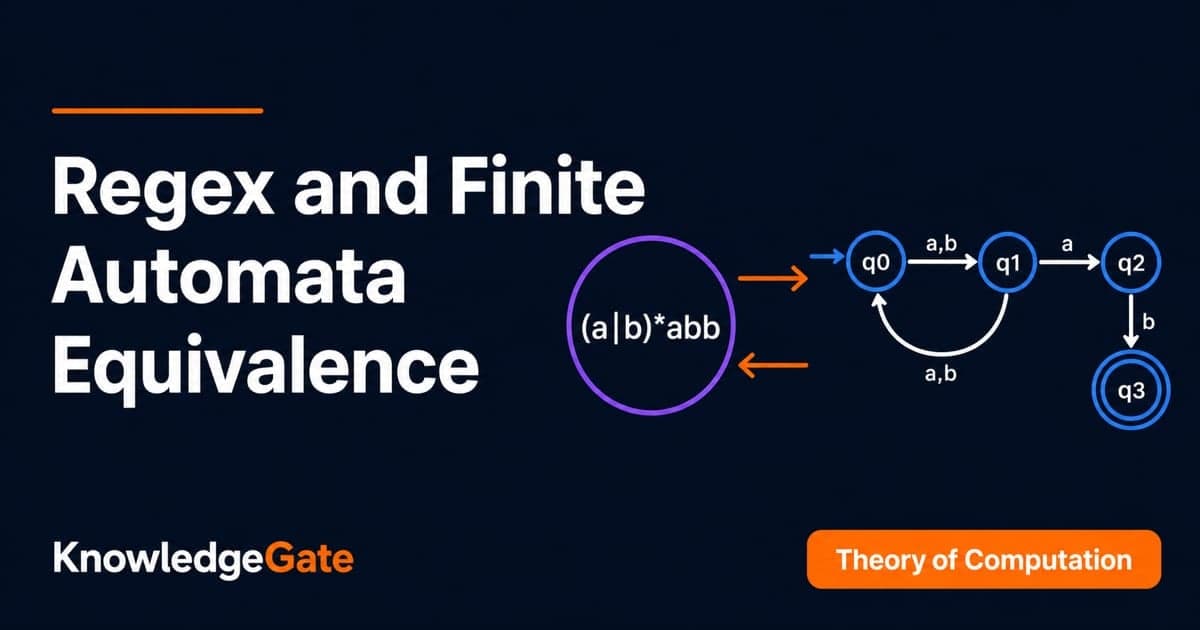
Regex and Finite Automata Equivalence: Conversions, Worked Examples and Exam Traps
Build and verify equivalent regex, NFA and DFA descriptions step by step. The worked conversions show what each state means and how to catch a false match.
Updated 17 Oct 20266 min readTheory of Computation
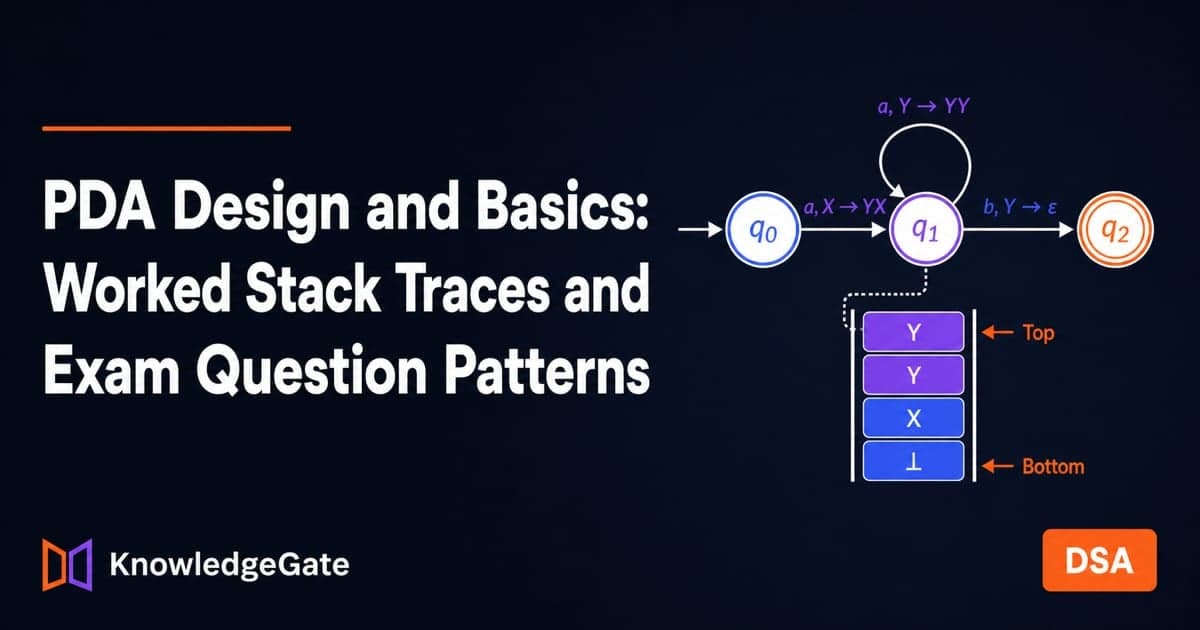
PDA Design and Basics: Worked Stack Traces and Exam Question Patterns
Learn how a pushdown automaton uses its stack, then design and trace a complete machine for a^n b^n. The worked CFG conversion and rejection checks make every move testable.
Updated 13 Oct 20266 min readTheory of Computation
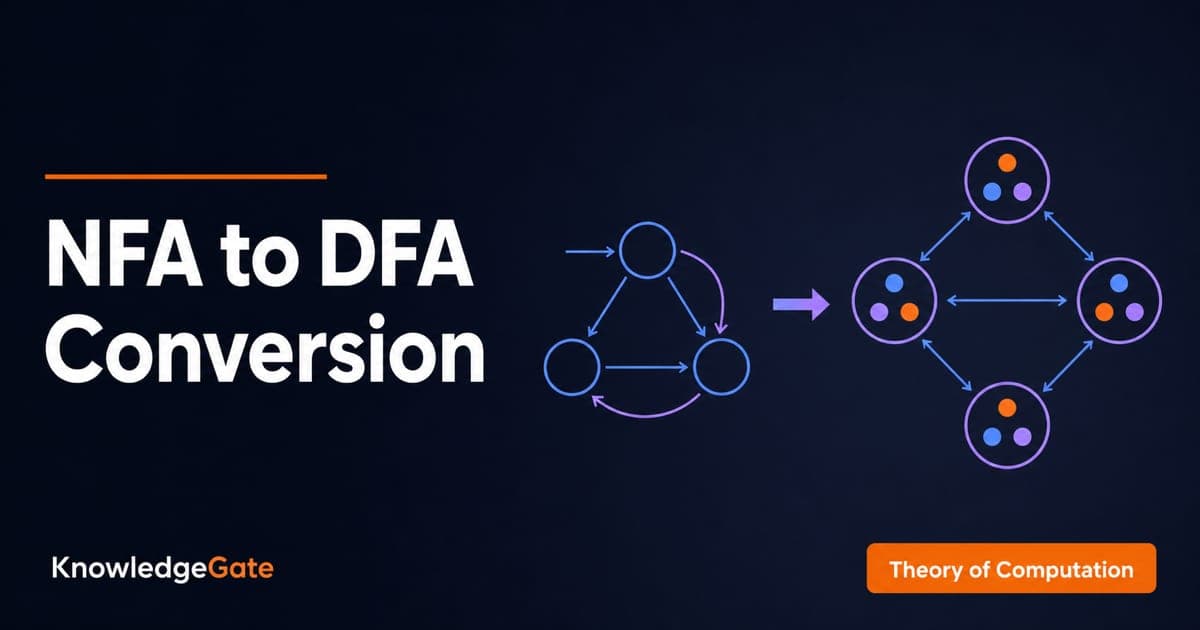
NFA to DFA Conversion: Subset Construction, Worked Example, and Exam Traps
Learn subset construction by converting one three-state NFA row by row, checking the result with strings, and then minimising the reachable DFA.
Updated 9 Oct 20265 min read50 viewsTheory of Computation