Python Lambda and Higher-Order Functions: Runnable Examples, Traps, and Exercises
Build lambdas from ordinary functions, pass them into higher-order operations, and trace a complete Python data pipeline. Then fix common errors and test yourself with runnable exercises.
KnowledgeGate Team
Exam prep & CS education
Updated 12 Sep 20265 min read
You may be comfortable reading lambda x: x * 2. The thread becomes harder to follow when a function is passed into sorted(), map(), or filter() and the data changes at each step. Trace the callback separately from the data to see what each function and operation contributes. The Coding & Skill Development Courses catalogue connects these ideas to core Python fundamentals.
Python lambda syntax: the smallest useful function
The exact form is lambda parameters: expression. According to the Python Language Reference, a lambda expression creates a function object, and its expression is evaluated when that function is called. The result is returned implicitly. A lambda body contains one expression, not a sequence of statements.
Here is a lambda beside an equivalent named function:
square = lambda n: n * n

def square_named(n):
    return n * n

print(square(6))        # 36
print(square_named(6))  # 36

add = lambda a, b: a + b
print(add(7, 5))        # 12
A lambda is a function object, not a faster form of def. Use one for a short, local operation whose meaning is immediately clear. Use def when the logic needs a descriptive name, type annotations, documentation, statements, or more than one conceptual step.
What makes a function higher order
A higher-order function accepts a function, returns a function, or does both. This works because Python names can hold function objects. transform = square stores the function under another name without calling it. transform(6) calls it and returns 36.
def apply_twice(fn, value):
    return fn(fn(value))

increase_by_three = lambda x: x + 3
result = apply_twice(increase_by_three, 10)
print(result)  # 16
Trace the nested calls from the inside out: 10 -> 13 -> 16. Therefore, the final output is 16. Here, apply_twice is the higher-order function, increase_by_three is the function argument, and 10 is the data. A callback is more specific: it is a function that another operation invokes at the required point.
Worked pipeline with filter, map, and reduce
Use one input throughout so that every change remains visible:
from functools import reduce

numbers = [12, 7, 20, 5, 14]

evens = list(filter(lambda n: n % 2 == 0, numbers))
squares = list(map(lambda n: n * n, evens))
total = reduce(lambda total, n: total + n, squares, 0)

print(evens)    # [12, 20, 14]
print(squares)  # [144, 400, 196]
print(total)    # 740
filter chooses the values that satisfy the condition, so 7 and 5 are removed. map transforms every retained value: 12 * 12 = 144, 20 * 20 = 400, and 14 * 14 = 196. reduce then combines the sequence into one value. Its complete accumulator trace is:
Start with the initial accumulator
0.0 + 144 = 144.144 + 400 = 544.544 + 196 = 740.
In Python, map and filter return iterators. Wrapping them with list() makes their values visible and also gives reduce a named, inspectable input. A list comprehension can express the selection and transformation together:
squares_again = [n * n for n in numbers if n % 2 == 0]
print(squares_again) # [144, 400, 196]filter, map, and reduce expose the stages separately, while the comprehension combines selection and transformation. The Python Comprehensions Tutorial: List, Set and Dictionary Examples owns comprehension syntax; here, the one-line version only checks that both forms produce the same values.
![Pipeline diagram: filter drops odd values from [12, 7, 20, 5, 14], map squares the evens to [144, 400, 196], and reduce sums them to 740.](https://cdn.knowledgegate.ai/blog-assets/blog_asset_1784181991733_brc10a.jpg)
Lambda as a key function for sorting records
The key argument tells sorted() which comparison value to calculate for every record.
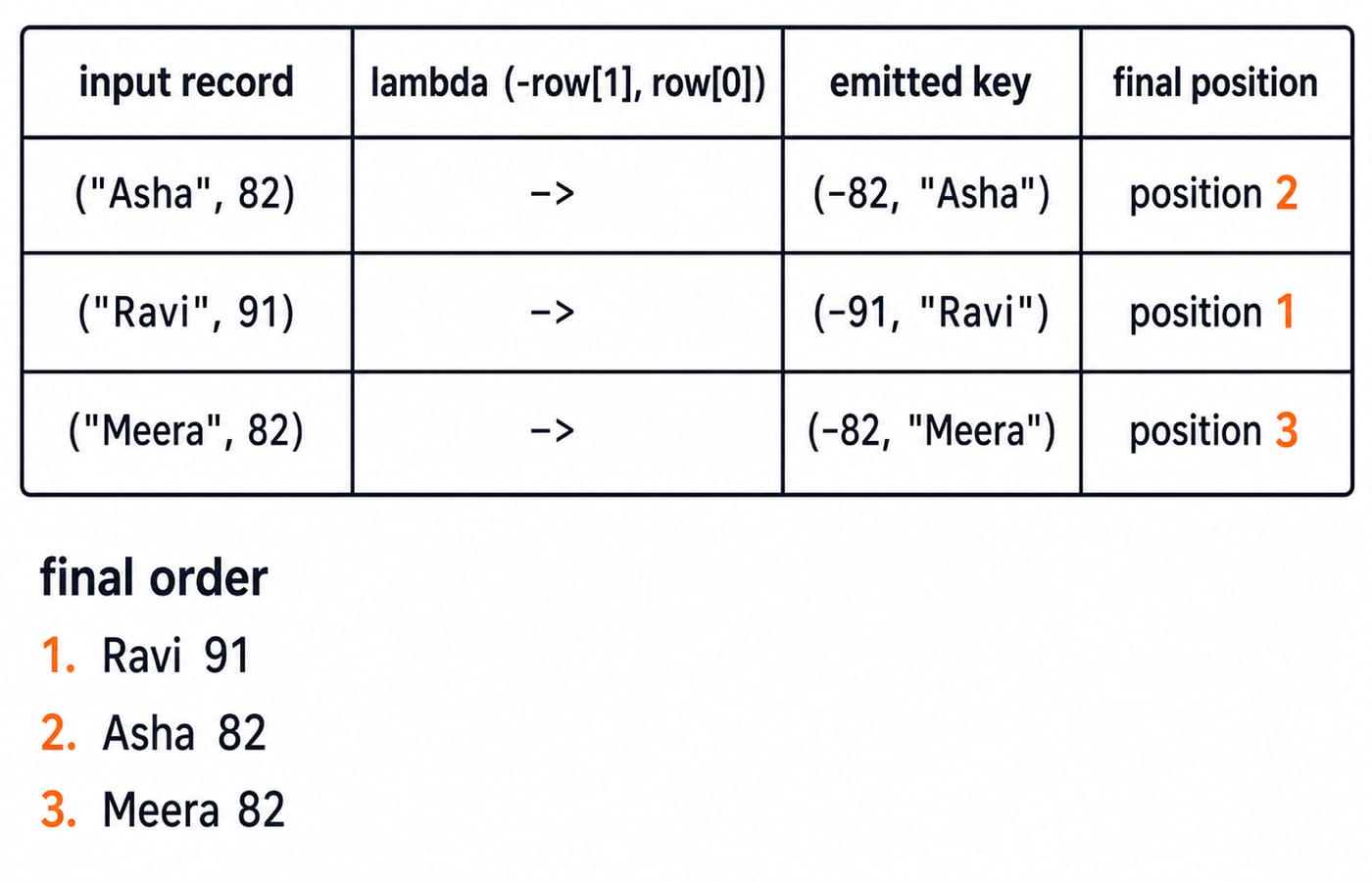
records = [("Asha", 82), ("Ravi", 91), ("Meera", 82)]

ranked = sorted(records, key=lambda row: (-row[1], row[0]))
print(ranked)  # [("Ravi", 91), ("Asha", 82), ("Meera", 82)]
For Ravi, the key is (-91, "Ravi"); for Asha and Meera, the keys start with -82. Sorting smaller negative values first places the larger score first. The name then breaks the score tie alphabetically, putting Asha before Meera.
Here, sorted() is the higher-order function and the lambda is its key callback. Python invokes that callback once per record to produce the comparison keys. To study what happens beyond the key function, see this sorting algorithms complexity and comparison guide.
Returning a function and remembering state
A higher-order function can also create and return another function:
def make_multiplier(factor):
    return lambda value: value * factor

triple = make_multiplier(3)
print([triple(n) for n in [2, 5, 8]])  # [6, 15, 24]

double = make_multiplier(2)
print(double(8))  # 16
print(triple(8))  # 24
make_multiplier is higher order because it returns a function. The returned lambda closes over factor, which means triple remembers factor = 3 even after make_multiplier(3) has finished. double remembers 2 instead. Each returned function keeps its own retained value, so the same input 8 produces 16 or 24 depending on which function you call.
Common lambda and higher-order-function errors
Late binding is a common surprise:
funcs = [lambda: i for i in range(3)]
print([f() for f in funcs])  # [2, 2, 2]
Each lambda reads i when it is called, after the loop has finished with i = 2. Capture the current value through a default argument:
funcs = [lambda i=i: i for i in range(3)]
print([f() for f in funcs])  # [0, 1, 2]
A lambda cannot contain an if statement, so lambda x: if x > 0: x is invalid syntax. A conditional expression is valid:
describe = lambda x: "positive" if x > 0 else "non-positive"
print(describe(4))  # positive
print(describe(0))  # non-positive
If either branch needs several actions, use def. Also remember that this does not display a transformed list:
print(map(lambda n: n + 1, [2, 4]))
print(list(map(lambda n: n + 1, [2, 4])))  # [3, 5]
Finally, avoid deeply nested anonymous functions. Naming the evens, squares, and total stages makes each stage separately inspectable and testable.
How code-tracing questions and interviews test the idea
Typical tasks ask you to predict a lambda's output, identify the higher-order function, complete a key callback, or repair a closure bug. These are common interview practices, not rules from any employer or exam. For syntax and evaluation details, use the official language reference linked earlier.
Predict each result before reading the checkpoints:
f = lambda x: x * 2 + 1; what isf(4)?What does
sorted(["pear", "fig", "banana"], key=len)return?What does
apply_twice(lambda x: x - 4, 20)return?
The answers are 9; ["fig", "pear", "banana"]; and 12. The last trace is 20 -> 16 -> 12.
Exercises, the short version, and the next step
Run these before checking the answers:
From
[3, 8, 11, 14], filter values greater than7, then double them.Sort
[("Nina", 3), ("Aman", 1), ("Kabir", 2)]by the second field.Write
make_offset(5)and apply the returned function to[-1, 0, 9].
Your checkpoints are [16, 22, 28]; [("Aman", 1), ("Kabir", 2), ("Nina", 3)]; and [4, 5, 14].
A lambda creates a small expression-based function, while a higher-order function accepts or returns functions. Trace the data and the callback separately. Beginners can continue with Python Programming. For larger problem-solving applications, move to DSA Using Python.
Keep learning
Pandas Basics in Python: Build, Clean and Analyse a DataFrame Step by Step
Follow one student dataset from its first DataFrame to a clean city summary, while learning how selection, missing values and vectorised calculations really work.
Updated 24 Sep 20265 min readPython
Python Operators and Expressions: Precedence, Types and Worked Output Traces
Trace Python expressions without guessing. This guide connects operator families, precedence, types, short-circuiting and exact output through worked examples.
Updated 23 Sep 20266 min readPython
CSV Files Explained: Parsing Rules, Worked Records and Exam Traps
Learn why commas and newlines are not always boundaries, trace a quote-aware parser, validate text fields with a schema, and calculate processing costs.
Updated 22 Sep 20265 min readPython
Polymorphism and Dunder Methods in Python: Runnable Examples and Exercises
See how one Python operation supports different types, then build a Vector2D class with readable output, addition, magnitude and equality. Includes runnable code, protocol failures and exercises.
Updated 21 Sep 20265 min readPython