

Python Collections Module: Counter, defaultdict, deque and namedtuple with Worked Examples
Counter counts values, defaultdict creates missing groups, deque works at both ends, and namedtuple gives fixed records readable fields.
KnowledgeGate Team
Exam prep & CS education
Updated 7 Nov 20265 min read

You already know list, tuple and dict, but manual counting, grouping and queue code can still make a simple program noisy. Specialised collections containers reduce that boilerplate. Their edge cases include missing keys, non-positive counts, bounded eviction and immutable records, so they complement the built-ins rather than replace them.
For built-in str, list, tuple, set and dict, plus a worked word counter, use Python Collections and Strings: Complete Guide with a Worked Word Counter. Python programming course connects collections to file paths, CSV, dates, statistics and JSON. The collections module itself handles narrower container jobs: counting, missing-key factories, two-ended queues, named records, layered mappings and explicit reordering.
Python collections module: choose the container from the operation
The collections module packages containers for recurring data-structure operations. Import names explicitly so each dependency and container choice remains visible:
from collections import Counter, defaultdict, deque, namedtuple, ChainMap, OrderedDictAvoid from collections import *. Explicit imports make both intent and dependencies clearer.
Operation you need | Container |
|---|---|
Count frequencies |
|
Initialise missing keys or group values |
|
Add or remove items at either end |
|
Create a lightweight named record |
|
Search layered mappings |
|
Reorder keys explicitly |
|
UserDict, UserList and UserString wrap built-in container behaviour for subclasses that need controlled overrides. Use them when a custom container benefits from delegation to an underlying data object. These wrapper bases connect Python syntax to practical Coding & DSA work.
Counter in Python: count, query, update and subtract
Counter counts hashable values and returns zero for a missing item:
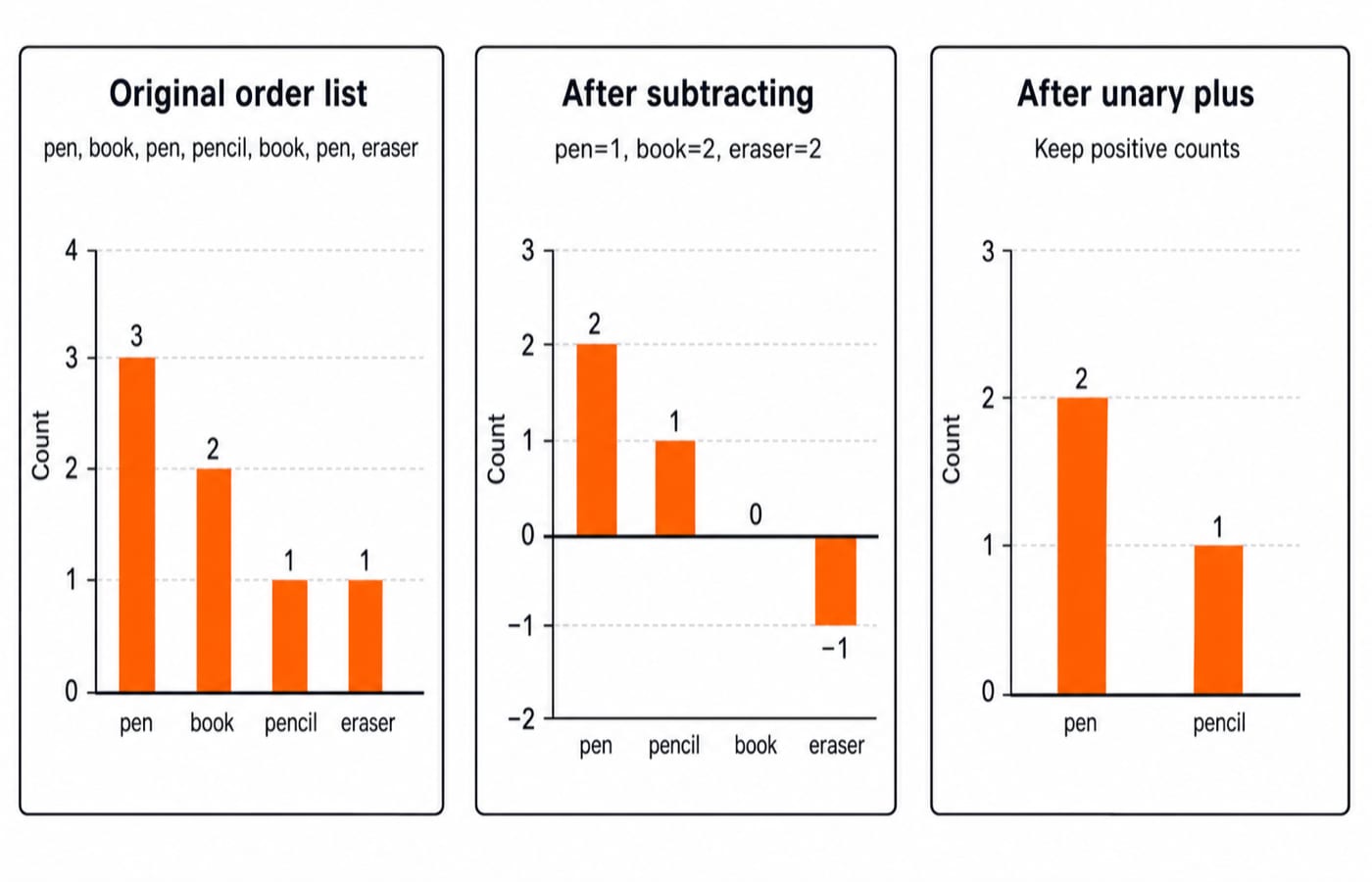
orders = ["pen", "book", "pen", "pencil", "book", "pen", "eraser"]
counts = Counter(orders)

print(dict(counts))        # {'pen': 3, 'book': 2, 'pencil': 1, 'eraser': 1}

counts["pen"]             # 3
counts["marker"]          # 0
counts.most_common(2)     # [('pen', 3), ('book', 2)]
Now subtract stock adjustments from the same object:
counts.subtract({"pen": 1, "book": 2, "eraser": 2})
print(dict(counts))        # {'pen': 2, 'book': 0, 'pencil': 1, 'eraser': -1}
print(+counts)             # Counter({'pen': 2, 'pencil': 1})
Subtraction retains zero and negative counts. Unary plus creates a new Counter containing only positive counts. Counter keys use normal dictionary hashing, and a missing key still reads as zero.
defaultdict in Python: group values without repeated key checks
With a plain dictionary, packages[city].append(tracking_id) raises KeyError when city is new. A defaultdict calls its factory to create the missing list:
shipments = [("Delhi", "PK-104"), ("Pune", "PK-105"),
             ("Delhi", "PK-106"), ("Kochi", "PK-107"),
             ("Pune", "PK-108")]
packages = defaultdict(list)

for city, tracking_id in shipments:
    packages[city].append(tracking_id)

print(dict(packages))
# {'Delhi': ['PK-104', 'PK-106'], 'Pune': ['PK-105', 'PK-108'], 'Kochi': ['PK-107']}
The grouping is deterministic: Delhi receives ['PK-104', 'PK-106'], Pune receives ['PK-105', 'PK-108'], and Kochi receives ['PK-107']. Keys retain their first-insertion order in the displayed dictionary.
Pass the callable as defaultdict(list), not defaultdict(list()). The latter passes an already-created list and raises TypeError. Reading packages["Jaipur"] returns [], but it also stores "Jaipur": [] in the mapping.
deque in Python: queues, bounded history and sliding windows
A deque supports append and pop at the right, plus appendleft and popleft at the left. A queue consumes its oldest item with popleft(), matching FIFO queue behaviour.
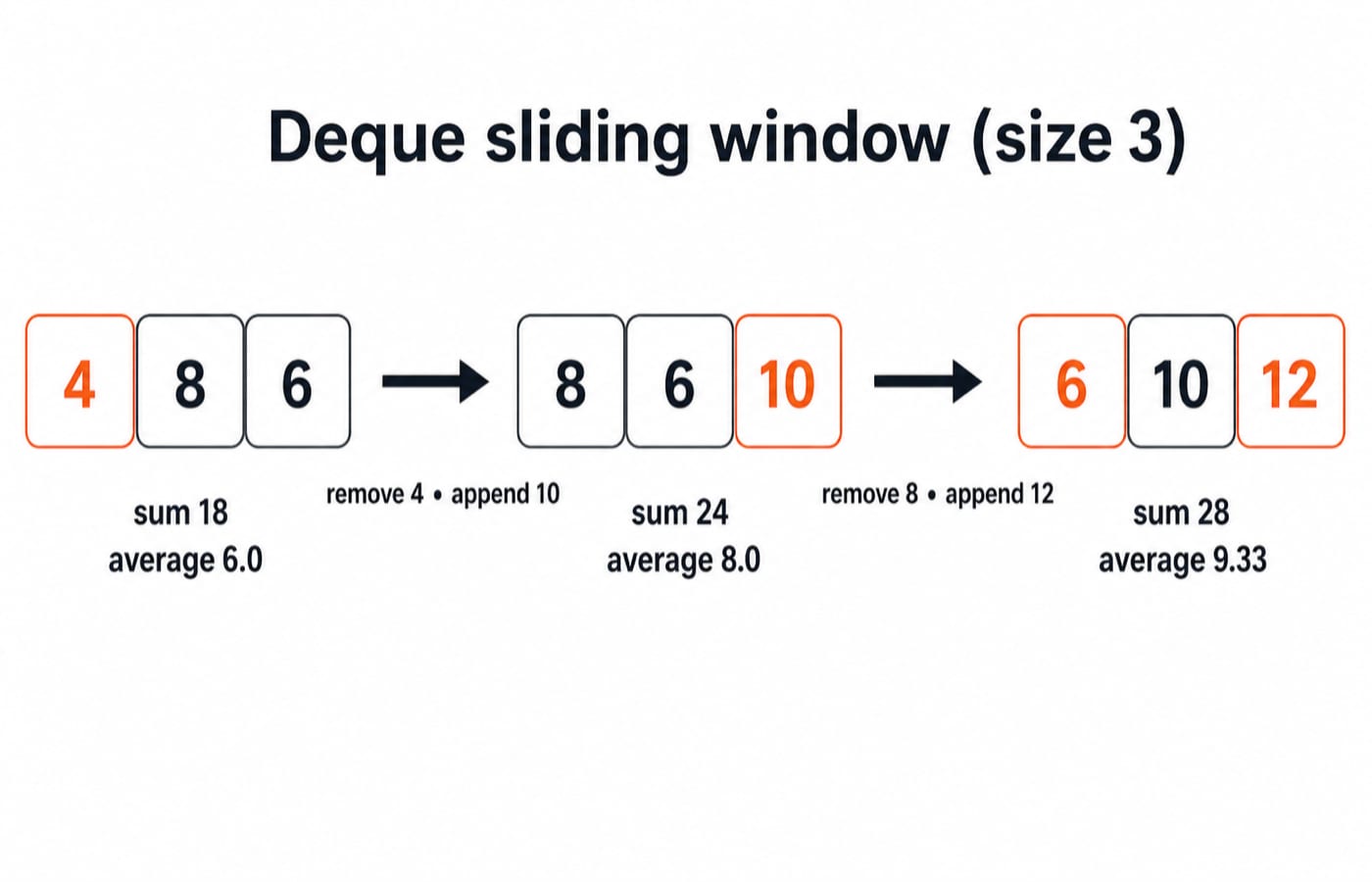
For a size-3 moving average over [4, 8, 6, 10, 12]:
Window
[4, 8, 6]: sum4 + 8 + 6 = 18, average18 / 3 = 6.0.Remove
4, append10: window[8, 6, 10], sum8 + 6 + 10 = 24, average24 / 3 = 8.0.Remove
8, append12: window[6, 10, 12], sum6 + 10 + 12 = 28, average28 / 3 = 9.333..., rounded to9.33.
The exact result list is [6.0, 8.0, 9.33].
A bounded deque evicts automatically. After history = deque(["T1", "T2", "T3"], maxlen=3) and history.append("T4"), "T1" disappears and the result is deque(['T2', 'T3', 'T4'], maxlen=3). Make automatic eviction explicit when silent item loss would be a bug.
namedtuple, ChainMap and OrderedDict: records and mapping layers
A named tuple gives tuple values readable field names:
from math import sqrt

Point = namedtuple("Point", ["x", "y"])
p = Point(3, 4)
x, y = p
distance = sqrt(3**2 + 4**2)  # sqrt(9 + 16) = sqrt(25) = 5.0
q = p._replace(x=6)
Here p.x == 3, unpacking gives x == 3 and y == 4, and q == Point(x=6, y=4). The original remains Point(x=3, y=4) because named tuples are immutable.
ChainMap searches mappings from first to last:
defaults = {"theme": "light", "page_size": 20}
user = {"theme": "dark"}
settings = ChainMap(user, defaults)
Now settings["theme"] == "dark" and settings["page_size"] == 20. Assigning settings["page_size"] = 50 writes to the first mapping. user becomes {"theme": "dark", "page_size": 50}, while defaults is unchanged.
Start an OrderedDict with [('compile', 2), ('test', 3), ('deploy', 1)]. After move_to_end("compile"), its key order is test, deploy, compile; popitem(last=False) then returns ('test', 3). Ordinary dictionaries preserve insertion order, so choose OrderedDict when explicit reordering, oldest-item removal or order-sensitive equality carries the logic.
Python collections mistakes: factories, mutation and access patterns
Match each failure to its repair:
defaultdict(list())passes a list, not a callable. Usedefaultdict(list).p.x = 6fails because a named tuple is immutable. Usep._replace(x=6).Counter.elements()omits zero and negative counts. Inspectitems()when those states matter.ChainMapassignment writes only to its first mapping. Mutate the intended underlying mapping explicitly.Frequent middle indexing is a poor
dequeaccess pattern. Use a list when random access dominates.
Bounded capacity is another trap. Given deque([1, 2, 3], maxlen=3), appendleft(0) silently removes 3 and produces deque([0, 1, 2], maxlen=3). Make automatic eviction explicit whenever losing an item could surprise the reader.
The choice checklist is therefore operational: count, group, process ends, model a record, layer settings or reorder keys.
Python collections exercises: predict the exact result
Counter:
letters = Counter("mississippi")givesm: 1,i: 4,s: 4,p: 2.letters.most_common(2) == [('i', 4), ('s', 4)]. Equal counts retain first-encounter order here, andiappears befores.Deque: start with
d = deque([10, 20, 30], maxlen=3). Afterd.appendleft(5), the state is[5, 10, 20]because30is evicted from the right. Afterd.rotate(1), the final state is[20, 5, 10].Defaultdict: use
defaultdict(set)to group[('red', 'A'), ('blue', 'B'), ('red', 'C'), ('blue', 'B')]. The logical result isred -> {'A', 'C'}andblue -> {'B'}. Repeating('blue', 'B')does not duplicateBin a set.
Coding quizzes and interviews commonly test output prediction, factory selection, mutation and edge cases.
Python collections module: the short version and next step
Container | Core job |
|---|---|
| Count values |
| Initialise missing values and group items |
| Work efficiently at both ends |
| Store immutable named fields |
| Search mapping layers |
| Perform explicit order operations |
Choose the container from the operation, then test its edge case: missing keys, non-positive counts, immutability or bounded eviction. Continue with the Python course for a complete language path. If your immediate goal is implementing data structures and solving problems, follow DSA Using Python instead.
Keep learning

JSON and CSV in Python: Read, Write and Convert Data with Worked Examples
Use Python's standard library to read, update, write and convert JSON and CSV safely. The examples trace types, quoting, calculations and validation.
Updated 9 Nov 20265 min readPython

Date and Time in Python: datetime Tutorial with Parsing, Arithmetic and Time Zones
Build reliable Python date-time values from input text, calculate across midnight, and convert one instant between Asia/Kolkata and UTC.
Updated 8 Nov 20265 min readPython

Python for GATE: DA Syllabus, Observed Weightage and Prep Order
Settle the DA-versus-CS language question, see what one official DA paper contained, and build Python, data structures and algorithms in the right sequence.
Updated 6 Nov 20265 min readPython

Type Hints in Python: Functions, Collections and Checked Examples
Learn what Python type hints do, how to annotate common data shapes, and how a checker catches mistakes through exact, runnable examples.
Updated 5 Nov 20266 min readPython