KVS vs NVS Computer Science Syllabus: Shared Core and Post-Level Differences
Study the common PGT Computer Science core once, understand where KVS and NVS routes diverge, and build a source-checked plan for your exact post.
KnowledgeGate Team
Exam prep & CS education
Updated 2 Aug 20265 min read57 views
If you have downloaded several “KVS syllabus” and “NVS syllabus” lists, the overlap can look harder than it is. In the 2025 joint recruitment, the officially labelled PGT Computer Science Tier-II core was shared; the real differences were the available posts, the PGT or TGT level, and the work setting. Coaching-list mash-ups blur that line; the dated CBSE and KVS documents do not. A later cycle can change the posts, scheme, or syllabus, so its current official notice must control.
Read the KVS/NVS syllabus by job post first, organisation second
CBSE's 13 November 2025 joint KVS-NVS notification listed PGT Computer Science under both organisations. The KVS-hosted Tier-II document from the same date contains one section headed PGT (Computer Science), not separate KVS and NVS PGT lists. Read together, they support one shared PGT subject core.
KVS and NVS are two organisations, not two separate study lists. Identify the exact job post first, then apply that cycle's scheme and syllabus. For the wider recruitment, including the general section and teaching aptitude, read KVS and NVS Computer Science: Exam Structure and Prep.
The shared PGT Computer Science core in five syllabus lanes
The dated KVS Tier-II PDF repeats several headings, so the PGT Computer Science topics collapse into five lanes rather than a long unit count. Pair each lane with one finished revision output instead of a reading target.
Official syllabus lane | Topics to cover | Concrete revision output |
|---|---|---|
Computer systems and organisation | Hardware and software, CPU and memory, operating-system functions, Boolean logic, number systems and encoding | One truth-table or conversion drill |
Computational thinking and Python | Problem solving, algorithms, flowcharts, data types, operators, conditionals, loops, strings, lists, tuples, dictionaries, modules, functions, and text, binary and CSV files | Two short Python traces |
Databases and data handling | Relational concepts and keys, DDL, DML, constraints, filtering, aggregates, grouping, joins, Python-SQL connectivity, Pandas and Matplotlib | Five SQL queries on one schema |
Networks and web | Communication terms, transmission media, devices, PAN, LAN, MAN, WAN, topologies, protocols, web services, HTML, XML, browsers and hosting | One labelled network map |
Society and emerging technology | Digital footprints, IPR, cybercrime and safety, e-waste, the Indian IT Act, AI, ML, NLP, AR/VR, robotics, big data, IoT, cloud, grid and blockchain | One page of ethics and emerging-technology contrasts |
What actually differs between KVS and NVS Computer Science routes
The 2025 CBSE joint notification separates the two routes on three points:
Route point | What the notification showed |
|---|---|
PGT Computer Science | Listed for both KVS and NVS |
TGT Computer Science | Listed in the NVS TGT table, but not in the KVS TGT table |
Tier-I expected knowledge | Postgraduate level for PGT and graduation level for TGT |
The KVS-hosted Tier-II PDF labels a PGT Computer Science syllabus but no separately labelled TGT Computer Science section. NVS TGT candidates should not silently reuse the PGT list; check the applicable notice, syllabus page and any post-specific clarification before freezing a checklist.
The notification also describes KVs as co-educational schools through Class XII and JNVs as residential schools where teachers carry residential-system responsibilities. That changes day-to-day role fit, not the technical syllabus.
The shared examination funnel and where subject knowledge enters
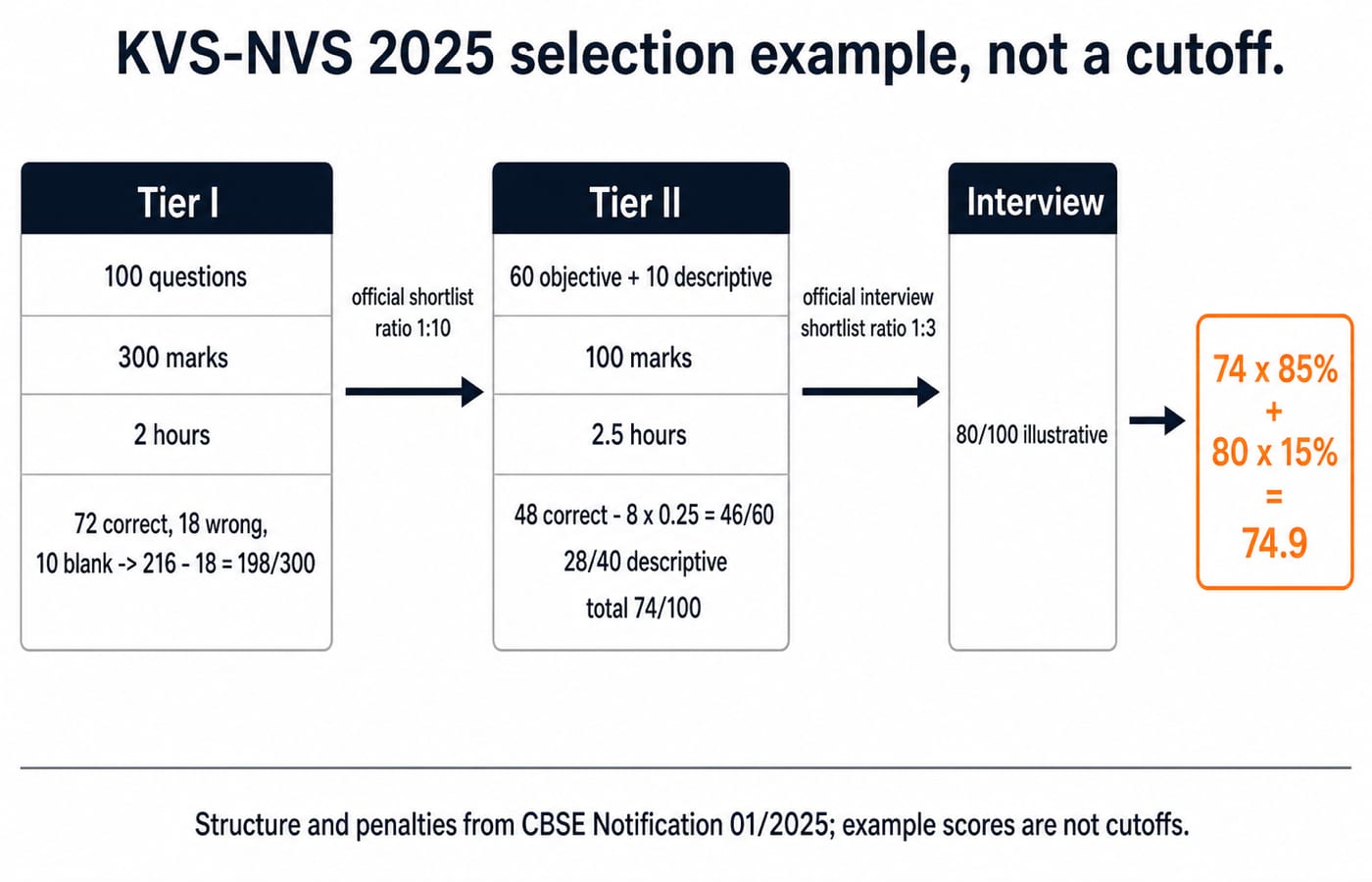
In the 2025 notification, Tier I was a qualifying OMR screen with 100 questions, 300 marks and 2 hours. It allocated 20 questions each to reasoning, numeric ability, basic computer literacy and general knowledge, plus 10 English questions and 10 in one chosen modern Indian language. A correct answer earned 3 marks, a wrong answer lost 1 mark, and candidates were shortlisted for Tier II at 1:10 against notified vacancies.
Tier II was a 2.5-hour, 100-mark subject-knowledge paper: 60 objective questions for 60 marks and 10 descriptive questions for 40 marks. Each wrong objective answer lost 0.25 mark. PGT and TGT routes then had a 100-mark interview, with shortlisting for it at 1:3 against notified vacancies. Tier II and interview contributed 85% and 15% to the published merit list.
Verify every figure here against the notice for your own recruitment cycle.
Worked score example: keep screening, subject depth and merit separate
In Tier I, suppose a candidate has 72 correct, 18 wrong and 10 unattempted answers:
72 x 3 - 18 x 1 = 216 - 18 = 198/300
Tier I is only the qualifying gate and does not contribute to final merit, so this score does its full job by clearing the bar.
In the Tier-II objective part, where subject depth is measured, suppose 48 correct, 8 wrong and 4 unattempted answers:
48 - (8 x 0.25) = 48 - 2 = 46/60
Add 28/40 descriptive marks to get 46 + 28 = 74/100. With an illustrative interview score of 80/100, merit combines as:
74 x 0.85 + 80 x 0.15 = 62.9 + 12 = 74.9
Those component scores are illustrative and carry no cut-off information.
Turn the official core into a 42-hour first-pass map
Build the first-pass study map around 14 days x 3 hours = 42 hours = 28 blocks x 90 minutes. Allocate:
4 blocks on systems, Boolean logic and number systems, where conversion and truth-table drills reward repetition.
8 blocks on Python and problem solving; coding and tracing earn the largest hands-on share.
4 blocks on DBMS and SQL, including Python-SQL connectivity, writing queries until the patterns stick.
3 blocks on networks and web, one structured pass through terms, devices, topologies and protocols.
3 blocks on Pandas and data visualisation, worked hands-on rather than read.
2 blocks on ethics and emerging technology, a compact recall-and-examples sweep.
4 blocks on mixed objective and descriptive revision, one final round in both response formats.
In the final four blocks, complete one 60-question objective home set, review every wrong or guessed answer, and write two descriptive responses containing a definition, an example with values and one limitation. The Govt Teaching Job Exam Preparation category collects the rest of the KVS and NVS material.
Freeze the right checklist, then choose the next preparation route
Finish with four source checks: save the applicable CBSE notice; identify KVS or NVS and PGT or TGT; match that post to the dated official Tier-II syllabus; record every corrigendum before adding topics.
The short version is that PGT candidates can reuse the shared technical core. NVS TGT candidates must not assume an unlabelled separate syllabus is identical. For focused preparation, use the KVS NVS Computer Science bundle. If you are genuinely comparing several teaching recruitments, consider the Teaching Recruitment Exams Bundle and first decide with Which Teaching CS Exam to Target.
Keep learning
NVS PGT Computer Science: A Topic-by-Topic Practice Map
Turn a topic list into checks you can actually solve. Map your NVS PGT Computer Science preparation through binary conversion, Python tracing, SQL results and IP addressing.
30 Sep 20265 min readKVS & NVS
NVS PGT Computer Science 60-Day Study Plan: Revision and Mock Strategy
Turn the final 60 days into four clear phases, with a worked 201-hour timetable, error-led revision blocks, timed mocks, recovery buffers, and a calm taper.
Updated 12 Aug 20265 min readKVS & NVS
PGT Eligibility: Is B.Ed Mandatory for KVS, NVS and State Recruiters?
A recruiter-first guide to the PGT teacher-training question, using dated KVS, NVS and DSSSB clauses, candidate profiles and a reusable eligibility audit.
Updated 10 Aug 20265 min read124 viewsKVS & NVS
KVS vs NVS vs EMRS: Choose the Right School System for Your Teaching Career
Compare KVS, NVS and EMRS through current post rules, lifestyle limits and a weighted personal-fit matrix. See why changing priorities can change the answer.
Updated 7 Aug 20267 min read84 viewsKVS & NVS