KVS vs NVS vs EMRS: Choose the Right School System for Your Teaching Career
Compare KVS, NVS and EMRS through current post rules, lifestyle limits and a weighted personal-fit matrix. See why changing priorities can change the answer.
KnowledgeGate Team
Exam prep & CS education
Updated 7 Aug 20267 min read83 views
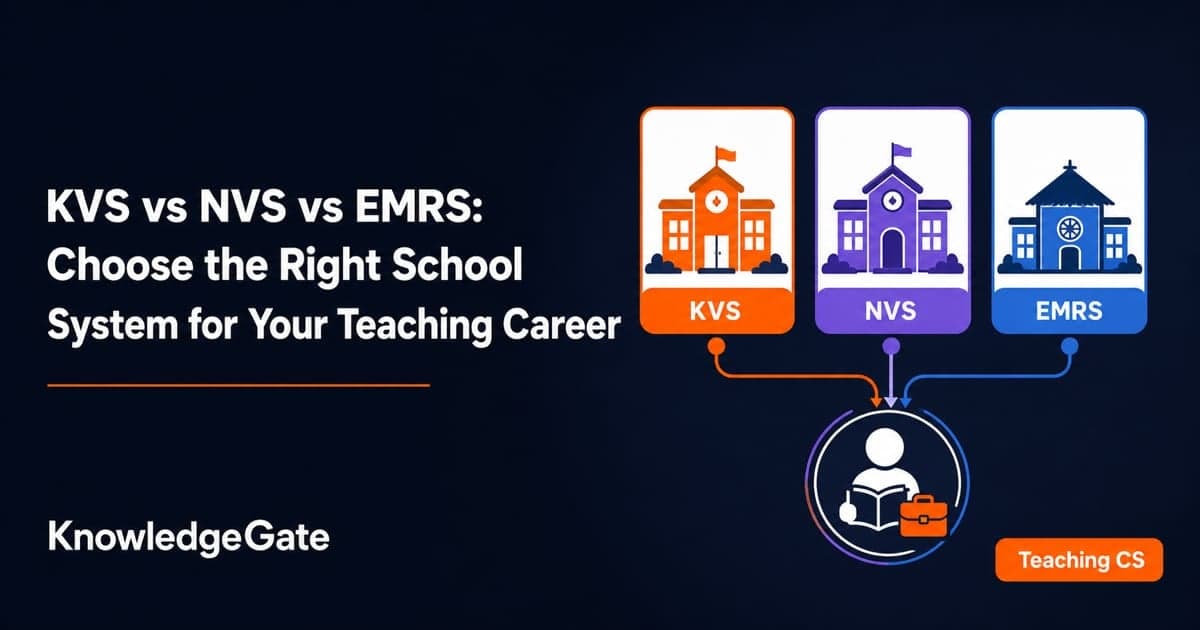
KVS, NVS and EMRS are not three labels for the same teaching life. KVS runs about 1,290 co-educational composite CBSE schools, a network the government itself describes as mainly urban and semi-urban. NVS runs one fully residential school per district for talented rural children selected on merit. EMRS is a residential network for Scheduled Tribe learners that answers to the Ministry of Tribal Affairs rather than the Ministry of Education, and its teaching posts are filled through a single recruitment cycle that NESTS runs centrally. Those three facts already decide where you would live, whom you would teach and whose service rules would govern you. Recruitment terms change every cycle, so read the live notice for the post you actually want before committing to a route.
Related reading: KVS and NVS exam structures and recruiter-specific PGT eligibility.
KVS, NVS and EMRS solve different schooling problems
System | Stable official purpose or setting | Scale and posting reach | Official source |
|---|---|---|---|
KVS | Common education for children of transferable Central Government employees, including Defence and paramilitary personnel, in co-educational composite CBSE schools. Its remit includes remote and undeveloped locations. | About 1,290 functional schools as on October 2025, mainly urban and semi-urban, with an annual transfer policy that KVS publishes itself. | |
NVS | Free, co-educational, fully residential CBSE schooling from class VI to XII for talented children, predominantly from rural areas, selected on merit. | 662 schools operational as on October 2025 against 689 sanctioned, on a one-per-district model, concentrated in rural interiors. | |
EMRS | Upper-primary through senior-secondary education for ST and PVTG learners in tribal-dominated areas, with all-round development. | 511 functional schools against 728 approved locations on the NESTS dashboard, all residential and sited in tribal-dominated areas. |
Those counts come from the government's November 2025 backgrounder on KVS and NVS and from the NESTS dashboard, and all three move as new schools open. For the wider map of Computer Science teaching-recruitment routes, see the teaching Computer Science exams comparison.
Choose one current post in each system before comparing eligibility
Eligibility is not one gate with three doors. Three separate bodies write three separate sets of wording and publish them on their own sites: KVS issues its own employment notifications at kvsangathan.nic.in, the Navodaya Vidyalaya Samiti recruits for JNVs at navodaya.gov.in, and every EMRS teaching post in every state is filled through one ESSE cycle that NESTS conducts centrally. That last point is the sharpest practical difference between the three routes: a single EMRS application is aimed at a nationwide network, while a KVS or NVS vacancy reaches only that samiti's own schools. Post labels do not transfer either, so PGT, TGT and PRT rules are read per system and per cycle. Pick one current post per system and fill one row each:
Exact degree and subject wording | B.Ed, CTET or other requirement | Age and category rule | Experience | Documents in hand | Official-notice URL | Yes / No / Unclear |
|---|
Take one worked example. Meera is a composite candidate rather than a real applicant: B.Tech in Computer Science, B.Ed, CTET Paper II, two years of school teaching, 12 study hours a week. That profile still decides nothing on its own. She has to read each line of her qualification against the exact wording of each current notice, because a near match in one system carries no weight in another. Where no notice is open, the honest entry in the last column is not currently verifiable. The KVS and NVS Computer Science exam explainer sets out how those two selection papers are built.
NVS and EMRS residential duty: what a boarding campus asks
Every JNV and every EMRS is a boarding school, so the working day does not end when the last class does. Children are on campus overnight, through weekends and across most of the year, which generates a standing set of duties somebody has to cover: house and hostel supervision, evening study hours, meals, sick-bay and pastoral care, and weekend or co-curricular slots. NVS advertises hostel superintendent as a separate cadre, which tells you that load is not spread identically across every campus or every teacher. Which of those duties land on your own appointment, and whether campus residence is required or merely offered, is set by the appointment conditions of the specific post, so read those before weighing a residential route against a day-school one.
KVS is the outlier. Its charter is a common programme of education for a mobile parent population, not a boarding mission, and the network sits mainly in urban and semi-urban locations while the charter still covers remote and undeveloped ones. That is not a promise of a city posting. KVS also publishes an annual transfer policy, so a KV career is built around periodic moves rather than one fixed station.
Meera's hard limits are exact: she can relocate once, accept up to two evenings per week of scheduled school activity, and cannot accept routine overnight residential duty. A route whose verified terms cross that boundary leaves her shortlist before scoring.
Test mobility, location and learner-mission fit separately
Start from what the three networks already tell you. About 1,290 KVs with an annual transfer policy give the widest map and repeated moves. One JNV per district gives a dense and predictable map, but a rural and residential one. The 511 EMRS campuses, all in tribal-dominated areas, make the thinnest map of the three and the tightest constraint on where you can be posted. Then give every route a four-part evidence card: initial posting geography, transfer liability, staff residence or commute, and family/travel constraint. Put a current official rule, notice or appointment-term URL beside each answer.
Test mission separately. Does the KVS common programme, NVS's predominantly rural residential community, or EMRS's ST/PVTG-focused mission fit your purpose? Rural, tribal-dominated and remote do not mean poor facilities, and none promises a station.
Meera wants to reach home within 24 hours in an emergency and will make at most one inter-state move in her first three years. Those two limits, not a preference for one network, are what her location score has to answer to.
Compare selection preparation only after the current syllabus is open
For each post, record exact line in current official syllabus, PYQ or official-sample evidence, and my current level: 0-5. Attribute every post-wise detail to the exact live notice.
After verification, Meera's 12-hour week uses 6 hours for confirmed common CS concepts, 2 for the selected system's non-CS or teaching component, 2 for timed syllabus practice, 1 for error-log correction, and 1 for notice and document checks. Total: 6 + 2 + 2 + 1 + 1 = 12 hours. An unshared topic leaves the common block.
Use the EMRS Tier 1 vs Tier 2 preparation guide for EMRS planning. Much of the Computer Science core is shared across school-teaching papers, which is why the DSSSB TGT Computer Science Section B course works as a base while you wait for your notice.
Worked decision matrix: one candidate, five weighted tests
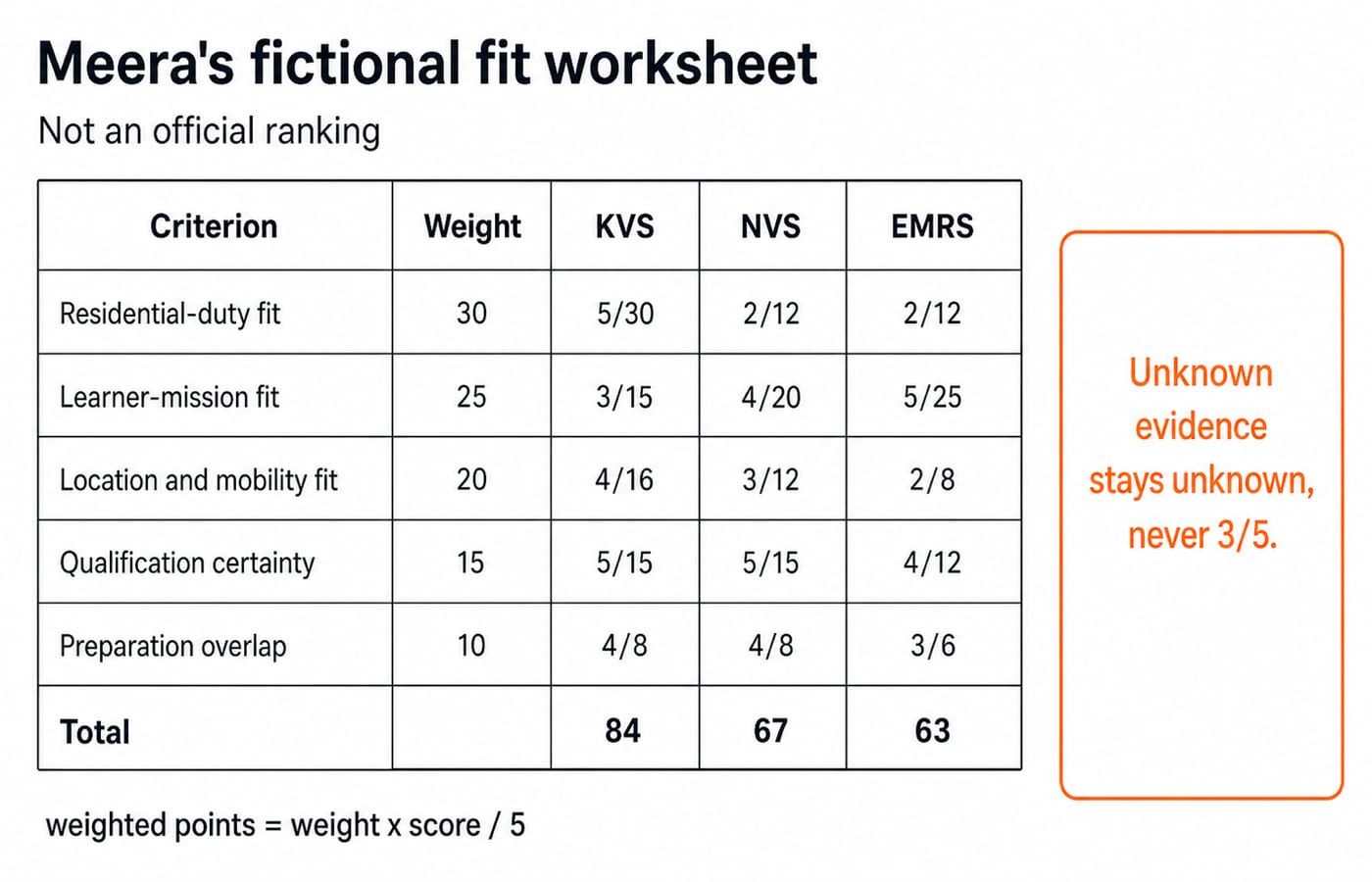
The weights and scores below are Meera's own, not an official ranking of the three systems. She sets weights totalling 100 and scores 1 to 5. Use weight x score / 5.
Criterion and weight | KVS score, points | NVS score, points | EMRS score, points |
|---|---|---|---|
Residential-duty fit, 30 | 5/30 | 2/12 | 2/12 |
Learner-mission fit, 25 | 3/15 | 4/20 | 5/25 |
Location and mobility fit, 20 | 4/16 | 3/12 | 2/8 |
Qualification certainty, 15 | 5/15 | 5/15 | 4/12 |
Preparation overlap, 10 | 4/8 | 4/8 | 3/6 |
Total | 84 | 67 | 63 |
KVS is 30 + 15 + 16 + 15 + 8 = 84. NVS is 12 + 20 + 12 + 15 + 8 = 67. EMRS is 12 + 25 + 8 + 12 + 6 = 63. KVS leads here because residential-duty fit carries weight 30. Source every real score; unverified criteria stay unknown, never 3/5.
Stress-test the answer before treating it as a choice
Change only Meera's priorities. Residential-duty fit falls from 30 to 5, learner-mission fit rises from 25 to 50, and the other weights stay 20, 15 and 10. They still total 100.
KVS: 5 + 30 + 16 + 15 + 8 = 74
NVS: 2 + 40 + 12 + 15 + 8 = 77
EMRS: 2 + 50 + 8 + 12 + 6 = 78
The choice flips to EMRS because the priorities changed. For a tie, resolve unknown official evidence, contact the authorised recruitment channel, then rerun the matrix. Prestige, assumed city access, guessed transfer frequency and recruitment-volume rumours cannot break it.
Short version and next step
Choose one current post per system. Clear its qualification gate, verify residential and mobility terms, map the live syllabus, score only sourced evidence, then run one sensitivity check. Complete this sentence: I prefer ___ because my verified top two fit factors are ___ and ___; I will reconsider if ___ changes.
Use the Govt Teaching Jobs category to view the current preparation catalogue. Save your dated worksheet with all three official URLs, then recheck every current notice before applying.
Keep learning

NVS PGT Computer Science: A Topic-by-Topic Practice Map
Turn a topic list into checks you can actually solve. Map your NVS PGT Computer Science preparation through binary conversion, Python tracing, SQL results and IP addressing.
30 Sep 20265 min readKVS & NVS

NVS PGT Computer Science 60-Day Study Plan: Revision and Mock Strategy
Turn the final 60 days into four clear phases, with a worked 201-hour timetable, error-led revision blocks, timed mocks, recovery buffers, and a calm taper.
Updated 12 Aug 20265 min readKVS & NVS
PGT Eligibility: Is B.Ed Mandatory for KVS, NVS and State Recruiters?
A recruiter-first guide to the PGT teacher-training question, using dated KVS, NVS and DSSSB clauses, candidate profiles and a reusable eligibility audit.
Updated 10 Aug 20265 min read124 viewsKVS & NVS
KVS/NVS Computer Science Section: Trace Programs, Map Networks and Choose Classroom ICT
Use one school-lab case to practise program tracing, subnet reasoning and classroom ICT selection. Each decision is worked from the given facts.
Updated 5 Aug 20266 min readKVS & NVS