NVS PGT Computer Science 60-Day Study Plan: Revision and Mock Strategy
Turn the final 60 days into four clear phases, with a worked 201-hour timetable, error-led revision blocks, timed mocks, recovery buffers, and a calm taper.
KnowledgeGate Team
Exam prep & CS education
Updated 12 Aug 20265 min read

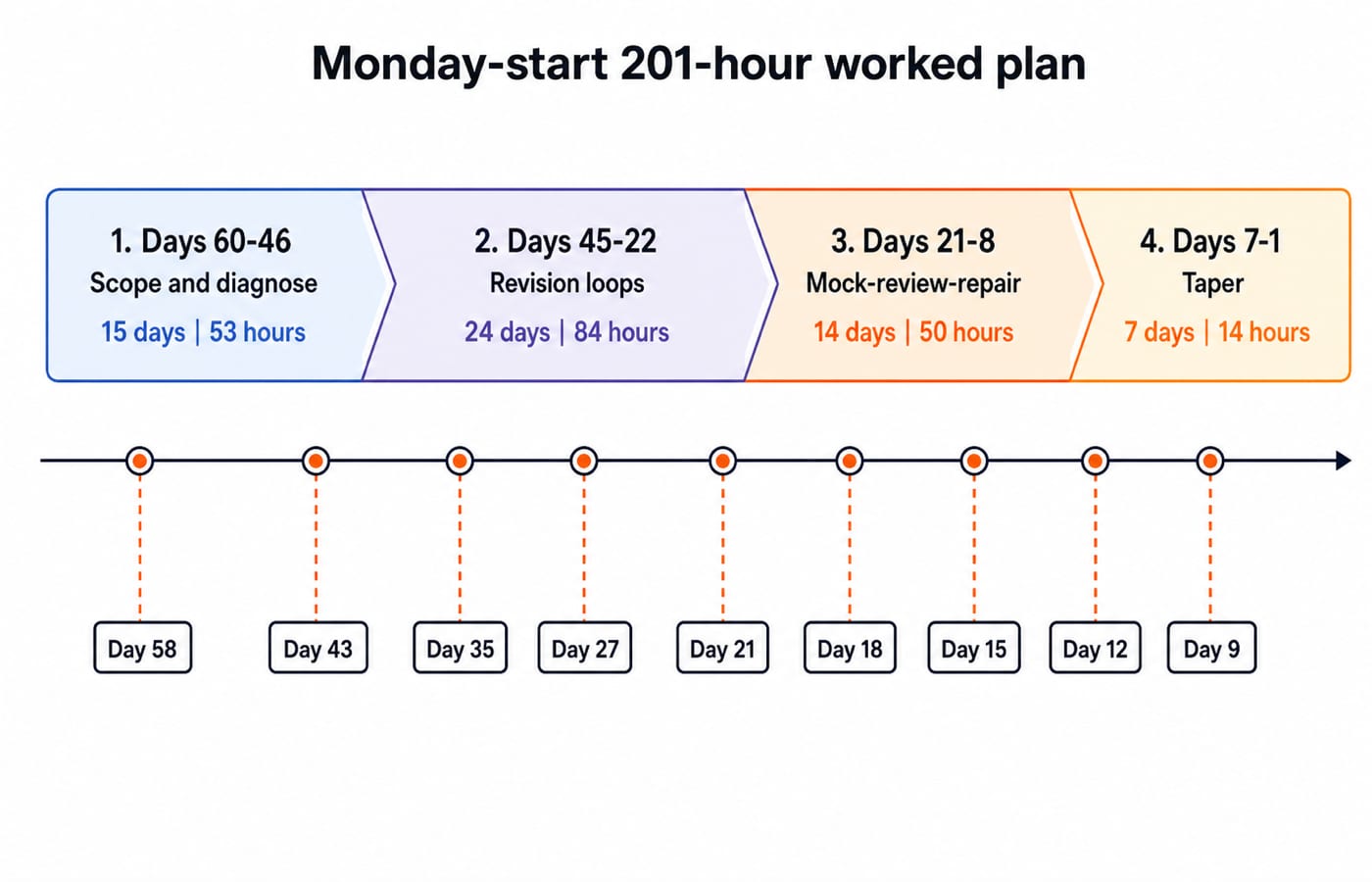
With 60 days left, broad rereading hides weak areas. Mock scores stay flat unless every error creates a revision task. So the calendar breaks at Day 46, Day 22 and Day 8: fifteen days to diagnose and rank weak topics, twenty-four to repair them in closed loops, fourteen for a fixed mock-review-repair rhythm, and seven to taper. The hour figures are a Monday-start example; check the syllabus and mock format against the current NVS notice before committing the calendar.
1. Lock the official scope before planning the 60 days
Start at the official NVS website. Copy the current, applicable syllabus into this tracker:
Official topic | Confidence, 0/1/2 | Last tested date | Next action |
|---|
Use the Govt Teaching Job Exam Preparation hub and KVS and NVS Computer Science: Exam Structure and Prep for orientation. Do not borrow marks, question counts, duration, negative marking, dates, or exam-day rules from an older cycle.
The example candidate starts on Monday, studies 3 hours per weekday and 5 per weekend day through Day 8, then 2 hours daily on Days 7 to 1. The phases contain 53 + 84 + 50 + 14 = 201 gross hours, including buffers. A 4-hour mock slot that overruns a 3-hour weekday takes the extra hour from that phase's buffer.
2. Days 60-46: diagnose, rank, and build the repair queue
Allocate 53 hours: 3 for the official scope and tracker, one 4-hour diagnostic mock-and-log slot on Day 58, 24 across four weak buckets, four 4-hour mixed-set-and-review slots, and a 6-hour buffer. Sit that mock to full time, then spend what is left of the slot logging every error.
Run a separate 40-question diagnostic of your own, built only to rank topics. Define error load = 2 × wrong + skipped:
Topic | Correct | Wrong | Skipped | Error load |
|---|---|---|---|---|
OS | 5 | 4 | 1 |
|
DBMS | 6 | 3 | 1 |
|
DSA | 7 | 2 | 1 |
|
Networks | 8 | 1 | 1 |
|
Repair OS, DBMS, DSA, then Networks. Convert the evidence into 14 blocks: 5, 4, 3, and 2 respectively. Keep every bucket inside the notified syllabus, and let measured error load set the block counts rather than guessed weightage.
3. Days 45-22: revise in closed loops, not by rereading chapters
The 84 hours cover fourteen 3-hour repair loops (42), six 3-hour mixed-practice blocks (18), four 90-minute spaced-recall checks (6), three 4-hour full-mock-and-log slots on Days 43, 35, and 27 (12), and a 6-hour buffer. Each mock runs to full time; the rest of the slot starts the error log.
One 180-minute repair loop contains:
20 minutes of blank-page recall.
70 minutes of targeted concept repair.
55 minutes of question solving.
20 minutes correcting every miss.
15 minutes scheduling the next recall.
A loop ends only after recording its errors and next-test date. Use Computer Fundamentals for CS Teaching Exams as a checklist. Use the Zero to Hero Complete CS Course to repair a specific mapped topic, not as a syllabus in its own right.
4. Days 21-8: use a fixed mock-review-repair rhythm
Follow this cadence: Day 21 Mock A, 20 review, 19 repair; Day 18 Mock B, 17 review, 16 repair; Day 15 Mock C, 14 review, 13 repair; Day 12 Mock D, 11 review, 10 repair; Day 9 Mock E, 8 review.
Five 4-hour mock-and-log slots use 20 hours, five 3-hour reviews use 15, four 3-hour repairs use 12, and overflow gets 3. Total: 20 + 15 + 12 + 3 = 50. Sit every mock to full time. Do not pause, search notes, or change the marking rule mid-test.
Days 58, 43, 35, and 27 plus these five make nine full mocks across the 60 days. Apply Teaching Exam Mock Strategy: Cadence and Review Plan. Most PGT Computer Science practice sets online are written for KVS. The subject core overlaps heavily, so they drill topics well, but count one as an NVS full mock only when its format matches the current NVS notice.
5. Turn each mock result into tomorrow's exact tasks
On a 50-question set of your own, suppose 43 are attempted: 31 correct, 12 wrong, and 7 skipped. Attempted accuracy is 31 ÷ 43 × 100 = 72.1%; overall correct rate is 31 ÷ 50 × 100 = 62%.
Tag the 12 errors: 5 concept gaps, 3 recall failures, 2 reading errors, and 2 time-pressure guesses. Spend 70 minutes on concept gaps, 35 rebuilding recall cards, 25 redoing misreads with keyword underlining, 25 on time-pressure questions, 10 retesting those four reading and timing items, and 15 updating the ledger. Total: 70 + 35 + 25 + 25 + 10 + 15 = 180 minutes.
A topic leaves the queue after two successive short sets reach at least 80% with no repeated concept error. 36 ÷ 45 × 100 = 80%: one set shows progress; the second clean set earns fewer blocks.
6. Recover missed days without destroying the mock calendar
Use each early phase's 6-hour buffer before moving a full mock. Missing both Day 32 and Day 31 costs 2 × 3 = 6 hours. Recover one repair block in the reserved 3-hour weekly buffer and replace one lower-priority 3-hour mixed-practice block with the other repair block. Do not compress six hours into one late night.
Preserve the official tracker, full mocks, reviews, and highest error-load topics. Cut duplicate sets and passive rereading first. After losing three or more days, recalculate blocks from current error load.
7. Days 7-1: taper workload while keeping retrieval active
Use 14 hours, 2 each day:
Day 7: Sweep the error ledger.
Day 6: Take a 30-question custom mixed drill with a self-set 45-minute timer, then review it.
Day 5: Complete two 45-minute weak-topic recalls and 30 minutes of correction.
Day 4: Check current official instructions and permitted items, then review one recall sheet.
Day 3: Complete a 20-question accuracy drill and review it.
Day 2: Review formulas, definitions, and marked errors only.
Day 1: Do 45 to 60 minutes of light recall, then handle logistics and rest.
Take no new full mock after Day 9 and add no source in the final week. Do not answer a weak score with night hours.
8. The short version: revise, test, repair, then taper
Use 15 days to scope and diagnose, 24 for closed revision loops, 14 for five tightly reviewed endgame mocks, and 7 to taper. Success means error load shrinks and corrected questions stay correct, not merely that nine tests are complete.
Tonight: open the current NVS notice, fill one tracker row per syllabus topic, and book Day 58 for the diagnostic mock. If a repair block exposes a core CS gap rather than a revision gap, work that topic through the Zero to Hero course, then return to the loop.
Keep learning

NVS PGT Computer Science: A Topic-by-Topic Practice Map
Turn a topic list into checks you can actually solve. Map your NVS PGT Computer Science preparation through binary conversion, Python tracing, SQL results and IP addressing.
30 Sep 20265 min readKVS & NVS

PGT Eligibility: Is B.Ed Mandatory for KVS, NVS and State Recruiters?
A recruiter-first guide to the PGT teacher-training question, using dated KVS, NVS and DSSSB clauses, candidate profiles and a reusable eligibility audit.
Updated 10 Aug 20265 min read124 viewsKVS & NVS

KVS vs NVS vs EMRS: Choose the Right School System for Your Teaching Career
Compare KVS, NVS and EMRS through current post rules, lifestyle limits and a weighted personal-fit matrix. See why changing priorities can change the answer.
Updated 7 Aug 20267 min read85 viewsKVS & NVS

KVS/NVS Computer Science Section: Trace Programs, Map Networks and Choose Classroom ICT
Use one school-lab case to practise program tracing, subnet reasoning and classroom ICT selection. Each decision is worked from the given facts.
Updated 5 Aug 20266 min readKVS & NVS