KVS and NVS Computer Science PYQs: Compare Papers and Build a Practice Loop
Compare KVS and NVS Computer Science practice without mixing weak evidence. Build matched samples, measure reproducible performance and turn errors into focused repair lanes.
KnowledgeGate Team
Exam prep & CS education
Updated 31 Jul 20266 min read
KVS and NVS Computer Science previous-year questions are close enough to tempt you into one shared practice pile, which hides which organisation, post and paper each question came from. Kendriya Vidyalaya Sangathan and Navodaya Vidyalaya Samiti recruit separately, yet both route Computer Science candidates through a common-subjects Tier 1, a Tier 2 Computer Science paper and an interview. The gap between the two papers is narrow; the gap between your two piles of evidence is not. Separate the lanes, measure them, then repair the shared core once.
KVS and NVS Computer Science papers: what is shared and what is not
Both organisations hire Computer Science teachers at TGT and PGT level through the same three steps: a Tier 1 paper on common subjects, a Tier 2 Computer Science paper, then an interview. Tier 1 runs on general knowledge, reasoning, quantitative aptitude, English, Hindi, computer awareness and teaching pedagogy, so it carries no Computer Science depth and belongs nowhere in a subject comparison.
Tier 2 holds the subject risk, and its list is identical on both sides: Programming, Data Structures and Algorithms, Operating Systems, Database Management Systems, Computer Networks, Computer Organization and Software Engineering, tested through objective and descriptive parts. The KVS and NVS Computer Science exam structure explainer walks the stages; either lane's scope is fixed by the Syllabus of Tier-II examination for Recruitment Notification 01/2025. Marks, counts, durations and negative marking come from the applicable notice, never from a sample.
So the comparison worth running is your KVS evidence against your NVS evidence, not paper against paper. Keep one sheet with these columns: source | organisation | post | cycle or paper label | question ID | subject | micro-concept | result | time | confidence | repair date. Fill the organisation cell from the document the question arrived with, never from a coaching watermark or a forwarded file.
Mark every item officially traceable, reliably reproduced, or practice-only: a previous-year question is officially traceable when it appears in a paper or answer key released by KVS or NVS, and reliably reproduced when a dated memory-based recovery names the post and cycle. Only officially traceable items may support a sentence about what a paper asked; the rest remain good concept practice. Roughly 2,900 KnowledgeGate practice questions carry a KVS or NVS tag, which makes them a practice pool rather than a paper archive, so they enter as practice-only unless a source document travels with them. The crosswalk that settles which concepts are shared is in KVS/NVS CS Weightage: Build a Shared High-Return Core; that ledger counts what the papers asked, while your comparison sheet measures what you can reproduce, so keep the two separate.
Build equal, matched samples instead of comparing raw piles
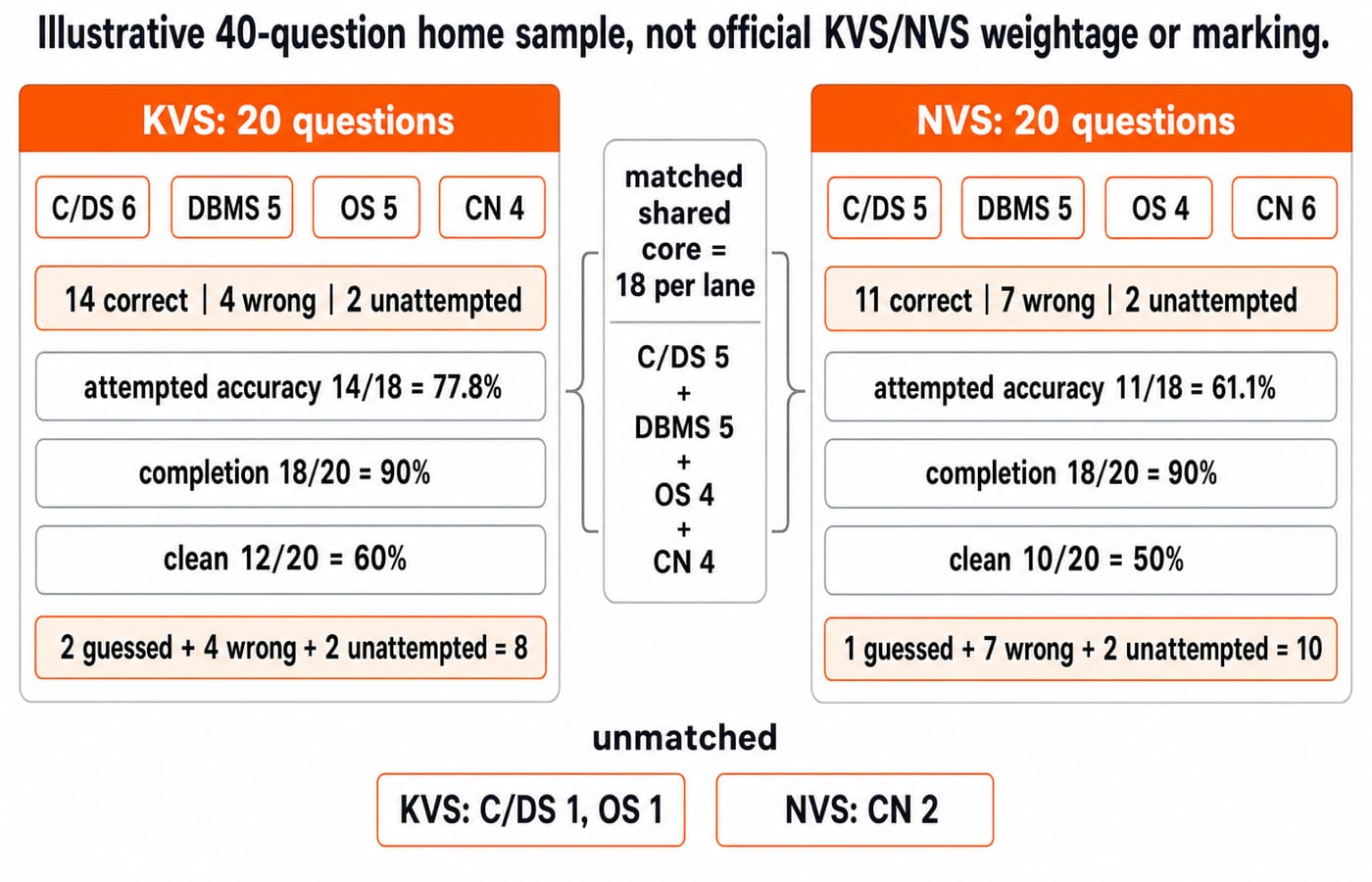
Say your sheet holds 20 source-labelled KVS questions and 20 source-labelled NVS questions across four subjects from the Tier 2 list.
Subject | KVS sample | NVS sample | Matched per lane |
|---|---|---|---|
C and Data Structures | 6 | 5 |
|
DBMS | 5 | 5 |
|
Operating Systems | 5 | 4 |
|
Computer Networks | 4 | 6 |
|
Each lane totals 20, for a combined 40. Pairing the minimum count gives a shared core of 5 + 5 + 4 + 4 = 18 questions per lane. The remainder is one C and Data Structures and one Operating Systems question on the KVS side, and two Computer Networks questions on the NVS side. Compare inside the matched 18: those four leftovers measure how you collected questions, not how the papers differ.
Compare accuracy, completion and reproducibility
Score each full 20-question lane: 14 correct, 4 wrong and 2 unattempted in the KVS lane, and 11 correct, 7 wrong and 2 unattempted in the NVS lane. Attempted accuracy is 14/18 = 77.8% for KVS and 11/18 = 61.1% for NVS, while completion is 18/20 = 90% in both. The two numbers disagree on purpose: you finish the lanes at the same rate and get the NVS one wrong far more often.
Now mark two KVS correct answers and one NVS correct answer as unsupported guesses. Clean reproducible performance becomes KVS (14 - 2)/20 = 12/20 = 60% and NVS (11 - 1)/20 = 10/20 = 50%. The review list is every guessed, wrong and unattempted item: KVS 2 + 4 + 2 = 8 and NVS 1 + 7 + 2 = 10. A ten-point reproducibility gap at equal completion sends the bigger repair queue to NVS; a 40-question home sample cannot rank two papers by difficulty.
Repair a shared-core concept once, then retest it in both lanes
Take a paging item from the shared Operating Systems core. A 32-bit byte-addressable system uses 4 KB pages, a single-level page table and 4-byte page-table entries. What is the page-table size? Options are A 1 MB, B 2 MB, C 4 MB and D 8 MB.
4 KB = 2^12 bytes, so the offset takes 12 bits and the page number takes 32 - 12 = 20 bits. The table has 2^20 entries, and its size is 2^20 x 4 bytes = 2^22 bytes = 4 MB, so C is correct. Write the rule down in your own words: page size fixes the offset bits, and entry size multiplies the number of entries.
Now do two closed-book transfers. A KVS-labelled variant with a 36-bit address, 8 KB = 2^13 pages and 8-byte entries gives 2^23 x 8 = 2^26 bytes = 64 MB. An NVS-labelled variant with a 30-bit address, 1 KB = 2^10 pages and 4-byte entries gives 2^20 x 4 = 2^22 bytes = 4 MB. One repair has then cleared the concept in both lanes, the whole return on a shared core. The KVS NVS Tier 2 Computer Science course runs this subject list in order with previous-year discussion.
Keep one shared repair queue and two small exam lanes
The 18 flagged items form the repair queue. Sort the KVS eight as Operating Systems 3, Computer Networks 2, C and Data Structures 2, and DBMS 1. Sort the NVS ten as Computer Networks 4, Operating Systems 2, DBMS 2, and C and Data Structures 2. That maps your errors, not the papers: Networks is your weak spot on the NVS side, Operating Systems on the KVS side, and both sit in the shared core.
Build the next 24-question block from 12 shared-concept repairs, split Computer Networks 4, Operating Systems 3, C and Data Structures 3 and DBMS 2, plus 6 source-labelled KVS and 6 source-labelled NVS questions. The shared block trains the concept; the organisation sets check that it survives a change of source context. Release a concept only after two fresh questions come out correct on separate days, with the working written and neither answer guessed.
Move from comparison to balanced timed practice
Set a 120-minute session at home. Give the KVS set 15 questions in 24 minutes plus 36 minutes of review, and the NVS set the same, so 24 + 36 + 24 + 36 = 120 minutes splits into equal counts and equal time. The review half earns the marks; a timed attempt you never review only confirms what you already knew.
Suppose KVS ends at 12 correct, 2 wrong and 1 unattempted, while NVS ends at 11 correct, 3 wrong and 1 unattempted. Open the next session with those 2 + 1 + 3 + 1 = 7 unresolved items. If a gap survives three matched sessions, read its error tags instead of adding volume: a concept you keep losing under time is usually a rule you never wrote down. When both lanes hold steady, move to mixed papers with Teaching Exam Mock Strategy: Cadence and Review Plan.
The short version
Spend 60 minutes now: 10 minutes building the sheet, 20 on 10 source-labelled KVS questions, 20 on 10 source-labelled NVS questions, and 10 tagging every wrong, guessed or unattempted item by subject and micro-concept. Whichever subject tops both lists is your first shared-core repair, and write the finding with its scope attached: 4 of 6 NVS Computer Networks items unresolved is one lane's error rate, not a claim about the paper. To start from a built core instead, the KVS NVS Computer Science bundle covers Tier 1 and Tier 2 Computer Science together.
Keep learning

NVS PGT Computer Science: A Topic-by-Topic Practice Map
Turn a topic list into checks you can actually solve. Map your NVS PGT Computer Science preparation through binary conversion, Python tracing, SQL results and IP addressing.
30 Sep 20265 min readKVS & NVS

NVS PGT Computer Science 60-Day Study Plan: Revision and Mock Strategy
Turn the final 60 days into four clear phases, with a worked 201-hour timetable, error-led revision blocks, timed mocks, recovery buffers, and a calm taper.
Updated 12 Aug 20265 min readKVS & NVS

PGT Eligibility: Is B.Ed Mandatory for KVS, NVS and State Recruiters?
A recruiter-first guide to the PGT teacher-training question, using dated KVS, NVS and DSSSB clauses, candidate profiles and a reusable eligibility audit.
Updated 10 Aug 20265 min read124 viewsKVS & NVS
KVS vs NVS vs EMRS: Choose the Right School System for Your Teaching Career
Compare KVS, NVS and EMRS through current post rules, lifestyle limits and a weighted personal-fit matrix. See why changing priorities can change the answer.
Updated 7 Aug 20267 min read84 viewsKVS & NVS