KVS/NVS Computer Science Section: Trace Programs, Map Networks and Choose Classroom ICT
Use one school-lab case to practise program tracing, subnet reasoning and classroom ICT selection. Each decision is worked from the given facts.
KnowledgeGate Team
Exam prep & CS education
Updated 5 Aug 20266 min read
Remembering syntax, subnet masks and ICT definitions separately is not enough when one objective question joins them in a school lab. Consider 30 students, 10 PCs, a 45-minute lesson, intermittent internet, one switch, one local quiz server and a program to trace. Compute the output, map packet movement and choose a plan that meets the learning objective. Kendriya Vidyalaya Sangathan and Navodaya Vidyalaya Samiti both recruit Computer Science teachers in tiers, and the Tier 2 Computer Science paper is where all three of those moves are examined together.
1. Read the school lab through three CS lenses
Identify the lens. Program state changes show variable updates. Network-layer relationships show data travel. Teaching-purpose fit tests a tool against the objective and constraints. The verb is the signal: trace means update variables line by line, deliver means follow addressing and protocols, and choose means match ICT to an instructional need.
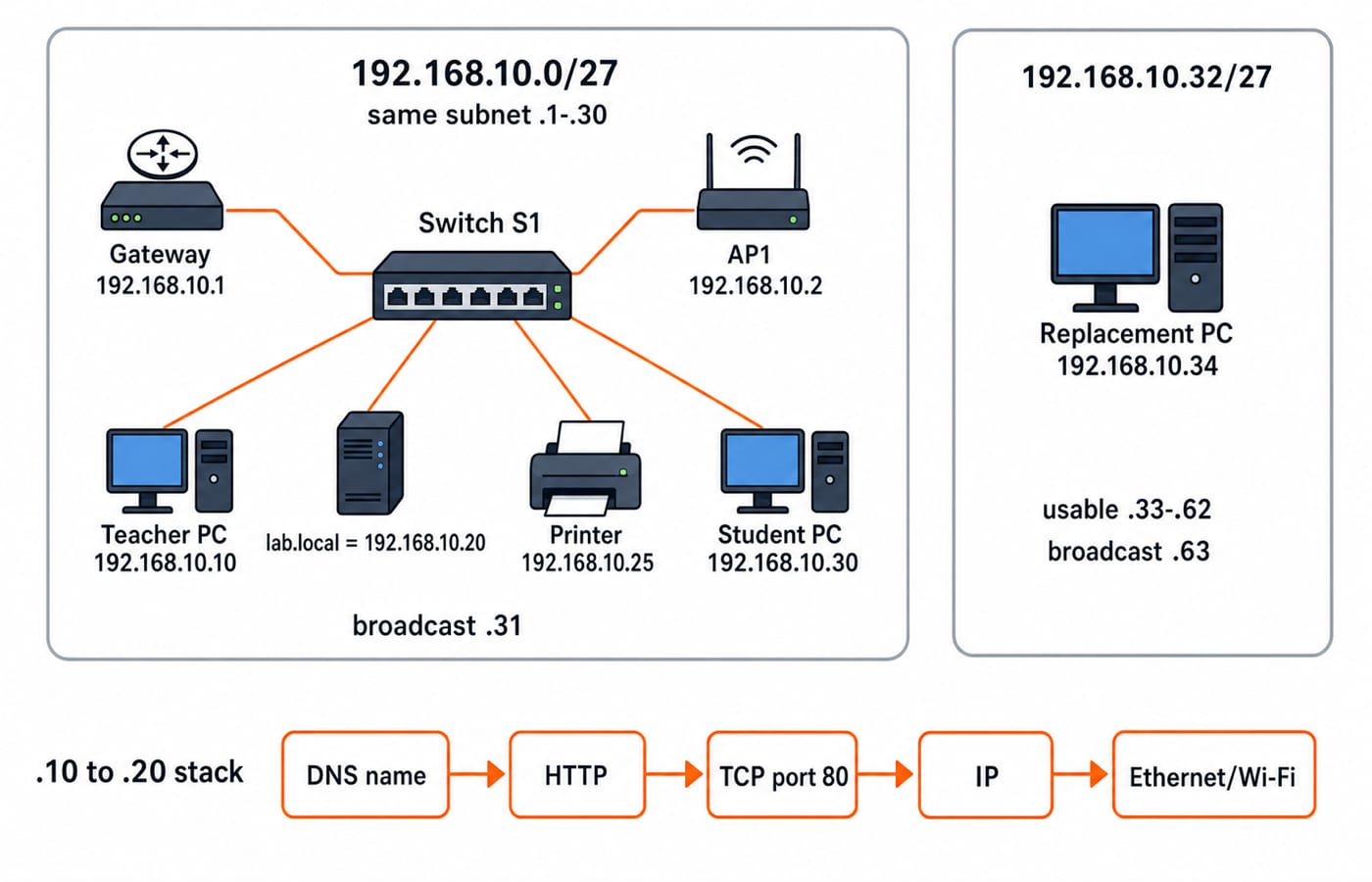
Keep one lab model. PCs PC01 to PC10 seat three students each. Switch S1 connects AP1 at 192.168.10.2, the teacher PC at 192.168.10.10, local server at 192.168.10.20, printer at 192.168.10.25, a student PC at 192.168.10.30 and gateway at 192.168.10.1. The network is 192.168.10.0/27, and lab.local names the server. Internet access may fail while the LAN remains available.
The three lenses are not an artificial mix. Tier 2 Computer Science covers Programming, Data Structures and Algorithms, Operating Systems, Database Management Systems, Computer Networks, Computer Organization and Software Engineering, while Tier 1 carries Computer Awareness alongside Teaching Aptitude and Pedagogy. A lab question that asks you to trace, deliver and choose is reaching across that whole spread in one stem. Neighbouring routes in the Govt Teaching Job Exam Preparation hub set the same three lenses under different section names, so the reasoning carries over even when the paper does not.
2. Programming worked example: trace values, not impressions
Trace this C-like fragment:
int a[5] = {12, 7, 18, 5, 14};
int score = 0, even = 0;
for (int i = 0; i < 5; i++) {
    if (a[i] % 2 == 0) {
        score += a[i];
        even++;
    } else {
        score--;
    }
}
printf("%d %d", score, even);
From score = 0 and even = 0, record all five updates.
|
| Condition |
|
|
|---|---|---|---|---|
0 | 12 | true | 12 | 1 |
1 | 7 | false | 11 | 1 |
2 | 18 | true | 29 | 2 |
3 | 5 | false | 28 | 2 |
4 | 14 | true | 42 | 3 |
The output is 42 3. Distractors add odd values instead of executing score--, report five as even, or treat i < 5 as six iterations. Review C Programming for Teaching CS Exams, then retrace the table.
![Two panels: a trace table listing i, a[i], the condition result and the running score and even count, beside a flow chart of the loop branches ending at the output 42 3.](https://cdn.knowledgegate.ai/blog-assets/blog_asset_1784618419513_hvb52t.jpg)
3. Network worked example: map the /27 lab first
A /27 prefix gives mask 255.255.255.224. Its last-octet block size is 256 - 224 = 32, so .10 and .20 fall in the .0 to .31 block:
Network address:
192.168.10.0Usable host range:
192.168.10.1to192.168.10.30Broadcast address:
192.168.10.31
The gateway .1, AP1 .2, teacher PC .10, server .20, printer .25 and student PC .30 share that subnet.
A replacement PC at 192.168.10.34/27 belongs to 192.168.10.32/27, with hosts .33 to .62 and broadcast .63. It cannot treat .20 as a same-subnet neighbour. Correct addressing or Layer 3 routing is required.
For a quiz, lab.local resolves to 192.168.10.20. HTTP is the application protocol, TCP uses destination port 80 here, IP carries logical addresses, and Ethernet or Wi-Fi frames handle local delivery. Since .10 and .20 share the /27, the gateway is not the next hop. A switch forwards LAN frames; a router joins IP networks.
4. Classroom ICT: optimise for learning, access and reliability
Within 45 minutes, every student must trace the five-row program and explain why the odd branch decrements score. Compare three plans on four 5-point criteria: fit to that objective, reliability when the internet drops, the feedback each student gets back, and access across 10 shared PCs.
Plan | Objective fit | Reliability | Feedback | Access | Total |
|---|---|---|---|---|---|
A: 30 cloud logins and HD video | 2 | 1 | 2 | 1 | 6/20 |
B: group work, offline IDE, local quiz, paper backup | 5 | 5 | 4 | 4 | 18/20 |
C: projector-only lecture | 3 | 5 | 1 | 3 | 12/20 |
Plan B fits best. Use 0-5 minutes for diagnosis, 5-12 for a projector trace, and 12-30 for groups to trace and run the code. Use 30-38 for the lab.local quiz, 38-43 to review two errors, and 43-45 for an individual paper exit slip.
If internet fails, the offline IDE, LAN quiz and paper fallback remain usable. Newest does not mean best. ICT for Teaching Exams: Fundamentals Explained reviews the tools; selection still depends on objective, participation, feedback, access and backup.
5. Objective-question traps, and one that mixes all three lenses
Work each prompt before reading its answer. The first four isolate one lens; the fifth mixes all three, which is how a lab scenario usually arrives.
What does the program print?
42 3. The distractor44 3ignores both odd-value decrements.What is the broadcast address for
192.168.10.0/27?192.168.10.31. The answer.32is the next network address.Is
.34/27in the.0/27subnet? No. Matching the first three octets is insufficient because the prefix also divides the last octet.Which plan best fits the stated objective and constraints? Plan B. Choosing Plan A merely because cloud tools appear modern ignores reliability and access.
The replacement PC at
192.168.10.34opens the offline IDE normally but cannot load thelab.localquiz, whilePC01loads it fine. What failed, and which criterion does it cost? Addressing, and access. That PC has no on-subnet path to.20and none to the gateway at.1, so name resolution and the HTTP request both go unanswered. The program, the server and the internet are all innocent.
Fast elimination follows the same discipline. Trace assignments before calculating totals. Write the network, host range and broadcast before comparing IP addresses. Keep protocol, port and device separate. Test a classroom option against the objective, participation, feedback, accessibility and backup.
6. One fact can support several kinds of question
/27 can support several reasoning levels. Recall asks what the prefix denotes. Calculation asks for .31. Diagnosis asks why .34 fails. Classroom application asks whether a local LAN activity can continue when internet access stops. The concept stays stable as wording changes.
Marks, question counts, timing and negative marking for each tier come from the recruitment notice itself, issued by Kendriya Vidyalaya Sangathan at kvsangathan.nic.in and by Navodaya Vidyalaya Samiti at navodaya.gov.in. Those numbers move between cycles. A /27 boundary and a trace table do not.
7. Practise the reasoning in one 40-minute cycle
Spend 12 minutes each on three code traces, three subnet or layer questions, and three classroom-technology scenarios. Use 4 minutes to record each wrong assumption and corrected rule. Three cycles give 27 decisions across the lenses.
In the next cycle, change only one fact: replace i < 5 with i < 4, move the student PC from .30 to .34, or remove reliable internet while keeping the LAN. This reveals whether you follow the condition or remember an answer. The DSSSB TGT CS 2026 Section B Course draws on the same Programming and Computer Networks core, so it is a usable source of extra traces and subnet drills between KVS/NVS cycles.
8. The short version and the next step
Trace every state change, derive the subnet boundary, then choose technology from the learning objective and constraints. Here, the checked results are 42 3, network .0/27 with broadcast .31, and Plan B at 18/20.
Repeat the example after changing one value, and explain why each answer moves or stays fixed. If you want both tiers built into one route, KVS NVS Computer Science covers Tier 1 and the Tier 2 Computer Science paper, with interview guidance for the final stage.
Keep learning

NVS PGT Computer Science: A Topic-by-Topic Practice Map
Turn a topic list into checks you can actually solve. Map your NVS PGT Computer Science preparation through binary conversion, Python tracing, SQL results and IP addressing.
30 Sep 20265 min readKVS & NVS

NVS PGT Computer Science 60-Day Study Plan: Revision and Mock Strategy
Turn the final 60 days into four clear phases, with a worked 201-hour timetable, error-led revision blocks, timed mocks, recovery buffers, and a calm taper.
Updated 12 Aug 20265 min readKVS & NVS

PGT Eligibility: Is B.Ed Mandatory for KVS, NVS and State Recruiters?
A recruiter-first guide to the PGT teacher-training question, using dated KVS, NVS and DSSSB clauses, candidate profiles and a reusable eligibility audit.
Updated 10 Aug 20265 min read124 viewsKVS & NVS
KVS vs NVS vs EMRS: Choose the Right School System for Your Teaching Career
Compare KVS, NVS and EMRS through current post rules, lifestyle limits and a weighted personal-fit matrix. See why changing priorities can change the answer.
Updated 7 Aug 20267 min read87 viewsKVS & NVS