Inverse Property in Group Theory: Concepts and a Complete Worked Example
Learn how identity and inverses work in a group, then prove and use every inverse in U(10). Includes a Cayley table, solved equations, and key inverse laws.
KnowledgeGate Team
Exam prep & CS education
Updated 6 Sep 20266 min read
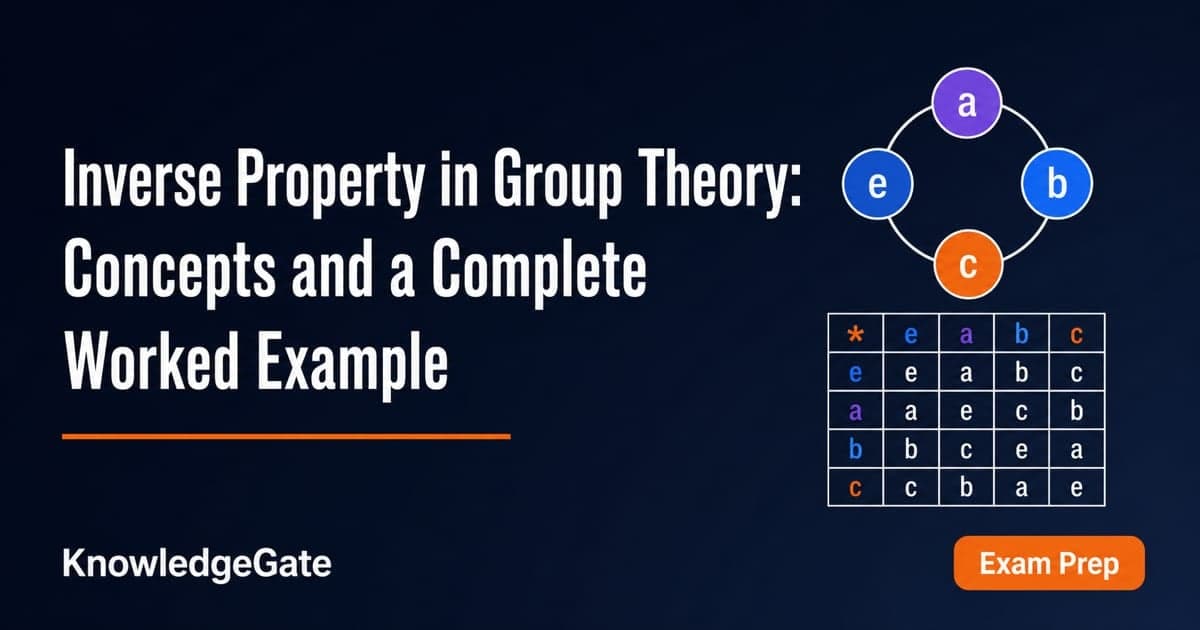
Knowing that a group needs inverses is not enough if you cannot identify the identity, find the inverse under the stated operation, or apply it on the correct side of an equation. In U(10) = {1, 3, 7, 9} under multiplication modulo 10, a Cayley table verifies closure, identity and every inverse, while associativity follows from modular multiplication. The same inverses solve left- and right-sided equations, distinguish group inverses from reciprocals, and explain why product inverses reverse order.
Related reading: group inverse MCQs and groups and algebraic structures.
What the inverse property means inside a group
A binary operation on G is a map *: G × G -> G. The set-operation pair is a group when four conditions hold: closure, associativity, one identity e, and, for every a in G, an element a^-1 in G such that a*a^-1 = a^-1*a = e. The inverse requirement is two-sided.
The carrier set and operation must travel together. The integers Z under addition form a group with identity 0 and inverse -a for each a. Under ordinary multiplication, Z is not a group: the inverse of 2 would be 1/2, which is not in Z.
Notation follows the operation. We write a multiplicative inverse as a^-1, but an additive inverse as -a because a + (-a) = 0. An additive inverse is not a reciprocal. For the wider framework, read Group Theory: Groups, Rings and Fields for GATE CS.
Identity and inverse are unique, not choices
The identity cannot change from one calculation to another. If e and f are both identities, then e = e*f = f. Therefore, a group has exactly one identity.
The inverse of an element is also unique. Suppose b*a = e and a*c = e. Associativity gives
b = b*e = b*(a*c) = (b*a)*c = e*c = c.
Thus the left and right inverse coincide, and a^-1 is unambiguous. This gives three useful facts:
e^-1 = e.(a^-1)^-1 = a.An element can be self-inverse without being the identity.
For the last fact, preview 9 in U(10): since 9*9 = 81, which is congruent to 1 mod 10, we have 9^-1 = 9, yet 9 is not the identity.
Worked example: prove that U(10) is a group and find every inverse
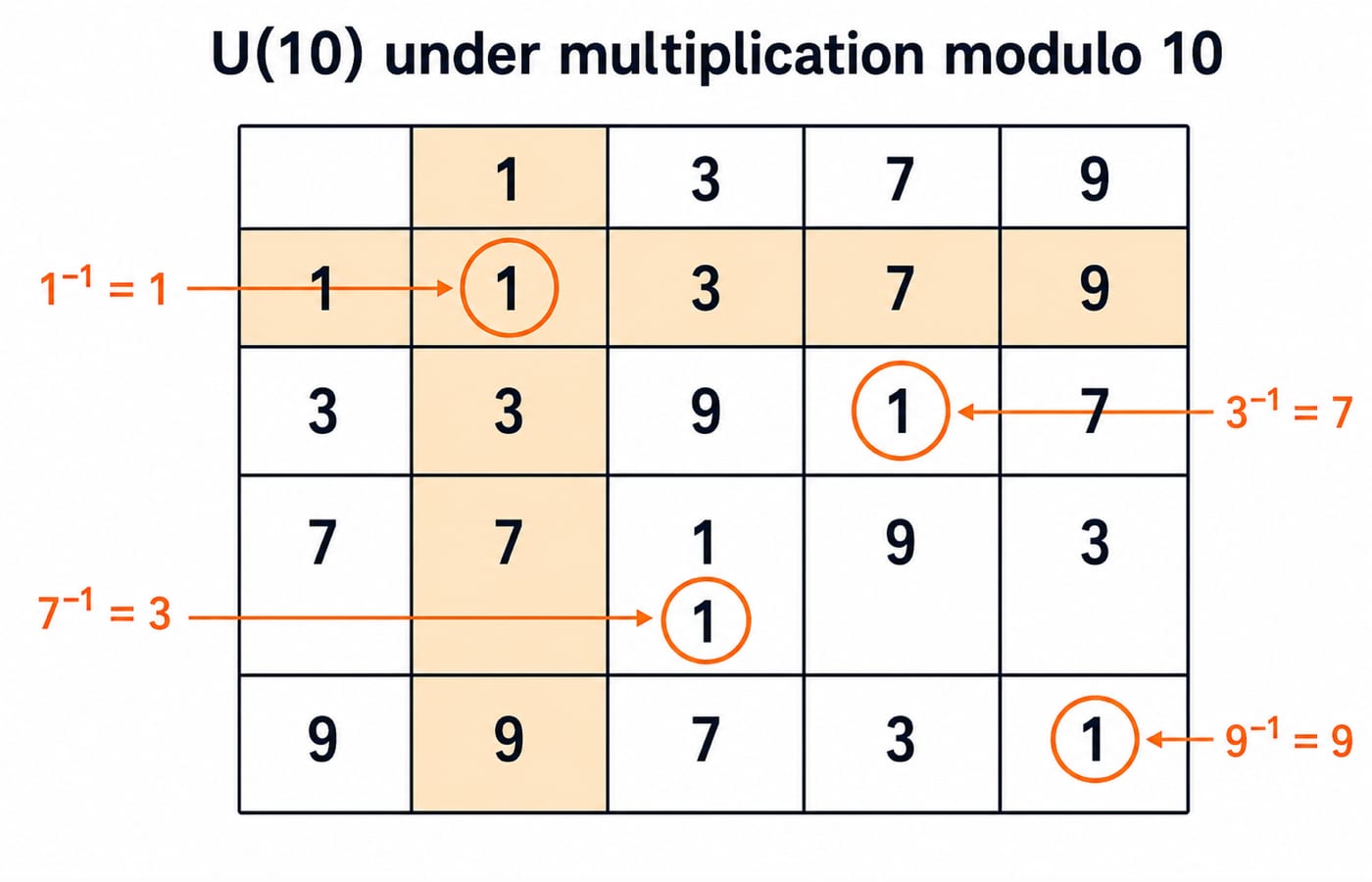
Define U(10) = {1, 3, 7, 9}, the residue classes relatively prime to 10, with multiplication followed by reduction modulo 10. The values 0, 2, 4, 5, 6, 8 are excluded because none is a unit modulo 10.
Use the row element as the first factor and the column element as the second:
|
|
|
|
|
|---|---|---|---|---|
|
|
|
|
|
|
|
|
|
|
|
|
|
|
|
|
|
|
|
|
For example, row 3 comes from 3*1 = 3, 3*3 = 9, 3*7 = 21 congruent 1 (mod 10), and 3*9 = 27 congruent 7 (mod 10).
Every entry belongs to U(10), so closure holds. Associativity is inherited from integer multiplication modulo 10, not established by scanning the table. The row and column headed 1 reproduce all headers, so 1 is the identity.
Now read the inverses from the cells containing 1:
1^-1 = 1.3^-1 = 7, because3*7 = 21, which is congruent to1 mod 10.7^-1 = 3.9^-1 = 9, because9*9 = 81, which is congruent to1 mod 10.
All four axioms hold. The table is symmetric, so this group is abelian, though commutativity is not part of the general definition of a group.
Use inverses to solve left and right group equations
Order matters when solving a group equation. From a*x = b, multiply on the left by a^-1:
a^-1*(a*x) = a^-1*b, so x = a^-1*b.
From x*a = b, multiply on the right by a^-1:
(x*a)*a^-1 = b*a^-1, so x = b*a^-1.
These formulas need not be interchangeable in a non-abelian group.
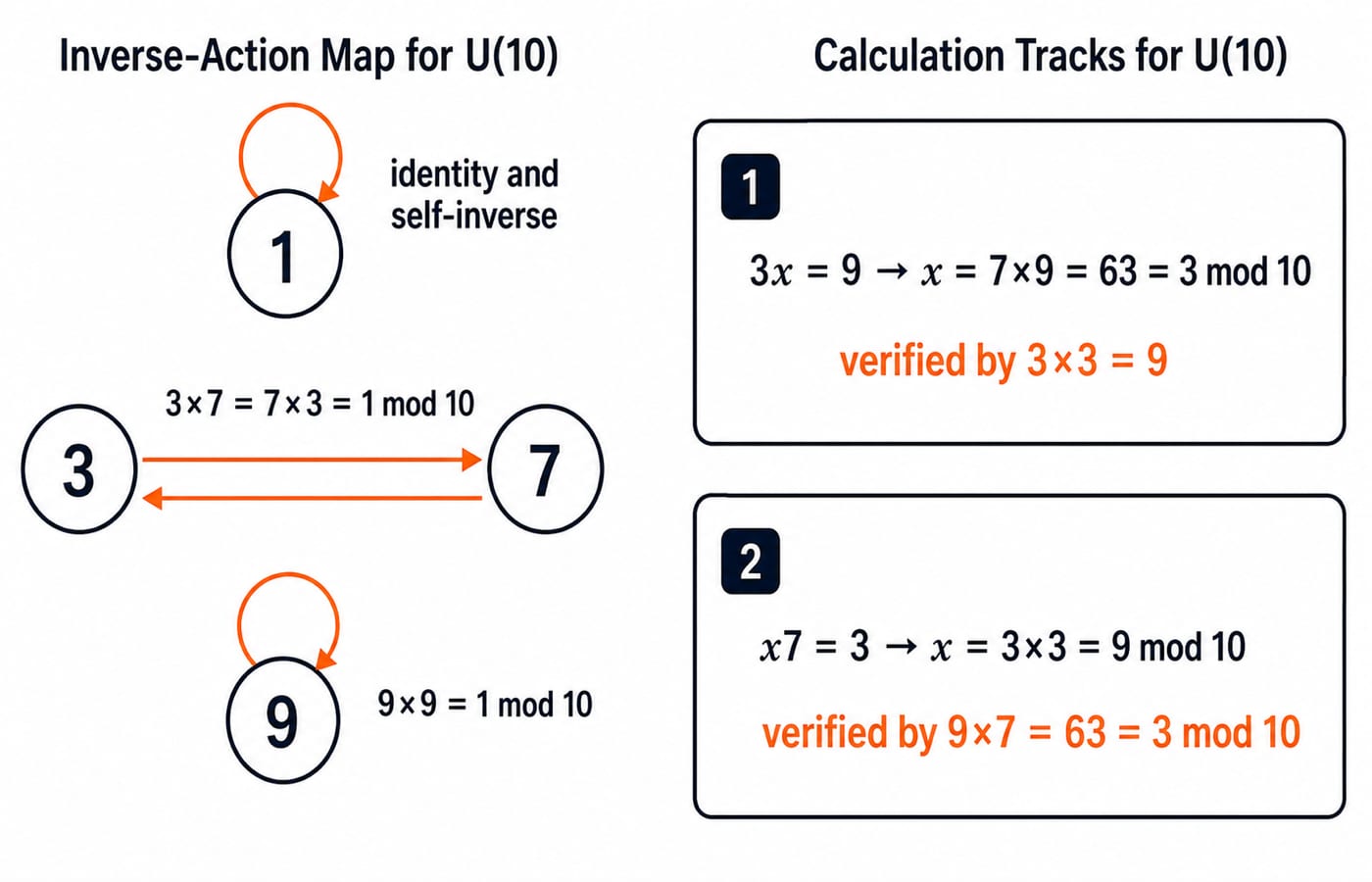
Inside U(10), solve 3*x congruent 9 (mod 10). Since 3^-1 = 7,
x congruent 7*9 = 63 congruent 3 (mod 10).
Substitution checks it: 3*3 = 9. Next solve x*7 congruent 3 (mod 10). Since 7^-1 = 3,
x congruent 3*3 = 9 (mod 10).
Again, substitution checks it: 9*7 = 63 congruent 3 (mod 10).
Cancellation uses the same idea. From a*b = a*c, left-multiplication by a^-1 gives b = c. From b*a = c*a, right-multiplication by a^-1 gives b = c.
Core inverse laws and why product order reverses
The inverse of a product is
(a*b)^-1 = b^-1*a^-1.
Both multiplication orders confirm it:
(a*b)*(b^-1*a^-1) = a*(b*b^-1)*a^-1 = e,
and
(b^-1*a^-1)*(a*b) = b^-1*(a^-1*a)*b = e.
The reversed order is essential. In general, a^-1*b^-1 is wrong.
For a non-abelian check, use right-to-left permutation composition in S3. Let a = (12) and b = (23). Then a*b = (123), so (a*b)^-1 = (132). Transpositions are self-inverse, and
b^-1*a^-1 = (23)(12) = (132).
The unreversed expression gives a different permutation:
a^-1*b^-1 = (12)(23) = (123).
For powers, if n is a positive integer, (a^n)^-1 = (a^-1)^n. Define a^0 = e, and for positive n, define a^-n = (a^-1)^n.
Inverse-property traps and their exact corrections
Use these five trap-and-fix pairs as a checklist:
Trap: Find a reciprocal immediately. Fix: Identify the operation and its identity first.
Trap: Accept an inverse outside the carrier set, such as
1/2for2inZunder multiplication. Fix: Require the inverse to belong toG.Trap: Check only
a*b = e. Fix: Use the two-sided definition,a*b = b*a = e, together with inverse uniqueness.Trap: Treat every self-inverse element as the identity. Fix: In
U(10),9^-1 = 9, but the identity is1.Trap: Write
(a*b)^-1 = a^-1*b^-1. Fix: Reverse the order. TheS3calculation gives(a*b)^-1 = b^-1*a^-1.
A Cayley table exposes closure, the identity, and inverse candidates, but not associativity. For U(10), associativity comes from modular multiplication, a known associative operation. For a structured route through the underlying material, use Engineering Mathematics for GATE Exam.
How mathematical questions test the inverse property
The main reasoning moves are identifying the identity, recognizing a self-inverse element, solving a group equation, and applying inverse uniqueness:
In
U(10), what is the inverse of3? It is7, because3*7 = 21 congruent 1 (mod 10).Is
9the identity because it is self-inverse? No.9*9 congruent 1 (mod 10), but the identity is1.Solve
3*x congruent 7 (mod 10). Multiply by3^-1 = 7:x congruent 7*7 = 49 congruent 9 (mod 10). Check:3*9 = 27 congruent 7 (mod 10).If
a*b = ein a group, what isb? It isa^-1; uniqueness rules out any second value.
Other common formats ask whether a given set-operation pair is a group or which formula correctly gives the inverse of a product. In every case, name the identity before giving an inverse.
Practise the same ideas with the solved sets in Discrete Mathematics MCQs.
The short version and the next study step
The operation determines the identity.
Every group element has one inverse inside the group.
Inverses undo multiplication on the correct side.
(a*b)^-1 = b^-1*a^-1.
A self-inverse element need not be the identity.
In U(10), identity 1, inverse pair 3 <-> 7, and self-inverse element 9 settle the whole table. Continue with GATE Guidance by Sanchit Sir for the broader preparation route.
Keep learning
Classification of Finite and Infinite Groups: Orders, Cyclicity and Worked Examples
Learn how group axioms, group order, element order and generators classify finite and infinite groups through complete, checkable examples.
Updated 4 Oct 20266 min readEngineering Mathematics
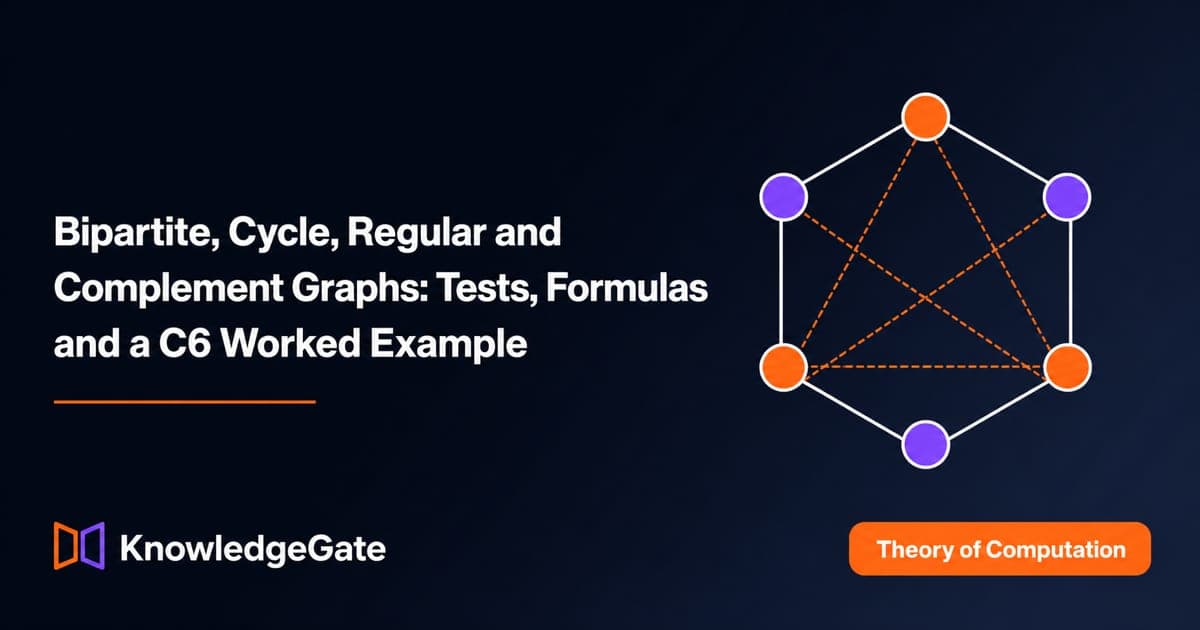
Bipartite, Cycle, Regular and Complement Graphs: Tests, Formulas and a C6 Worked Example
Learn a dependable order for classifying simple graphs, then apply it to C6 and list, count and test every edge in its complement.
Updated 29 Sep 20266 min readEngineering Mathematics
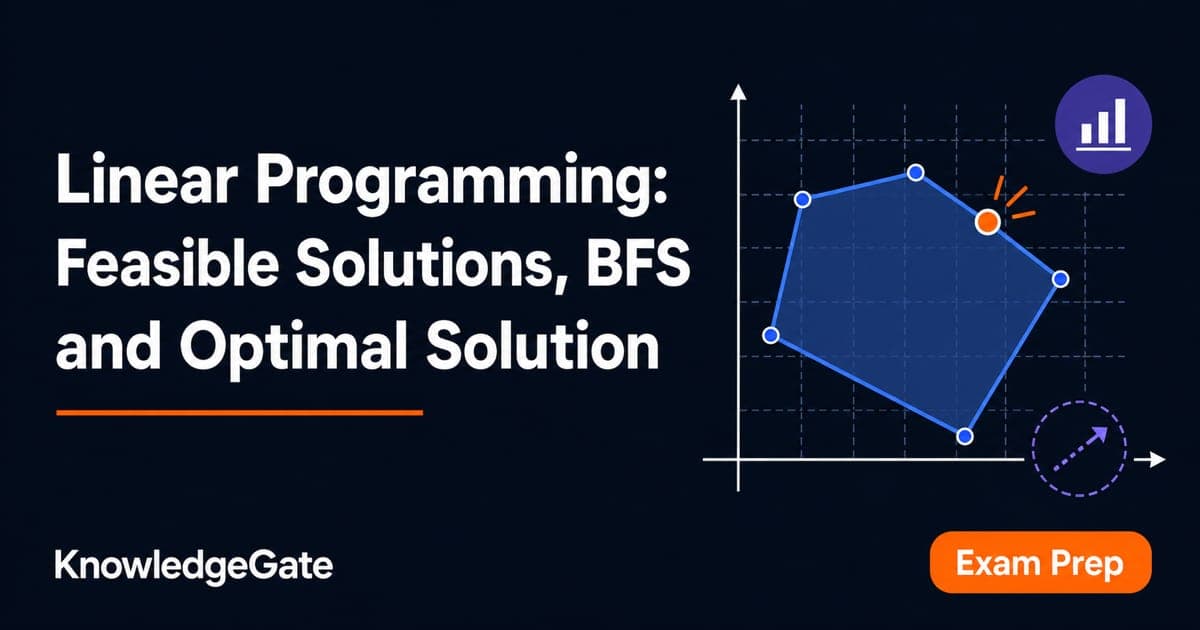
Basic Terminologies in Linear Programming: Feasible Solutions, BFS and an Optimal Solution Worked Step by Step
Separate feasible, basic feasible and optimal solutions through geometry, slack variables, vertex enumeration and concise counterexamples.
Updated 25 Sep 20265 min readEngineering Mathematics
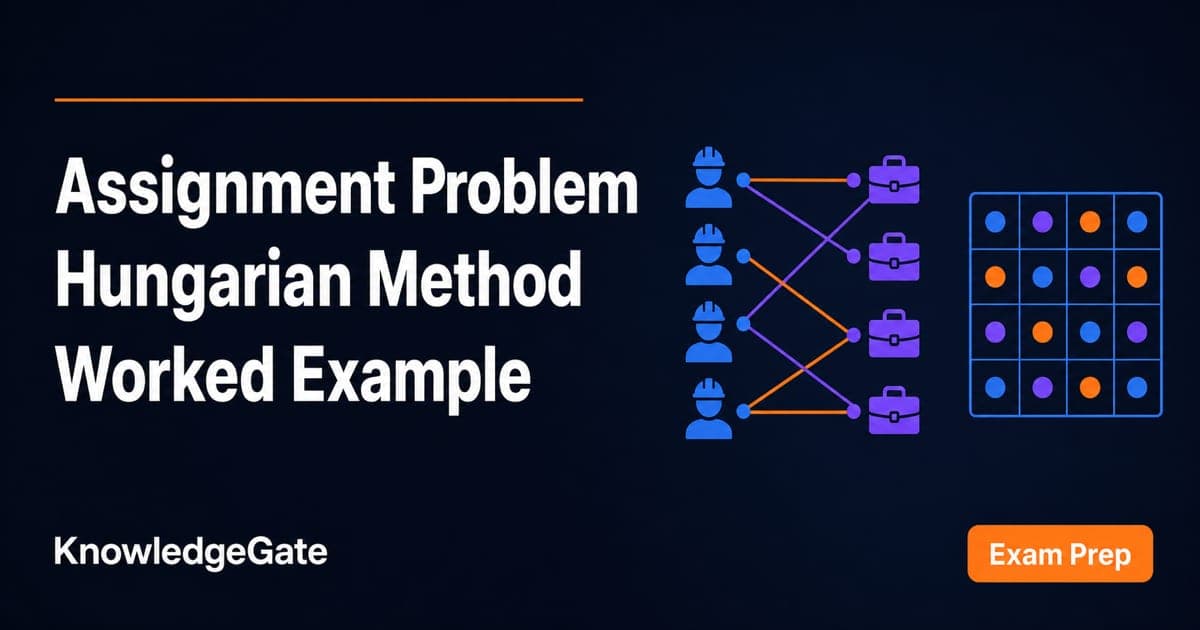
Assignment Problem and Hungarian Method: Formulation with a Complete Worked Example
Learn why greedy assignment fails, how matrix reductions preserve the optimum, and how the uncovered-value adjustment leads to a minimum cost of 140.
Updated 24 Sep 20266 min readEngineering Mathematics