Basic Terminologies in Linear Programming: Feasible Solutions, BFS and an Optimal Solution Worked Step by Step
Separate feasible, basic feasible and optimal solutions through geometry, slack variables, vertex enumeration and concise counterexamples.
KnowledgeGate Team
Exam prep & CS education
Updated 25 Sep 20265 min read
A point can satisfy every constraint without being a basic feasible solution (BFS), while a BFS can still fail to maximise or minimise the objective. That is why memorising “corner point” is not enough. Within broader GATE CS Exam Preparation, the hierarchy becomes concrete: geometry identifies feasible vertices, standard-form algebra tests whether a solution is basic, and objective values decide optimality.
Related reading: assignment optimisation and constrained knapsack optimisation.
Linear programming terminology starts with the model, not the corner points
An LP has decision variables, a linear objective, linear constraints and sign restrictions. Consider the following model:
Maximise
Z = 3x + 2ySubject to
x + y <= 4,x <= 2,y <= 3With
x, y >= 0
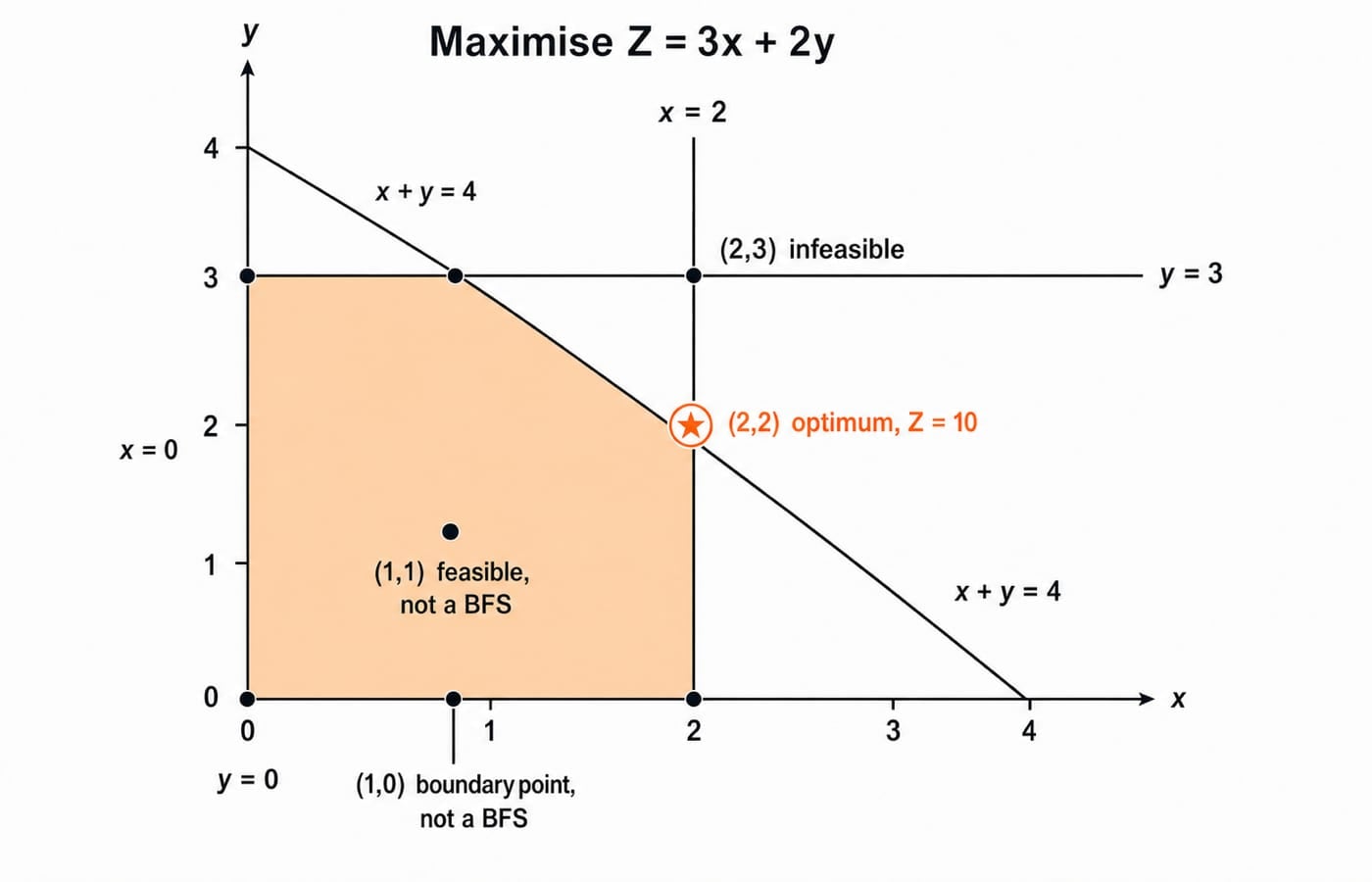
A solution is simply an assignment of values to x and y. It becomes a feasible solution only when it satisfies every constraint. For (1,1), we get 1 + 1 <= 4, 1 <= 2 and 1 <= 3, so the point is feasible. At (2,3), the individual bounds hold, but 2 + 3 = 5 > 4, so the point is infeasible.
Keep the hierarchy clear: every optimal solution is feasible, a BFS is a feasible basic solution, and a feasible solution need not be basic.
Feasible region and extreme points give the geometric meaning of a BFS
Draw x + y = 4, x = 2, y = 3, x = 0 and y = 0. The feasible region is the intersection of their allowed sets. Set Theory and Relations Explained for GATE is an optional notation refresher.
In order, the polygon vertices are (0,0), (2,0), (2,2), (1,3) and (0,3). The point (1,1) is feasible but interior. The point (1,0) is on an edge. Neither is a vertex. At (2,2), x = 2 and x + y = 4 are active, producing an extreme point. Here the feasible extreme points correspond to BFS points after standard-form conversion.
Basic solution and basic feasible solution in standard form
Introduce one slack variable for each <= constraint:
x + y + s1 = 4, x + s2 = 2, y + s3 = 3, with x, y, s1, s2, s3 >= 0.
With three independent equations, choose three linearly independent columns as a basis, set the other two variables to zero, and solve for the basic variables.
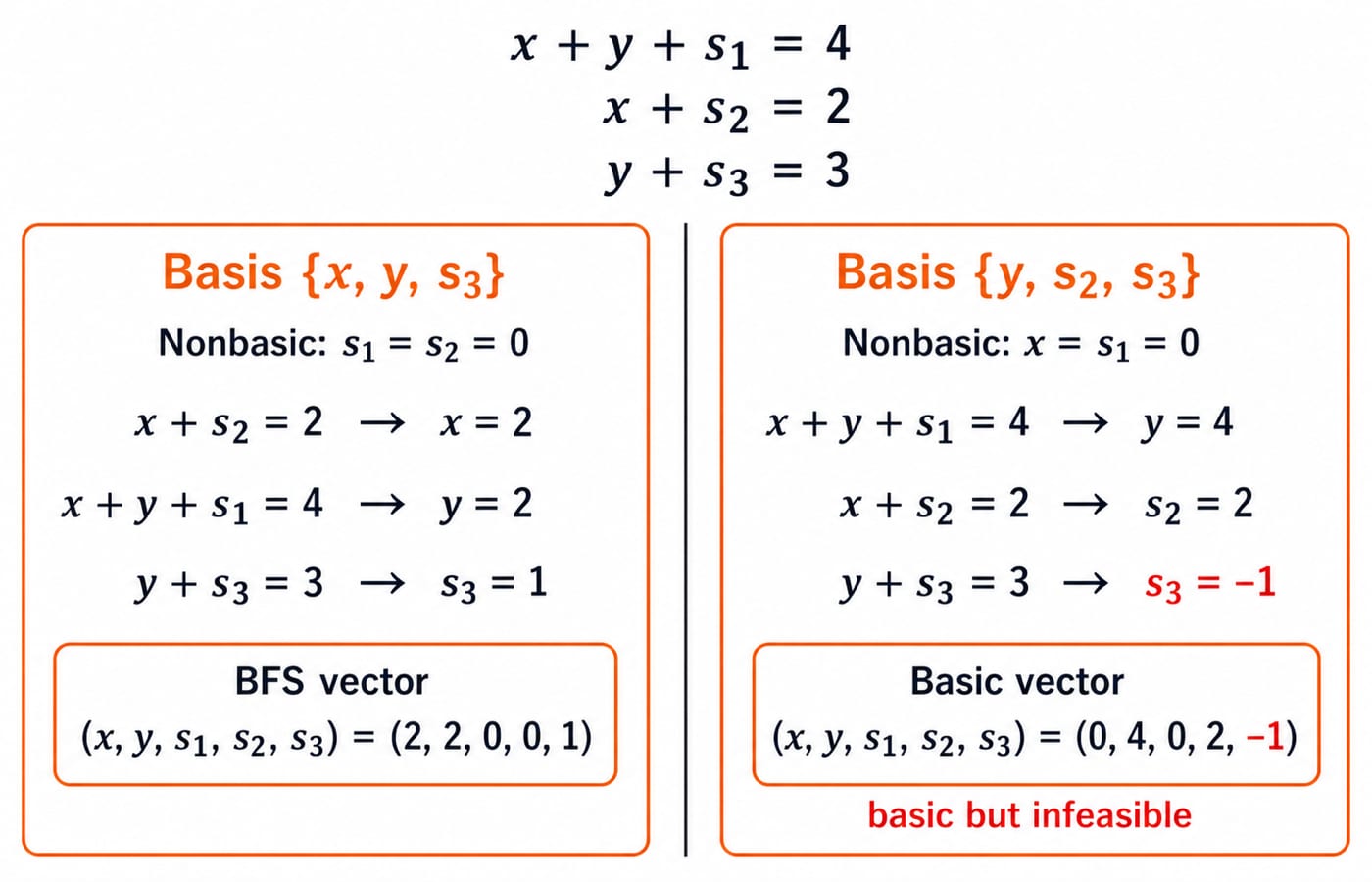
Choose {x, y, s3} as basic and set s1 = s2 = 0. The equations give x = 2, y = 4 - 2 = 2 and s3 = 3 - 2 = 1. Thus (x,y,s1,s2,s3) = (2,2,0,0,1). Every entry is nonnegative, so this is a BFS.
Set x = s1 = 0 with basis {y,s2,s3}. This gives (0,4,0,2,-1), basic but not feasible because s3 = -1. At (1,1), the vector (1,1,2,1,2) has no zero variable, so it cannot have two nonbasic variables set to zero.
Linear programming worked example: enumerate every BFS and find the optimum
The slack values are s1 = 4 - x - y, s2 = 2 - x and s3 = 3 - y. Evaluate them and the objective at every feasible vertex:
Point | Slack vector |
| Classification |
|---|---|---|---|
|
|
| BFS |
|
|
| BFS |
|
|
| BFS and unique optimum |
|
|
| BFS |
|
|
| BFS |
The procedure is:
Find intersections of the boundary lines.
Reject any intersection outside even one constraint.
Record the remaining extreme points.
Substitute each point into
Z = 3x + 2y.Compare the objective values
0, 6, 10, 9, 6.
The maximum is Z = 10 at (2,2). Feasibility comes before optimisation because an infeasible point proves nothing.
To verify uniqueness, slide 3x + 2y = k towards increasing k. At k = 10, it touches the polygon only at (2,2), and no feasible edge lies along it. This model has a unique optimal BFS, but not every LP does.
Degenerate BFS, alternate optima, infeasible LP and unbounded LP
Degeneracy means a basic variable is zero. Consider x + y <= 2, x <= 1, y <= 1, with x,y >= 0. At (1,1), all three inequalities are active and the standard-form vector is (1,1,0,0,0). The valid basis {x,y,s1} has basic variable s1 = 0, so this BFS is degenerate. It remains feasible, and several bases can represent one vertex.
Three short counterexamples separate other edge cases:
Alternate optima: maximise
x + ysubject tox + y <= 4andx,y >= 0. Every point from(4,0)to(0,4)has value4.Infeasible LP:
x + y <= -1andx,y >= 0cannot hold together.Unbounded LP: maximise
2x + ysubject tox - 2y = 0andx,y >= 0. For everyt >= 0,(2t,t)is feasible and givesZ = 5t, which has no finite upper limit.
Linear programming terminology traps students should avoid
Term | Decisive test | Counterexample |
|---|---|---|
Feasible | Satisfies every constraint |
|
BFS | Is a nonnegative basic solution |
|
Basic solution | Comes from a valid basis |
|
Optimal | Has the best feasible objective value | Every point on |
Degenerate | Has at least one zero basic variable |
|
Here BFS means Basic Feasible Solution, not breadth-first search. A polygon vertex is geometric, not a graph-theory vertex. For that separate usage, see Graph Theory: Euler, Hamiltonian, Coloring for GATE CS.
How exams test feasible solutions, BFS and optimal solutions
Typical questions ask you to check a point, identify active constraints, add slack variables, test a basic solution, count BFS points or recognise degeneracy. Longer problems may ask for the optimum, alternate optima, infeasibility or unboundedness.
The main model yields three quick checks:
(1,1)is feasible but not a BFS.(1,3)is a BFS withZ = 9but is not optimal.(2,3)is infeasible.
Use the order constraints -> nonnegativity -> active constraints or basis -> objective value. It prevents you from optimising a rejected point. The GATE Test Series offers broader timed practice, including Engineering Mathematics tests, if you want to build exam speed on top of this drill.
Basic linear programming terminology: the short version and next step
A solution assigns values. A feasible solution obeys every constraint. A basic solution comes from a basis. A BFS is a nonnegative basic solution and appears as a feasible vertex. An optimal solution gives the best objective value among all feasible solutions.
Use Engineering Mathematics for GATE Exam to shore up the adjacent mathematical foundations this topic leans on. For your next step, set y = s1 = 0, take {x,s2,s3} as the basis, and explain why (4,0,0,-2,3) is basic but infeasible.
Keep learning
Classification of Finite and Infinite Groups: Orders, Cyclicity and Worked Examples
Learn how group axioms, group order, element order and generators classify finite and infinite groups through complete, checkable examples.
Updated 4 Oct 20266 min readEngineering Mathematics
Bipartite, Cycle, Regular and Complement Graphs: Tests, Formulas and a C6 Worked Example
Learn a dependable order for classifying simple graphs, then apply it to C6 and list, count and test every edge in its complement.
Updated 29 Sep 20266 min readEngineering Mathematics
Assignment Problem and Hungarian Method: Formulation with a Complete Worked Example
Learn why greedy assignment fails, how matrix reductions preserve the optimum, and how the uncovered-value adjustment leads to a minimum cost of 140.
Updated 24 Sep 20266 min readEngineering Mathematics

Applications of Mathematical Induction in Inequalities and Recurrence Relations: Worked Proofs
Learn how to choose a valid base index, complete an inequality step, and verify closed forms for first-order and second-order recurrences.
Updated 23 Sep 20266 min readEngineering Mathematics