Classification of Finite and Infinite Groups: Orders, Cyclicity and Worked Examples
Learn how group axioms, group order, element order and generators classify finite and infinite groups through complete, checkable examples.
KnowledgeGate Team
Exam prep & CS education
Updated 4 Oct 20266 min read
A set can be finite or infinite without being a group, and a finite group and an infinite group can both be cyclic. Classification starts only after the stated operation satisfies all four group axioms. The reliable route is to separate group order from element order, compute a finite cyclic example completely, contrast it with the finite non-abelian group S_3, and then classify infinite examples by their actual structure rather than by how large or complicated their notation looks.
Finite and infinite groups: classify the structure, not just the set
For a set G with operation *, (G, *) is a group only when it has closure, associativity, an identity e in G, and an inverse in G for every element. Only then is its order |G|, a positive integer for a finite group or an infinite cardinality for an infinite group.
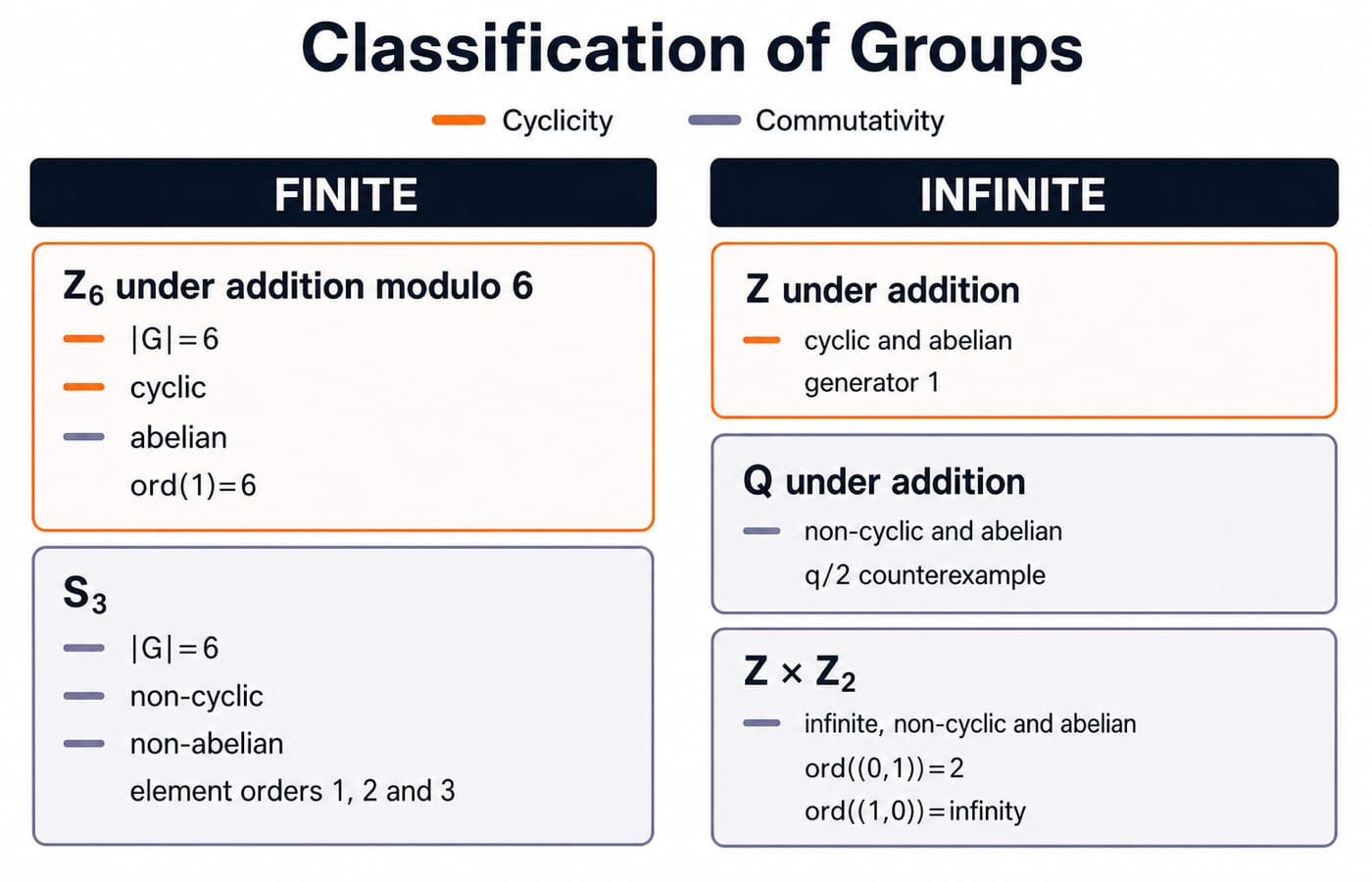
Three labels answer separate questions. Finite or infinite counts elements. Abelian or non-abelian asks whether a*b=b*a. Cyclic or non-cyclic asks whether one element generates the whole group. One label does not mechanically determine another.
Size alone proves nothing. (N_0,+) is closed and associative with identity 0, but 1 has no additive inverse in N_0. (Z,multiplication) has identity 1, but 1/2, the inverse of 2, is outside Z, and 0 has no inverse. Review Set Theory and Relations for GATE: Closures and Posets if the underlying notation needs work, or use the broader GATE CS Exam Preparation pathway for context.
Finite cyclic group worked example: Z_6 under addition modulo 6
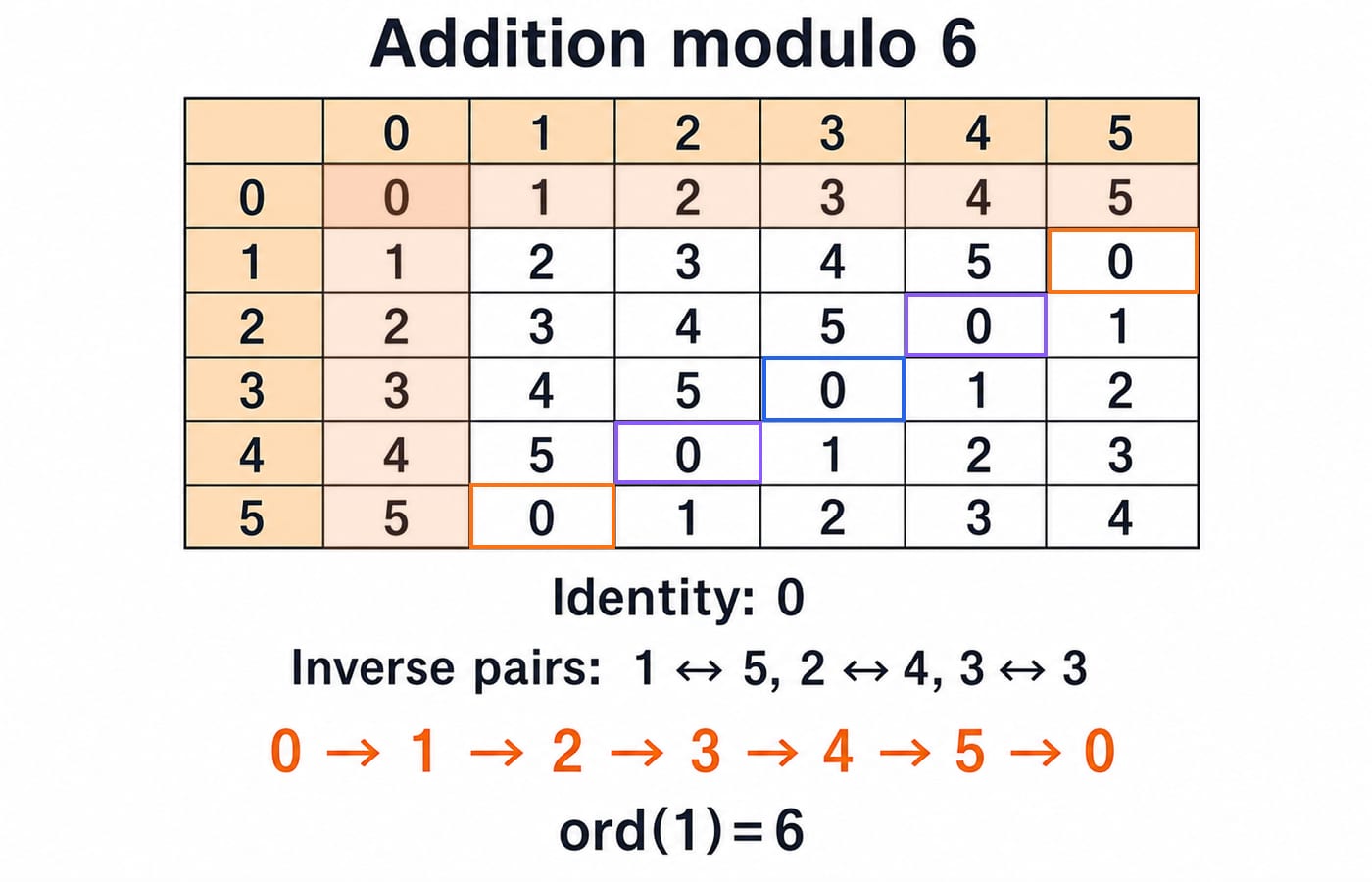
Let G=Z_6={0,1,2,3,4,5} and define a *_6 b=(a+b) mod 6. Every reduced sum lies in G, so closure holds. Associativity comes from integer addition. The identity is 0. The inverse pairs are 0<->0, 1<->5, 2<->4, and 3<->3. Thus all four group axioms hold.
The complete Cayley table is:
| 0 | 1 | 2 | 3 | 4 | 5 |
|---|---|---|---|---|---|---|
0 | 0 | 1 | 2 | 3 | 4 | 5 |
1 | 1 | 2 | 3 | 4 | 5 | 0 |
2 | 2 | 3 | 4 | 5 | 0 | 1 |
3 | 3 | 4 | 5 | 0 | 1 | 2 |
4 | 4 | 5 | 0 | 1 | 2 | 3 |
5 | 5 | 0 | 1 | 2 | 3 | 4 |
Every entry belongs to G. The 0 row and column expose the identity, while symmetry across the main diagonal shows that the operation is commutative.
Repeatedly add 1: 0,1,2,3,4,5,0. Every element appears before the return to 0, so <1>=Z_6, ord(1)=6, and the group is cyclic. Every cyclic group is abelian, and here |Z_6|=6.
The element orders are ord(0)=1, ord(1)=6, ord(2)=3, ord(3)=2, ord(4)=3, and ord(5)=6. Each element order divides the group order |Z_6|=6, as Lagrange's theorem requires.
A finite group need not be cyclic or abelian: the S_3 contrast
The earlier Group Theory in Discrete Mathematics: Group Tests, Subgroups and Worked Examples owns group tests, subgroups, cosets and homomorphisms. Here S_3 separates finite order from cyclicity and commutativity; the remaining examples classify infinite cyclic, non-cyclic and torsion structures.
S_3 contains all permutations of {1,2,3}: e, (12), (13), (23), (123), and (132). Therefore |S_3|=3!=6, so it is finite.
Use composition with the right-hand permutation applied first. For (12) o (23), the images are 1->1->2, 2->3->3, and 3->2->1. Hence the result maps 1->2, 2->3, 3->1, which is (123). In the reverse order, (23) o (12) gives 1->2->3, 2->1->1, and 3->3->2, so the result is (132). The two products differ, making S_3 non-abelian.
The first calculation sends 1 to 2, 2 to 3, and 3 to 1. The reverse calculation sends 1 to 3, 3 to 2, and 2 to 1. These are distinct cycles, not two names for the same permutation.
Also, ord(e)=1; each transposition (12), (13), (23) has order 2; and each 3-cycle (123), (132) has order 3. No element has order 6, so no element generates all six permutations. A generator would need to visit every group element before returning to e. Thus S_3 is non-cyclic. It and Z_6 both have group order 6, yet their structures differ completely.
Infinite groups can be cyclic, non-cyclic or partly torsion
(Z,+) is infinite cyclic because <1>={n.1:n in Z}=Z. Its identity is 0, the inverse of n is -n, and every nonzero element has infinite order. -1 is also a generator.
(Q,+) is infinite abelian but non-cyclic. For any proposed nonzero generator q, its integer multiples are {nq:n in Z}, while q/2 is rational but is not an integer multiple of q. The candidate q=0 cannot generate any nonzero rational.
Now take Z x Z_2 with componentwise addition. It is infinite, but (0,1)+(0,1)=(0,0), so ord((0,1))=2, while (1,0) has infinite order. It is also non-cyclic. A generator would need first coordinate 1 or -1 to reach every integer. Its only multiple with first coordinate 0 is then the zero multiple, so it cannot generate (0,1). This example places torsion beside infinite-order elements.
Every element of a finite group has finite order. An infinite group may have only infinite-order non-identity elements, or it may mix finite-order and infinite-order elements.
A classification checklist applied to four concrete candidates
Always follow this order: operation, four axioms, cardinality, then abelian and cyclic refinements.
Candidate | Axiom check | Classification | Decisive value |
|---|---|---|---|
| Passes all four | Finite cyclic abelian |
|
| Passes all four because these are the nonzero residues modulo prime | Finite cyclic abelian |
|
| Fails inverses | Not a group |
|
| Passes all four | Infinite cyclic abelian | Identity |
For the second row, the powers of 2 modulo 5 are 2^1,2^2,2^3,2^4 = 2,4,3,1. They reach every member and return to the identity, confirming that 2 is a generator. Notice that classification came only after the group test.
Finite and infinite group traps: repair the exact reasoning error
The fastest repair is to name the unjustified inference and replace it with a calculation or counterexample. Use these checks before trusting any classification label.
Count first. Write the operation and test closure, associativity, identity and inverses before classifying size.
Confuse
|G|withord(a). InZ_6,|G|=6, butord(2)=3andord(3)=2.Assume finite means cyclic.
Z_6andS_3both have order6, but onlyZ_6is cyclic.Assume infinite means non-cyclic.
(Z,+)=<1>is infinite cyclic.Assume every non-identity element in an infinite group has infinite order. In
Z x Z_2,(0,1)has order2.Treat closure as sufficient.
(N_0,+)lacks additive inverses for positive elements.Infer commutativity from notation. Declare the convention and compute both product orders, as the
S_3calculation shows.
How classification questions test the same ideas in different forms
Representative tasks ask you to decide whether a set-operation pair is a group, find |G| and ord(a), identify cyclic or abelian structure, or apply a finite-group divisibility constraint. Solve each form in the same order: test the axioms, compute orders, identify generators, then apply divisibility.
For G=(Z_12,+ mod 12) and a=8, calculate 1a=8, 2a=16 mod 12=4, and 3a=24 mod 12=0. Therefore ord(8)=3 and <8>={0,4,8}. If a group has order 18, Lagrange's theorem permits subgroup orders only among 1,2,3,6,9,18. Divisibility is necessary, but it does not guarantee that a subgroup exists for every divisor.
Use this check routine: state the operation, locate the identity, find inverses inside the set, calculate the first positive power or multiple returning to the identity, then compare element order with group order. The Discrete Mathematics MCQs provide broader practice.
Classification of finite and infinite groups: the short version and next step
A group must pass four axioms. Finite versus infinite is decided by |G|. Element order is the first positive return to identity. Finite does not imply cyclic. Infinite does not imply non-cyclic or torsion-free.
Reproduce the Z_6 inverse pairs and all six element orders, then explain why S_3 behaves differently despite also having six elements. For a sequenced route through Discrete Mathematics, continue with GATE Guidance by Sanchit Sir.
Keep learning
Bipartite, Cycle, Regular and Complement Graphs: Tests, Formulas and a C6 Worked Example
Learn a dependable order for classifying simple graphs, then apply it to C6 and list, count and test every edge in its complement.
Updated 29 Sep 20266 min readEngineering Mathematics

Basic Terminologies in Linear Programming: Feasible Solutions, BFS and an Optimal Solution Worked Step by Step
Separate feasible, basic feasible and optimal solutions through geometry, slack variables, vertex enumeration and concise counterexamples.
Updated 25 Sep 20265 min readEngineering Mathematics
Assignment Problem and Hungarian Method: Formulation with a Complete Worked Example
Learn why greedy assignment fails, how matrix reductions preserve the optimum, and how the uncovered-value adjustment leads to a minimum cost of 140.
Updated 24 Sep 20266 min readEngineering Mathematics
Applications of Mathematical Induction in Inequalities and Recurrence Relations: Worked Proofs
Learn how to choose a valid base index, complete an inequality step, and verify closed forms for first-order and second-order recurrences.
Updated 23 Sep 20266 min readEngineering Mathematics