Inverse Property and Group MCQs: 11 Solved Questions with Explanations
Solve 11 inverse property and group MCQs covering symmetric difference, group axioms, matrices, subfields, element order and reversed products. Each answer includes the decisive check.
KnowledgeGate Team
Exam prep & CS education
22 Aug 20267 min read
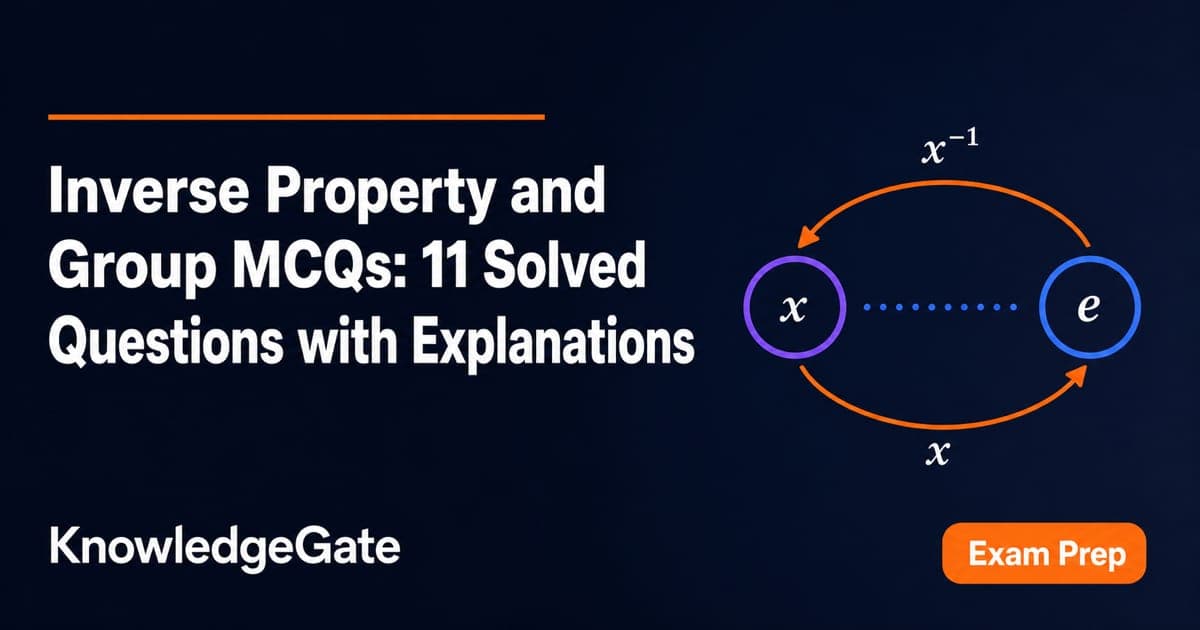
Inverse questions are often lost by reversing a product incorrectly, forgetting which set contains the identity, or testing commutativity before the four group axioms during a timed attempt. Apply the group axioms to symmetric difference, matrices, subfields, element order and inverses of group words; choose an option and write one decisive line before reading each explanation. You can practise with more than 30 questions on Inverse Property and Group in our practice bank. If closure, associativity, identity and inverse are not yet automatic, first revise Group Theory: Groups, Rings and Fields for GATE CS.
Related reading: group inverse properties and group theory.
Inverse property and group tests to use before the MCQs
Use this order: check closure, associativity, an identity element e, and an inverse for every element. Check commutativity only when the question asks whether the group is Abelian. For products, remember (ab)^-1 = b^-1a^-1 and (a1a2...ak)^-1 = ak^-1...a2^-1a1^-1.
This order stops you from finding an inverse inside a set that was never closed.
For calibration, consider Z6 under addition. Its identity is 0, and its inverse pairs are 0<->0, 1<->5, 2<->4 and 3<->3. Also, 2+5 = 7 = 1 (mod 6), so the operation stays inside the set.
Multiplication modulo 6 is different. The element 2 has no inverse because 2x mod 6 can only be 0, 2 or 4, never 1. Therefore, the full set {0,1,2,3,4,5} is not a multiplicative group. Finally, group multiplication is associative but need not be commutative: you may regroup factors, but you may not silently swap them.
Inverse property MCQs 1-2: symmetric difference and commutativity
Question 1
Let X be a set and 2X denote the powerset of X. Define a binary operation Δ on 2X as follows: Let H = (2X, Δ). Which of the following statements about H is/are correct?
A. H is a group.
B. Every element in H has an inverse, but H is NOT a group.
C. For every A ∈ 2X, the inverse of A is the complement of A.
D. For every A ∈ 2X, the inverse of A is A.
Correct answer: A, D.
With X={1,2,3}, A={1,3} and B={2,3}, we get A Δ B={1,2}. The identity is ∅ and A Δ A=∅, so every subset is its own inverse; closure and associativity complete the group test. C fails because A Δ A^c=X, not ∅, for nonempty X.
Question 2
Which of the following statements is/are TRUE for a group G ?
A. If for all x, y ∈ G, (xy)2 = x2y2, then G is commutative.
B. If for all x ∈ G, x2 = 1, then G is commutative. Here, 1 is the identity element of G.
C. If the order of G is 2, then G is commutative.
D. If G is commutative, then a subgroup of G need not be commutative.
Correct answer: A, B, C.
From xyxy=xxyy, left-cancel x and right-cancel y to get yx=xy. In B, each element is its inverse, hence xy=(xy)^-1=y^-1x^-1=yx; order-2 groups are cyclic, proving C. D fails because subgroups inherit commutativity.
Group MCQs 3-4: roots of unity and the non-Abelian boundary
Question 3
Consider the set S = {1, ω, ω2}, where ω and ω2 are cube roots of unity. If \* denotes the multiplication operation, the structure (S, \*) forms
A. A group
B. A ring
C. An integral domain
D. A field
Correct answer: A.
Modulo 3 powers give ω^3=1, ω·ω=ω^2 and ω·ω^2=1. Multiplication is closed and associative, with identity 1 and mutual inverses ω, ω^2. No second operation is specified, so no ring, integral-domain or field is established.
Question 4
Which one of the following in NOT necessarily a property of a Group?
A. Commutativity
B. Associativity
C. Existence of inverse for every element
D. Existence of identity
Correct answer: A.
Associativity, identity and inverses are group axioms; commutativity is the extra Abelian condition. Invertible matrices A=[[1,1],[0,1]], B=[[1,0],[1,1]] give AB=[[2,1],[1,1]] but BA=[[1,1],[1,2]]. Hence commutativity is unnecessary.
Matrix group MCQs 5-6: why non-singularity is the inverse condition
Question 5
Let A be the set of all non-singular n × n real matrices, for some fixed n ≥ 2, and let \* be the matrix multiplication operation. Then ⟨A, \*⟩ is:
A. A is closed under \* but ⟨A, \*⟩ is not a semigroup.
B. ⟨A, \*⟩ is a semigroup but not a monoid.
C. ⟨A, \*⟩ is a monoid but not a group.
D. ⟨A, \*⟩ is a group but not an abelian group.
Correct answer: D.
Since det(AB)=det(A)det(B) != 0, closure holds; multiplication is associative, with identity I_n and inverses. Question 4 gives AB != BA for n=2; an identity block extends this to larger n. Hence the group is not Abelian.
Question 6
Which of the following is true?
A. The set of all rational negative numbers forms a group under multiplication.
B. The set of all non-singular matrices forms a group under multiplication.
C. The set of all matrices forms a group under multiplication.
D. Both (2) and (3) are true.
Correct answer: B.
Fix one square matrix order. A fails closure since (-1)(-1)=1 is positive, while C contains the noninvertible zero matrix. B has identity I; each nonsingular A has A^-1, with det(A^-1)=1/det(A) != 0.
Group MCQs 7-9: closure, missing inverses and subfields
Question 7
Which one of the following is false?
A. The set of all bijective functions on a finite set forms a group under function composition.
B. The set {1, 2, ..................., p-1} forms a group under multiplication mod p where p is a prime number
C. The set of all strings over a finite alphabet ∑ forms a group under concatenation
D. A subset S≠∅ of G is a subgroup of the group <G, \*> if and only if for any pair of element a, b ∈ S, a∗b^−1 ∈ S
Correct answer: C.
The empty string ε is an identity, but no w makes 01w=ε, so 01 lacks an inverse. Bijections have inverses, nonzero residues modulo prime p have inverses, and D is the one-step subgroup test. Strings form a monoid, not a group.
Question 8
Which of the following statements is false?
A. The set of rational numbers is an abelian group under addition
B. The set of integers is an abelian group under addition
C. The set of rational numbers forms an abelian group under multiplication
D. The set of real numbers excluding zero is an abelian group under multiplication
Correct answer: C.
For C, 0 is rational but no r satisfies 0r=1. Under addition, identity 0 and inverse -x settle A and B. Nonzero reals are closed under multiplication and each x has inverse 1/x, so D holds.
Question 9
Consider the field C of complex numbers with addition and multiplication. Which of the following form(s) a subfield of C with addition and multiplication? (S1) the set of real numbers (S2) {(a + ib) | a and b are rational numbers} (S3) {a + ib | (a2 + b2) ≤ 1} (S4) {ia | a is real}
A. only S1
B. S1 and S3
C. S2 and S3
D. S1 and S2
Correct answer: D.
S1 is a subfield. In S2, nonzero a+ib has inverse (a-ib)/(a^2+b^2), still with rational coordinates, and the other field operations stay inside. S3 fails addition since (0.75+0i)+(0.75+0i)=1.5+0i has modulus 1.5>1; S4 lacks 1, and i*i=-1 leaves it.
Inverse property MCQs 10-11: element order and reversing a group word
Question 10
Consider the following statements: : If a group is of order , and is such that for some integer , then must divide . : If a group is of even order, then there must be an element such that and . Which of the statements is (are) correct?
A. Only
B. Only
C. Both and
D. Neither and
Correct answer: B.
In additive Z6, take a=3, m=4: 4a=12=0 (mod 6), so a^m=e in multiplicative notation, yet 4 does not divide 6. The element order, here 2, divides the group order; every exponent producing e need not. Cauchy's theorem proves S2 because 2 divides an even group order.
Question 11
If x and y are elements in a group G and if x5 = y3 = e, where e is the identity of G, then the inverse of x2yx4y2 must be
A. y2xy2x4
B. yxy2x3
C. yx6y6x3
D. x4y2x2y
Correct answer: B.
Reverse first: (x^2 y x^4 y^2)^-1 = y^-2 x^-4 y^-1 x^-2. Now y^3=e gives y^-2=y, y^-1=y^2; x^5=e gives x^-4=x, x^-2=x^3. This yields y x y^2 x^3, option B, without commuting factors.
Inverse property and group MCQ answer pattern and next step
The key is 1-A,D; 2-A,B,C; 3-A; 4-A; 5-D; 6-B; 7-C; 8-C; 9-D; 10-B; 11-B. Key ideas include identities and self-inverses (Q1-Q3), group versus Abelian properties (Q4-Q6), closure and missing inverses (Q7-Q9), and element order with factor reversal (Q10-Q11).
Reproduce A Δ A=∅, AB != BA, and y^-2 x^-4 y^-1 x^-2 without looking. Then use Discrete Mathematics MCQs for wider practice.
For the full Discrete Mathematics sequence and Group Theory path, follow GATE Guidance by Sanchit Sir. For a broader route, use GATE CS Exam Preparation Courses & Test Series.
Keep learning
Graph Traversal MCQs: 12 Solved Questions on Walks, Paths, Trails, Circuits and Connectivity
Attempt 12 graph traversal and connectivity questions, then check each answer through definitions, reachability, degree conditions and edge-count arguments.
Updated 3 Oct 20267 min readDiscrete Mathematics MCQs
Planar Graphs MCQs: 12 Solved Questions on Kuratowski’s Theorem, Homeomorphism and Edge Bounds
Solve 12 planar graph questions, then check each answer through a forbidden-subdivision argument, a crossing-free redraw, or a short calculation.
Updated 28 Sep 20268 min readDiscrete Mathematics MCQs
Power Set and Cardinality MCQs: 12 Solved Questions with Explanations
Solve 12 power set questions, from direct enumeration and nested sets to inclusion chains, ordered pairs and recurrence-based counting.
25 Sep 20267 min readDiscrete Mathematics MCQs
Null Set, Universal Set, Subset and Proper Subset MCQs: 12 Solved Questions
Practise 12 MCQs on null sets, universal sets, subsets, proper subsets, complements and nested inclusion, with clear reasoning for every answer.
Updated 24 Sep 20267 min readDiscrete Mathematics MCQs