Subgroup Definition and Verification Techniques: Worked Examples for GATE CS
Learn how to prove or reject a subgroup using the definition, the one-step test, operation tables, and precise counterexamples. The main worked example checks {0,3,6,9} in Z_12.
KnowledgeGate Team
Exam prep & CS education
Updated 8 Sep 20266 min read
A subset may contain the identity and still fail to be a subgroup. The definition test, the one-step test, and a complete operation table may look like three separate methods, but each checks the same group requirements. The subgroup H={0,3,6,9} inside (Z_12,+) can be verified by all three routes, and counterexamples show where shortcuts fail. If closure notation is unfamiliar, review Set Theory and Relations for GATE: Closures and Posets first.
Subgroup definition: the set and operation must stay together
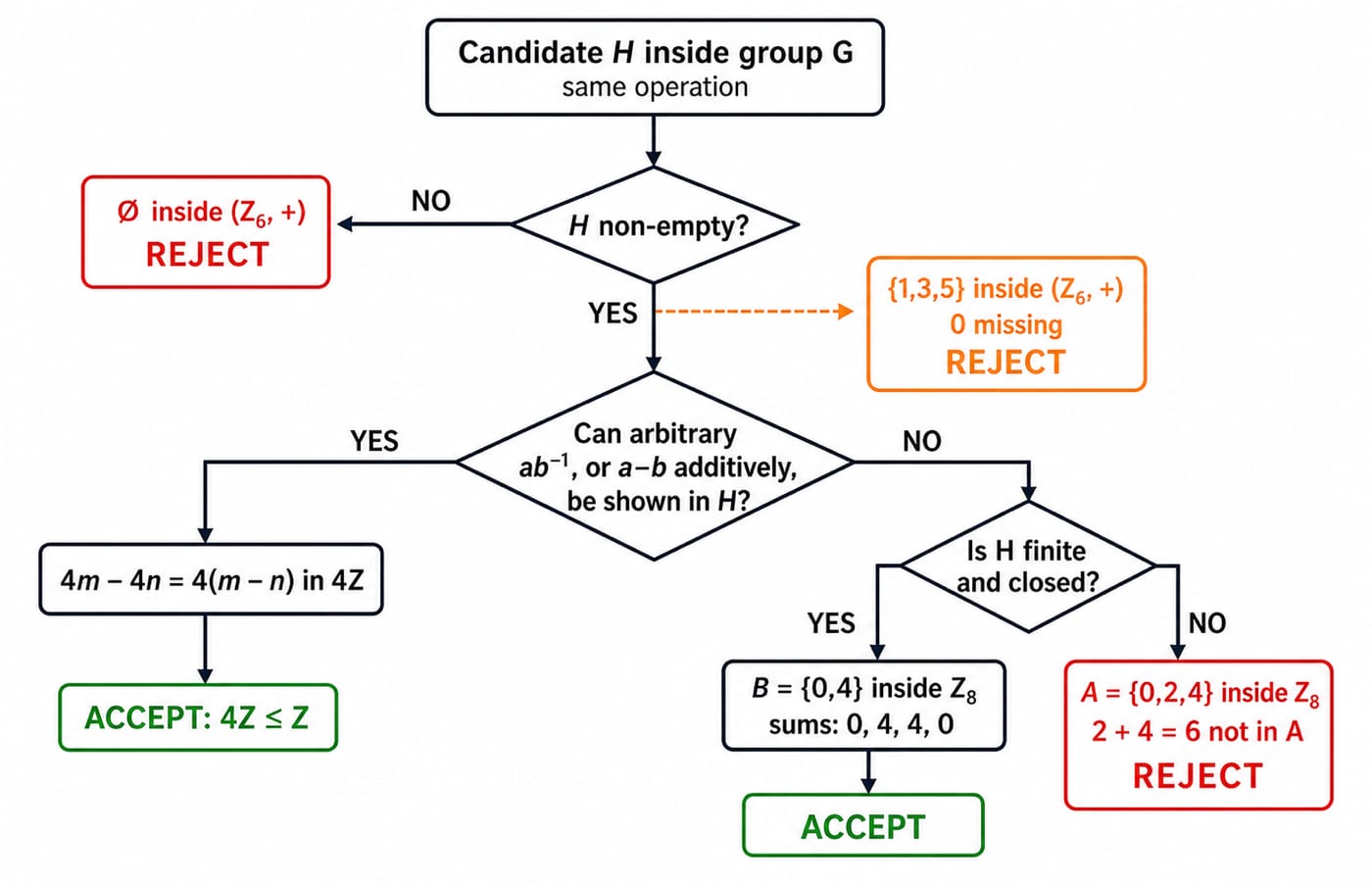
Writing H <= G means that G is a group under a stated operation *, H is a non-empty subset of G, and H is itself a group under that same restricted operation. Therefore, H must have closure, associativity, an identity, and inverses. Associativity is inherited from G, so direct verification checks non-emptiness, closure, the identity, and inverses.
Containing the identity is not enough. In (Z_8,+), A={0,2,4} contains 0, but 2+4=6 mod 8, and 6 is not in A. In contrast, B={0,4} is a subgroup: its four sums are 0+0=0, 0+4=4, 4+0=4, and 4+4=0 modulo 8. Both elements are self-inverse.
For additive groups, the identity is 0 and the inverse of a is -a. For multiplicative groups, the identity is e or 1, and the inverse is a^-1. The wider map is covered in Group Theory: Groups, Rings and Fields for GATE CS.
Subgroup verification techniques: choose the shortest valid proof
Each technique below is a complete proof only when all its stated conditions hold.
Technique | Condition to prove | Best use |
|---|---|---|
Definition test |
| Small sets or a first proof |
One-step test |
| Compact general proofs |
Additive form |
| Additive groups |
Finite shortcut | Show that the non-empty finite subset is closed under the operation | Only after finiteness and the ambient group are established |
The one-step test really includes the missing checks. For a in H, choosing a,a gives aa^-1=e in H. Choosing e,a then gives ea^-1=a^-1 in H. Since b^-1 is in H, applying the condition to a,b^-1 gives a(b^-1)^-1=ab in H.
For 4Z <= Z under addition, take arbitrary 4m,4n in 4Z. Then (4m)-(4n)=4(m-n), and m-n is an integer, so the difference stays in 4Z. Checking several numerical pairs would only suggest this infinite pattern, not prove it.
Worked subgroup example: verify {0,3,6,9} inside Z_12
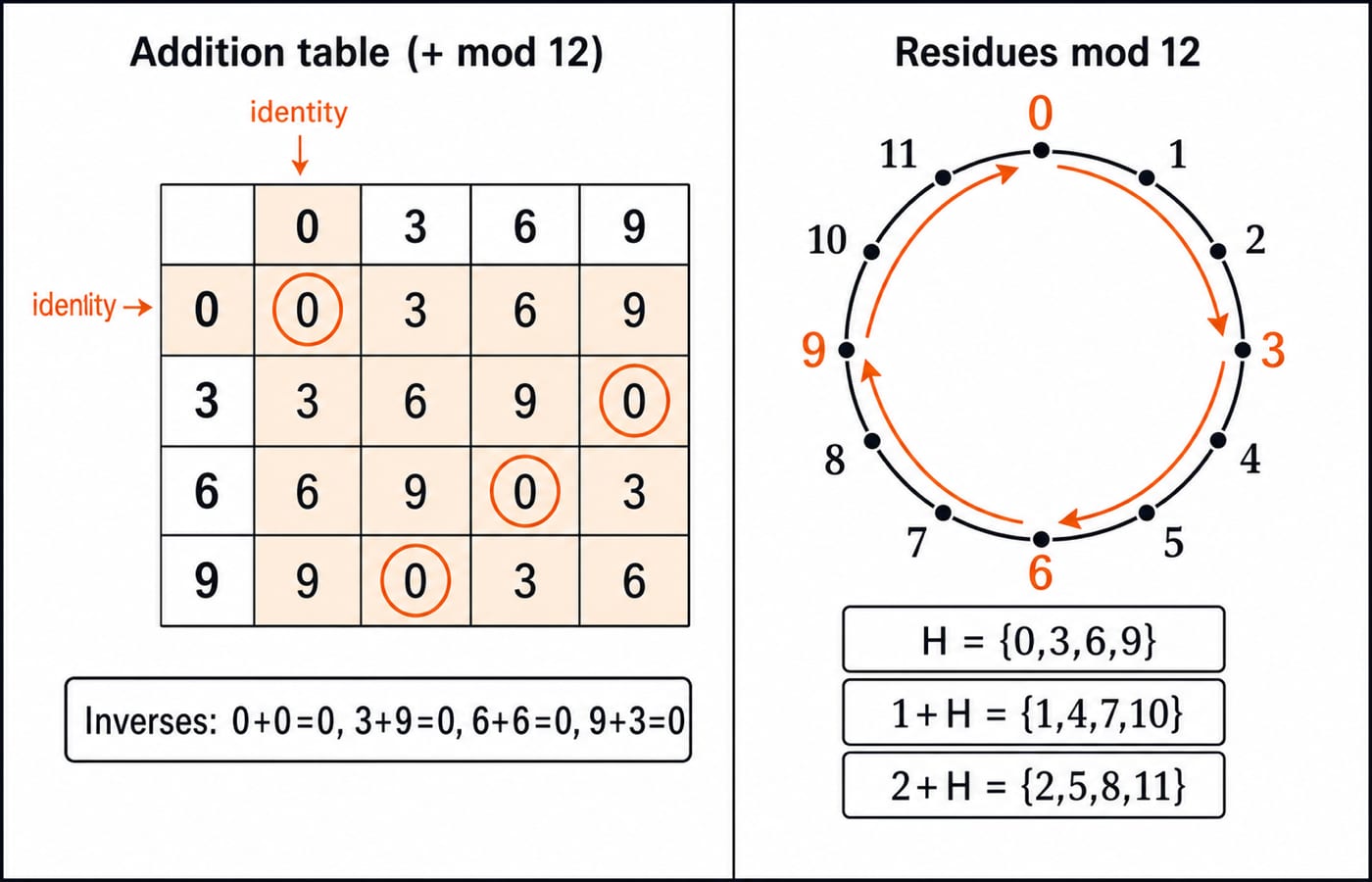
First fix the objects. Let G=Z_12={0,1,...,11} under addition modulo 12, and let H={0,3,6,9}. The set is non-empty, and it contains the identity 0.
Closure can be checked completely because H is finite. Every entry below is the row element plus the column element, reduced modulo 12.
|
|
|
|
|
|---|---|---|---|---|
|
|
|
|
|
|
|
|
|
|
|
|
|
|
|
|
|
|
|
|
Every result belongs to H, so closure holds. The cells whose sum is 0 give the inverses: -0=0, -3=9, -6=6, and -9=3 modulo 12. Associativity is inherited from addition modulo 12; inspecting selected table cells would not prove it. All subgroup conditions are now accounted for, so H <= Z_12.
The additive subgroup test compresses the proof. Write H={3k mod 12 : k in Z}. If a=3r mod 12 and b=3s mod 12, then a-b=3(r-s) mod 12, which is again in H. Since H is non-empty, the test proves the result.
There are also two useful structural checks. Repeated addition of 3 gives <3>={0,3,6,9}, so H is cyclic of order 4. Its distinct cosets are H={0,3,6,9}, 1+H={1,4,7,10}, and 2+H={2,5,8,11}. They are disjoint and together contain all 12 residues.
Subgroup examples and non-examples across common operations
The infinite additive example 4Z <= Z follows from 4m-4n=4(m-n). For a finite multiplicative example, consider U(8)={1,3,5,7} under multiplication modulo 8. For K={1,7}, the product table has rows 1,7 and 7,1: 1x1=1, 1x7=7, 7x1=7, and 7x7=49, which is congruent to 1 mod 8. Thus 1 is the identity, and both elements have inverses in K.
A single witness can reject a candidate. The set A={0,2,4} in (Z_8,+) fails closure because 2+4=6 mod 8. The positive integers P={1,2,3,...} are not a subgroup of the positive rationals under multiplication because the inverse of 2 is 1/2, which is not in P.
The same-looking carrier can behave differently under another operation. A correct solution always names the ambient group, the operation, and the satisfied or failed axiom. It also confirms that the proposed ambient set is itself a group.
Subgroup traps: necessary conditions are not complete proofs
The claim "H contains the identity, so it is a subgroup" is false. In Z_3, {0,1} contains 0, but 1+1=2 lies outside the subset. The claim "|H| divides |G|, so H is a subgroup" reverses Lagrange's theorem. The set {0,1} has size 2, which divides |Z_4|=4, yet 1+1=2 lies outside it.
For finite groups, Lagrange's theorem is a rejection screen: if H <= G, then |H| divides |G|. A five-element candidate cannot be a subgroup of a group of order 12. A four-element candidate passes that screen but still needs verification.
Always use the stated operation. Ordinary addition is irrelevant if the operation is addition modulo n. A Cayley table can display closure, identity, and inverse candidates, but associativity must come from the ambient group or a separate proof.
Unions create another trap. In Z_12, H=<3>={0,3,6,9} and K=<4>={0,4,8} are subgroups. Their union is not: 3+4=7 belongs to neither set and hence is outside the union.
How exam-style subgroup questions test the same checks
Common question forms include direct verification, finding a counterexample, determining a generated subgroup, applying an order screen, and deciding whether intersections or unions remain subgroups. The GATE CS Exam Preparation category connects this topic to the wider discrete-mathematics syllabus.
Four rapid checks capture the pattern:
In
Z_12,<4>={0,4,8}, so its order is3.A subgroup of a group of order
12cannot have order5, by Lagrange's theorem.For
H=<3>andK=<4>inZ_12,H intersection K={0}, which is a subgroup.Their union fails closure because
3+4=7lies outside it.
Under time pressure, first write the operation and identity. Next try the one-step test, and stop as soon as a counterexample appears. Use Lagrange's theorem only as a filter. Then state the conclusion with the exact condition proved or violated. Practise the same decisions in Discrete Mathematics MCQs, which mixes subgroup checks with other discrete-mathematics questions.
Subgroup verification checklist and the next step
The short version is to confirm the ambient group and operation, show the candidate is non-empty, then use the definition test or prove ab^-1 in H. Reject with one valid counterexample, and treat order divisibility only as a necessary screen. Here, {0,3,6,9} <= Z_12 because it contains 0, stays closed modulo 12, has inverses 0,9,6,3, and inherits associativity. For a structured route through Discrete Mathematics and Group Theory, consider GATE Guidance by Sanchit Sir.
Keep learning
Classification of Finite and Infinite Groups: Orders, Cyclicity and Worked Examples
Learn how group axioms, group order, element order and generators classify finite and infinite groups through complete, checkable examples.
Updated 4 Oct 20266 min readEngineering Mathematics
Bipartite, Cycle, Regular and Complement Graphs: Tests, Formulas and a C6 Worked Example
Learn a dependable order for classifying simple graphs, then apply it to C6 and list, count and test every edge in its complement.
Updated 29 Sep 20266 min readEngineering Mathematics
Basic Terminologies in Linear Programming: Feasible Solutions, BFS and an Optimal Solution Worked Step by Step
Separate feasible, basic feasible and optimal solutions through geometry, slack variables, vertex enumeration and concise counterexamples.
Updated 25 Sep 20265 min readEngineering Mathematics
Assignment Problem and Hungarian Method: Formulation with a Complete Worked Example
Learn why greedy assignment fails, how matrix reductions preserve the optimum, and how the uncovered-value adjustment leads to a minimum cost of 140.
Updated 24 Sep 20266 min readEngineering Mathematics