

Digital Payment Systems Explained: UPI Flow, Net Settlement and Exam Traps
Separate payment instruments, interfaces and rails, then follow a transfer of 750 units and reduce three inter-bank flows to one net obligation.
KnowledgeGate Team
Exam prep & CS education
Updated 29 Oct 20266 min read

UPI, QR, IMPS, NEFT, RTGS, cards and wallets are often memorised as one list, although they describe different layers. Classify them by value source, payment rail and interface, then test the method with exact payment and settlement calculations. UPI-style account transfers use bank-account value, while cards and wallets supply useful contrasts; netting reduces opposing bank obligations to one residual.
Digital payment systems: separate the money, message and settlement layers
A digital payment electronically transfers monetary value between a payer and payee. Actors include their banks, an app, a network or switch, and a settlement mechanism.
Separate three layers. The funding source or instrument may be a bank account, card-linked account or stored-value wallet. The rail or system carries and processes the instruction. The interface, such as an app, QR code, terminal or feature-phone menu, starts it. A QR code is an instruction-capture interface, not money and not a settlement rail.
Customer ledgers can show a debit and credit before the banks discharge their inter-bank obligation. Payments are one slice of a wider ICT syllabus, so revise them alongside ICT for Teaching Exams rather than in isolation.
Digital payment systems: classify UPI, IMPS, NEFT, RTGS, cards and wallets
Name | Value source | How the instruction starts | Core distinction | Common trap |
|---|---|---|---|---|
UPI | Bank account | App, payment address or QR | Bank-account initiation | UPI is a wallet |
IMPS | Bank account | Bank channel or app | Immediate account transfer | Speed equals settlement |
NEFT | Bank account | Bank channel | Funds transfer with net settlement | Net means low value |
RTGS | Bank account | Bank channel | Real-time, transaction-wise gross settlement | Gross means high value |
Card | Linked account or credit arrangement | Card or merchant device | Instrument using acceptance infrastructure | Card is the rail |
Wallet | Stored value | Wallet interface | Value is held in the instrument | Every app is a wallet |
AEPS or feature-phone channel | Usually a bank account | Assisted device or menu | Assisted or low-device access | Channel is the value source |
Gross handles obligations separately. Net offsets opposite obligations and settles the residual. Real time means no wait for a later batch in this model. Customer confirmation, clearing and inter-bank settlement differ.
Scanning a merchant QR changes the interface, not the bank-account value source. A wallet loaded with 1,000 units and then used for 240 units retains 1,000 units - 240 units = 760 units.
Worked UPI-style payment flow: Asha sends Ravi 750 units
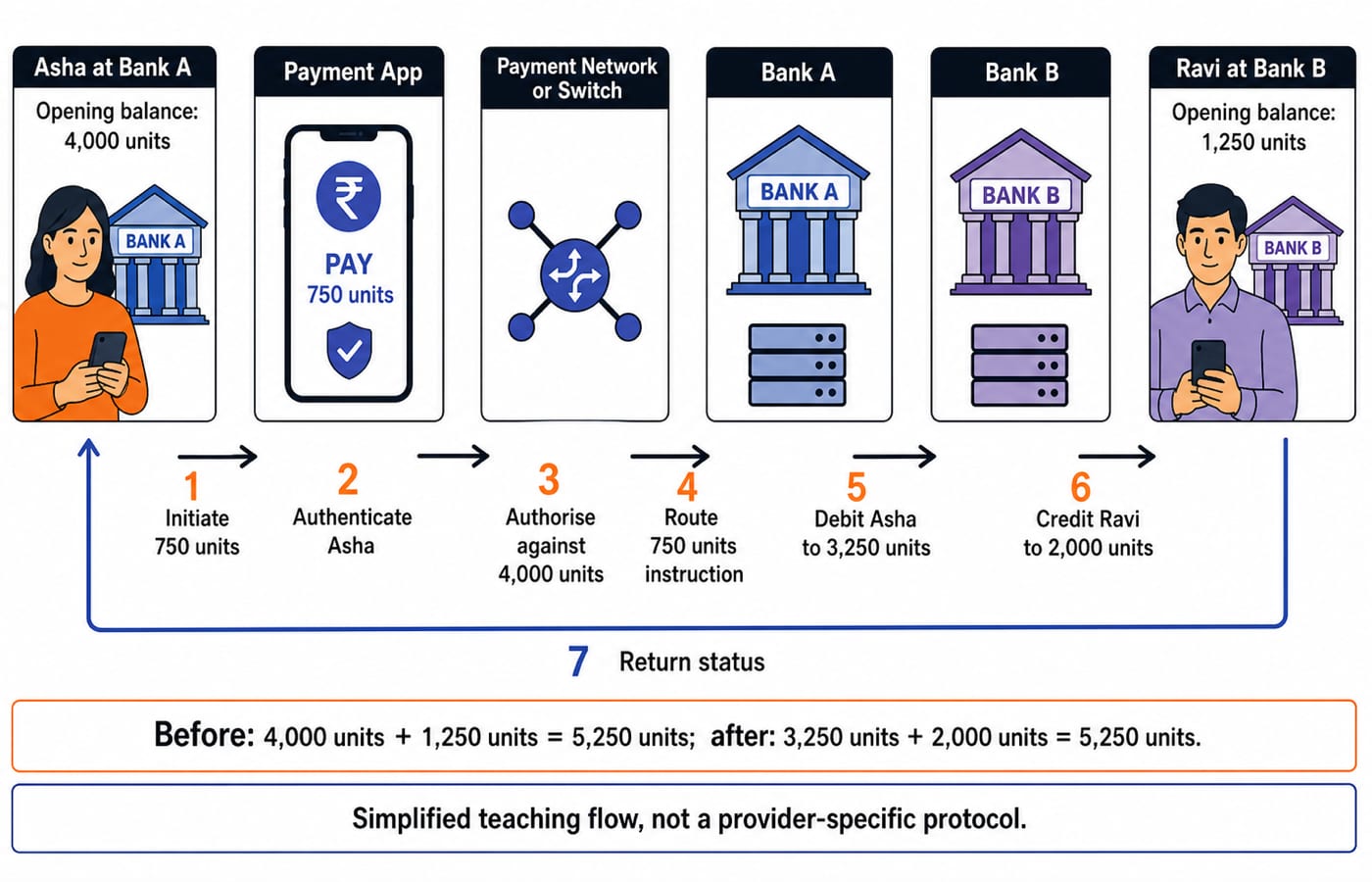
Asha has 4,000 units at Bank A and Ravi has 1,250 units at Bank B. She initiates a UPI-style account-to-account payment of 750 units through an app, so the value leaves her bank account rather than a stored balance:
Asha selects Ravi and enters 750 units.
The app presents it for authentication.
Bank A checks the credential, balance and rules, then authorises or rejects it.
A network or switch routes the authorised instruction to Bank B.
Bank A debits Asha: 4,000 units - 750 units = 3,250 units.
Bank B credits Ravi: 1,250 units + 750 units = 2,000 units.
A status message returns.
Authentication establishes control of a credential. Authorisation decides whether this transaction of 750 units may proceed. Submission, authorisation and Ravi's final confirmation are separate boundaries. Timeout and reversal periods are provider rules, so neither follows from the arithmetic.
Checksum: 4,000 units + 1,250 units = 5,250 units before, and 3,250 units + 2,000 units = 5,250 units after.
Worked clearing and net settlement: three transfers become one obligation of 600 units
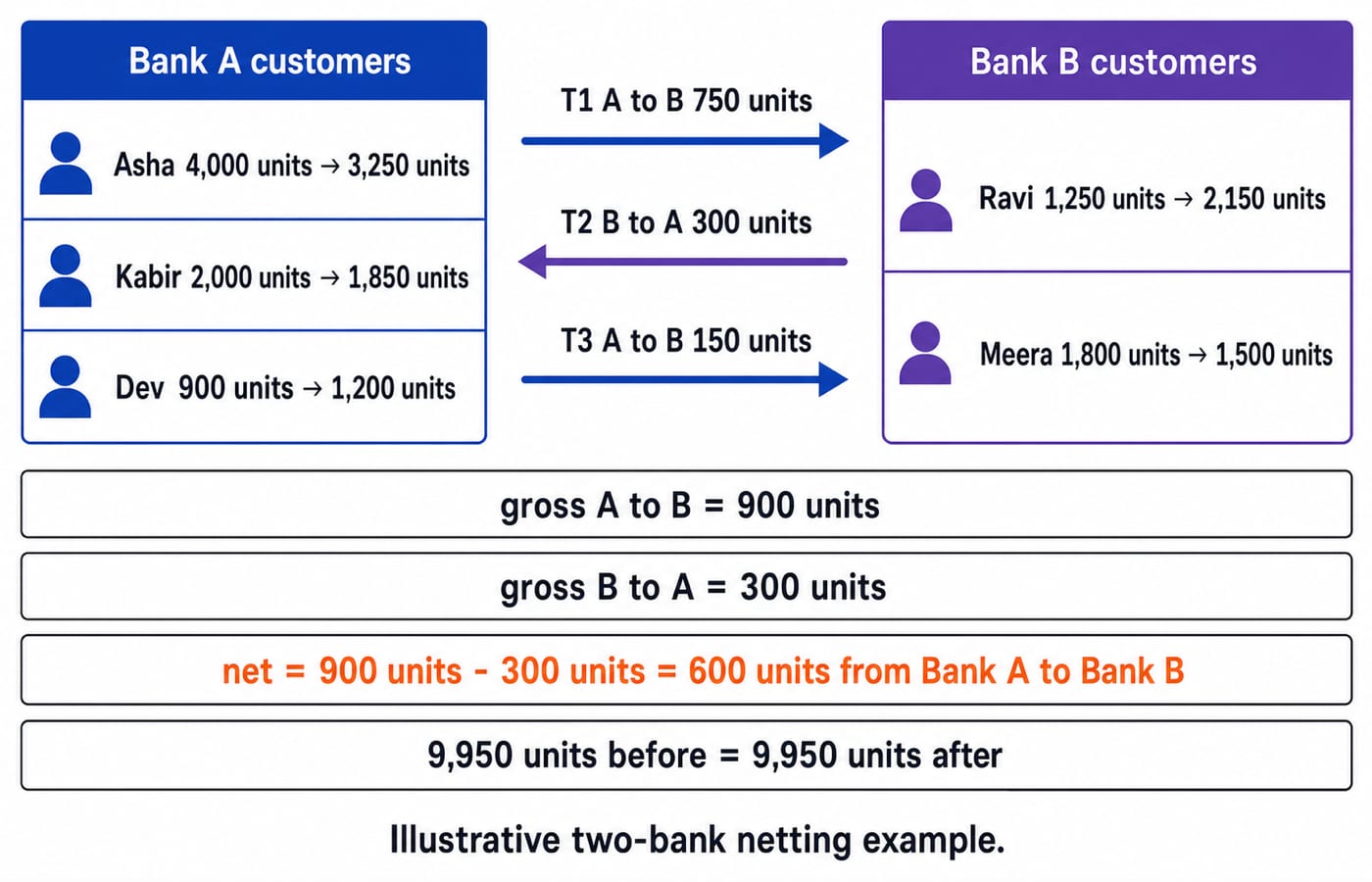
Add Kabir and Dev at Bank A, and Meera at Bank B. Process T1, Asha to Ravi 750 units; T2, Meera to Dev 300 units; and T3, Kabir to Ravi 150 units.
Customer | Opening balance | Change | Closing balance |
|---|---|---|---|
Asha, Bank A | 4,000 units | -750 units | 3,250 units |
Kabir, Bank A | 2,000 units | -150 units | 1,850 units |
Dev, Bank A | 900 units | +300 units | 1,200 units |
Ravi, Bank B | 1,250 units | +750 units + 150 units | 2,150 units |
Meera, Bank B | 1,800 units | -300 units | 1,500 units |
Opening: 4,000 units + 2,000 units + 900 units + 1,250 units + 1,800 units = 9,950 units. Closing: 3,250 units + 1,850 units + 1,200 units + 2,150 units + 1,500 units = 9,950 units. Value is conserved.
Bank A owes Bank B 750 units + 150 units = 900 units; Bank B owes Bank A 300 units. Netting leaves 900 units - 300 units = 600 units from A to B. Gross settlement handles all three obligations individually. A production system may clear and settle on a provider-defined cycle, but the net obligation remains the residual after offsets.
Security controls and payment states solve different problems
Authentication checks a user or credential; authorisation checks transaction permission. Encryption protects stored or transmitted data, integrity checks detect alteration, tokenisation substitutes limited-use data for sensitive card details, and records aid reconciliation. No control alone removes risk.
States are initiated, pending or uncertain, successful, and failed or reversed. Without reliable confirmation, Asha should check authoritative status before assuming receipt or duplicating the payment of 750 units.
Map threats to controls: stolen credential to stronger authentication; altered instruction to integrity checks and server-side validation; duplicate submission to a unique reference and idempotent processing; fake QR to payee and amount verification.
Digital payment traps: correct the category error before solving
Trap | Correction |
|---|---|
UPI is a wallet | UPI can initiate a bank-account transfer, while a wallet stores value. |
QR code is a payment rail | A QR code encodes or presents payment information. |
Authentication means sufficient balance | Authentication and transaction authorisation answer different questions. |
Instant message means settlement is complete | Customer confirmation, clearing and inter-bank settlement are separate concepts. |
Gross traffic is 750 units + 300 units + 150 units = 1,200 units, but Bank A nets 600 units. Ravi still receives 900 units and reaches 2,150 units. Gross describes no offsetting, not size; real time describes timing.
How assessments test digital payment systems
Questions ask you to match systems to features, order stages, separate authentication from authorisation, or calculate obligations. Here Bank A settles 600 units to Bank B after netting, not 900 units, 1,200 units or 300 units.
Use these quick checks:
A merchant displays a QR. What is it here? An interface or encoded instruction, not the source of money.
Asha proves control of her credential, but the balance check for 750 units fails. Which stage failed? Authorisation, not necessarily authentication.
Which term says obligations are handled one by one without offset? Gross settlement.
How heavily your paper weights this topic is set by the official syllabus or notification, so check the current one before deciding how deep to go. NET aspirants start with UGC NET Paper 1 vs Paper 2 for orientation, then move to the UGC NET Paper 1 Test Series for practice.
Digital payment systems: the short version and next step
Ask four questions: Where is value held? How is the instruction initiated? Which system processes it? Is settlement gross or net? Here: bank-account value, app initiation, a generic network or switch, and a net obligation of 600 units from Bank A to Bank B.
The checksums are 5,250 units before and after one transfer, and 9,950 units before and after three. The latter carries 1,200 units gross but nets to 600 units.
Reproduce 600 units without notes. Then use the NET category for a wider path, or the NTA UGC NET Paper 1 course for broader Paper 1 preparation.
Go deeper with the full courseUGC NET Computer Science (Paper 1 + Paper 2)
Keep learning
Electronic Payment Systems Explained: Concepts, Worked Settlement and Exam Traps
Learn how payment instruments, participants, clearing and settlement fit together. Includes a two-bank netting calculation, EDI distinctions and security traps.
Updated 10 Nov 20265 min readUGC NET Computer Science
E-Commerce and Digital Transactions Explained: Models, Flow and a Worked Funnel
Separate e-commerce from e-business, follow one order through its systems, and learn how to choose the right denominator in a transaction funnel.
Updated 11 Nov 20266 min readTeaching Recruitment (Computer Science)
UGC NET Paper 1 Higher Education Timeline: Institutions, Commissions, Policies and Digital Initiatives
Turn disconnected Higher Education dates into a classified timeline. Learn the ancient centres, modern bodies, policies and digital initiatives through worked ordering drills.
Updated 3 Sep 20266 min read80 viewsNET Strategy & Updates
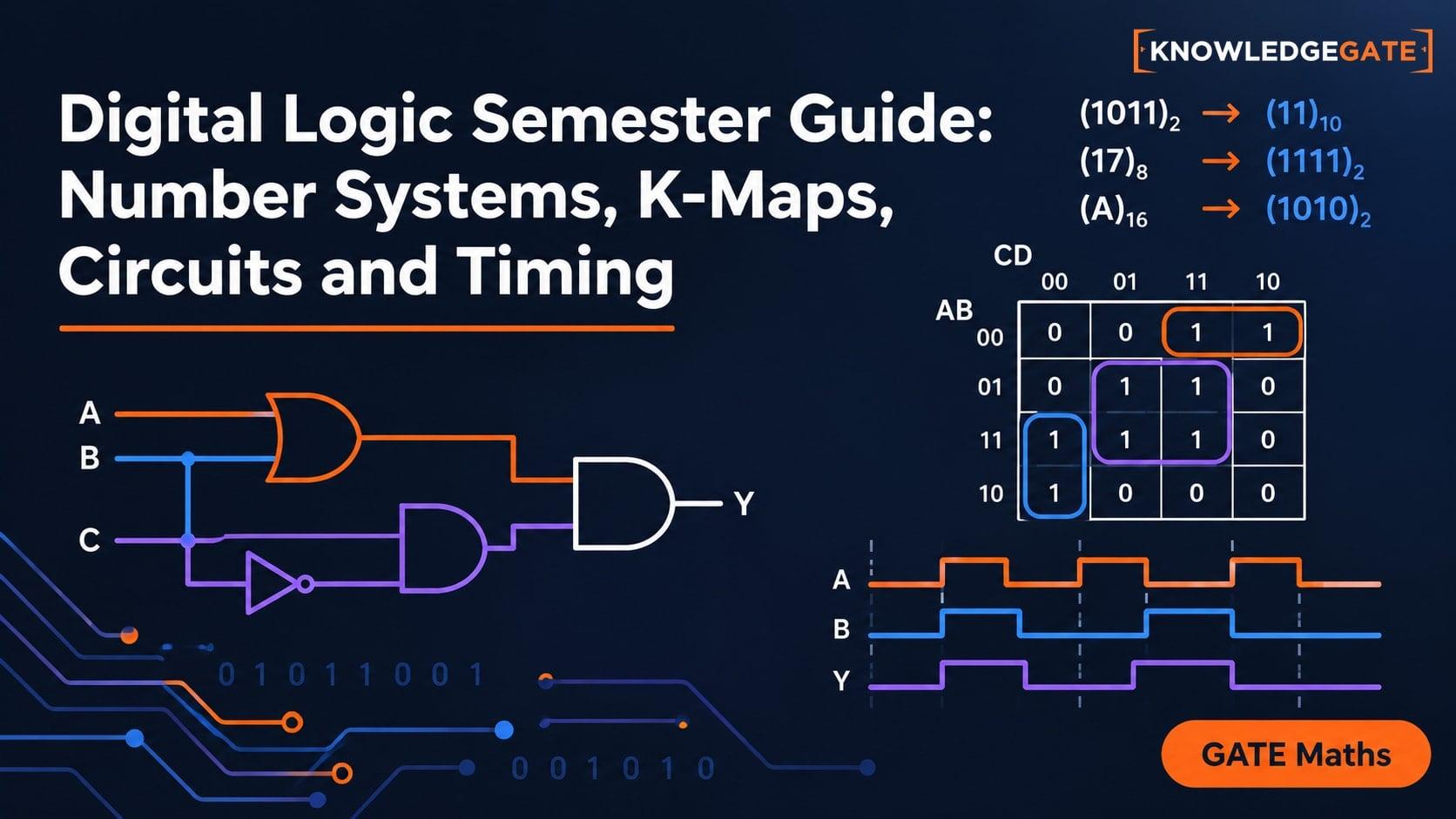
Digital Logic Semester Guide: Number Systems, K-Maps, Circuits and Timing
Build Digital Logic as one connected workflow. Follow complete examples and checkpoints covering number representation, circuits, state and timing.
Updated 3 Nov 20266 min readDigital Logic