

Stop-and-Wait ARQ MCQs: 12 Solved Questions with Worked Explanations
Solve 12 published Stop-and-Wait ARQ MCQs, then check each answer against a fresh explanation covering protocol rules, loss patterns, utilisation and throughput.
KnowledgeGate Team
Exam prep & CS education
28 Oct 20267 min read
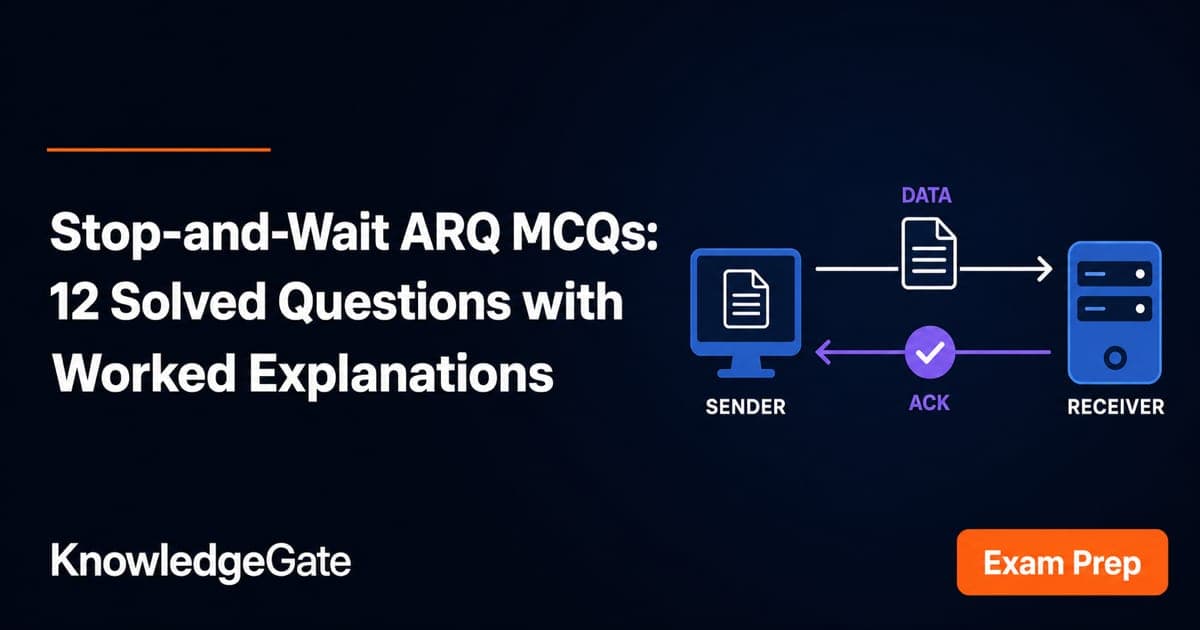
Stop-and-Wait ARQ MCQs test propagation direction, units, ACK time, retransmissions, efficiency, and throughput. Stop-and-Wait ARQ ranges from basic reliability ideas to throughput numericals. Write the governing equation or rule before checking each explanation. KnowledgeGate has over 30 practice questions on Stop-and-Wait ARQ within GATE CS Exam Preparation. Continue in the Stop-and-Wait ARQ practice hub. Questions 4 and 12 do not have their own practice page, so use that hub for both.
Stop-and-Wait ARQ: the model and formulas behind the set
Send one numbered frame, wait for its ACK, advance after a valid ACK, and retransmit after timeout. The alternating bit blocks duplicates. If ACK 1 for frame 0 is lost, the sender repeats it; the receiver discards the duplicate payload and repeats ACK 1.
Use this formula sheet:
Data transmission time:
Tt = L/R.With negligible ACK and processing time:
Tcycle = Tt + 2Tp.Utilisation:
U = Tt/(Tt + 2Tp) = 1/(1 + 2a), wherea = Tp/Tt.Add ACK transmission and processing terms once when they matter.
Throughput is useful data per cycle, not raw link rate.
For L = 1000 bits, R = 10 kbps, and one-way Tp = 25 ms, Tt = 1000/10000 = 0.1 s = 100 ms. Then Tcycle = 100 + 2(25) = 150 ms, U = 100/150 = 2/3 = 66.67%, and throughput = 1000/0.15 = 6666.67 bps. Keep the units consistent in every calculation.
Stop-and-Wait ARQ reliability, sender behaviour and ACK counting
Question 1
What network property is achieved through the use of the Automatic Repeat reQuest (ARQ) mechanism?
A. Reliability
B. Availability
C. Confidentiality
D. Scalability
Correct answer: A. Reliability.
ARQ resends damaged or missing frames using error detection, ACKs, timeout, and retransmission, providing reliability. Review the RPSC 2024, Programmer - P1 solved question.
Question 2
ARQ (Automatic Repeat Request) is:
A. Asking question and getting the reply
B. Protocol in which the sender waits for positive acknowledgement before advancing to the next data item
C. Protocol allows a newly booted workstation to broadcast its Ethernet address
D. Protocol allows both manual IP address assignment and automatic assignment
Correct answer: B. Protocol in which the sender waits for positive acknowledgement before advancing to the next data item.
One data item may be outstanding; the sender advances after its positive ACK. Other options describe address protocols. See the DSSSB 2021, TGT - Shift 3 solved question.
Question 3
For Stop-and-Wait ARQ, for 10 data packets sent, __________ acknowledgements are needed.
A. 11
B. 9
C. 10
D. 20
Correct answer: C. 10.
Each received packet needs one ACK: 10 packets × 1 ACK = 10 ACKs. Check the RPSC 2024, Programmer - P1 solved question.
Stop-and-Wait ARQ losses and retransmission counts
Question 4
Using stop and wait protocol, sender wants to transmit 10 data packets to the receiver. Out of these 10 data packets, every 4th data packet is lost. How many packets sender will have to send in total?
A. 10
B. 11
C. 12
D. 13
Correct answer: D. 13.
Count attempts. Numbers 4, 8, and 12 are lost. Attempts 1-3, 5-7, and 9-11 deliver nine packets; attempt 13 delivers the tenth. Thus 10 successes + 3 losses = 13 transmissions.
Question 5
On a wireless link, the probability of packet error is 0.2. A stop-and-wait protocol is used to transfer data across the link. The channel condition is assumed to be independent from transmission to transmission. What is the average number of transmission attempts required to transfer 100 packets?
A. 100
B. 125
C. 150
D. 200
Correct answer: B. 125.
Success probability is 1 - 0.2 = 0.8, so one delivery needs 1/0.8 = 1.25 attempts on average. Then 100 × 1.25 = 125. Open the GATE 2006 Information Technology solved question.
Stop-and-Wait utilisation: identify the direction, then calculate
Question 6
Suppose two hosts are connected by a point-to-point link and they are configured to use Stop-and-Wait protocol for reliable data transfer. Identify in which one of the following scenarios, the utilization of the link is the lowest.
A. Longer link length and lower transmission rate
B. Longer link length and higher transmission rate
C. Shorter link length and lower transmission rate
D. Shorter link length and higher transmission rate
Correct answer: B. Longer link length and higher transmission rate.
In U = 1/(1 + 2Tp/Tt), a longer link raises Tp, while a higher rate lowers Tt = L/R. Both reduce utilisation. See the GATE 2023 solved question.
Question 7
What will be the efficiency of a Stop and Wait protocol, if the transmission time for a frame is 20ns and the propagation time is 30ns?
A. 20%
B. 25%
C. 40%
D. 66%
Correct answer: B. 25%.
With one-way Tp = 30 ns, the cycle is 20 + 2(30) = 80 ns, and U = 20/80 = 25%. Review the ISRO 2013 solved question.
Question 8
Suppose we are transmitting frames between two nodes using Stop-and-Wait protocol. The frame size is 3000 bits. The transmission rate of the channel is 2000 bps (bits/second) and the propagation delay between the two nodes is 100 milliseconds. Assume that the processing times at the source and destination are negligible. Also, assume that the size of the acknowledgement packet is negligible. Which ONE of the following most accurately gives the channel utilization for the above scenario in percentage?
A. 88.23
B. 93.75
C. 85.44
D. 66.67
Correct answer: A. 88.23.
Tt = 3000/2000 = 1.5 s and 2Tp = 2(0.1) = 0.2 s. Therefore U = 1.5/(1.5 + 0.2) = 0.88235 = 88.23%. Check the GATE 2025, Set 2 solved question.
Stop-and-Wait numericals: propagation delay and minimum frame size
Question 9
Calculate the link utilization (efficiency) for the stop-and-wait flow control mechanism if the frame size is 4800 bits, bit rate is 9600 bps, and the distance between the devices is 2000 km. Given propagation speed is 200000 km/s.
A. 0.92
B. 0.82
C. 0.96
D. 0.86
Correct answer: C. 0.96.
Tt = 4800/9600 = 0.5 s, while one-way Tp = 2000/200000 = 0.01 s. Thus U = 0.5/(0.5 + 2(0.01)) = 0.961538, matching 0.96. See the Coal India 2020 solved question.
Question 10
A link has a transmission speed of 10⁶ bits/sec. It uses data packets of size 1000 bytes each. Assume that the acknowledgement has negligible transmission delay and that its propagation delay is the same as the data propagation delay. Also assume that the processing delays at the nodes are negligible. The efficiency of the stop-and-wait protocol in this setup is exactly 25%. The value of the one-way propagation delay (in milliseconds) is
A. 10
B. 24
C. 12
D. 05
Correct answer: C. 12.
1000 bytes = 8000 bits, so Tt = 8000/10^6 s = 8 ms. From 0.25 = 8/(8 + 2Tp), get 8 + 2Tp = 32, 2Tp = 24, and Tp = 12 ms. Option 24 is RTT. Open the HPSC 2021 solved question.
Question 11
A channel has a bit rate of 4 kbps and one-way propagation delay of 20 ms. The channel uses stop and wait protocol. The transmission time of the acknowledgement frame is negligible. To get a channel efficiency of at least 50%, the minimum frame size should be
A. 80 bytes
B. 80 bits
C. 160 bytes
D. 160 bits
Correct answer: D. 160 bits.
At the minimum boundary, 0.5 = Tt/(Tt + 2(20 ms)), giving Tt = 40 ms = 0.04 s. Then L = RTt = 4000 × 0.04 = 160 bits. Review the GATE 2005 Information Technology solved question.
Stop-and-Wait throughput with a non-negligible ACK
Question 12
A sender uses the Stop-and-Wait ARQ protocol for reliable transmission of frames. Frames are of size of 630 bytes and the transmission rate at the sender is 45 Kbps. Size of an acknowledgement is 72 bytes and the transmission rate at the receiver is 6 Kbps. The one-way propagation delay is 56 ms. Assuming no frame is lost, the sender throughput is ______ bytes/sec.
A. 2000.25
B. 1975.12
C. 1953.13
D. 1968.75
Correct answer: D. 1968.75.
Include ACK time: data takes (630 × 8)/45000 = 0.112 s, ACK takes (72 × 8)/6000 = 0.096 s, and propagation takes 2(0.056) = 0.112 s. Thus Tcycle = 0.112 + 0.096 + 0.112 = 0.320 s, and throughput = 630/0.320 = 1968.75 bytes/s.
Stop-and-Wait ARQ traps and score check
Trap or idea | Questions to revisit |
|---|---|
Reliability versus unrelated properties | 1-2 |
One ACK per successful frame | 3 |
Deterministic loss versus expected attempts | 4-5 |
Higher rate can reduce Stop-and-Wait utilisation | 6 |
One-way | 7-10 |
Bits, bytes, and ACK transmission time | 11-12 |
Identify the metric, use one unit system, write the full cycle before dropping terms, and verify the requested unit or direction.
Study cues: at 10-12, revise unit traps; at 7-9, redo Questions 7 to 12; at 0-6, revisit the protocol loop. This is not an official benchmark.
The short version
Use Computer Networks MCQs and the Computer Networks hub, then re-solve Questions 4, 5, 8, 10, and 12. For a sequenced route, GATE Guidance by Sanchit Sir places them within the subject. Count the full cycle, separate one-way from round-trip delay, include non-negligible ACK time, and report the requested unit.
Keep learning
Routing Basics and Flooding MCQs: 12 Solved Questions with Explanations
Solve 12 routing and flooding questions with clear explanations, a shortest-path warm-up, protocol classification and a quick checking routine.
Updated 26 Oct 20267 min readComputer Networks MCQs
Authentication and Digital Signature MCQs: 12 Solved Hash and Signing Questions
Work through 12 solved exam questions that connect challenge-response, integrity, hash lengths, X.509 certificates and the exact key order for signing and confidentiality.
Updated 25 Oct 20267 min readComputer Networks MCQs
UDP Protocol and Header MCQs: 12 Solved Questions with Explanations
Solve 12 UDP questions, then check the reasoning behind connectionless service, application choices, the 8-byte header, and packet-length calculations.
24 Oct 20267 min readComputer Networks MCQs
Repeater, Hub, Bridge & Switch MCQs: 12 Solved Questions with Explanations
Solve 12 exam questions on device layers, MAC forwarding, VLANs, collision and broadcast domains, port mirroring, bridges and crosspoint counting.
Updated 20 Oct 20267 min readComputer Networks MCQs