

Cloud Computing Concepts and Evolution MCQs: 12 Solved Questions with Explanations
Solve 12 cloud computing MCQs, then use clear explanations and a compact revision map to separate cloud enablers, models, architecture and limitations.
KnowledgeGate Team
Exam prep & CS education
Updated 30 Oct 20268 min read
Introductory cloud MCQs look like vocabulary checks, but their distractors mix enabling technologies, applications, architectural ideas and business models. Cloud identity, abstraction, utility computing, architecture, adoption planning and WAN latency distinguish the options; answer each question before opening its explanation. If the networking context feels weak, revise Computer Networks first, then use CS Fundamentals as the broader route. The key distinctions determine the correct option. Keep each option’s category clear as you solve.
Cloud computing concepts: the distinctions to make before solving
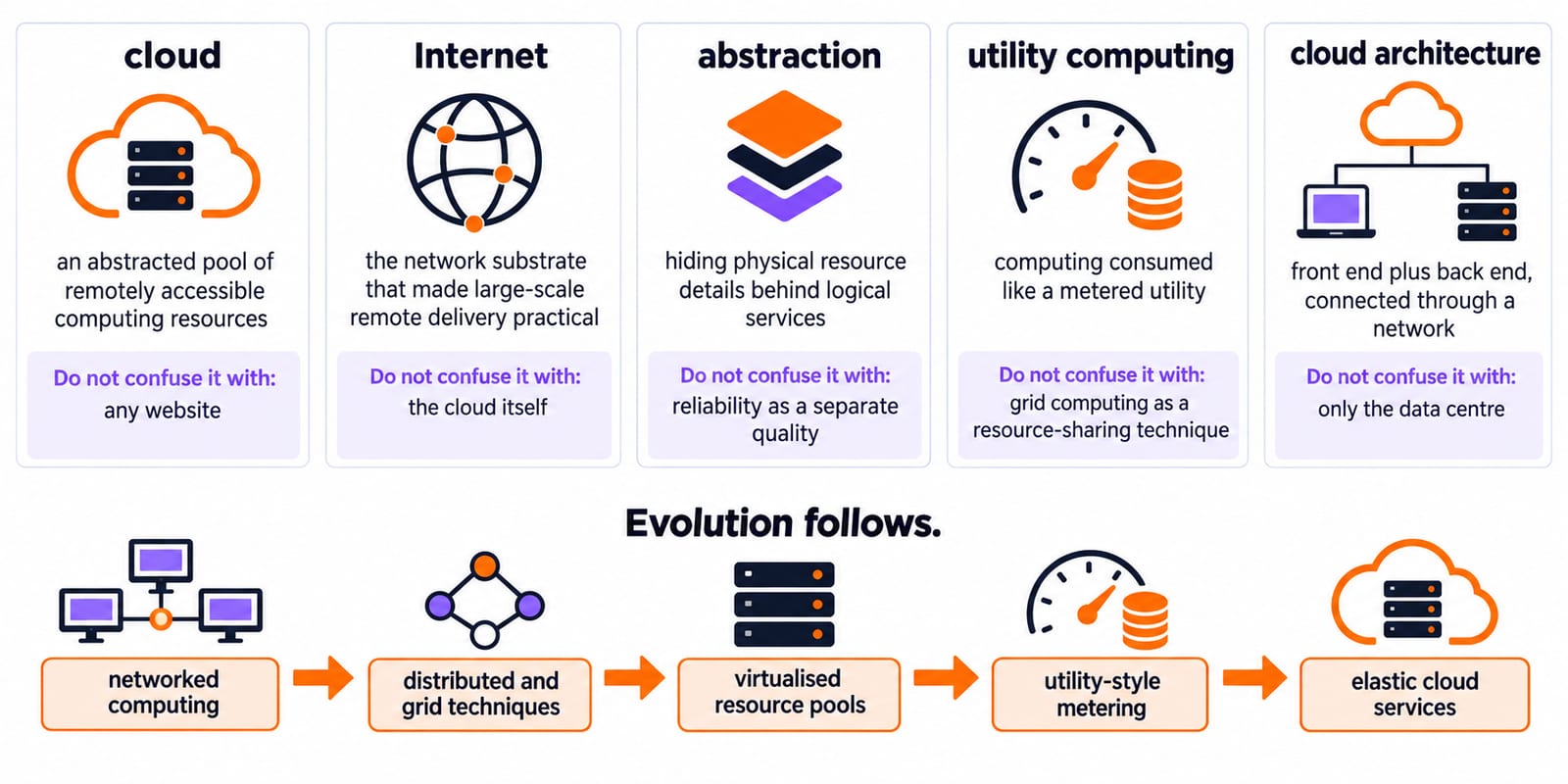
Use this decision key throughout. Classify each option as an example, enabler, architecture principle, consumption model or limitation.
Term | What it means here | Do not confuse it with |
|---|---|---|
cloud | an abstracted pool of remotely accessible computing resources | any website |
Internet | the network substrate that made large-scale remote delivery practical | the cloud itself |
abstraction | hiding physical resource details behind logical services | reliability as a separate quality |
utility computing | computing consumed like a metered utility | grid computing as a resource-sharing technique |
cloud architecture | front end plus back end, connected through a network | only the data centre |
Evolution follows networked computing -> distributed and grid techniques -> virtualised resource pools -> utility-style metering -> elastic cloud services. These ideas overlap, but are not synonyms.
Cloud identity and abstraction MCQs 1 to 3
Question 1: identify what the source treats as a cloud-like resource
Accenture 2025 | Open the full solved question
Which one of the following options can be considered as the Cloud?A. Hadoop
B. Intranet
C. Web Applications
D. All of the mentionedCorrect answer: A. Hadoop
This tests pooled-resource abstraction. Hadoop can present a cluster as one distributed storage and processing resource; an intranet is a private network, and a web application is user-facing software. The latter two may participate in a cloud system, but neither supplies that abstraction alone, so D is too broad.
Question 2: separate the Internet from cloud computing
Accenture 2023 | Open the full solved question
Which of the following has many features of that is now known as cloud computing?A. Web Service
B. Softwares
C. All of the mentioned
D. InternetCorrect answer: D. Internet
The awkward stem makes a historical comparison. The Internet enabled broad access and remote services before modern cloud added pooling, elasticity and service delivery. A web service is only an interface style; software is too broad.
Question 3: identify the essential cloud concept
Accenture 2025 | Open the full solved question
Which of the following is essential concept related to Cloud? A. Reliability
B. Productivity
C. Abstraction
D. All of the mentionedCorrect answer: C. Abstraction
Abstraction lets users request compute, storage or applications without managing physical servers. Reliability and productivity may be outcomes, but are not the defining mechanism. Since A and B are not equally foundational, D fails.
Cloud evolution and utility computing MCQs 4 to 7
Question 4: name the long-standing utility dream
Accenture 2023 | Open the full solved question
Which one of the following can be considered as a utility is a dream that dates from the beginning of the computing industry itself?A. Computing
B. Model
C. Software
D. All of the mentionedCorrect answer: A. Computing
Computing as a utility means consuming computing capability when needed as a supplied service, rather than owning each machine as a separate project. “Model” is incomplete and software is only one layer. Only A completes the historical idea.
Question 5: distinguish cloud computing from soft computing
Accenture 2023 | Open the full solved question
Point out the wrong statement. A. The massive scale of cloud computing systems was enabled by the popularization of the Internet
B. Soft computing represents a real paradigm shift in the way in which systems are deployed
C. Cloud computing makes the long-held dream of utility computing possible with a pay-as-you-go, infinitely scalable, universally available system
D. All of the mentionedCorrect answer: B. Soft computing represents a real paradigm shift in the way in which systems are deployed
B’s deployment shift belongs to cloud computing, not soft computing, which tolerates approximation or uncertainty. Cloud computing changes resource provisioning and delivery. C is historical framing, not a guarantee that any cloud has infinite capacity.
Question 6: connect managed IT services to their consumption model
Accenture 2025 | Open the full solved question
Managed IT services are based on the concept of which one of the following?A. Virtualization
B. Utility Computing
C. Grid Computing
D. SOACorrect answer: B. Utility Computing
Managed IT supplies an operational capability as a service, so utility computing best describes its consumption model. Virtualisation isolates resources, grid computing pools capacity and SOA composes services. None describes the customer’s consumption relationship alone.
Question 7: identify the basis of utility computing
Accenture 2025 | Open the full solved question
On which one of the following utility computing is based? A. Grid Computing Model
B. SOA Model
C. virtual isolation Model
D. Pay-per-Use modelCorrect answer: D. Pay-per-Use model
Utility computing connects measured usage to consumption, exactly as pay-per-use states. Grid, SOA and virtual isolation may support a service platform, but do not define its accounting basis. Question 4 names the idea; Question 7 names the model.
Cloud architecture and adoption planning MCQs 8 to 10
Question 8: recognise the architectural combination
Accenture 2024 | Open the full solved question
Cloud computing architecture is a combination of?A. service-oriented architecture and grid computing
B. Utility computing and event-driven architecture.
C. Service-oriented architecture and event-driven architecture.
D. Virtualization and event-driven architecture.Correct answer: C. Service-oriented architecture and event-driven architecture.
Here, service-oriented architecture exposes capabilities through service interfaces, while event-driven architecture responds to state changes without tight coupling. Grid computing, utility computing and virtualisation remain related ideas. The stem asks for the architectural pairing, not every cloud enabler.
Question 9: split cloud architecture into its broad parts
Accenture 2023 | Open the full solved question
In how many parts we can broadly divide the architecture of the Cloud?A. 4
B. 3
C. 2
D. 5Correct answer: C. 2
The two broad parts are front end and back end. The front end is the client-facing interface; the back end provides compute, storage, services, management and security. A network joins them, but the classification still has two sides.
Question 10: locate the strategy record in the adoption process
Accenture 2024 | Open the full solved question
In which of the following phases is a strategy record or document created corresponding to the events and conditions a user may face while adopting the cloud computing model?A. Cloud Computing Value Proposition
B. Cloud Computing Strategy Planning
C. Planning Phase
D. Business Architecture DevelopmentCorrect answer: B. Cloud Computing Strategy Planning
A document anticipating adoption conditions and decisions belongs to cloud computing strategy planning. A value proposition asks why the move is worthwhile; business architecture describes the organisation and its processes. The generic “Planning Phase” is less precise than B.
Cloud suitability and WAN latency MCQs 11 to 12
Question 11: reject the claim that every application belongs in the cloud
Accenture 2024 | Open the full solved question
Point out the wrong statement.A. All applications benefit from deployment in the cloud
B. With cloud computing, you can start very small and become big very fast
C. Cloud computing is revolutionary, even if the technology it is built on is evolutionary
D. None of the mentionedCorrect answer: A. All applications benefit from deployment in the cloud
The word “all” makes A false. Strict latency needs, specialised hardware, data-location constraints or difficult legacy dependencies can make a workload a poor cloud fit. B describes elastic growth, while C separates a newer delivery model from gradually evolved technologies.
Question 12: name the WAN cost built into remote cloud access
Accenture 2025 | Open the full solved question
All cloud computing applications suffer from the inherent _______ that is intrinsic in their WAN connectivity. A. propagation
B. latency
C. noise
D. All of the mentionedCorrect answer: B. latency
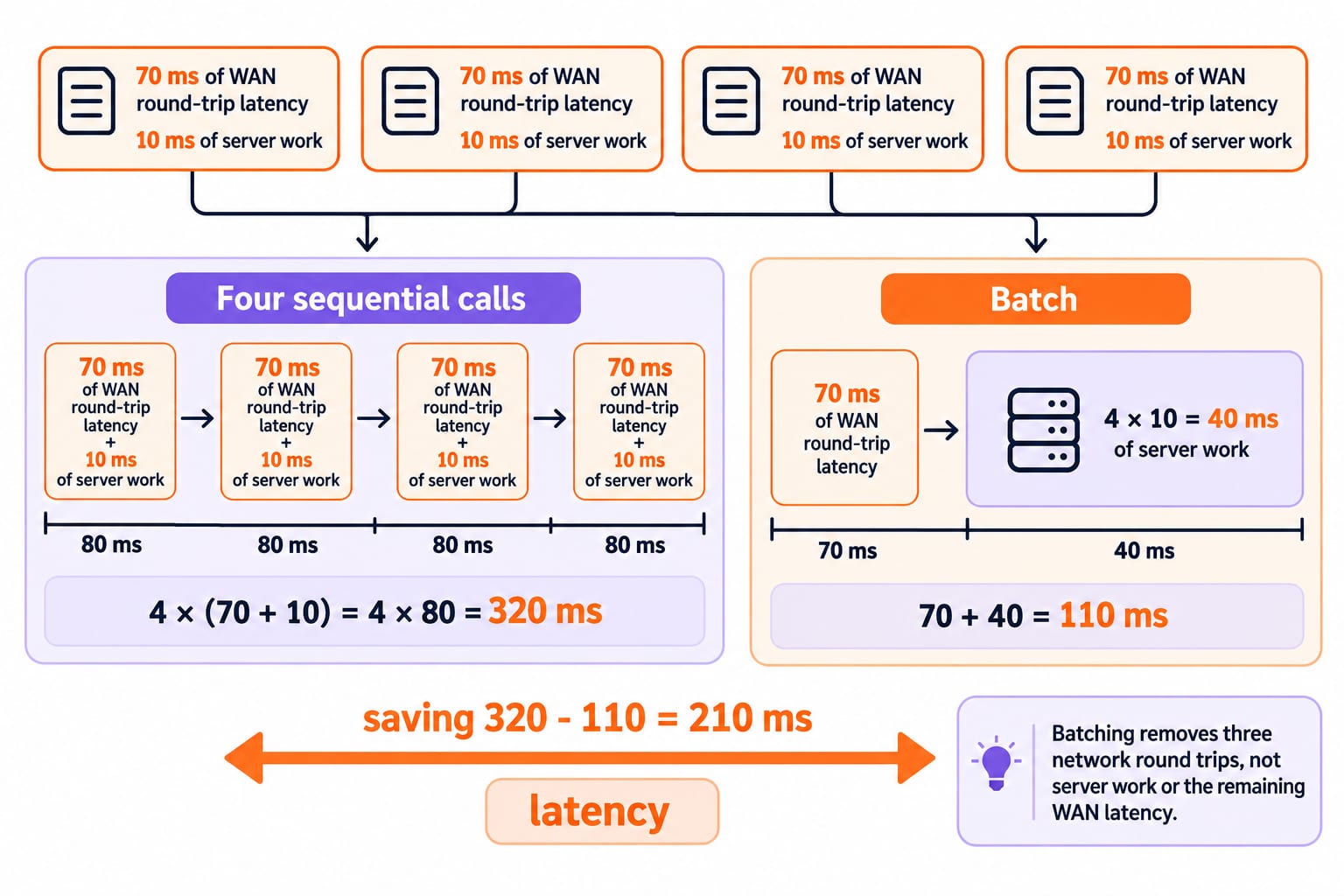
Latency is the elapsed delay between a request and response across a WAN. Propagation contributes to it, while noise is not the general application-level cost, so D is too broad. Assume four requests each need 70 ms of WAN round-trip latency and 10 ms of server work. Four sequential calls take 4 × (70 + 10) = 4 × 80 = 320 ms; a batch pays one WAN round trip but still performs 4 × 10 = 40 ms of server work, so it takes 70 + 40 = 110 ms, saving 320 - 110 = 210 ms. Batching removes three network round trips, not server work or the remaining WAN latency.
How cloud computing concepts and evolution are tested
Revision area | Questions | Decision rule |
|---|---|---|
identity and abstraction | 1 to 3 | Separate the pooled resource from its network or application examples. |
evolution and utility | 4 to 7 | Distinguish an enabler from the measured-consumption model. |
architecture and planning | 8 to 10 | Identify the requested structural part or named planning activity. |
suitability and latency | 11 to 12 | Test absolute claims and recognise the unavoidable WAN delay. |
Watch four recurring traps:
Treating every Internet application as a cloud.
Treating virtualisation, grid, utility and cloud as synonyms.
Choosing “All of the mentioned” before checking every option.
Ignoring absolute words such as “all” and “infinitely”.
For a 30-second attempt, classify the stem as definition, history, architecture, business model or limitation. Remove category errors, then test inclusive options only after every component survives. Continue with Computer Networks MCQs for broader practice.
Cloud computing MCQs: the short version and next step
Abstraction hides physical resources, the Internet supplies reach, and utility computing supplies measured consumption. Cloud architecture joins front end and back end through service-oriented and event-aware components. WAN access adds latency, and not every workload suits cloud.
Now solve the 12 questions again without explanations. GATE Guidance by Sanchit Sir builds the wider CS route, while the Accenture Superset Course is the direct next step for these questions.
Keep learning
Cloud Computing: Concepts, Service Models, Evolution and a Worked Capacity Plan
Learn what makes a service a cloud, how its two classification axes differ, and how elasticity changes compute and storage capacity.
Updated 30 Oct 20266 min readComputer Networks

Cloud Computing Explained: Service Models, Worked Calculations and Exam Traps
Build a clean cloud-computing concept map, classify common scenarios, and solve VM-hour, availability and replicated-storage calculations step by step.
Updated 26 Oct 20265 min readUGC NET Computer Science
Cloud Computing and IoT in Computer Networks: Complete Guide with Worked Examples
Learn how cloud models, IoT protocols, network throughput, messaging overhead, and edge latency fit together through three solved examples.
Updated 30 Oct 20265 min readComputer Networks
OS Types & Evolution MCQs: 12 Solved Questions with Explanations
Solve 12 published OS Types & Evolution questions. Each answer identifies the clue that separates batch, multiprogramming, time sharing and other OS models.
Updated 29 Oct 20268 min read109 viewsOperating System MCQs